

Cast:
Christian Slater (Clarence Worley), Patricia Arquette (Alabama Whitman), Dennis Hopper (Clifford Worley), Val Kilmer (Mentor), Gary Oldman (Drexl Spivey), Brad Pitt (Floyd), Christopher Walken (Vincenzo Coccotti), Bronson Pinchot (Elliot Blitzer), Samuel L. Jackson (Big Don), Michael Rapaport (Dick Ritchie), Saul Rubinek (Lee Donowitz), Conchata Ferrell (Mary Louise Ravencroft), James Gandolfini (Virgil), Anna Thomson (Lucy), Victor Argo (Lenny), Chris Penn (Nicky Dimes), and Tom Sizemore (Cody Nicholson) Directed by Tony Scott (#029 - Top Gun, #253 - Unstoppable, and #357 - The Last Boy Scout)
Review:
"The biggest edge I live on is directing. That's the most scary, dangerous thing you can do in your life."
Curiosity can reign free when it comes to looking upon two merging visions make a film together in the writer and director. The writer of the film was Quentin Tarantino, who based his script of a script Roger Avary had done called "The Open Road", and Avary helped organize the structure of that script. He had met director Tony Scott while lurking around the set of Scott's film The Last Boy Scout, and he gave Scott two scripts (True Romance and Reservoir Dogs), for which Scott wanted to make films of (when faced with having to pick just one, he picked the former (the latter script was turned into a film first, although it had been written later than the former). The script was written by Tarantino with the lead character as a stand-in for himself. Scott was obviously no stranger to making enterprising efforts in action. A graduate of the Royal College of Art in London like his older brother Ridley, with each becoming inspired to move from an interest in art to advertisements to eventually films, with the younger Scott specializing in action and thriller over the course of sixteen films. This was the seventh feature effort from Scott, which he made on a budget of $12 million that led to fair notice but a limited appeal in terms of box office. Its stature has risen in recent years as a cult favorite, for obvious reasons to those who look at the film at the nexus of two directors. There is of course one key difference from script to film - the final fate of one of the characters, in which Tarantino had them die (as a sign of comeuppance for all the cynical folks), but Scott liked one of the characters so much that he wanted them to stay together, acting it as a fairy tale love story. Of course, the acting choices would certainly be interesting if looked upon by Tarantino, since he wrote the film with Robert Carradine and Joan Cusack in mind for the leads (for his part, Scott desired Drew Barrymore at first), so wrap your head how that would have looked.
When one is tired of relationships, they should pick a romance, obviously. If Natural Born Killers (1994, the second script he sold) represents a compromised vision between Tarantino's scripting and the director, True Romance is certainly a case of writer-director cohesion, one where the details all come together to make what might seem like a fantasy come alive with energy and intrigue (although there is some satire included by Scott, who molded Rubinek's character after producer Joel Silver). It never seems like a compromise, balancing eloquence of amusement with violence that only got more interesting upon the progression of Tarantino over the next few years, and Scott makes his effort count in riveting interest with what is needed, whether that means scenes shot at the Ambassador Hotel, or with scenes that can jump from amusement to violent at a turn that go with the aspects of Elvis Presley adoration to a collection of cast that could make up two separate big-time movies (Oldman, Jackson, and Pitt basically make up about 20 minutes of time on screen, and this is 1992 we are talking about). Is it perfect? No, but it certainly is bold enough to linger with anyone curious enough to seek it out for those who like to see an interesting time that runs the gamut from pulp to black comedy without running itself ragged. Slater thought of the role as a comedy before Scott and him saw Taxi Driver (1976) in order to hone in a darker, cooler approach. Obviously it worked out well, since he plays it off with a refined sense of daredevil charisma, where one can see him roll with everything that goes in action and romance without any trouble, playing this quasi-Tarantino character with no false note (even when dealing an imaginary friend that looks like Elvis) Arquette fits on the other side of the coin, matching well in making this romance easy to believe in from the very first few moments, because one sees plenty of magnetism between these folks in their pursuit of living free within the domain of enjoying kung fu among other hobbies and vices. She makes for a mix of worldly innocence that makes this dark fairy tale come around with dutiful interest that holds her own (just as Slater does) when not together - the best scene might be her paired with another actor though, as the scene in the motel room with Gandolfini (in a key early role marked with brutal effectiveness) makes for a tense tête-à-tête in rising action and a natural bludgeoning edge to close it out. Others do their part with less time on screen, such as Hopper, who naturally gets one interesting scene to spend making it all count - his last, spent with one-scene wonder Walken, which involves a few choice words involving Sicily that makes for a riveting standoff. Kilmer spends his time with a good voice needed to play off scenes spent in quasi-hiding, which go well when playing an imagined presence. Oldman may not be in it much, but he sure makes a worthy rough presence count that never betrays the makeup and voice set for such an unsavory curiosity. Pitt (no stranger to making supporting turns count in the first part of the 1990s) makes his buzzed time count, an observer with improvised dialogue to make for bemused amusement (one might recognize the influence this role had on another film released years later with Pineapple Express). Pinchot (mostly known for his star role in Perfect Strangers for seven years) makes well with panic-laced pacing, which plays right into the climax fine, particularly with the bravado played by Rubinek, while Rapaport, Penn, and Sizemore contribute in their own little ways (mostly with the standoff). By the time the film closes down its 118 minute run-time, one will find a pretty good experience in balancing dark humor and violence that has plenty of energy where it needs to go without seeming too much like a brazen fantasy running around in references. It makes for a fun time, accomplishing what it needs to do with its pursuit of story beat to drive it over the finish line to its standoff that will hit with the viewers that enjoy what comes from either Tarantino or Scott without too much worry about every detail or just who did what. Sometimes one just has to sit and enjoy the tale for itself.
Well, you are probably wondering just why there were a few reviews this week that happened to tie to the years of 1990-1993. Sure, these films have been in consideration for several months (for obvious reason), but there is also another reason: They happen to be the years involving a team dear to me when it comes to rooting interest in the Buffalo Bills, who went to the Super Bowl in four straight years. I don't usually take to the sports pulpit when it comes to these writings, but let's bend the rule for this one because of the fact that they are playing for the right to be in the Super Bowl again: Let's go Buffalo, let us see you pull of a great big upset today and move on to February, so say it with me now: No one circles the wagons like the Buffalo Bills!
Overall, I give it 9 out of 10 stars.

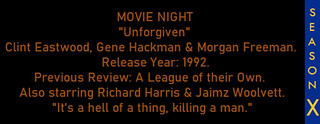 Review #1501: Unforgiven.