
Showing posts with label Susan Sarandon. Show all posts

August 30, 2026

Speed Racer.

Review #2574: Speed Racer.

Cast: 
Emile Hirsch (Speed Racer; Nicholas Elia as Young Speed Racer), Christina Ricci (Trixie; Ariel Winter as Young Trixie), John Goodman (Pops Racer), Susan Sarandon (Mom Racer), Matthew Fox (Racer X / Rex Racer; Scott Porter as Young Rex Racer), Roger Allam (E.P. Arnold Royalton), Paulie Litt (Spritle Racer), Benno Fürmann (Inspector Detector), Hiroyuki Sanada (Mr. Musha), Rain (Taejo Togokahn), Richard Roundtree (Ben Burns), Kick Gurry (Sparky), John Benfield (Cruncher Block), Christian Oliver (Snake Oiler), Ralph Herforth (Jack "Cannonball" Taylor), Yu Nan (Horuko Togokahn), Nayo K. Wallace (Minx), and Melvil Poupaud (Johnny "Goodboy" Jones) Directed by The Wachowskis (#1272 - The Matrix)

Review: 
"We had that exact conversation so many times.  The whole impetus for 'Speed Racer' came out of the fact that we are visually-thinking people.  We go to art galleries and art museums all the time.  We go into the Art Institute and every room there, there are paintings that look completely and utterly different from the other rooms.  But in cinema, everything looks the same.  And it's a really aggressive straight-jacket, aesthetically.  We started talking about cubism, for instance, and we started talking about could you make a cubist film?  And we realized that if you try to make a cubist film for adults, you will end up like Picasso, running from the angry mob when he first showed Guernica.  They wanted to kill him.  Literally.  It's because adults… they reject change, and an aesthetic change is too aggressive a death for them.  Every generation experiences aesthetic death, and when you really assault an aesthetic, people freak out.  But we said that kids are okay with aesthetic change." - The Wachowskis

Not all adaptations are created equal. It was originally known as Mach GoGoGo in its native Japan that was created by Tatsuo Yoshida, who previously did an automobile racing comic with Pilot Ace. It started out as a manga in 1966 and became its own anime in 1967 that took inspiration from Viva Las Vegas (specifically the image shown with Elvis) and Goldfinger. The American localization changed it to Speed Racer (which saw the character "Go Mifune" morph into "Speed Racer") with plenty of editing and dubbing from Peter Fernandez. Sure, there were various TV adaptations of the franchise in the years that followed with The New Adventures of Speed Racer (1993), Mach GoGoGo/Speed Racer X (1997), and Speed Racer: The Next Generation (2008; made to promote the film), but, well, I think you see which one stuck around in people's heads (for me, I've seen clips of the 60s show, namely ones that make light of the English dub that selectively use clips that make it sound like Speed is a sociopath). As early as 1992, Warner Bros. wanted to make a movie adaptation, and over the years the project saw various turnover (Johnny Depp was once cast as the title character, for example). Eventually, by 2006, the folks who recently finished the Matrix trilogy (at the time) in the Wachowskis were hired to write and direct in what became quite the spectacle. Speed Racer came out on May 9, 2008, premiering the same week as What Happens in Vegas...and one week after Iron Man, and I think you know which movie ended up being the big hit of its time (yep, Vegas-nah, just kidding, it actually was Indiana Jones and the Kingdom of the Crystal Skull, which premiered two weeks after Racer with its own type of curiosity*). The next movie of the Wachowskis came with Cloud Atlas (2012), which coincidentally has its own small following.

It's easy to see where the line between "oh hey, the movie is doing this!" and "oh, the movie is really doing this" gets blurred with this movie many, many, many times over. There were parts where one can either roll along with in its "sensibility" or just roll their eyes, such as say, its fluid transitions, its top-heavy fiddling of exposition, or the wavering interest in these characters (if Spritle and Chim Chim fell into a pit, would you miss them? Or Sparky the mechanic?). I pondered over what I experienced with seeing the movie and honestly, I'll give it credit for its passion even I really wanted a bit more. It wants to be bold, it wants to be colorful, it wants to stick out, it wants to just be its thing, and yet somehow, in all of its car-fu and "modern sensibility", it is more of a "good" movie on the track (reminding me of, say, Grand Prix [1966]) than off it. For whatever reason, for me, at least, it just is a much more interesting movie when it tries to be creative about a car race would look if designed by an insane person with green screen as opposed to when it tries to be cute in its dialogue (honestly, when playing with little toy cars as a kid, I was more of a line-'em-up guy more than "here's the story involving guys telling their evil plan" guy). Hirsch is given the job of trying to make a mountain out of a molehill with a role that doesn't really have for him to really do when not in the Mach 5, but at least his earnest innocence does come out for some enjoyment (incidentally, he remains proud of the film). Sure, one wishes they had a little more time to spend with Ricci or the delightful ham in Allam (who among us haven't seen a corporate overlord being a twerp right in front of people and trying to skate along anyway?); Goodman seems to be having a bit more fun than, say, Sarandon, for example.

It just goes and goes for 135 minutes, and you either admire its tenacity (i.e. the equivalent of running around and making stuff up) or you just wait for it to shut up and flush. As silly as it sounds, either give me a racing movie that really does me care about Speed and the dynamic of, take your pick (Speed and his offbeat parents, Speed and his totally-dead brother Racer X*,, or, and this is just taking this too seriously, a dynamic that doesn't stall as long as humanly possible on Speed and Trixie doing the art of kissing*). Sitting around gawking at what is shown from the cars beyond the usual four-wheel action probably would make an interesting experience. You either find its conclusion one of triumph and go (speed racer) for it or go (speed racer) for the remote, and I would say, hey, I could go (speed racer go) enough to say it was worth one viewing. It goes all out for those to see and hear to the point of near-insanity and you probably will at least get where some might call it a "cult classic". I'm not sure if I would see it again, but I at least can say it was worth one trip. It overwhelms and rewards the curious (perhaps now more than ever), for better or worse.
  
Overall, I give it 8 out of 10 stars.


Next up: Looking back at a movie I wasn't too big on the first time...

*Remember when trying to survive a nuclear explosion in a lead-lined fridge was a thing to whine about? Looking back, yea, Kingdom of the Crystal Skull was pretty neat, and I'll stand on that hill with pride.

*Wonder if the English adaptation was inspired by Son of Dracula with R...a...c...E...r...X.

*Hell, why stop there? Let's just go full crass and have Speed and Trixie do it right on the race track. Sure, you lose the kid market, but you would have a key experiment: can you make a racing movie where the O doesn't automatically stand for octane? On second thought, maybe I should just watch Crash (1996) at some point in time, I keep hearing that movie is sick as hell. I hope you understand that, yes, I love throwing stuff out for notes. 

April 5, 2021

Bull Durham.

Review #1663: Bull Durham.

Cast:
Kevin Costner (Lawrence "Crash" Davis), Susan Sarandon (Annie Savoy), Tim Robbins (Ebby Calvin "Nuke" Laloosh), Trey Wilson (Joe "Skip" Riggins), Robert Wuhl (Larry Hockett), William O'Leary (Jimmy), David Neidorf (Bobby), Jenny Robertson (Millie), Danny Gans (Deke), and Max Patkin (Himself) Written and Directed by Ron Shelton (#381 - Cobb and #1075 - Hollywood Homicide)

Review:
“I thought if I was gonna have a shot as a director, I’m gonna have to write something that everybody else can say, ‘Well, whatever we think of Shelton, certainly nobody in the world knows more about the subject.”

This was the debut film directed by Ron Shelton, who has directed nine feature films in a career of over three decades - five of these films revolve around sports in some way (all except Cobb have comedy in some way, for example). But it is this film that is most personal for Shelton, who had graduated from Westmont College in California (studying English Literature for his major while being a star in basketball in baseball) and immediately went to play minor league baseball. For five years, he would play in various leagues and even reach Triple-A (the highest level in the minors) with Rochester before he decided to quit at the age of 25 in 1971, shaped by a strike in Major League Baseball. The curiosity for filmmaking came in part because he would go to see movies while on the road, with one particular film that inspired him being The Wild Bunch. Afterwards, he would do study within graduate school, graduating from the University of Arizona with a fine arts degree before moving on to do work with painting and carpentry with time spent writing screenplays. In 1981, Shelton received his first film credit when he worked on The Pursuit of D.B. Cooper, a troubled film that had three directors while Shelton worked as an associate producer and creative consultant. Two years later, he wrote his first screenplay, doing so in collaboration with Clayton Frohman on Under Fire (1983).

The idea for the film was quoted by him as “Lysistrata in the minor leagues", which if you may not be aware reflects a play about a woman who wants to end a way by having the women withhold romancing their husbands and lovers in order to garner peace (several writers and filmmakers have made their own works based on being inspired by the play) - Shelton wrote the film in one draft, with the filmed version having few changes (interestingly, one person that Shelton did have help from with the script was Kurt Russell, a former minor leaguer himself). Shelton drew upon his experiences in the minors for the script, ranging from moments such as an intentionally flooded field or a manager throwing bats at his team after a loss. He wanted to make a film with character development that did not necessarily go the way a number of sports films usually go, since what we are seeing is a movie about folks in transition, complete with a lead in Costner that might as well be drawn out from a Western (as per Shelton's liking for that kind of genre) for folks that will prevail in whoever happens to have less self-awareness. It's a study on human behavior that works fine for what is needed, which means a pretty good experience. Respectfully though, if I am asked about its place as a great sports film, there is one easy statement: the best baseball movie ever made in that decade came the following year with either Costner as the star (you know the one), or it came with the big ending at the end (Major League)...it might have been a mistake to watch the latter again before I saw this feature (look at it this way, maybe it inspired all those other baseball movies to come in its wake). But hey, if you want your romance comedy to mix with the usual sports movie, go right ahead. Writing about movies is a perspective different from person to person, and I found it to be good - and that's a fine place to be for a movie with a director that wanted to make it with his own perspective without fancy mythologizing (if one has to be pedantic, however, the minor league record for home runs was certainly not 246 - Buzz Arlett had 432; of course, if one really wants to drag it out word by word, I could also take umbrage with anyone who dislikes the designated hitter rule). Baseball is a business that has adults and kids playing a game, after all, and Shelton wanted a movie from an athlete's perspective, complete with filming in Durham on cold nights in winter (if one is curious about the name, as I was, it actually refers to a tobacco company of the same name, for which the city became famous for).

Oh, but enough about all of that, how's the cast? They do pretty well for themselves, with a core trio that is hard to resist in seeing on and off the park. Costner does well here, in part because he excels where others would probably grimace with a role that grits and grins in a way that might as well sound like Shelton talking about himself, one where each loves the game more than it loves him in a gunslinger-type of way (Costner's character was modelled after William Holden's performance in...you guessed it, The Wild Bunch). You can see the passion in his eyes any time he is on the field, one with honesty and charm that never wavers whether paired with Robbins or Sarandon. There are quite a few highlights one can note with him around, but I think the last scene spent with Robbins is a charmer, one where he imparts a key lesson about fear and arrogance for the majors while getting a shiner in the eye and asking which hand it came from. Sarandon gives her heart and charm with the depth one should expect from a veteran presence like her (she had been an actress for nearly 20 years before this film). She breathes baseball and care into a role that could have been bungled into casual fluff with a lesser actress; here we have a crisp performance that makes those intimate moments spent with either Costner or Robbins come out clear in balance in connections. The interesting thing to note is that the studio did not want Robbins for the role, since they really desired Anthony Michael Hall (Hall was ten years younger than Robbins...who was only three years younger than Costner), and it took Shelton threatening to quit for Robbins to stick around. He proves quite genuine here, brimming in confidence that makes for a quality one-two punch for what is needed in a coming-of-age (for baseball) tale that keeps everyone fresh without being sold out for a cheap joke. Let's put it this way: being on the mound in a garter belt makes for quite a fascinating little scene. Wilson (who died the following year at 40) contributes as well in character presence expected for a manager with good timing; the same can be said of Wuhl and his shepherding presence. If you need an easy confirmation that we have a movie that breathes baseball, one could just watch the parts with Max Patkin performing before the game. Patkin was the famous "Clown Prince of Baseball", and he would perform to any size of crowd for over a half-century. As a whole, what matters most for 108 minutes is in how much one connects with the story told here through the lens of sports with people at the crossroads of life, whether that means someone who only just taken their first few steps in a career or for people nearing the end of one path, or for those somewhere in between. In that sense, it makes for a fairly engaging movie, never tiring itself out at any road it wants to take that never compromises its vision for anything, and in the end that means a worthwhile time for all who find themselves involved with it.

Overall, I give it 9 out of 10 stars.

Editor's Note: Obviously this review was meant to be published at a different time...four days late, as it turns out, since writing this took a bit longer than expected. At any rate, I wanted it to accompany the start of the season in Major League Baseball, back in its regular format of playing in the spring - as always, I hope for a great season, but I also hope that you enjoyed this review as well.

Personally, there is one more thing: Go Astros!

November 20, 2020

Wall Street: Money Never Sleeps.

Review #1595: Wall Street: Money Never Sleeps.

Cast:

Michael Douglas (Gordon Gekko), Shia LaBeouf (Jacob "Jake" Moore), Josh Brolin (Bretton James), Carey Mulligan (Winnie Gekko), Susan Sarandon (Sylvia Moore), Eli Wallach (Julius Steinhardt), Frank Langella (Louis Zabel), Austin Pendleton (Dr. Masters), Sylvia Miles (Dolores the Realtor), Vanessa Ferlito (Audrey), and John Buffalo Mailer (Robby) Directed by Oliver Stone (#095 - Wall Street, #1090 - Platoon, #1265 - Natural Born Killers, and #1523 - Any Given Sunday)

Review:

"When I made the movie I thought greed was NOT good. But I learned people really like money. They like to make money. They will even admire the villain with the money - even when he breaks the law."

What, another sequel to a film from the 1980s that came out over two decades later? Truly, we live in an age of the comeback. At least this time around it features the return of not only one of the main stars but also the director again in Oliver Stone. He has had a variety of stages to his filmmaking career that have distinct edges revolving from films involving Vietnam (such as Platoon) or his biographical dramas (such as Alexander), and this is his 18th feature effort along with his first-ever sequel. The original Wall Street (1987) film, which Stone co-wrote with Stanley Weiser with inspiration from Stone's father being a broker during the Great Depression. It was a film that raged against the excess of the times in greed and ambition (which owes to the inspiration drawn from several corporate raiders) that nevertheless inspired others to become stockbrokers themselves. The seduction of one into money seems to be limitless if one just slides under the lines of what we consider to be the rules of right and wrong, you might say. Honestly, I grew up with this film on my shelf as one I admired in curiosity, and I find that it still stands well in its staying power about greed and its acting from Michael Douglas alongside Charlie Sheen (since Stone has noted the latter as the one contributing the meat of the film, namely in the family dynamic with his father Martin). Stone wrote the original film with Stanley Weiser, but the sequel would be written by Allan Loeb and Stephen Schiff (whose last writing credits included The Switch (2010) and True Crime (1999), respectively)

So here we are, with a film made on the heels of a generation growing up as essentially the children of Gordon Gekko. Stone wanted to make a film that is a reckoning about our obsession of money as a society. Honestly, the curiosity to do this film lurked in the shadows for years, and it only grew with the viewings of other movies about the financial crisis of 2008 in The Wolf of Wall Street (2013) and The Big Short (2015). While it may not be fair to compare this film to those subsequent ones, you could cite the fact that each of those subsequent works had come from books already published by 2010. It sure is a surprise to see the end-result from Stone: a soft, average production, more of a glossy puddle than anything, a middling movie in the parts that matter most: genuine interest. For 133 minutes, one wonders exactly where it is going to end up in terms of its supposed cat-and-mouse game between Douglas and LaBeouf, which only goes to show just how much more captivating it was the first time around. Simply put, the pulpit has been converted into a stool, with a sprinkling of financial information in trying to make speculation the curiosity to spring around with. It is just an empty experience, where one doesn't seem to really gain or lose much by viewing it and its details that seem more like a PowerPoint presentation relying on sprinkling of style (particularly with some choice editing, where one scene has a phone call and a bubble showing up) to make up for less passion. Even its attempt at promoting fusion energy come off as ridiculous, complete with a presentation about what it could be in potential for clean energy...sure. Its hostility is instead a bag of corn. Douglas is the most enjoyable part of the film, even if he is sprinkled throughout - for example, he shows up briefly in the opening before not showing up in full again until the 30 minute mark; honestly, he serves as the best part of the film, mostly in his molding of former nasty greed showman into buy-my-book showman that hasn't changed all of his spots. While his best moments might be in the latter half for empire building, there is at least a subtle joy to seeing one scene with Charlie Sheen again, mostly to see the tides of time pass by (the sprinkling of other cameos, including Stone himself, are probably not as effective). LaBeouf, freshly established in the past few years with franchises like Transformers and Indiana Jones (for better or worse) falls squarely in the middle ground of interest. He exists to do another game of pseudo son-father figure with Douglas and Brolin that is seems more in search of an idea than a real representation of anything. The melodrama with Mulligan (who is okay) reflects this especially, sopping wet in syrup that slows the film in its bewildering act of "I hate my dad, but I like someone who does things like him". Brolin makes what he can with a mild substance kind of adversary, packed with some slime to various effect. Did you know Sarandon is the film? Honestly, you might be able to forget she is even there with a whole two or three scenes spent in vagueness about the housing element that seems to need more desperation, honestly. Wallach, a veteran of stage and screen for 65 years, is quietly effective, moving along in the background with character presence and an improvised whistle while Langella is there for the first half to set the wheels of "payback" in motion. For me, the film is like assembling a game of Uno to play without all the cards present or a rulebook to properly play the game, which eventually results in a process of missing passion and ultimate disappointment. Others may find something more worthwhile despite is flaws, but it is easily more preferable to stick with the original Wall Street film instead.

Overall, I give it 6 out of 10 stars.

June 19, 2020

The Rocky Horror Picture Show.

Review #1449: The Rocky Horror Picture Show.

Cast: 
Tim Curry (Dr. Frank-N-Furter), Susan Sarandon (Janet Weiss, a heroine), Barry Bostwick (Brad Majors, a hero), Richard O'Brien (Riff Raff, a handyman), Patricia Quinn (Magenta, a domestic), Nell Campbell (Columbia, a groupie), Jonathan Adams (Dr. Everett V. Scott, a rival scientist), Peter Hinwood (Rocky Horror, a creation, with Trevor White as singing voice), Meat Loaf (Eddie, an ex-delivery boy), and Charles Gray (The Criminologist) Directed by Jim Sharman.

Review: 
"For me it was, I think, the most joyous time of my life. You know, I was still very young, it took me to Hollywood and to Broadway and into a kind of very peculiar immortality, and I'm very grateful for that."

It was inevitable to cover a film like this at some point. Some movies are born to be cult favorites, and this sure has proven to have a life of its own 45 years after release. It wasn't a big hit with initial releases, but it proved a winner with midnight showings, and the lingering success of doing these screenings have meant that it has not completely left the theater, the longest-running release in film history. When it comes to screenings nowadays, audiences usually are encouraged to say certain lines and practices for scenes or engaging in dressing up as the characters. It was based on The Rocky Horror Show, a stage play written by Richard O'Brien that was first performed in London in 1973. He wrote it as a combination of the unintended comedy of B-horror films with fifties rock and roll alongside his love of science fiction that hit in a time where glam rock was a hit within the United Kingdom. Curry, O'Brien, Quinn, and Campbell reprise their roles from the play into the film. 20th Century Fox wanted to make the film on a bigger budget with contemporary musicians of the day, but a compromise was made to use American leads with a cheaper budget instead. A follow-up film (of sorts) was made six years later in Shock Treatment, which retained Sharman as director/writer alongside O'Brien as writer again while retaining actors such as Campbell and Gray but without Curry, Bostwick, or Sarandon. Funny enough, it was a bigger failure at the box office than the first film (complete with being a midnight movie flop) although it has a small cult following of its own.

Perhaps I wasn't in the right mindset when I watched the film. How many horror and musicals can you watch before they all seem familiar? Of course how many films have a DVD that offer numerous versions to watch involving audience participation? Is it really something to make a film where you can exclaim a reference? The answer to these questions for me is simple: I don't care. Seriously though, while I can acknowledge that it may be an interesting film deserving of some sort of following with an audience (there are many mocking things one can say about encouraging yelling at the screen, but I'll let my bile pass), I cannot say that this was a winning film to enjoy wholeheartedly. Maybe it is the manner of its parody of horror and comedy, where making a hodgepodge of the two with mediocre songs is meant to be something to really laugh at as some sort of camp. You know that song "Science Fiction, Double Feature"? Most, if not all of those films mentioned in that song are probably better than this film. "Sweet Transvestite" may very well work as a song, but that don't help slop like "Dammit Janet" get much better. It proves exhausting to try and keep up with the film's supposed charms, where it proves to be one of the most infuriatingly mediocre films to ever run under two hours at 100 minutes. It may prove iconic for its era, but that sure doesn't mean it is any sort of high-end achievement either. There are basically five simple zones of defining a film's quality: awful, bad, average, good, and great to me, with no substitution or weaseling out of. Simply put, this falls completely in the average pile, with a sort of refusal to ever move towards being good or bad at any point where Curry isn't there.

If anyone proves to be a great highlight, it is surely Curry. A 1968 graduate of the University of Birmingham (studying English and Drama), he debuted on the stage (alongside television) the same year he graduated with the London production of Hair, where he met O'Brien. It isn't hard to see why this was the role that helped him to prominence, since one never really seems to take their eyes off such a daring performance, filled plenty of strange allure of grisly reality and parody. In a more-improved mediocre movie, one might actually just let the Curry performance sweep the other flaws aside and make it truly enjoyable. Bostwick and Sarandon nearly get lost in the entire shuffle, although the latter seems more suited for songs (of sorts, at least with that high voice). O'Brien and Quinn make some sort of duo, while Meat Loaf is sorely wasted here. The straight-laced Gray works only to deliver redundant explanations at times and occasional lyric contributions, which I guess is fine. Of course we are dealing a campy film filled with quietly ridiculous fellow acting, where everything is obvious for the sake of being obvious, where one is almost tempted to spray them with a water bottle to stop it. Patience wears thin when you start to grimace at the idea of yet another song, as if the true horror is actually how many times they can do a string of songs, since the horror-sci-fi pastiches only can so far. If anybody is going to claim the title of affectionate tribute to horror with comedy for the 1970s, it sure isn't going to be this film, since Young Frankenstein (1974) did every aspect with better style and better execution, whereas this just falls short of really resonating with me as a film (perhaps it just worked better on stage). Perhaps another time of watching it could provide some levity, but there are simply too many films to go forth and watch once before even thinking about revisiting stuff that didn't quite click the first time around. No sir, I will not in fact do the Time Warp again any time soon. It may not be a winner enough to make me like it, but it has its own following for a reason and it may prove just fine for those into what it tries to do in camp value.

Overall, I give it 6 out of 10 stars.

August 5, 2019

Igby Goes Down.

Review #1253: Igby Goes Down.
Cast: 
Kieran Culkin (Jason "Igby" Slocumb, Jr.), Claire Danes (Sookie Sapperstein), Jeff Goldblum (D.H. Banes), Amanda Peet (Rachel), Ryan Phillippe (Oliver "Ollie" Slocumb), Bill Pullman (Jason Slocumb, Sr.), Susan Sarandon (Mimi Slocumb), Bill Irwin (Lt. Ernest Smith), Jared Harris (Russel), and Celia Weston (Bunny) Written and Directed by Burr Steers.

Review: 
Call it writer's block, call it a logjam - this review took over a week to actually come to fruition, with two reviews sandwiched between UHF and this.

What is there to say about a film like this? It is an independent comedy drama that likely fits best to languish on a film shelf for years before you eventually get around to actually seeing if its worth it. The most annoying films to write about are the mediocre ones, where it isn't a terrible experience to sit through but it also isn't anything to really write home about either. In the long run, this mixed bag middles too much with its misanthrope main character for its first half while faced with more interesting supporting actors before its second half lands with a soft thud. There isn't a terrible performance in the bunch, nor is the film really that awful to sit through in the long run, but it sure takes its time in making itself seem worth a look, as if making a coming-of-age movie needed acidic foundations (in this case, a nutty rich family) to really make for entertainment. It feels like an interesting film when not faced with its silly misanthrope lead (or when he isn't being romanced / being assaulted by someone, like a therapist), but it really does seem at times more fitting for a novel than a film, albeit with a few chapters being tossed around. The best response one can have for the question of why should I care about what is going on is that it is meant to be sharply witty and observant, the kind of film that can picked and poked at the same way one could poke at The Catcher in the Rye, I suppose. This for a film that features a scene of someone who when told of how dirty he looks comes back to the family dinner table without clothes. When I really care about the movie is the parts around the main character - it needed more weird moments with people like Goldblum, Pullman, and Sarandon, who are each adept at garnering some humor along with showing the flip-side of life as an adult with some money - whether that involves hypocrisy or succumbing to pressures. I do at least appreciate Culkin for taking a role as ridiculous acidic as this one is and making an attempt to garner some humor. The same can be said for Danes and Peet, who clearly need more time on screen besides just being around the main character from time to time. Phillippe and Irwin provide small but useful moments. Sometimes a film can make you think about how you were growing up with all the changes that occur around you, whether through friends, family, or all of the above. Igby just happens to be on the fringes of adulthood - what better way to respond to it by skipping school, romantic moments, and plenty of loathing to go around. It sure wants to play cynical with its coming-of-age story - heck, why not go further? Fully drag its soap opera level of weird events to its natural conclusion - blather on for longer than 98 minutes and give these characters enough depth (and perhaps rope) to trap themselves within hypocrisy and what it means to be a human being - whatever that means. Go nuts and make this an attempt at garnering some real humor instead of trying to have it both ways with jokes and pathos. Of course one can't really take much of this that seriously, minus the parts involving Igby and his father (to a point); the time spent with him and his mother only really seems to come out in the second half rather than really drive the film home all the way. On the whole, this proves to be a frustrating film to sit through, where one can see the intentions from its director/writer Steers try to come out through a film that can't quite live up to making a clear resonating path. It becomes more depressing to see where the cast is and isn't used than the material itself, really. It may prove well for those who seek it out and have the right mindset for its tactics, but I just couldn't find this a clear enough winner to recommend it.

Overall, I give it 6 out of 10 stars.

April 25, 2018

Thelma & Louise.


Review #1076: Thelma & Louise.

Cast: 
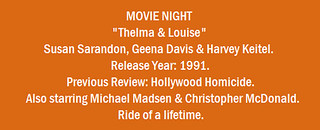
Susan Sarandon (Louise Sawyer), Geena Davis (Thelma Dickinson), Harvey Keitel (Detective Hal Slocumb), Michael Madsen (Jimmy Lennox), Christopher McDonald (Darryl Dickinson), Stephen Tobolowsky (Max), Brad Pitt (J.D.), and Timothy Carhart (Harlan Puckett) Directed by Ridley Scott (#100 - Blade Runner, #530 - Alien, and #739 - The Martian)

Review: 
Thelma & Louise is an engaging road movie that has its shares of laughs and tough moments that belies itself on the strength of its two main characters. It manages to serve as great entertainment full of self-discovery and sharp honestly that resonates even after over two decades since its release. Sarandon and Davis make for a capable duo in part because of how their distinct personalities mix and match. Sarandon plays her role with a roughly honest type of viewpoint that never seems too cynical nor too out-of-place in any scene. Davis does a great job in making her dependably energetic character seem the perfect match to play with Sarandon, and her chemistry with Pitt is fairly well-done if not quick. Pitt has a slinky hustler charm to him that makes him watchable each scene that he is in, having a magnetic pull that served to be his breakthrough role. Keitel does a good job, evoking honestly in his authority role that never comes off as distracting. Madsen sells his casual rocker role fairly adeptly, quick to charm and care. McDonald plays his character with the right sense of control and inflated self-importance that fits the movie pretty well. The film has numerous particularly emotions in its scenes, whether shocking or amusing, and it manages to never veer itself too much in one direction that would come off as distracting. The screenplay by Callie Khouri is a tightly packed one that was rewarded with Academy Award and Golden Globe honors. The film has a controlled look that feels fairly authentic, having an execution to it that is surely captivating - particularly since it doesn't betray its principles. It doesn't ever comes off as just a road movie without much substance, with these main characters becoming memorable ones to follow. It has some turns and cliches that seem par for the course for this type of genre, but it doesn't detract from its value as an adventure too much. Even at 129 minutes, this is a film that never feels like it is wasting any moment with these characters and the tale that it is weaving. The movie has an ending that certainly serves as a symbolic and memorable capstone to something that clicks at the right times with the right kind of people behind and in front of the camera. It makes a leap for entertainment - and it succeeds at that quite well.

Overall, I give it 9 out of 10 stars.

December 1, 2013

Movie Night: The Witches of Eastwick.


Review #493: The Witches of Eastwick.

Cast
Jack Nicholson (Daryl Van Horne), Cher (Alexandra Medford), Susan Sarandon (Jane Spofford), Michelle Pfeiffer (Sukie Ridgemont), Veronica Cartwright (Felicia Alden), and Richard Jenkins (Clyde Alden) Directed by George Miller (#380 - Mad Max and #392 - Happy Feet)

Review
I woke up in the morning, realizing it was my birthday today, and in light of that, I decided to not only begin the new month with watching a movie, but a movie I've wanted to watch for a long while, and since I had time on my hands and couldn't think of a movie that actually dealt with birthdays, I watched this. The film itself is mostly enjoyable, and Jack Nicholson (as usual) steals the show. He seems to be born to play this role, he has a good deal of manic energy and scenes to use them in. Cher does an good job, pairing well with Nicholson. Sarandon and Pfeiffer are good, the trio seem to mesh well together. The rest of the cast are alright, and the story is balanced. The climax of the film has been criticized for being overdone or ridiculous in the past, but I don't really hate the climax that much, maybe it's because it just feels right, and I wouldn't know how the climax could be improved on anyway. The film has its ups and downs of lunacy, but it is enjoyable nonetheless. Happy birthday to me. Countdown to 500 Reviews: 10, 9, 8, 7...

Overall, I give it 8 out of 10 stars.