Showing posts with label Paul Dooley. Show all posts

August 12, 2024

O.C. and Stiggs.

Review #2243: O.C. and Stiggs.

Cast: 
Daniel H. Jenkins (O.C.), Neill Barry (Mark Stiggs), Paul Dooley (Randall Schwab), Jane Curtin (Elinore Schwab), Jon Cryer (Randall Schwab, Jr), Laura Urstein (Lenore Schwab), Victor Ho (Frankie Tang), Ray Walston (Gramps), Donald May (Jack Stiggs), Carla Borelli (Stella Stiggs), Stephanie Elfrink (Missie Stiggs), Amanda Hull (Debbie Stiggs), James Gilsenan (Barney Beaugereaux), Tina Louise (Florence Beaugereaux), Cynthia Nixon (Michelle), Greg Wangler (Jefferson Washington), with Dennis Hopper (Sponson), Martin Mull (Pat Coletti), Melvin van Peebles (Wino Bob), Tiffany Helm (Charlotte), Dana Andersen (Robin), and Bob Uecker (himself) Directed by Robert Altman (#900 - Nashville#1433 M*A*S*H, #1890 - The Delinquents#2061 - Health)

Review: 
"[O.C. and Stiggs] was about how two teenage boys spend their summer, and it was also about cultural anarchy. Teenage exploitation films were all the rage at the time… I agreed to do it because I hated teenage movies so much. I thought I could do it as a satire of a teenage movie. But of course, it was sold as a teenage movie. It was a suspect project from the beginning."

It is strange, I'm not actually that much of an expert on the filmmaking of Robert Altman and yet here we are with something a bit on the odd side for a filmmaker with such a long and winding road over the span of multiple decades. This strange time would come around particularly after the double-edged sword of 1980's Health and Popeye, neither, where the former barely had a release and the latter wasn't as successful with audiences or critics as one hoped. Afterwards, he did a handful of plays and TV productions to go with smaller-scale films, such as Come Back to the 5 & Dime, Jimmy Dean, Jimmy Dean (1982) and Streamers (1983). But O.C. and Stiggs would be an attempt to get back in Hollywood. ...which went a certain type of way. For context, O.C. and Stiggs were originally characters in stories written for National Lampoon magazine by Ted Mann and Tod Carroll, most notably with the 1982 story ""The Utterly Monstrous Mind-Roasting Summer of O.C. and Stiggs". One of the producers of this film was Peter Newman (who had been the production executive of the Jimmy Dean play that Altman had made into a film), who was interested in what he saw of the Stiggs stories. Newman had made an agreement to help produce the film, which would have had Mike Nichols eventually make the film after he finished his other commitments...and then one day Newman, in a conversation with Altman, found someone willing to do the film right then and there, complete with fast tracking for MGM because of their desperation for a teen-movie hit. It was shot in Arizona for MGM away from executives and screenwriters in 1983 that saw a party atmosphere (gambling, smoking pot, here is an informative article about that). While Mann and Carroll were given credit for the story, Carroll elected to take his name off the screenplay (which was credited to Mann and Donald Cantrell) for a film that Mann wasn't particularly big on anyway, calling it "of little interest and believe that the chatter of an ordinary street corner schizo is of equal weight and consequence." MGM hated the film in screenings done for the film in 1984 before limited screenings were eventually one in 1987. Of course, by 1987, Altman was already on the next thing, receiving some notice with Secret Honor (1984) to go along with subsequent notice with his TV production Tanner '88 alongside Vincent & Theo (1990) before his "comeback" with The Player (1992).

Sure, one could see the truth that Carroll and Mann had tried to seek out in their characters in "middle-class America" in a coming of age. Of course, I had a feeling that somehow, this film would remind me of Health (1980) in that "oh it seems kinda funny, but you just know only five people would like it in theaters". To see O.C. and Stiggs is to see a movie wrapped with plenty of seething amusement for the time and place it exists in. Imagine a film set in suburban Arizona of all godforsaken places and think that this would be a normal teen movie, although you do get a song courtesy of King Sunny Adé and His African Beats. Screw it, I kind of enjoyed this movie, which just manages to hit the sweet-spot when it comes to chaotic hellraisers. The few people that actually saw the movie upon release basically took the movie seriously without thinking of all the caricatures that are present in a world of self-absorbed weirdos (just get a look at the bomb shelter near the end). These folks really believe they are living the American Dream (consider one quote involving "Arkansas is one of the United States. All America is the same" coming from one of the parental figures to go alongside the other one that, well, is a bigot) that happens to have smug self-satisfied avengers for leads. It is a contorted and twisted film that happens to have a bevy of riches for its supporting cast (speaking of people in little-seen Altman films, Paul Dooley...) to support our two leads. It may seem mean, but the madcap bitterness is the point, and I think you could really interpret Mann's statement about the film as being bitter at being outclassed by a director who made a prank film at the expense of both writers and studio executives. Jenkins and Barry (each first-timer film stars) may not have ended up being a duo that had multiple films to engage in madcap stuff together, but I think they do pretty well together here. They smirk and engage with the world as if they were a trickster God, which actually seems pretty in line with what teenagers really seem to be to the ones around them: silly jerks with every-changing fashion sense (others probably had at least one person they treated like crap as a friend growing up anyway). The object of their bullying is Dooley, who is delightfully smarmy and amusing in the ways one would expect from a portrayal of a 1980s conservative in his suburban element, one that sees past the strangeness of his family in the known alcoholic to all but herself with Curtain and the stunted weirdo in Cryer to go along with a son-in-law who has the most decisive moment to finally speak after so many casual snipes at his Asian heritage. It is probably apt of something that Hopper appeared in this film the same year that he did a daredevil stunt in front of college students involving a chair and sticks of dynamite. Altman having Hopper doing a riff on the role he did in Apocalypse Now (1979) is crispy in its amusement, actually, one who gets to casually say lines such as calling guns a "disease" with worthwhile conviction, particularly when he gets to go loose for the climax. One sees plenty of presences of once and future presences in film/TV (such as a young bemused Nixon to go with a typically "on" Mull to go with a goofy codger in Walston), which probably takes the cake when one sees Bob Uecker ramble to essentially nobody for his cameo sequence. The 109-minute experience gives plenty of anarchy to see among the odd suburbanites (take one look at the places) that lands more often than not in Altman's practical joke among those looking for a typical teenage comedy in the 1980s without some sort of abject shot at society as one knows it.  I found this movie by the stupidest of ways, googling random films to maybe transfer over to USB (after finding a copy on the Internet) for later use (this goes along with "amusing" perspectives on obscure stuff). I can't say the film is for everyone, but if one manages to find this film (Internet or otherwise), I recommend seeing the film in all of its zany idiocy as an Altman movie wrapped in the underbelly of artificiality for delightful hit-or-miss entertainment.

Overall, I give it 8 out of 10 stars.
Next up: Time enough at last with Nothing But Trouble.

September 22, 2023

Strange Brew.

Review #2088: Strange Brew.

Cast: 
Dave Thomas (Doug McKenzie), Rick Moranis (Bob McKenzie), Max von Sydow (Brewmeister Smith), Lynne Griffin (Pam Elsinore), Angus MacInnes (Jean "Rosie" LeRose), Paul Dooley (Uncle Claude), Brian McConnachie (Ted), Mel Blanc (Father McKenzie), Tom Harvey (The Inspector), and Douglas Campbell (Henry Green) Directed by Dave Thomas and Rick Moranis.

Review: 
There is something fascinating about watching an adaptation of TV material into a feature film, if you think about it. But there is something really fascinating about watching a film based on material that was originally created as a mockery that initially was a two-minute sketch. No, really. In 1980, Second City Television (SCTV), a TV show with a handful of members of the Toronto Second City troupe, was making its return to television for its third season after a momentary hiatus that saw it broadcast nationwide in Canada on the Canadian Broadcasting Corporation (with select syndication in America). In light of the fact that the Canadian rendition of the series would be two minutes longer due to less commercial content than the American rendition, the CBC requested that those two minutes be allocated to Canadian content material." When SCTV cast members Dave Thomas and Rick Moranis heard this, they asked, "Well what do you want us to do, put up a map of Canada and sit in front of it wearing toques and parkas and cook back-bacon and 'Talk like dis, eh'?" The answer was essentially, yes. As related by Thomas, these sketches would be done at the end of a production day with a minimal crew of three to basically try and get a couple of two-minute stuff they could improvise out of a filming hour, which they called "all very low key and stupid". To get a gauge on the segments, one of them involved "Twist-off Tops". Oddly enough, the segments first gained popularity within the American edition first, particularly when NBC picked up the show for network airing on Fridays in 1981. The result of "Bob and Doug" resulted in a comedy album (The Great White North) and this film, which essentially served as their finale. Of course, the two have reprised the roles for a handful of commercials (such as one against beer taxes in 2023), a "Two-Four Anniversary", and a loose inspiration (yes, in moose form) in the Brother Bear films (2003, 2006). Such is the popularity of the two is that they have their own statue in Edmonton (where a good chunk of SCTV was filmed).

The success of the album, combined with seeing John Candy get an offer to do a film (Going Berserk) inspired them to think about doing a film, which saw them hire Steve De Jarnatt to do a first draft, complete with asking him to use Hamlet as a "sort of springboard". The result was a script that went from agents to a deal with MGM in a flash despite the fact that Thomas and Moranis felt was going to need tinkering from them to make it more of their own voice. Jack Grossberg gave the two guidance as executive producer when the duo was unexpectedly asked to direct the film as well as star and write it. As a whole, you can see the efforts done by the two to make a goofy feature that seems just about at home with other films of its ilk in sketch-turned-films such as the earlier The Blues Brothers (1980) or the subsequent Wayne's World (1992). As someone who went on a lark to pick this one out for a spotlight (for a film that happened to turn 40 last month), I can say it is a lovingly silly feature that makes the most of two goofball leads packed into a story wrapped in the amount of foliage you would expect to hold up a number of gags that come around. Of course, I have to admit my surprise that Hamlet was the loose thread to build around, if only because we are talking about a film that involves mind control beer, heroic flying dogs, and ghosts that possess electrical outlets. The 90-minute runtime sees a good deal of rambling and entertainment from Moranis and Thomas, who seem to squeeze any and every trick in the book of bits to mine together for chuckles, which manages to give them both time to shine without seeing a crack in the jovially dense characterizations that stick in your head in inane interest. Of course, it helps to have a game supporting cast, for which von Sydow and Dooley make dependable heavies to go along with the proceedings that seemingly reward those already quite familiar with their presence (the former was a surprise recruitment because Thomas and Moranis didn't actually think MGM could get him and the latter is Paul Dooley, what more do you need?). Griffin and MacInnes round out the general cast with good balance to accompany the bumblers with mostly straight-man routine (of note is among the rest of the cast is one scene spent with the famed voice actor Mel Blanc). At any rate, the film holds its own with a jovial pace that has two distinct halves, one involving the duo showing a poorly received film before they come up with "this mouse was in my beer bottle" and the other one involving them stumbling onto a brewery going into the world domination business (and yes, a dead uncle intervention) that results in a good deal of offbeat amusement. It is a casually enjoyable Canadian film through and through for all the folks (and hosers) at home. 

Overall, I give it 8 out of 10 stars.

July 30, 2023

Health.

Review #2061: Health.

Cast: 
Carol Burnett (Gloria Burbank), Glenda Jackson (Isabella Garnell), James Garner (Harry Wolff), Lauren Bacall (Esther Brill), Paul Dooley (Dr. Gil Gainey), Donald Moffat (Colonel Cody), Henry Gibson Bobby Hammer), Diane Stilwell (Willow Wertz), MacIntyre Dixon (Fred Munson), Alfre Woodard (Sally Benbow), and Dick Cavett (Himself) Directed by Robert Altman (#900 - Nashville, #1433 - M*A*S*H, and #1890 - The Delinquents)

Review: 
"HealtH could have only been made when it was made, and that was the end of the Carter era."

Somehow, at the end of this little blurb about talking about a film that did not get a proper release is a joke. But I'm sure you already came into that with a film made by a director as noted as Robert Altman that has the dubious achievement of having never received a proper home video release. You may or may not already know that Altman was an interesting presence amongst filmmakers you could say have their own style of filming. He may not have had the best of times with his initial feature efforts such as The Delinquents (1957), but his lengthy time spent in television work would shine well when he got to do regular film work after the massive hit of M*A*S*H (1970). Over the next ten years he would direct in a variety of genres that went from the Western (McCabe & Mrs. Miller) to horror (Images) to psychological drama (3 Women). Some films ended up better than others, as evidenced by Quintet (1979). Altman had at least one film released from the year of 1969 to 1980 that went from That Cold Day in the Park (1969) to Popeye. Now back to this film (sometimes referred to as HealtH or H.E.A.L.T.H.): it was shot in the Don CeSar Beach hotel in St Petersburg Beach, Florida for a number of months in 1979. He rushed the film to production just to make sure that it could be done for 20th Century Fox while Alan Ladd Jr was still around. He wrote the script in collaboration with Frank Barhydt and Paul Dooley. It was planned for a released in the winter of 1979, but changeover at the studio led to shuffling for test previews in the spring of 1980 with ideas of getting it seen in full by the summer (the aforementioned Popeye film somehow went better despite being filmed in 1980 for release in the winter, incidentally). It did not end well, and Altman had a falling out with personnel, particularly with one that didn't return his calls for weeks on end that led to being labeled as "scum" by the director. Long story short, there was no public release of the film until New York’s Film Forum showed in 1982, but there were enough film festival showings to account for a knowing of it. It certainly did not come from 20th Century Fox, who had decided the film was not commercially viable enough for release in 1980. So, what did they decide was a better candidate for release than an Altman film? Oh! Heavenly Dog.

I can't promise you a good punchline for the end of this review, but I thought it tickled me. There are two sides that can come with talking about a film not appreciated in its time: the part where you call it a hidden gem that deserves your attention or one that you believe was best left to rest in the dustbin. This is a film that at least one person liked watching on the Fox Movie Channel enough to record it and try to put it online. As for me, I enjoyed it about as much as I thought would happen for an attempt at a satire of politics of the time that is a frenzied hodgepodge of observations that come from looking at a health food convention that really is looking at the conventions that come with America. In other words: showmanship has run amok, and one can still see the carnival atmosphere that we call politics now more than ever. Granted, it isn't exactly packed with a developed story, and it definitely isn't on the same level as, say, Nashville (1975), but it really did deserve an audience to judge it for themselves rather than letting it being thrust into the shadows (for the decade of the 1980s, Altman was left with making films on small-scale budgets, with varying respect). To me, the movie stumbles around two timelines to make light of: the end of the Jimmy Carter era (beaten in a landslide by Reagan in the fall of 1980) and the Dwight Eisenhower-Adlai Stevenson elections of the 1950s that incidentally saw the candidate with vast media drawing Powe win each time. Life is messy, and Altman made a whole movie about the odd carnival of hucksters in health and beyond. The film isn't really wrapped in an involving plot of note, so it really does verge its entertainment on just how much you like the people involved in said film. This namely involves folks who can be pegged to sentence-descriptions such as Garner and his general huckster observer persona or Jackson in a spry and uptight impersonation of Stevenson right down to the speeches. Of course, those 50s elections didn't have a third-party worth mentioning, so Dooley is more just there as the ignored option, but I like Dooley and his huckster self that seems too much for these fellow hucksters, so it shouldn't surprise me that he had a hand in writing this. Woodard is probably the only sane observer of said proceedings, which includes a man of great bluster in Moffat or the always enduring presence of Gibson. Burnett is basically there as the wishy-washy presence that is mildly funny in tension, but one wonders if there was more one could do with this role (this reflects perhaps most on Cavett, who might as well be trying out a mild sedative). At least Bacall and her slogan-happy presence of feeling oneself is amusing in just how much of a puppet one can be with slogans (in being used and using others). It is interesting to make a film about two women running for president and have one of them go on to win to form a new leadership of sexless strength. As a whole, the movie is merely fine, but 20th Century Fox should have known better than to think that it was going to work out nicely to skip over releasing this film (one that cost $6 million!). It isn't a great sort of missing gem or far from easy to ignore, instead falling along the middle with a few amusing moments that with a proper release would've nurtured a possible cult favorite. As it stands now, the only way to enjoy it is for those who enjoy digging further into Altman films or for those who like to watch bootlegs.  But hey, don't take my word for how the film worked when it came to satire and its targets, take it from Ronald Reagan, who was reported to have seen the film in 1982 and called it "the world's worst movie". That I think tells you all you need to know about Health.

Overall, I give it 7 out of 10 stars.

July 20, 2015

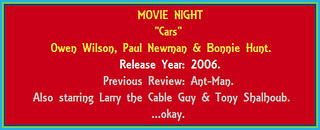
Cars.


Review #729: Cars.

Cast
Owen Wilson (Lightning McQueen), Paul Newman (Doc Hudson), Bonnie Hunt (Sally Carrera), Larry the Cable Guy (Mater), Tony Shalhoub (Luigi), Cheech Marin (Ramone), Michael Wallis (Sheriff), George Carlin (Fillmore), Paul Dooley (Sarge), Jenifer Lewis (Flo), Guido Quaroni (Guido), Richard Petty (Strip "The King" Weathers), Michael Keaton (Chick Hicks), Katherine Helmond (Lizzie), John Ratzenberger (Mack), and Joe Ranft (Red) Directed by John Lasseter (#440 - Toy Story, #441 - Toy Story 2 and #539 - A Bug's Life) and Joe Ranft.

Review
Yep, this one. I remember getting this a birthday gift when I was 10 or 11. This was back when I was just a kid, without much to worry about, as opposed to now. I remember that the movie was fine, and yeah, I probably liked it back then. Anyway...how is the movie for me after a few years passed me by? I suppose the movie's okay. But when held up to the standards that Pixar films had, it isn't as good, though I'd say the movie is at least passable enough. I am aware of the plot resemblance to the movie Doc Hollywood, but I was more focused on the anthropomorphic cars. Apparently, there are no humans, but the cars are fueled by other cars. Did the cars suddenly take over the Earth? And if so, did they...get rid of the humans? But regardless, the movie is well crafted in terms of animation and style. The cars are wonderful to look at, and it's obvious that the movie has a good deal of passion for Route 66, and it is at least entertaining enough. The plot has its cliches (the hotshot, the country bumpkin, the one with a secret, the hippie, etc.) and it is admittedly slightly predictable, but at least the movie doesn't drag on too much. It showcases what it wants and doesn't let itself linger too much. The voice cast is fine, and it seems the cars in Radiator Springs have a decent accord with each other, which helps make the movie feel more friendly. It's hard to say if the movie is more interesting with the racing or the town, but at least it never bored me too much. It's a movie that for all of its flaws manages to squeak out a passable experience, heightened for younger kids. And...then there was a sequel. I will deal with that shortly.

Overall, I give it 7 out of 10 stars.

September 29, 2012

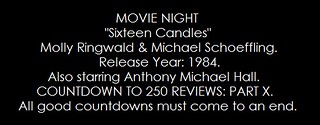
Movie Night: Sixteen Candles.


Review #249: Sixteen Candles.

Cast
Molly Ringwald (Samantha Baker), Michael Schoeffling (Jake Ryan), Anthony Michael Hall (Ted), Gedde Watanabe (Duk), Haviland Morris (Caroline), Paul Dooley (Jim Baker), Edward Andrews (Howard Baker), and Billie Bird (Dorothy Baker) Directed by John Hughes (The Breakfast Club - #046 and Ferris Bueller's Day Off - #207)

Review
This was John Hughes' first film that he directed and wrote, and...it's decent. While it may not be as rough as Breakfast Club or as zany as Ferris Bueller, it does have enough good gags and such to keep the film going long enough. Ringwald and the rest of the cast is memorable in their roles, which is a strength that accompanies Hughes' films. I have this one memorable conversation from the film: ("Everybody thinks I'm a dork." "I don't think you're a dork, your mother doesn't think you're a dork." "Mike thinks I'm a dork." "Mike is a dork") It has aged decently, and it is a staple of high school popculture, which does make sense. Sort of. And so, it is now time. Countdown to 250: 10, 9, 8, 7, 6, 5, 4, 3, 2, 1.

Overall, I give it 8 out of 10 stars.