Showing posts with label Nat Pendleton. Show all posts

June 22, 2024

The Cat's-Paw.

Review #2220: The Cat's-Paw.

Cast: 
Harold Lloyd (Ezekiel Cobb), Una Merkel (Petunia Pratt), George Barbier (Jake Mayo), Nat Pendleton (Strozzi), Grace Bradley (Dolores Doce), Alan Dinehart (Mayor Ed Morgan), Grant Mitchell (Silk Hat McGee), and E. Alyn Warren (Tien Wang) Directed by Sam Taylor (#667 - The Freshman, #727 - For Heaven's Sake, #758 - Safety Last!, #864 - Hot Water, #903 - Dr. Jack, #918 - Why Worry?, #938 - Girl Shy, #1331 - Coquette)

Review: 
Amusingly, this was the first film starring Harold Lloyd in which his character name was something other than "Harold" since Hot Water (1924; of course in that movie, that character was named "Hubby"). The movie was the eighth and final film collaboration between director Sam Taylor and star Harold Lloyd. You may remember that Taylor got his start as a director with Dr. Jack (1922) after a number of years as a writer. He directed Lloyd alongside Fred C. Newmeyer (back when co-directing was the rage) from that film all the way to For Heaven's Sake (1926) before going on to direct a variety of other stars such as Will Rogers and Mary Pickford. Taylor may not have been a distinct director of his time in say, personality, but he was a dedicated filmmaker regardless. This was near the end of Taylor's career as a director, where the release of his next film in Vagabond Lady (1935) was his penultimate feature before closing his career out with a Laurel and Hardy production in Nothing but Trouble (1944); Taylor died in 1958 at the age of 62. At any rate, the genesis for this film came from a novel that had been first serialized in The Saturday Evening Post by Clarence Budington Kelland (a prolific writer that had plenty of stories turned into films, such as Mr. Deeds Goes to Town [1936]) that Lloyd had liked enough to buy the rights to when only the first chapter had been out for the public. Taylor and an uncredited Clyde Bruckman did work for the script adaptation while Lloyd did a bit of uncredited directorial work (as one probably expects from someone producing his own film). The next feature film with Lloyd would come in 1936 with Leo McCarey's The Milky Way.

It's funny that a two-year gap between this and Movie Crazy was something critics of the time needed to point out with Lloyd, as if one was checking problems in an assembly line. To be fair, some of the films did fall along the same outline with Lloyd in bumbling nature. Admittedly, when one is considering the fact that Movie Crazy (1932) was the only good feature of Lloyd's first three sound efforts, it sort of seems easy to say that The Cat's Paw (the name refers to a guy being used as a dupe) ends up being just as decent (at least this time, the "well-meaning boy or fumbler type of character", as I said in my last Lloyd review, doesn't seem too much on the nose here). Sure, it is a bit weird (take a guess at the stereotypes and wonder where the line is drawn), but it is pretty efficient at 102 minutes in letting Lloyd grow up just a bit. Not packing as much slapstick but still pretty loaded in useful principles, he may be playing a "fish out of water", but it is a compelling one to watch that straddles the line between silly and the eventual figure of actual interest without needing a climax involving stunts (unlike a handful of previous Lloyd films). Making light of dirty politics is handled in a silly way that at least is funny for a little while Merkel and Lloyd make a pretty decent pairing to go with a worthwhile honest dishonest man in Barbier. So yes, the climax involves a bout of trickery that amuses me because well, who doesn't love a bit of stage magic. As a whole, Lloyd may have a strange time getting into the groove of making consistent sound features, but The Cat's-Paw is a worthwhile example of Lloyd still trying to make his style of comedy connect to the audiences at large. While not everything has probably aged well in the nine decades since its release, it will likely be worth one's time.
 
Overall, I give it 7 out of 10 stars.

September 16, 2022

The Thin Man.

Review #1887: The Thin Man.

Cast: 
William Powell (Nick Charles), Myrna Loy (Nora Charles), Maureen O'Sullivan (Dorothy Wynant), Nat Pendleton (Lt. John Guild), Minna Gombell (Mimi Wynant Jorgenson), Porter Hall (Herbert MacCaulay), Henry Wadsworth (Tommy), William Henry (Gilbert Wynant), Harold Huber (Arthur Nunheim), Cesar Romero (Chris Jorgenson), Natalie Moorhead (Julia Wolf), Edward Brophy (Joe Morelli), Edward Ellis (Clyde Wynant), and Skippy (Asta) Directed by W. S. Van Dyke (#231 - San Francisco)

Review: 
Admittedly, a movie with a director known as "One Take Woody" sounds like a recipe for an interesting time. W. S. Van Dyke entered film in 1915 after a wide variety of time spent in business school and numerous part-time jobs and theater company tours. He went from assistant director with D. W. Griffith to director in the span of two years. When it came to sound, he was adept in his craft that made him a solid company man for Metro Goldwyn Mayer that served him well until his death in 1943. Of course, this is something worthwhile to mention because of the fact that he was one of the key parts behind what ended up becoming a film series. The Thin Man saw five further features: After the Thin Man (1936), Another Thin Man (1939), Shadow of the Thin Man (1941), The Thin Man Goes Home (1945), and Song of the Thin Man (1947). Van Dyke would direct three of the sequels while its main stars in Powell and Loy starred in each of the movies (one would notice that the "Thin Man" actually originally refers to a missing man played by Ellis, but people referred to Powell as "Thin Man" pretty early on). The movie, if you didn't know, is an adaptation of the 1934 novel of the same name by Dashiell Hammett. Hammett was a member of the Pinkerton National Detective Agency (both private law enforcers and aggressors against organized labor) before he was a writer, which led him to write numerous stories and novels with characters such as Sam Spade (as it turned out, this was the last novel written by Hammett, who dealt with tough health and other struggles before his death in 1961). Husband-and-wife duo Albert Hackett and Frances Goodrich wrote the feature, with instruction by Van Dyke to loosely adapt the novel while having concentration on providing witty banter for its lead actors, with Van Dyke often shooting the first take due to his belief that actors lose spontaneity with every passing take.

Go figure that a movie shot in less than three weeks ended up being a complete success for all involved.  The chemistry between Powell and Loy in banter is one that other filmmakers would be jealous enough to wish they could steal for themselves. Van Dyke knew he had magic with these folks, so he made a movie with resourceful pacing and spontaneity that makes for a capable mystery with chuckles to go around. Powell may have been considered a bit too old for the part (42) when compared to Loy (29), associated with exotic roles at the time. But they are so dazzling here, zinging off each other without serving as distraction for tired plotting. Powell knows exactly what to lend to the material in his timing and mannerisms, sophisticated in deduction without coming off as a Sherlock pastiche. He glides through 91 minutes as if the plot wasn't particularly important to having fun. It wasn't his first crack at playing a detective (he had played the character Philo Vance in four films from 1929 to 1933), but it was his first crack at having a film that wanted to show him with sophistication and charm. Powell and Loy would star in fourteen total movies together. Loy makes a quality partner in her own wiry charm that pushes things along with easygoing flair that matches wit (and alcohol) with Powell all the same in pure escapism. O'Sullivan and the others have to play a bit of catch-up in maintaining the plot to some sort of believable level (i.e. things that you've probably heard from a detective story but not completely cliche), in order to not be completely overshadowed by the duo, much less the dog and his paw movement. The dinner sequence where all are seated in order to gradually explain the whodunit is particularly effective in execution in closing the romp. This is the kind of movie where a guy can sock someone from behind before getting into a scuffle or have lines like "didn't come anywhere near my tabloids", you should have a real good time with this movie. Regardless how the follow-up films went, Dyke cultivated in record time a work of useful entertainment that saw one of the best pairings in film history (Powell and Loy) come together for one of the most interesting films of its era that practically walks on air with its sophistication that all would be proud to be part of.

Overall, I give it 10 out of 10 stars.

February 21, 2020

The Great Ziegfeld.


Review #1344: The Great Ziegfeld.

Cast: 
William Powell (Florenz Ziegfeld Jr.), Myrna Loy (Billie Burke), Luise Rainer (Anna Held), Frank Morgan (Billings), Fannie Brice (Herself), Virginia Bruce (Audrey Dane), Reginald Owen (Sampson), Ray Bolger (Himself), Ernest Cossart (Sidney), Mae Questel (Rosie), Joseph Cawthorne (Dr. Ziegfeld), Nat Pendleton (Sandow), Harriet Hoctor (Herself), Jean Chatburn (Mary Lou), and Paul Irving (Erlanger) Directed by Robert Z. Leonard.

Review: 
I did not foresee a thousand word review that took longer to write than it did to get through the film. And yet, here we are.

One needs a bit of history now and then. Or at the very least needs a big show to really drive up attention. This is a film based on the life of Florenz Ziegfeld Jr and his Ziegfeld Follies, which made numerous productions from 1907 to 1931 (with two further revivals after Ziegfeld's death). There were numerous entertainers that appeared in the show over the years, ranging from W. C. Fields to Will Rogers to Louise Brooks to Fanny Brice. Who else to deliver a film with elaborate costumes, dances and sets but Metro-Goldwyn-Mayer, with the most notable set being for the set for "A Pretty Girl Is Like a Melody", which spent roughly $220,000 on a 100 ton, 175 spiral stepped towering rotating volute. The music for the film was done by Walter Donaldson, Irving Berlin, and lyricist Harold Adamson, while Seymour Felix did the dance direction, and William Anthony McGuire wrote the film. I suppose it shouldn't have proved a surprise that this won the Academy Award for Best Picture. It happened to be one of the highest grossing films of the year, right next to another fellow MGM Best Picture nominee with San Francisco. Of course it also shouldn't be surprising that this is a tremendous long spectacle, running 176 minutes (185 for roadshows). One expects a veteran director to serve as a reliable hand for a big production, which is the case with Robert Z. Leonard. He had studied law at the University of Colorado before moving to Hollywood to start his film career acting in various short subjects in 1908. Five years later, he would take up directing the subjects to go alongside his career. It was not long before he got into directing feature-length films, starting with the mostly lost serial The Master Key (1914). In his five decade career, he directed two films nominated for Best Picture and Best Director (this and The Divorcee from 1930). He is known for his association with MGM, where he made most of his features for (starting with their predecessor Metro Pictures) from Peacock Alley (1922) to The King's Thief (1955).

One thing that is easy for me to say is that I don't know too much about the life of Florenz Ziegfeld Jr. After this film, I still don't think I really know much about the man that seems substantial. Even his death is wrongly depicted, as if him dying of pleurisy in Hollywood didn't seem impactful enough to depict for film. It all seems carefree, where the ups and downs seem more catered for its audience to escape with than something that presents anything other than bloated lavishness. In trying to cover all the bases of production value, it soon becomes a hollow experience that seems dated more than anything, although I suppose big-budget effects extravaganzas have some sort of link with this film in attempts at trying to hide hollow plots with some sort of flash. One seems to feel the passage of time of this film like it is taking 30 years rather than three hours. Powell does seem like the man for a role like this, having risen from heel roles in his early years since starting a career in Hollywood in 1922 to leading man roles, most notably with The Thin Man (1934). He starred in five further films in that series, each with Myrna Loy (they appeared in 14 total features together). He received three nominations for Best Actor (1934, 1936, 1947), and although he never won an Oscar, he cultivated a 33-year career with class and charm. I like seeing him here, even if he is playing a role that begs to have at least one flaw show itself on screen. He seems like a nice rogue, but he almost seems lost in a sea of pep and convenience. Loy has the disadvantage of time, since she doesn't show up until over two hours in. In that sense, she pulls off an okay performance playing a living actress (after Ziegfeld's death, she had sold off the film rights to try and pay off his debts and subsequently worked as technical consultant for this film), where one will say it has some stature but not too much else. Rainer (who aspired to be an actress at 16) was in her fifth role in film, having moved from the theatre to film after seeing A Farewell to Arms (1932), describing it as "beautiful". She moved from her native Germany to Hollywood three years later, signing with MGM, with her first American feature being Escapade, which also happened to have Powell and Leonard. She had a peak like no other actress, being the first actress to win back-to-back Academy Awards (Spencer Tracy would do the same for actors for 1937 and 1938), having won for this and The Good Earth (1937). She made fifteen film appearances in her career, owing to the pressure in living up to audience expectations along with dissatisfaction with MGM head Louis B. Meyer with getting roles she found to her liking (as opposed to the other way around). The one highlight scene for Ranier is the phone sequence, a heartbreaker that likely gave her the edge in winning an Academy Award for Best Actress. She does fine with delivering vulnerability, but the film's melodramatic approach does tend to make some of her scenes a bit over-the-top. The others prove hit and miss. Morgan and Brice deliver a bit of levity, but the rest seem to get a bit lost in the shuffle.

There would be further ventures with the Ziegfeld name by MGM, who released Ziegfeld Girl (1941, also directed by Leonard), and Ziegfeld Follies (1946, directed by Vincente Minnelli), which was composed of musical numbers and sketches. At the end of the day, this could prove a curiosity, for either the right or wrong reasons. One could hold up the musical pieces and its designs with some respect, alongside its boundless optimism in the face of marginalizing some of the facts. Or perhaps one could find it to be an overlong affair that can't quite satisfy in every department that creaks with age. I wish I liked this better than I did, because there is some entertainment value present in the film. Its a film that aspires to be the cream of the crop and instead seems to have a bit too much sugariness to really get there and stay on top. 

Overall, I give it 6 out of 10 stars.

January 29, 2014

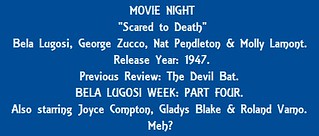
Movie Night: Scared to Death.


Review #534: Scared to Death.

Cast
Bela Lugosi (Prof. Leonide), George Zucco (Dr. Joseph Van Ee), Nat Pendleton (Bill Raymond), Molly Lamont (Laura Van Ee / Laurette La Valle), Joyce Compton (Jane Cornell), Gladys Blake (Lilybeth), Roland Varno (Ward Van Ee), and Douglas Fowley (Terry Lee) Directed by Christy Cabanne.

Review
The movie claims to be filmed in "natural color", and while it may seem utterly ridiculous to market especially in the title card, the movie doesn't look that bad, though even if it was in black in white, this would still be a mediocre film. The movie has a premise that could either be seen as creative or entirely useless. And what's the premise? The character that was scared to death narrates (I put that one loosely, given that all is speaking brief lines while just lying on the table) over the film, complete with really silly screamy music that occurs every time the corpse narrates (The narration lasting about 30 seconds)...and after it ends, which makes me wonder why didn't they just have narration over the film itself, and not these stupid interruptions that aren't long enough to be called interruptions. Lugosi is hamming up to the max, and hey, he's not the villain here, though he does have a short sidekick, which is really bizarre because it doesn't really add anything to this shoe string plot. The actors look like they don't care, and the film's plot is so ludicrous that you'll be begging for it to end by the half way mark. It's a strange, but ultimately useless film that shows its age, and it's lack of scares. It actually would work better as a comedy, but even that sounds too generous. For the next film on Bela Lugosi Week, we'll be dwelling into...the 1950's.

Overall, I give it 4 out of 10 stars.