Showing posts with label Jack Nicholson. Show all posts

December 20, 2023

Mars Attacks!

Review #2160: Mars Attacks!

Cast: 
Jack Nicholson (US President James Dale & Art Land), Glenn Close (First Lady Marsha Dale), Annette Bening (Barbara Land), Pierce Brosnan (Professor Donald Kessler), Danny DeVito (Rude Gambler), Martin Short (Press Secretary Jerry Ross), Sarah Jessica Parker (Nathalie Lake), Michael J. Fox (Jason Stone), Rod Steiger (General Decker), Tom Jones (Himself), Lukas Haas (Richie Norris), Natalie Portman (Taffy Dale), Jim Brown (Byron Williams), Lisa Marie (Martian Girl), Sylvia Sidney (Grandma Florence Norris), Paul Winfield (General Casey), Pam Grier (Louise Williams), Jack Black (Billy-Glenn Norris), Janice Rivera (Cindy), Ray J (Cedric Williams), Brandon Hammond (Neville Williams), Joe Don Baker (Glenn Norris), and O-Lan Jones (Sue-Ann Norris) Directed by Tim Burton (#040 - Batman [1989], #107 - Beetlejuice, #132 - Alice in Wonderland, #196 - Charlie and the Chocolate Factory, #262 - Corpse Bride, #316 - Batman Returns, #969Planet of the Apes [2001], #1257Pee-wee's Big Adventure, #1295Sleepy Hollow, and #1615 - Edward Scissorhands)

Review: 
“I wanted to do something fun with a bunch of Martians with big brains. Basically, make a modern version of Plan 9 From Outer Space or The War of the Worlds.”

Yes, there were two big-budget films about alien saucers coming onto Earth in 1996. Take one guess which ended up as the big audience hit. Of course, the basis for the film was a Topps trading card series of the same name which had a mix of gore and other such content that come with cards that made their debut in 1962 around the Cuban Missile Crisis that gave a couple of kids a curious glance and outcry from parents that led to the culling of production not long after. Alex Cox actually proposed doing a film in the 1980s but couldn't get past the scriptwriting approval stage. In 1993, Jonathan Gems approached Tim Burton about the idea of doing a film based on a Topps card property in "Attack!": Mars and Dinosaurs. Jurassic Park (1993) kind of influenced going away from the latter, to put it mildly. As such, when it came to the screenplay, it was done with a vast array of characters and situations involved, which included that opening sequence of burning cows. As noted by a handful of folks, the spaceship designs were inspired by the film Earth vs. the Flying Saucers (1956). Attempts to do stop-motion for the aliens were rejected due to costs, but the CG from Industrial Light & Music was stylized to have a cheap look on purpose. One other film used for inspiration by Burton and Gems was The Towering Inferno (1974), with them relating how they had watched the film a year prior while stoned. Gems was let go from the project by Warner Bros. (because they wanted Gems to take out that opening sequence) in favor of Larry Karaszewski and Scott Alexander (who had written Ed Wood (1994) for Burton) and then he was put back in a year later. Burton also wrote the screenplay but did not request credit. 

The film (Burton's seventh as a feature director) was made on a budget of $80 million with a good deal more spent on promotion. The film barely met the budget back, while Independence Day, released five months earlier, was the audience favorite when it comes to setting a trend for blockbusters in a sense. I don't think you need me to say which has aged particularly better, because Mars Attacks! is the superior film in every sense of the word Both films do an attempt at effects extravaganza-making in the manner of Irwin Allen, but this is the one that has the most fun along with not insulting one's intelligence. It is a star-studded delight that comes and goes as a pretty good pastiche of the 1950s B-flicks that doesn't insult them or turn into a puddle worse than the material. This time, it isn't big authority or heroic figures that deal with saving the day but instead the ones you don't really see coming. It kind of frustrates me, how could people of 1996 ignore the fun of this? Nicholson apparently took on the film because he enjoyed working with Burton on Batman so much. Weirdly enough, he makes the Peter Sellars of what might as well be the Dr. Strangelove of alien invasion films, because he plays two different roles. He gets to play a towering force of centrist weirdos and a swaggering puddle of sleaze (complete with a gag about his hair) - how can you resist? Close meanders in snobbery for that time required before the inevitable plop. Bening makes a useful hippie in a film filled with broad amusing stereotypes, which even includes the smallest use of DeVito one might expect. You've got Brosnan (one year removed from GoldenEye) getting to do exposition and silly snobbery next to Parker in bewildering chemistry that has some fun head-play. The most noted presence though is Brown, becuase there has to be at least one person who seems serious enough to take on Martian ass-kicking. Haas and Sidney make a charming pair when it comes to families that sure love to stay together and find the oddest way to take down aliens: one old crooner song. Jones apparently wanted to do something different and thus signed on for this film, where he gets to sing "It's Not Unusual" and pop in and out in escape. Ha. I imagine Steiger loved the bluster as much as the check, and that's alright with me. This was actually one of Fox's last live-action film appearances (prior to going public with his Parkinson's disease diagnosis in 1998), and it is fine to see him play a would-be bigshot before the inevitable. The Martians as a whole look pretty funny, particularly with the "ack" dialogue and their plastic features without needing to be explained too much when it comes to the art of "invaders for the sake of being invaders", where Marie doesn't even have to speak to make an eerie Martian as well. The 106 minutes run off pretty well for amusement when it comes to playing against the Establishment type, and it truly bewilders me that this didn't get the respect it deserved for its time. Over 25 years later, this is one of Burton's most underrated films as a director when it comes to entertaining vision in alien disasters and humor with a star-studded cast to back it up.

Overall, I give it 8 out of 10 stars.

June 18, 2022

Redux: Batman (1989).

Redux #040: Batman (1989)

Cast: 
Jack Nicholson (Jack Napier / The Joker), Michael Keaton (Bruce Wayne / Batman), Kim Basinger (Vicki Vale), Robert Wuhl (Alexander Knox), Pat Hingle (Commissioner Gordon), Billy Dee Williams (Harvey Dent), Michael Gough (Alfred Pennyworth), Jack Palance (Carl Grissom), Jerry Hall (Alicia Hunt), Tracey Walter (Bob the Goon), Lee Wallace (Mayor Borg), and William Hootkins (Lt. Max Eckhardt) Directed by Tim Burton.

Review: 
"I liked parts of it, but the whole movie is mainly boring to me. It's OK, but it was more of a cultural phenomenon than a great movie." - Tim Burton

If you remember correctly, 1989's Batman took the world by storm when it was released in June of 1989 in ways that have not been forgotten when it comes to blockbusters and comic book movies. Michael E. Uslan, inspired by reading Batman comics as a kid, had a desire to make the definitive version of Batman that had been envisioned by artist Bob Kane and writer Bill Finger when they created the character in 1939. Uslan was a fan of the main character alongside the family of villains, and he even taught a class about comic books at Indiana University. Of course, when Uslan first approached DC Comics about making a movie, they thought it was a crazy idea, because the character's popularity had diminished in the years that followed the cancellation of the 1966 television series, which certainly was still in the public consciousness for the character (which makes sense, as the Adam West interpretation certainly matched the era to a T). Uslan cultivated his movie credentials by working at United Artists (after graduating law school), and he credit DC head Sol Harrison as a mentor in getting the process to a good start - the rights to Batman were bought by Uslan and Benjamin Melniker in 1979, aligning with producers Jon Peters and Peter Guber (it should be noted that Guber and Peters, hairdresser-turned producer and possible scumbag,  manipulated their way to be main producers in getting a deal with Warner Brothers that sent Uslan and Melniker to executive producers with only "net profits"). Uslan even wrote a script with a friend to try and give people an idea of what he wanted to make to counteract the preconceived idea from doubtful skeptics along with a "creative blueprint" memo, complete with having Jack Nicholson in mind for the Joker. Warner Bros. decided to serve as the studio to produce Batman in 1980, but their attempts to have a script by Tom Mankiewicz (contributor on the Superman movie in 1978) did not go well. At any rate, pre-production stalled until 1986. Warner executive Bonni Lee got Burton to join in on the project, helped by the success seen in his work on Pee-wee's Big Adventure (1985) for the studio, although the success with Beetlejuice (1988) gave the formal greenlight in 1988. Burton, at the suggestion of Peters, picked Keaton to play Batman because of their work together on the latter film, one that he felt would have the audience suspend its belief and take the actor seriously. He also stated that the locale of Gotham City had to be just as important a character for the movie to work. Steve Englehart and Julie Hickson each wrote film treatments before a screenwriter was hired. Sam Hamm wrote the story (alongside side work done by Burton, without credit), but the screenplay was done by Hamm and Warren Skaaren. Rewrites were done by Skaaren with others, excluding Hamm due to a strike by the Writers Guild of America. Influences included stories such as Alan Moore & Brian Bolland's The Killing Joke (a story that Burton personally loved in understanding the mythology) and Frank Miller's The Dark Knight Returns. Bob Kane worked as a consultant on the film (coincidentally, he credited Finger, who died in 1974, as a "contributing force", although Finger was not given proper credit until 2015). Peters tried to mold Burton in his image when it came to making a Batman that he didn't want to be thought of (in his words) "Wussman", complete with making suggestions for the climax, which originally involved a different character meeting their end, and he actually commissioned a 38-foot model of a cathedral for the characters to be for said climax. At any rate, Peters and Guber did not return to produce the sequel, but they reaped the benefits of being behind one of the biggest blockbusters of its time; as his third feature film, Burton described the filming process as "torture", but he returned for the sequel in 1992.

When I saw this film originally in 2011, I was a fourteen-year-old trying to write quickly and write what I liked on the spot with a movie. Long story short, those reviews aren't great, so a redux movement is slowly building up steam by me to get as many redux-es possible for reviews I feel deserve better. This one, even with 200 words for what was somehow called a 10/10 movie, seemed very ripe for a second look. Actually, it is a third look, because I did watch this movie a couple of years later to try and refresh my memory, which didn't exactly help this movie too much. The third time around has basically confirmed that the best memories about a movie are sometimes left to younger eyes. Burton thought that the best way to approach the movie is to see Batman and Joker as essentially two of a kind in odd freaks that are intertwined in origin. Anton Furst and Peter Young designed the sets for the film, which shows an Art Deco style that makes Gotham seem reminiscent of something like The Cabinet of Dr. Caligari (1920) or noir. You have to understand that people actually thought that casting Keaton was going to make it seem like a comedy because of his work on stuff like Mr. Mom (1983). It is interesting to consider that because of the fact that Keaton approaches the material with righteous timing and balance required, even if one seems to think that he is overshadowed by you-know-who - him going "you wanna get nuts?!" is an interesting highlight when thinking of the fair blend of seeing the deeper-voiced Batman and the unassuming Bruce Wayne. Of course, the high-priced and high-billed Nicholson steals the show, because playing an agent of chaos that grins his way through the proceedings is a role to dream for that he stretches right to form. This isn't to say that it is a hammy performance as it is just one that controls the mood of the movie that might as well make it his movie more than Keaton's movie. Basinger does fine with the balance between the battle of freaks, bewildered but not washed out; the scene where she waltzes into the Batcave doesn't exactly help. Apparently, Wuhl's character was meant to die in the climax, but the filmmakers liked him so much they let him live. That is probably the best compliment I can find when talking about him in this film, because the less said about him, the better. Hingle and Gough don't have too much to particularly do, but at least one takes them seriously for what is needed. Williams in theory should be really interesting, but since there would be no more Williams as the character of Dent, it comes off as ridiculous to have him cast but not actually do anything (besides, Walter is the amusing quiet man in the group). 

Maybe there is an argument that the movie might be a bit too dark for younger folks. This is ridiculous, since I doubt that one will really have this much trouble with a PG-13 rated movie like this in just letting the visuals play out on screen; one could also just stick with the West version of Batman, since it also holds up well, incidentally. Danny Elfman, best known for his work with the band Oingo Boingo alongside Burton's previous two features, did the music, albeit with Prince composing and writing songs as well. The music score ends up sticking better than the songs, because one clearly won't forget the main theme. As a whole, the 126 minutes does go by with loose construction, one that tries hard to ride on style rather than substance, which only can go so far before falling all the way off the offbeat wayside. Seeing the origin for the Joker is far more interesting than the eventual reveal of the Wayne murder, because it makes things too convenient to have two characters create the origin for each other (i.e., having a random guy being the killer is far more tragic than just finding out it is the guy you happen to be going off to face and probably take down). I think the fact that the success of the movie inspired the development of an animated series for television probably is more of a point in the favor of the legacy of the film in what it impacted rather than the overall content of the film itself (the series, premiering in 1992, is arguably the best portrayal of Batman outside of the comics). It is a roaring adventure that builds a mystery with fair success for haunted spectacle with Burton's sensibilities clashing with other visions to make a strange concoction that lives and dies in the time it was made. It is the movie that tried to top the heights raised by Superman (1978), pure and simple. Of course, whether the movie works or not in its execution is up to you. 

Overall, I give it 8 out of 10 stars.

September 22, 2020

The Departed.


Review #1544: The Departed.

Cast:
Leonardo DiCaprio (William "Billy" Costigan), Matt Damon (Colin Sullivan), Mark Wahlberg (Sean Dignam), Jack Nicholson (Francis "Frank" Costello), Martin Sheen (Capt. Oliver Queenan), Ray Winstone (Arnold French), Vera Farmiga (Dr. Madolyn Madden), Alec Baldwin (Capt. George Ellerby), Anthony Anderson (Trooper Brown), Kevin Corrigan (Sean Costigan), James Badge Dale (Trooper Barrigan), and David O'Hara (Patrick "Fitzy" Fitzgibbons) Directed by Martin Scorsese (#990 - Taxi Driver, #992 - The King of Comedy, #1276 - Mean Streets, #1463 - Raging Bull, and #1496 - Goodfellas)

Review:
"It's the only movie of mine with a plot."

There really is no such thing as too much of one director, so it only makes sense to cover another film of Martin Scorsese in yet another prime classic to represent another decade of work, with this being his 20th feature. The film is based on the Hong Kong film Infernal Affairs (2002), which dealt with infiltration into a Triad as the first of three films (with the other two being done in 2002 and 2003 respectively), and it has subsequently been remade in other countries like South Korea and Taiwan, with novelist/screenwriter William Monahan tapped to write and eventually Martin Scorsese to direct (citing his love of White Heat (1949) that the script reminded him of), which was his second remake of a previous work (the other being 1991's Cape Fear).

What we have here is a cat-and-mouse game of tremendous excellence, one that carries itself with great pacing (as done by the usual Scorsese collaborator in editor Thelma Schoonmaker) that makes a 151 minute tale with dual storylines come together with great stature and blazing skill that captures its aspects of crime splendidly while also having a great look upon identity and what it means in various degrees for others. DiCaprio rolls greatly in a panic-attack kind of performance, one that wraps himself in a world all too ready to consume one in power and lose their sense of self in their identity in society, balancing that line of being a tool for both sides with the precision and excellence we expect from someone as confident in pulling off that edge as he is. Damon has a similar challenge in a role that reflects greatly in the other side of calm adversarial power, one who just as much at the mercy of his masters as DiCaprio that desires to escape this part and attain more and more within vain effort. Wahlberg (chosen after others like Denis Leary and Ray Liotta could not take the role) does fine in basing a man of bruising authority with snappy righteous timing that counters along with the main duo or Sheen & Baldwin with the right sense of rough honesty. Nicholson took on the role (after first choice Al Pacino declined) after some prodding because he was looking to play a villainous role again (equating this role to the ultimate incarnation of evil), which was inspired by real-life gangster Whitey Bulger. He does quite well in portraying someone wrapped with so much power and command that shows all the hunger and paranoia that comes from trying to keep it in check, and he clearly seems to be having a good time weaving this role together with the time he has as a twisted sort of father figure to the two main leads. Sheen does alright here with resonating authority that only needs a few connective moments with DiCaprio to make it all come together, although I do admire one small sequence with Nicholson and him in their engagement of taunting the other. Winstone follows along terrifically, doing menace with interest that never wavers whether in the foreground or background. Farmiga goes along with careful touch, operating her moments shared with DiCaprio and Damon with countering grace and capability. Baldwin is generally interesting in those little moments shared with the actual investigation.

On the whole, I enjoyed the film because of what it shows about the push for trying to be something one is not that never seems used to spread out into overuse of violence or become just a show for hammy acting to take place. It is an enjoyable movie for all the nitty-gritty ways it goes through  its narrative with well enough talent on and behind the camera to elevate what could have been a standard crime film into something that grabs you every step of the way and never lets go in all the right ways. Tense, riveting, and always on the move towards something useful with a wide range of good actors, The Departed is a triumph for Scorsese, his cast, and his crew that all reaped the benefits of being the best of its year in 2006 with deserved stature.

Overall, I give it 10 out of 10 stars.

August 26, 2020

As Good as It Gets.


Review #1516: As Good as It Gets.

Cast: 
Jack Nicholson (Melvin Udall), Helen Hunt (Carol Connelly), Greg Kinnear (Simon Bishop), Cuba Gooding Jr. (Frank Sachs), Skeet Ulrich (Vincent), Shirley Knight (Beverly Connelly), Yeardley Smith (Jackie), Lupe Ontiveros (Nora), and Jill the Dog (Verdell) Produced and Directed by James L. Brooks (#1470 - Terms of Endearment and #1485 - Broadcast News)

Review: 
"Just let the wardrobe be the character. You play yourself. That's the way you approach it."

It's easy to do a romantic comedy-drama when you have two of a kind playing against each other. Jack Nicholson was already an icon in doing a variety of outsider/anti-hero roles through a long and varied career that toiled for years in low-budget fare and writing before rising to prominence with Easy Rider (1969) and Five Easy Pieces (1970). As for Helen Hunt, she came from a family of photographers and directors and worked as a child actress from a young age. She eventually took on film with films like Trancers (1984) before reaching some success with the sitcom Mad About You in 1992. As for director Brooks, this was his fourth film venture (the first after the flop I'll Do Anything three years prior). It came about because of a script he found named Old Friends, written by Mark Andrus (who went from graduating in business from UC Riverside to creative writing, and he had his first script credit with Late for Dinner (1991) at the age of 36). Its story of a vile man and his gay neighbor had toiled around for years in limbo with various actors like Kevin Kline expressing interest. A year was spent in doing reworking of the script in changing its emphasis, but Brooks would spend considerable time experimenting when filming along with tinkering with the editing and its ending (which apparently changed five times).

As a love story of aggravation and change, it certainly has quite a strange appeal. Over the gradual pace of 139 minutes, it creaks and moves towards romance with a reluctant foot forward and a good cast to make a moderately funny piece of entertainment. It all starts with Nicholson, who is quite enjoyable in acidic misanthropy, one that is hard to resist in viewing because of how Nicholson makes the role across in compulsions and obsessions with conviction that never is sold out for cheap tricks. He can throw a dog in a chute and yet we still find ourself going along with his curious nature in what makes one the way they are and aren't. Hunt matches him with a mix of weariness and her own rediscovering of herself that makes a well-rounded performance of charm that goes quite hand-in-hand for some interesting chemistry like fire and ice when with Nicholson that doesn't seem too out of the blue for where they need to go. Kinnear accompanies the proceedings as the other piece of a trio of human frailty and wit that comes from it with a snappy Gooding Jr or brief moments of charm from Knight alongside smaller moments from folks like Harold Ramis that lend the film some breath of a capably human world trying to deal with very real miseries and quibbles that come from all facets of life, whether that means work or other stuff. The first half definitely works better than the second in setting up moments of back-and-forth between Nicholson and Hunt (along with pretty much anybody else his orbit, such as a quip about how he writes about romance), while the second half travels on the road with our trio and sticks itself in a bit of sentiment that gels adequately to try and arrange what you could (or could not) expect from its setup of exacting change in the patterns of people - if you remotely believe that our main duo can stick as a couple, then it will work out with wonders. For me, it sticks okay, but it definitely seems a bit tinkered one too many times to really separate it as a great experience, particularly with a length of 139 minutes. On the whole, the film gradually builds a human story towards romance with most of it in the right place with an absolute winning pair in Nicholson and Hunt to go along with a few good humorous moments to make something worth going for both the heart and the throat in charm.

Overall, I give it 8 out of 10 stars.

July 24, 2020

Broadcast News.

Review #1485: Broadcast News.

Cast:
William Hurt (Tom Grunick), Albert Brooks (Aaron Altman), Holly Hunter (Jane Craig), Robert Prosky (Ernie Merriman), Lois Chiles (Jennifer Mack), Joan Cusack (Blair Litton), Peter Hackes (Paul Moore), Christian Clemenson (Bobby), Jack Nicholson (Bill Rorish), and Leo Burmester (Mr. Craig) Written, Produced, and Directed by James L. Brooks (#1470 - Terms of Endearment)

Review:
"I always feel that I am the advocate for my character. More than anyone else on the set, including the director. I'm there to protect my character, in a way."

"I am a character actor in a leading man's body."

It must have been an interesting task to try and follow up a debut success like the one James L. Brooks had. And to do so with three captivating actors in a romantic comedy-drama about the news (for someone who worked at CBS News as copywriter and newswriter) is surely a solid curiosity, with each having been featured in a couple of films in their own interesting paths. The first key to the film is in Hunter, who had started acting from a young age and had entered film and television in 1981, with work gradually following that built to luck in 1987 with this (chosen prior to production after Debra Winger became pregnant) and Raising Arizona. The next key piece is Hurt, who shifted his focus to acting despite having studied theology at Tufts University, utilizing his training at Juilliard School to start in the stage in 1977 and then film in 1980. The third piece to the puzzle is A. Brooks, who quickly rose through the ranks of stand-up comedy to fair amount of variety and television fame before shifting focus to writing/directing his own films along with acting (most notably debuting in Taxi Driver).

Alongside Brooks' own experiences with the news, one other key inspiration for the film was producer Susan Zirinsky, who Brooks based for Hunter's character, who would also serve as technical advisor and associate producer. It is evident fairly quickly that we are dealing with a smart and capable movie, one with a distinct trio of performances that line up together for an interesting look upon the nature of romance within workaholics and a prevailing shift in the way news is delivered to the public. Each of these performances reflect well upon the other sides of the triangle because they all drive the film with comedic anguish that is easy to see traits of in ourselves without looking away. Hunter is the one to gravitate to first, with a high-strung performance that generates skillful intensity that can be both admirable and one to fear in anyone that hard-driving, which generally makes for plenty of interesting sparks when paired with anyone, particularly with Hurt; the best scene to represent that is when she is guiding Hurt through his first broadcast as anchorman with an earpiece, which almost in a way feels like sex. Hurt proves just as well with the other side of the news coin as the harbinger of fresh-faced infotainment that proves convincing in secretive charm, aware of the surroundings yet managing to never be sacrificed for pretty boy cheap shots. A. Brooks makes up the conscience of the film, and he is quite riveting in keeping our interest over with cynical charm and timing - one of the best lines come from him that asks if it would be "a great world if insecurity and desperation made us more attractive", which only makes scenes like his first anchorman show all the more entertaining. Others prove just as endearing in their own ways, such as the amiable Prosky or with Cusack (participant in another interesting scene involving a dash to get a tape in time), or retired news correspondent-turned-actor Hackes. And yes, Nicholson is also present for a time in the film, and he delivers his brief time with the spry standards one would expect from him. In general, the film does a fine job in showing people and the way they work around it in an evolving landscape along with how they work around themselves in various quibbles and high-strung desperation for 133 minutes. We seem them as children, then as adults, and then finally we see them all together again, steadfast in the honesty of who they are, for better or worse. On the whole, this is a fairly entertaining work, an achievement that hits most of its marks in sharp honesty and amusement that holds together long after its release because of how much we still see of it play out now.

Overall, I give it 9 out of 10 stars.

July 11, 2020

Terms of Endearment.

Review #1470: Terms of Endearment.

Cast:
Shirley MacLaine (Aurora Greenway), Debra Winger (Emma Greenway-Horton), Jack Nicholson (Garrett Breedlove), Danny DeVito (Vernon Dalhart), Jeff Daniels (Flap Horton), John Lithgow (Sam Burns), Lisa Hart Carroll (Patsy Clark), Huckleberry Fox (Ted "Teddy" Horton), and Troy Bishop (Tom "Tommy" Horton) Directed by James L. Brooks.

Review: 
"While you're doing it, it is sort of a lonely kind of feeing, even though you are surrounded by so many people giving beyond the call. That's generally true of movies, there's a sense of urgency, people risking their tail, people woking past exhaustion. That's what moviemaking is."

Some films just have all the right pieces go into the right places, one where talented people can be led by talented directors to make a talented comedy-drama, which is proven tremendously so with this film. At the helm at director was James L. Brooks, who would serve as producer and adapted the screenplay from the 1975 novel of the same name by Larry McMurty (who you may recognize as the writer of novels such as Horseman, Pass By and The Last Picture Show), which was the first of two novels involving the character of Aurora (with The Evening Star turned into a film of its own thirteen years later). It was the first film for the 43-year old Brooks, who had forged a long road from a rough childhood to work at CBS as a host-turned-copywriter to work in television writing. through the help of Allan Burns. It was in 1969 that he helped create his first television series - the groundbreaking Room 222, one of the first shows with a black lead character (played by Lloyd Haynes). The following year proved just as beneficial, since Brooks and Burns were brought on by Grant Tinker to help develop a show for Tinker's wife, which resulted in the enormous hit The Mary Tyler Moore Show and subsequent spinoff classics in Rhoda and Lou Grant, and he soon added film to his lineup with writing and co-producing in Starting Over (1978). The chance to do a film of his own came not long after, although it would take a few years to develop into full. The original actress intended for the main role of Aurora was Jennifer Jones, since she and her husband had the rights to the book and had sent the book to Brooks as a vehicle for her. However, while he liked the book, he wanted to do on his terms without it being a vehicle for a certain actress, which led to him getting Paramount to get involved and do the film themselves. MacLaine was picked because Brooks felt that she was the only one who saw it as a comedy, while Sissy Spacek soon left for Winger to enter. The third key piece to the film is Nicholson, who came into the film because of the rejection of another actor for a role that was written into the film independent of the book: Burt Reynolds (an actor I love to see in films that unfortunately honored his commitment to Stroker Ace). Sure, others did decline the role before Nicholson signed on (including Paul Newman), but I think we both know how much a tremendous presence Nicholson proved to be, who wanted to play a middle-aged character without the requisite crisis that came with it for those type of character while taking inspiration from an astronaut friend and a relative of his.

It is evident pretty quickly how the film operates as a comedy-drama: a curious movie with a balnce of laughs and tears that earns most of its moments on screen in coming to terms about what family means as things continually change for both parent and child. We care to see these characters because we believe in these folks and their struggle - whether it involves fussy squabbles or squabbles of the heart. It is smart enough to maintain its 132 minute pace with meaningful foundation and sentiment without becoming a manipulated parody of itself, since there is so much great chemistry between its main trio that never seems sacrificed for any sort of cheap joke or sob-story moment (alongside the fact that I don't take manipulation arguments seriously for films like this that are too competent to be labeled as such). MacLaine and Winger might've had a strange time filming together, but they sure make for a great mother-daughter team on screen. MacLaine bursts with a great understanding of what is needed from the material, hovering over things with pathos and attention to all that matters in chemistry with her on-screen daughter and her on-screen lover with Nicholson, which serves well for inquisitive excitement. Winger proves just as well in delivering a captivating performance filled with smart independent charm and timing for interaction with the situations that require it, evolving with the times in how she is with others like Daniels (a good immature performance for someone in their second film role). If the film just had those two, that would probably be enough, but having Nicholson in the mix pushes it into the stratosphere with his presence, because he is such a force of nature even when having just a portion of time to really spring your attention for his interesting appetite for life. Others, like DeVito, Daniels, and Lithgow prove well in filling in the counterparts to the main duo when it comes to trying to define some sort of "love". On the whole, the film moves from place to place that makes the time go by carefully while getting to its wrenching climax with focus.

For the fourth time in the history of the Academy Awards, a director would win an award for their directorial debut (Delbert Mann, Jerome Robbins, and Robert Redford), and Brooks gained a further distinction as one of a select group of folks (twelve as of 2020) to win three Oscars for one film, since the film also won for Best Picture and Best Adapted Screenplay. It is evident to see why the film attracted so much attention, because it is a tremendously well-made film that tugs at the heart with wit and tragedy that make for a prime film to watch of its era for its stars and direction.

Overall, I give it 9 out of 10 stars.

May 29, 2020

Easy Rider.

Review #1430: Easy Rider.

Cast: 
Peter Fonda (Wyatt), Dennis Hopper (Billy), Jack Nicholson (George Hanson), featuring Phil Spector (Connection), Warren Finnerty (Rancher), Luke Askew (Stranger on highway), Luana Anders (Lisa), Sabrina Scharf (Sarah), Robert Walker Jr (Jack), Hayward Robillard (Cat Man), Arnold Hess Jr (Deputy), Toni Basil (Mary), Karen Black (Karen), with David C. Billodeau and Johnny David (Pickup Truck drivers) Directed by Dennis Hopper.

Review: 
"I am just a middle-class farm boy from Dodge City and my grandparents were wheat farmers. I thought painting, acting, directing and photography was all part of being an artist. I have made my money that way. And I have had some fun. It's not been a bad life." - Dennis Hopper

If one ever needed a time capsule of 1969 that would encapsulate a journey filled with wanderers that look for America and find something beyond their wildest dreams, I would say Easy Rider is that kind of fitting movie. It is a road film like no other, one that represented a high point of the New Hollywood era that would be characterized by films with directors that were given the tools to try and express something different from the studio-dominated directed films of the past. Every few decades have their share of directors that come through the ranks to forge their place with iconic films or presences, and this applies just as much for stars as well. Fonda was already a counterculture icon to some for films such as The Wild Angels (1966) and this picture, and he found inspiration from seeing a still of himself in the former film to make a sort of modern Western with bikers travelling across the country. Hopper, who had made a name for himself as a method actor with a combative personality on film and television (which led to him turning to photography) was called by Fonda to see about trying to make that idea into a film. Hopper and Fonda wrote the film with novelist and Dr. Strangelove co-writer Terry Southern, while Hopper directed, and Fonda produced it. One shouldn't forget Nicholson in all of this, as he had collaborated with Hopper and Fonda previously with his written script for Roger Corman's LSD film The Trip. The credit for who did what when it came to writing is a bit murky, since one can see a good deal of improvisation among a thin story and attempts by Hopper and Fonda to downplay Southern's role in the film. Instead of a music score, the soundtrack is comprised of songs from noted artists and bands such as The Byrds, Steppenwolf, and The Jimi Hendrix Experience, with the licensing for the songs costing around a million dollars (which was larger than the filming budget of over $300,000).

This is a film with its own kind of freedom to move around with its main duo on its own terms that is wild at heart with a power that still has an appeal after all these years, for better or worse. 1969 and 2020 are two completely different years in terms of communication and other various things, but it isn't too hard to still see a commonality in one's search for their own kind of freedom and the problems that can come from it, where the clash of cultures never really did end with the 1960s - it has merely amplified in the prevailing years. What does it really mean to be free?  Through their travels, Hopper and Fonda find themselves in the presence of farmers, hippies, rough locals, and one strange trip in Mardi Gras that make quite an interesting portrait of the times in all of its hopes, dreams, and ultimately anguish, complete with them and Nicholson getting high on marijuana on camera. Fonda makes for a solid performance, not needing to say too much until the trip sequence that gives him room to show a tortured spirit within the guise of freedom (notably, Hopper convinced a reluctant Fonda to talk to the statue as if it was his mother, who had died when he was 10). Hopper makes a subdued but worthwhile misfit to accompany Fonda and make a film with frenzied interest both in the film and outside it. He reportedly had proposed doing a four hour cut that had extended sequences along with extensive use of flash-forward that would insert scenes from later parts of the film into a current scene. Nicholson, who had toiled in low budget roles for over a decade, does a tremendous job with the time he is given as an outsider with spirit and conviction in whatever he does and says on screen, whether that means hitching a ride with a football helmet or talking a theory about aliens among us. In the end, the swift and sudden climax makes for a thoughtful conclusion to a film that travels to being itself with no sense of trying to be something it isn't, appealing to an audience that had seen plenty of events and furor in the sixties that linger in our consciousness now without seeming played out or something to poke at. One gets a feel for the road without being overwhelmed by it all. The jump cuts alongside the carefree camera movements and natural lighting make for an experience worth 95 minutes. As one probably already knows, this was a tremendous hit for Columbia Pictures (at one point, an executive apparently stated that while he didn't know what it meant, it would "make a fuck of a lot of money."), and others would follow in its wake with their own kind of free-spirited and free-willing technique that makes for a worthwhile legacy for a film that is an interesting worthwhile time. It isn't perfect by any means, but it is certainly deserving of a place in the mentions of the films of the 1960s as a sign of the times for present and future in more ways than one.

Overall, I give it 9 out of 10 stars.

December 12, 2018

About Schmidt.


Review #1169: About Schmidt.

Cast: 
Jack Nicholson (Warren R. Schmidt), Kathy Bates (Roberta Hertzel), Hope Davis (Jeannie Schmidt), Dermot Mulroney (Randall Hertzel), June Squibb (Helen Schmidt), Howard Hesseman (Larry Hertzel), Harry Groener (John Rusk), Connie Ray (Vicki Rusk), and Len Cariou (Ray Nichols) Directed by Alexander Payne (#635 - Nebraska)

Review: 
About Schmidt (based on the novel of the same name by Louis Begley) is an interesting movie to see play out from start to finish, balancing comedy and drama in its presentation of a man who has found sudden meaningless in his existence going on a journey that ends up helping him find some sort of purpose. At the heart of what makes this an entertaining film is Nicholson, who delivers a captivating performance that is hard to resist in how he depicts someone with such an empty life and desperation that goes against type for Nicholson brilliantly. From the very beginning, one knows that they will be for an interesting type of movie, with a silent opening and some shots of the WoodmenLife Tower in Nebraska (where most of the film was shot), complete with the ticking of a clock towards retirement and the look on Nicholson's face, giving the audience something to think about without even having to say a word. There is a fine balance of humor and pathos throughout the film, never going too hard into one category while keeping itself on a steady trail throughout the numerous places the film wants to encounter. The rest of the cast do pretty well to accompany Nicholson, such as Bates. She pulls off a wonderful performance for her time on-screen in the latter half of the film, having plenty of free spirited energy to go around along with delivering some biting humor that goes well at times to contrast with Nicholson. Davis does fine with her key role, capturing a sense of alienation and frustration while trying to keep things together, and she pulls it off pretty well. Mulroney does a fine job with his role, having a fun sense of foolish nature that makes him amusing to watch with his time on screen. The rest of the cast have their moments to do fine on screen, but the film drives itself on its take on the ordinary and what it means to live in life - whether in making a difference in someone's life or finding time to appreciate the things around someone. It is evident that the screenplay (done by Payne and Jim Taylor) was given a careful amount of crafting to try and deliver a movie that wanted to touch upon its subject without going too much into easy crowd-pleasing moments. It never delves into being too sentimental or overtly harsh throughout its journey - it goes for a sense of honesty and emotional depth without straining too much to achieve said goals, complete with an effective ending to capstone the whole experience. It isn't a perfect movie, but it is at the very least an interesting one to examine that rewards anyone willing to have the patience for what it offers. With a run-time of 124 minutes, the film does take its time to get itself going, but it more than makes up for it with multiple entertaining performances, with Nicholson being a crucial and engaging part of what makes the film work as well as it does.

Overall, I give it 9 out of 10 stars.

November 28, 2018

One Flew Over the Cuckoo's Nest.


Review #1164: One Flew Over the Cuckoo's Nest.

Cast: 
Jack Nicholson (Randle McMurphy), Louise Fletcher (Nurse Ratched), Will Sampson ("Chief" Bromden), William Redfield (Dale Harding), Brad Dourif (Billy Bibbit), Sydney Lassick (Charlie Cheswick), Christopher Lloyd (Max Taber), Danny DeVito (Martini), Dean Brooks (Dr. John Spivey), William Duell (Jim Sefelt), Vincent Schiavelli (Bruce Frederickson), Michael Berryman (Ellis), Nathan George (Attendant Washington), Marya Small (Candy), and Scatman Crothers (Orderly Turkle) Directed by Miloš Forman.

Review: 
One Flew Over the Cuckoo's Nest was originally a novel by Ken Kesey that he had done based off his time working as an orderly in a mental healthy facility, for which he wrote the novel in 1959 before it was published in 1962. In the original novel, the story was narrated through the character named Chief Bromden, who found that society was controlled by some sort of system called "The Combine". A year after the novel was released, the novel was turned into a play, written by Dale Wasserman that had McMurphy played by Kirk Douglas, who had bought the rights to make it for the stage or for film. After a decade of trying to make it into a film, he gave the rights to his son Michael, who helped co-produce the film along with Saul Zaentz, with Lawrence Hauben and Bo Goldman doing the screenplay. The film was primarily filmed at Oregon State Hospital in Salem. Kesey was not happy with how the film adaptation came out, later suing Douglas and Zaentz for a percentage of the gross and damages for “breaking our verbal agreement and ruining the book.” He objected to the fact that the film was from the perspective of McMurphy rather than the Chief, describing it as such: "they took out the morality; they took out the Combine—the conspiracy that is America.”

At any rate, it isn't hard to see why the film is fairly enjoyable, having a certain kind of energy and pull with a fine deal of craftsmanship and interesting people to follow along with. Nicholson and his rebellious presence give a great magnetic pull for the film, bemused at having to deal with the state of the people on both sides of this mental institution that he deals with, while also having a bit of humor and will to him that makes for good entertainment. Fletcher plays her insidious role with a good degree of understated manipulation, having no sense of overblown nature nor being overshadowed by the other members of the cast, having a voice and enough presence to make this battle of wills work without too many hitches. One good scene with Nicholson and Fletcher that I can highlight is the scene where his character tries to get the television to be turned onto the World Series, where he tries to get the necessary amount of votes from the submissive ones in the ward and her attempts to assert her authority, complete with an ensuing (and amusing) act of defiance - imagining the game out loud. Sampson, who had been discovered by the producers due to his 6'7 frame, does a fine job for his acting debut, doing just alright with the small amount of lines he has while playing his part in the climax without any hitches. Dourif and Lloyd (who both had done work on the stage prior to this film) shine in their own ways, with the former's fear and willingness to try and please everyone coming out fairly well and the latter being amusing when picking on Redfield. Lassick does well with conveying panic and nervousness, and DeVito (reprising his role from the 1971 revival of the play) also does fine with brief moments to talk.

The film does take some time to show the conformity and mindless automation of the people in the ward, and for the most part the film keeps itself consistent. The fishing sequence is a bit of a miss when compared to other sequences in part because it just feels a bit too silly that kind of messes with the rest of the film's tone. It should be mentioned that the fishing sequence was present in the novel, although it has a few significant differences - such as the fact that the trip is planned in the book, for example. In any case, it's a bit of a understatement to say that the film turned out to be such a great success, being a hit with audiences while winning numerous awards, winning what is described as the Big Five categories of the Academy Awards: Best Picture (beating films such as Jaws and Nashville), Best Director, Best Actor, Best Actress, and Best Adapted Screenplay. On the whole, the film is pretty entertaining, having an enduring spirit to it that makes it work more often than not in its 133 minute run-time. It still manages to hold up well after over forty years since its release with a game cast and an enduring spirit that makes for at least one watch.

Overall, I give it 9 out of 10 stars.

November 2, 2018

Wolf (1994).


Review #1157: Wolf.

Cast: 
Jack Nicholson (Will Randall), Michelle Pfeiffer (Laura Alden), James Spader (Stewart Swinton), Kate Nelligan (Charlotte Skylar Randall), Richard Jenkins (Detective Sgt. Carl Bridger), Christopher Plummer (Raymond Alden), Eileen Atkins (Mary), David Hyde Pierce (Roy MacAllister), Om Puri (Dr. Vijav Alezais), and Ron Rifkin (Doctor Ralph) Directed by Mike Nichols (#175 - Who's Afraid of Virginia Woolf?, #550 - The Graduate, and #637 - The Birdcage)

Review: 
I suppose there must have been a desire to make a new kind of werewolf film for the 1990s, particularly since this film doesn't even use the word "werewolf", as if that was somehow taboo or something. It's also clear that they really wanted to be taken seriously, since this is a romantic horror film. On the whole, the film is decent, but it doesn't really live up to the potential it could've reached, although I certainly do find some enjoyment from it, whether when trying to be a metaphor or for unintentional amusement. Perhaps this is a movie that needed more beastly nature, since the real horror that jumps out involves office politics at a publishing house. The screenplay was done by author Jim Harrison and Wesley Strick, although there were un-credited re-writes done by Elaine May. Harrison was not a particular fan of the final result of the film made by Nichols, explaining "I wanted Dionysian, but he wanted Apollonian. He took my wolf and made it into a Chihuahua. I cracked up for 10 minutes and then went out into the country and stood in front of a wolf den and apologized while my dog hid under the truck." This is a strange film to spend 125 minutes with, and it does sometimes feel a bit too long.

The acting does help carry the movie well enough. Nicholson is entertaining, being watchable as ever without overdoing anything, whether when prancing around with mutton-chops or when having more energy to him after being bit. After all, this is a movie that gives him a bunch of abilities to show off as a wolf, such as being able to read without his glasses, being able to be more active in romance with his wife, jumping in the air, or having animals hate him. Pfeiffer, in a role that occasionally delves into cliches, manages to come out as someone interesting to follow along with, having a few moments with Nicholson that makes this romance seem semi-workable. Spader is excellent at playing such a smarmy character like this one, making the art of flattery and treachery that works oozy wonders each time he's on screen. Nelligan is okay, but the real highlight in the supporting cast is Plummer, who plays his domineering rich guy role with an understated touch. The special makeup effects are done by Rick Baker, who you may recognize from his work on other films, most notably An American Werewolf in London (1981) and Coming to America (1988). His effects here are pretty good, although they certainly feel restrained in contrast to the bits involving the romance or the office scenes, although at least they are given time to shine in the climax. Honestly, the movie is more fun when it doesn't feel so restrained between either being a metaphor or being actual horror/romance. One of my favorite bits of amusement comes when Nicholson's character decides to "mark his territory" at the bathroom when he's firing Spader's character, as if this was supposed to be taken seriously. Other other fun bit comes when Nicholson's character finds out that he has been cheated on by his wife through his super-scent, so he goes up to the house where his wife and the other guy are located, and he bites the other dude on the hand before going up the stairs, taking one look at his wife, and then leaves. The climax is a bit of a ridiculous one, and it isn't as effective as it probably should've been. Maybe it's the fact that there really isn't that much buildup for its showdown between its two wolves (complete with the use of slow motion), or maybe it's the fact that the film keeps shuffling between what it really wants. This is especially apparent in the scene after involving a shot of eyes mixed in with a shot of a wolf - and that's it. If you think the film will resemble something like The Wolf Man (1941), you will likely be disappointed, but I did manage to find some strange enjoyment out of how weird and energetic it is, even if it manages to muddled in ridiculousness at times. It isn't a highlight in the horror or romance genres, but it works just enough for me to win out as entertainment.

Overall, I give it 7 out of 10 stars.

October 21, 2016

The Terror (1963).


Review #852: The Terror.

Cast: 
Boris Karloff (Baron von Leppe/Eric), Jack Nicholson (Andre Duvalier), Dick Miller (Stefan), Sandra Knight (Helene/Ilsa), Dorothy Neumann (Katrina the Witch), and Jonathan Haze (Gustaf) Directed by Roger Corman (#368 - The Little Shop of Horrors and #684 - It Conquered the World)

Review: 
It figures that I get to a Roger Corman movie for this month, and it just so happens to have Jack Nicholson in one of his earliest roles, alongside Boris Karloff. The idea for the movie came not because of a really great idea for a movie, but because Corman wanted to take advantage of sets left over from another production of his, The Raven. In fact, Karloff's scenes were done in three days, and he later described Corman as having "the sketchiest outline of a story.", which is amusing. One thing I can say is that there are some good looking sets, and some moderately entertaining effects. The movie is a bit of a mess, suffice to say, but what do you expect? In addition to Corman, there were four other people who directed parts of the movie (Francis Ford Coppola, Monte Hellman, Jack Hill, and Jack Nicholson), with an 81 minute run time as well. The movie runs at such a strange jumbled pace, with a small cast making up the characters and plot twists being revealed here and there, which one should remember was written for the price of $1,600. You might as well make a flow chart for the movie, or set up a bingo card of things that happen (witch being struck by lightning got me bingo)...and what is The Terror anyway? (the answer to this is placed under your floorboard). I especially love the climax where Karloff and Knight "fight" each other right before a flood happens. Karloff does what he does best in a role as strange as it would be for anyone not named Boris Karloff, and he has quite the screen presence. Nicholson can't really give his character much charisma, but he tries his best to make for an adequate performance. Honestly this isn't a terrible movie, just a strangely cobbled one that could be entertaining to watch late at night before going to bed, which is easy considering this is in the public domain. 

Overall, I give it 5 out of 10 stars.

January 1, 2015

Movie Night: Tommy.


Review #687: Tommy.

Cast
Roger Daltrey (Tommy Walker), Oliver Reed (Frank Hobbs), Ann-Margret (Nora Walker), Elton John (The Pinball Wizard), Eric Clapton (The Preacher), Tina Turner (Acid Queen), Keith Moon (Uncle Ernie), Jack Nicholson (The Specialist), Paul Nicholas (Cousin Kevin), and Robert Powell (Captain Walker) Directed by Ken Russell.

Review
After I saw the movie, I didn't know if I liked it, and if I did, how much. So I decided to listen to the rock opera of the same name the movie was based off of. I had already listened to Pinball Wizard beforehand, and I liked it. As for the rock opera itself...it's pretty awesome. The Overture is one of my favorite parts, right next to Pinball Wizard. Now then, the movie. It does take a few liberties with the opera (such as the period it is set in and the shuffling a few songs), and it has the actors sing the songs instead of album dubbing over them. Not only that, it's directed by Ken Russell, in his first time being reviewed on this show. So now you're wondering if I actually do like the movie, for all of its quirks. Yes, pretty much. It's about weird as is gets, but it is also really cool to watch along with being a weird and enjoyable movie. The movie is good looking to watch in all of its quirks and uniqueness, such as Elton John as the Pinball Wizard...in big boots. It may be odd to see Oliver Reed (or Jack Nicholson, for that matter) sing, but I find his way of singing the words out oddly effective. It just feels perfectly awkward enough in a role perfectly awkward. The songs are enjoyable, Margret and Daltrey are the most enjoyable and the most fun to watch. While it may take a while to get into this movie, once you're interested, it never lets go and it makes for good entertainment. There really isn't much of a supporting cast, more like cameos in one scene only, making it seem like a bunch of scenes compiled to make a movie. But I do enjoy Jack Nicholson and his strange stare, and I also enjoy Elton John as the Pinball Wizard, and his rendition of the song being just fine (both versions are good, so take your pick). The movie is what is: a weird, rambunctious, strange, occasionally thought-provoking, hypnotic, and rebellious movie. Both the opera and the movie are well made, so I would recommend both and keeping the opera in mind when watching this.  Welcome to 2015, everyone, now go play some pinball.

Overall, I give it 8 out of 10 stars.

September 19, 2014

Movie Night: The Bucket List.


Review #640: The Bucket List.

Cast
Jack Nicholson (Edward Cole), Morgan Freeman (Carter Chambers), Sean Hayes (Thomas/Matthew), Beverly Todd (Virginia Chambers), and Rob Morrow (Dr. Hollins) Directed by Rob Reiner (#108 - This Is Spinal Tap, #232 - The Princess Bride, and #363 - North)

Review
I do wonder how it is in real life for patients with lung cancer after they are diagnosed. Evidently after about a few days, you can be fine enough to go travel around the world to cross off stuff to do. Yes, it truly is a good idea to go cross stuff off a list before you die with somebody you barely met (the setup to them meeting could be compared to how couples meet in terrible romance films) instead of going home and settling things with your family. Granted, it seems he probably did that beforehand while in the hospital, but let's not forget that after he gets home, he gets to spend a grand total of one day before he get sicker. Is it selfish? You decide. These are characters that are at best just okay, it's the performances that make the movie look interesting because without these performances by Nicholson and Freeman, the movie would lose a lot of its strength. The supporting cast is small and barely focused on, but I guess Sean Hayes is okay, he's really just playing a cliche snippy assistant, which you can see done better in other movies, such as Arthur (1981). Is the movie funny? I guess so, but the movie hinges on if you like the premise. If you like the premise, you'll probably watch the movie. If you feel that people don't just spend of their time away from their families to go globetrotting with their friend before dying like me...you'll have to forget the movie immediately. Is it a well made movie? Yes, but it is not well made in its script, the key element. Or in this case, bucket.

Overall, I give it 5 out of 10 stars.

August 17, 2014

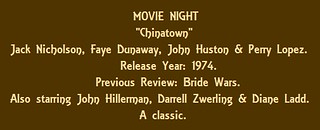
Movie Night: Chinatown.


Review #631: Chinatown.

Cast
Jack Nicholson (J.J. "Jake" Gittes), Faye Dunaway (Evelyn Cross Mulwray), John Huston (Noah Cross), Perry Lopez (Lieutenant Lou Escobar), John Hillerman (Russ Yelburton), Darrell Zwerling (Hollis I. Mulwray), Diane Ladd (Ida Sessions), and Roy Jenson (Claude Mulvihill) Directed by Roman Polanski.

Review
Chinatown is a movie that basks in the past with much originality, with a high crafted story by Robert Towne. Nicholson is fun to watch here, he makes for a interesting character that is fun to watch in any scene. Dunaway seems like she's playing a femme fatale, but in reality she plays anything but that, and her emotions are very expressive, you get to feel for this character, and in a way also pity her as well. It's amazing how John Huston (a director who I've covered a few times before) can be so effective as a villain when you realize his soft demeanor hides his dark side, which is evident in the end scene. Speaking of which, the end scene is probably the most memorable aspect of this movie (that, and Nicholson's bandaged face), Towne originally had written a happier ending, but it was changed by the director to make for a more cynical, but still a better ending. It's a perfectly sad ending, a way to make the movie more than just a detective story, and more importantly, a classic story. The movie has its thrills and most importantly its chills, which make for a very well-rounded movie that's heartbreaking, but also very entertaining. Take the ending for what it's worth, or don't, whatever you want.

Overall, I give it 10 out of 10 stars.

December 1, 2013

Movie Night: The Witches of Eastwick.


Review #493: The Witches of Eastwick.

Cast
Jack Nicholson (Daryl Van Horne), Cher (Alexandra Medford), Susan Sarandon (Jane Spofford), Michelle Pfeiffer (Sukie Ridgemont), Veronica Cartwright (Felicia Alden), and Richard Jenkins (Clyde Alden) Directed by George Miller (#380 - Mad Max and #392 - Happy Feet)

Review
I woke up in the morning, realizing it was my birthday today, and in light of that, I decided to not only begin the new month with watching a movie, but a movie I've wanted to watch for a long while, and since I had time on my hands and couldn't think of a movie that actually dealt with birthdays, I watched this. The film itself is mostly enjoyable, and Jack Nicholson (as usual) steals the show. He seems to be born to play this role, he has a good deal of manic energy and scenes to use them in. Cher does an good job, pairing well with Nicholson. Sarandon and Pfeiffer are good, the trio seem to mesh well together. The rest of the cast are alright, and the story is balanced. The climax of the film has been criticized for being overdone or ridiculous in the past, but I don't really hate the climax that much, maybe it's because it just feels right, and I wouldn't know how the climax could be improved on anyway. The film has its ups and downs of lunacy, but it is enjoyable nonetheless. Happy birthday to me. Countdown to 500 Reviews: 10, 9, 8, 7...

Overall, I give it 8 out of 10 stars.

April 22, 2013

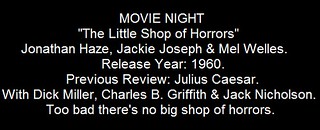
Movie Night: The Little Shop of Horrors.


Review #368: The Little Shop of Horrors.

Cast
Jonathan Haze (Seymour Krelboyne), Jackie Joseph (Audrey Fulquard), Mel Welles (Gravis Mushnick), Dick Miller (Burson Fouch), Myrtle Vail (Winifred Krelboyne), Karyn Kupcinet (Shirley), Leola Wendorff (Siddie Shiva), Lynn Storey (Hortense Fishtwanger), Wally Campo (Joe Fink/Narrator), John Shaner (Dr. Phoebus Farb), Jack Nicholson (Wilbur Force), and Charles B. Griffith (Audrey Junior) Directed by Roger Corman.

Review
Not only is today Jack Nicholson's birthday, it is also the first review of a film directed by Roger Corman, who reportedly has directed over 50 films and produced 300...one of them being Sharktopus. But nevertheless, this is an early 60's film made in two days from sets used in another Roger Corman production that has inspired a musical and a remake. And...the film is good. Despite the title, it actually has a good amount of laughs, which make the horror scenes more contrasting, creating a good balance. And of course, Audrey Junior makes me giggle, and that may sound strange, given the amount of reviews here. Nicholson may have a small part, but it certainly is memorable. The acting is fine, and it has its good moments all throughout. The effects work well and the film flows well given the small, but fine length. Happy 76th birthday, Jack. Great way to celebrate Earth Day, huh?

Overall, I give it 9 out of 10 stars.

August 17, 2011

Movie Night: The Shining.

Review #065: The Shining.

Cast
Jack Nicholson (Jack Torrance), Shelley Duvall (Wendy Torrance), Danny Lloyd (Danny Torrance), Scatman Crothers (Richard Hallorann), Barry Nelson (Stuart Ullman), and Phillip Stone (Delbert Grady) Directed by Stanley Kubrick (#044 - Full Metal Jacket and #093 - 2001: A Space Odyssey)

Review
Let me just say this right off the bat, I have not read the book. For the Review's sake, I will not compare the book to the film, as it would be unfair. This film is...psychologically thrilling. The film actually does scare you at times (Although I find the transitions completely more laughable then scary) Nicholson delivers a creepy performance that scares you (I think he used that skill or the Joker, 4 years later). I think this Redrum thing to be annoying. Why? If you know what it means immediately and it is repeated, it gets on your nerves quickly (not really scaring you). I find the film to be a maze-like entry. It gives you confusion from the start, and it gives you a confusing end that makes you ask questions days or even weeks later, especially the ending, which is one of the most confusing ones in movie history. It's one of those films you'll love for it's confusion or hate for it's oddness.

Overall, I give it 8 out of 10 stars.