Showing posts with label Mykelti Williamson. Show all posts

December 27, 2025

Heat (1995).

Review #2491: Heat.

Cast: 
Al Pacino (LAPD Robbery Homicide Lieutenant Vincent Hanna), Robert De Niro (Neil McCauley), Val Kilmer (Chris Shiherlis), Jon Voight (Nate), Tom Sizemore (Michael Cheritto), Diane Venora (Justine Hanna), Amy Brenneman (Eady), Ashley Judd (Charlene Shiherlis), Mykelti Williamson (Sergeant Bobby Drucker), Wes Studi (Detective Sammy Casals), Ted Levine (Detective Mike Bosko), Dennis Haysbert (Don Breedan), William Fichtner (Roger Van Zant), Natalie Portman (Lauren Gustafson), Tom Noonan (Kelso), Niki Haris (Marcia Drucker), Kevin Gage (Waingro), Hank Azaria (Alan Marciano), Danny Trejo (Gilbert Trejo), Susan Traylor (Elaine Cheritto), Kim Staunton (Lillian), Henry Rollins (Hugh Benny), and Jerry Trimble (Detective Danny Schwartz) 

Written and Directed by Michael Mann (#1531 - Ali, #1631 - The Last of the Mohicans, #1713 - Manhunter, #2091 - Miami Vice, #2325 - Collateral)

Review: 
"I charted the film out like a 2 hr 45 min piece of music, so I'd know where to be smooth, where not to be smooth, where to be staccato, where to use a pulse like a heartbeat."

It helps to know the story a bit, admittedly. Once upon a time, a Chicago detective named Chuck Adamson kept tabs on the crew of one Neil McCauley, an ex-inmate of Alcatraz that one time saw the two end up meeting for a cup of coffee. Adamson later became a producer and screenwriter himself (where he co-created Crime Story, a show Mann was the executive producer on from 1986-1988). What interested him was the professionalism that Adamson respected in McCauley even with the recognized fact that one of them probably would kill the other. Mann had first written a draft in 1978 but he trimmed it down when NBC approached him to do a TV show. The result (filmed in less than a month) was L.A. Takedown (starring Scott Plank), a TV film that aired in 1989 that the network rejected because they didn't like the lead actor. But a few years later, with a few more moves under his belt, Mann set out to do the movie he wanted to do at last, complete with having Al Pacino and Robert De Niro being in the same movie (a relatively big deal for the time for a film that, well, has them meet twice) and one that was shot in Los Angeles that used nearly a hundred locations around the city for 100+ days of filming. Released on December 15, 1995, the film was a relative success with audiences (particularly abroad). Apparently, actual robbers took inspiration from the movie in later years to go along with video games such as Grand Theft Auto and directors such as Christopher Nolan.* In 2022, Heat 2, a novel written by Mann and Meg Gardiner was released that was both a prequel and sequel to the movie. A feature film adaptation is currently under development that may start filming in 2026.

What we have here is a movie full of intensity in the great game of choices, personal codes and the consequences that can have an effect on a wide range of people. It's a wonderful epic in the sprawling confines of a frontier that is intimidating as it is lonely. It's as much a neo-noir as it arguably is also a Western in its own respect, one that looks upon the nature of obsession and the sacrifices one makes to burnish that fire and live on the edge. A good chunk of the characters that we see throughout the near-three hour run time all have illusions about who they are vs. what really lies beneath the surface of their work, one in which it isn't so easy to just turn it off just because it's time to go home now, whether that involves cops that can't exactly tell their spouses about recently murdered people or men who believe themselves to be alone in their process or even those trying to dig their way out besides being an "ex-con". Simply put, the juice comes and goes but the work will be playing everywhere until the Earth is nothing but dust. Apparently, there was a scene that showed Pacino's character chip a bit of cocaine before it was cut out of the film. At any rate, high-strung user or not, I don't see anything wrong with where Pacino is going with such a fascinating role because, well, volatile is volatile (besides, "overacting" is only a bad thing when one wants to pick at things - the scene interrogating Azaria is delightful more than just "ham"). He handles it with such gusto that you understand pretty quickly how one can hate the sight of a horrible crime (dead hookers, robberies, you get it) and yet have the juice to want to crack it. Regardless of if one had a person like Venora or Portman in their orbit, there are just some people that need the chase because the pursuit of justice is just as addicting as the pursuit of a good score. De Niro matches that with his own type of worthwhile energy, a brooding man who values success at his craft because there is nothing better in his worldview even if he is confined by a code that might as well be a prison (such as how he lives or the ever-changing cars). One can only try to fool themselves with thoughts of being with Brenneman but really what matters to him is fulfilling his obligation to this mythic code of no excuses (and no second chances for violators) and trust for certain folks only. Pacino and De Niro basically are yin and yang in the knowing sense of "whatever it takes". It is just as well to see Kilmer and others fill the tapestry of obsession that wants to believe they are in control of their own lives in responsibility, whether that involves the disciplined (and still fallible as a character) Kilmer or the cut-rate Sizemore or even tragic side figures such as Haysbert that remind you that nothing is easy to escape. The robbery sequence obviously is the highlight of the film in its slam-bang execution of loud devastation that works to clockwork in seeing where one will go in realizing the full process of the job, right down to the eventual climax in wordless (but impactful for what is seen) resolution*. As a whole, Heat is a long burn not so much about a heist but about the people that toil in the work of people at a variety of angles that crisscross with each other in sacrifice and foibles to worthwhile staccato execution. It's a hell of a movie to see turn 30 years old.

Overall, I give it 9 out of 10 stars.

*Apparently, the way that Kilmer reloads his weapon during the famous shootout scene is apparently a thing that professionals tell others to aspire to do in real life.

*Honestly, it is a bit weird but not a dealbreaker at what happens to (the Kilmer character in how he just...escapes). 

February 28, 2021

Fences.

Review #1647: Fences.

Cast: 
Denzel Washington (Troy Maxson), Viola Davis (Rose Lee Maxson), Stephen McKinley Henderson (Jim Bono), Jovan Adepo (Cory Maxson), Russell Hornsby (Lyons Maxson), Mykelti Williamson (Gabriel Maxson), and Saniyya Sidney (Raynell Maxson) Directed by Denzel Washington.

Review: 
"The star of the movie is the screenplay and August Wilson's words. What Denzel said to me, to Scott, to all the actors, the cinematographer, and the production designer was, 'Don't make any decision without August Wilson's words leading you to make that decision.' Whatever you do, let the words inform your decision first. That's what we all had to abide by."

If the right person is found, the right result will be found for the material to show to the screen. The source material for the film was the play of the same name, which was first developed on the stage in 1983. Written by playwright August Wilson, it was the sixth play done by him in what is now considered part of the "Pittsburgh Cycle", with each play taking place in a different decade of the 20th century. The city native wrote ten plays that all dealt with the African American experience within his city (although one was actually set in Chicago); this and Ma Rainey's Black Bottom (1985) were his first triumphs with audiences, and Wilson would win a Pulitzer Prize for Drama and a Tony Award for Best Play upon Fences' premiere on Broadway in 1987. When asked about the idea of turning Fences into a film, he wanted an African American director, or more specifically, one who would in his eyes be a director that "shares the specifics of the culture of black Americans." Despite Paramount Pictures buying the rights to make a film in 1987, the idea stalled for years, despite Wilson having wrote a screenplay for it before his death in 2005. When there was time at last do make a film, the script was generally kept intact, although there were a few uncredited rewrites done by Washington, Tony Kushner, and Spike Lee in pre-production. In the director's chair was actor/director Washington, who had added directing into his repertoire with Antwone Fisher (2002) and The Great Debaters (2007), and he also served as a co-producer on this feature. The film retains the main duo from the 2010 revival on Broadway with Washington and Davis, who toured for a limited run of 13 weeks and each had been awarded Tony Awards for their performances; Henderson, Hornsby, and Williamson also reprised their roles from the 2010 stage show.

What we have here is a film ripe for great actors to pair with each other that could prove mesmerizing and poetic in the right hands. I'm sure Wilson would have been quite proud of the result in turning his play into a film, as it manages to be quite an entertaining time, one shot right in the setting of the Hill District in Pittsburgh. The film moves with timing of a poet that manages to seem right at home within a film that drives its strength from two actors in their prime that makes one almost seem right there at a distance to hear their cadence come out with clarity in a family drama that generally hits the mark for what it wants to say regarding its time and place (in this case, the 1950s). No matter how much one tries or doesn't try, the folks that raise us a child are always going to be a part of us, flaws or not, where duty matters more so than just having someone liking you for the sake of it. Of course there is also the idea of what a fence means, both literally and in metaphor. In an era of films that seem to bill themselves on trying to out explode the other or try to hit marks on quieter stream services, it is nice to have a film that wants to reach its own depth of interest in terms of meaningful drama that does not come off as too fenced off for interest. Washington and Davis are our main focus, and while each received buzz for their performances, the latter was generally felt to be a supporting presence. To level it as tha is to forget the fact that each compliment the other in their own ways, where one doesn't seem to be lacking the other or feel that they are watching a director-actor's show. Washington does quite well with such an imposing role, one wrapped with plenty of the human element of what makes a father from Wilson's perspective with reasoned edge and tough interest. He makes his dealings with no overblown moments of playing to the rafters that obviously excelled from the performances done in the theater. In that mindset, Davis (who had starred in Washington's first directorial effort but best known for her star role on How to Get Away with Murder) follows with a resourceful touch, one that stands with Washington and brings everyone together with grace and stature to drive the drama just as well as Washington. Each have their moments when paired with Adepo in regards to the nature of parental influence, whether that means devotion or something else, and that is made pretty clear with Davis' scene near the end when talking about what one person meant to her and her son in terms of legacy (the scene Davis and Washington share in a pivotal moment about secrets is a close second). Adepo manages to do his best when faced with acting with either of them with reasoned care. Henderson accompanies the proceedings at times with a bit of charm and advice that goes along fairly well. Hornsby and Williamson close out as the primary support with well-done touch (mostly for the latter). All in all, what we have is a captivating family drama that captures the essence of a time, place, and upbringing that resonates with the viewer through its main two performances with flourish that hits most of its marks for 139 minutes for a solid accomplishment of turning a stage classic into a film.

Overall, I give it 9 out of 10 stars.
Well, I hope you folks enjoyed this month and what it tried to cover with Black History Month. Perhaps it will be done again next year, but I assure you that there will be some surprises ahead in 2021 for Movie Night that I hope you enjoy. Any suggestions you have are always appreciated; thank you and have a good night...

September 9, 2020

Ali.


Review #1531: Ali.

Cast: 
Will Smith (Cassius Clay Jr / Muhammad Ali), Jamie Foxx (Drew Bundini Brown), Jon Voight (Howard Cosell), Mario Van Peebles (Malcolm X), Ron Silver (Angelo Dundee), Jeffrey Wright (Howard Bingham), Mykelti Williamson (Don King), James Toney (Joe Frazier), Jada Pinkett Smith (Sonji Roi), Nona Gaye (Belinda Boyd / Khalilah Ali), Michael Michele (Veronica Porché), Joe Morton (Chauncey Eskridge), Paul Rodriguez (Dr. Ferdie Pacheco), and Bruce McGill (Bradley) Directed by Michael Mann.

Review: 
"The accomplishment of Will Smith in that movie is extraordinary: It’s not just the movement and the boxing — that’s difficult enough; it’s having your head in 1964, which came from sitting where you’re sitting and talking to Geronimo Pratt. That’s the challenge, because that’s what’s really, sincerely exciting — to get things to the point where they become emotionalized and real, so hopefully they have an impact upon audiences.”

It takes a life as big as Muhammad Ali to have two big names behind a biopic about his crucial years, which is why Michael Mann and Will Smith seemed destined to make this film together. The Chicago-born Mann studied English at the University of Wisconsin-Madison, but it was the viewing of films by F. W. Murnau and G. W. Pabst along with the release of Dr. Strangelove (1963) that influenced him about becoming a director and making a film with an individual statement with successful appeal for serious cinema without needing to be niche. He attended London Film School and subsequently made commercials and shorts before eventually moving back to the United States to do television, which led to his TV breakthrough with The Jericho Mile (1979) before a feature film breakthrough with Thief (1981). Known for his focus on his work with detail and style, this is the seventh of his eleven directorial efforts, and he would also serve as a co-producer and co-writer on the screenplay (with Eric Roth, Stephen J. Rivele, and Christopher Wilkinson, while Gregory Allen Howard got credit for the story). As for Smith, he had risen to fame through various media, which included hip hop in the late 1980s and television with The Fresh Prince of Bel-Air (1990-96) before carving a breakthrough in film with Six Degrees of Separation (1993). Smith had his hesitations of taking on Ali in part because of uncertainty about the script but also in if he was ready to be involved in the feature. He went through months of training in learning about boxing and Islamic studies while gaining weight for the role for a project that ultimately ballooned to over $100 million in budget.

Ali had been prominent on and off the ring, with his pursuits involving writing, music, and acting, which included features such as a.k.a. Cassius Clay (1970, documentary), which had archival footage and interviews with Ali about his exile from the ring, The Greatest (1977), in which Ali starred as himself detailing his life from 1960-1974, and When We Were Kings (1996, documentary), which detailed the "Rumble In The Jungle" fight with archival footage. One could likely do multiple projects on the life of Ali or study him and his prominent life through simply seeing him near a boxing ring. However, this is a film that details the most important years of his life that go from 1964 to 1974, detailing his holding to his principles through a rise, fall, and rise again to the ring and what matters to him most when it comes to holding his principles in religion and against war. In this sense, Ali is a decent film, packed to the prim with observation and some of the confidence and curiosity that made Ali such an icon while perhaps dragging its feet in covering all the fine points of what it wants to show in its vision, a man filled with idiosyncrasies that made him a courageous rebel with struggles and human flaws. In this sense, Smith pulls off a wonderful performance, wrapped in confidence that does well in bravado and stature that works as a tribute to the man portrayed without seeping into hagiographic worship, elevating the material beyond putty if in lesser hands. Foxx proves just as well in delivering someone wrapped in hype and mystery with the right kind of conviction and timing when he is needed for the experience. Voight, wrapped in makeup, pulls off a pretty convincing performance, one with enterprising presence that likely captures the blustery confidence of the real Cosell (in my vague awareness of him the film did actually teach me something I didn't know, namely that he studied law before broadcasting) without just seeming like a pale imitation. Others do fine, but they generally seep in and out of the film as time goes on that make it a bit difficult to really grab a hold on (aside from one might know about them, as is the case with figures played by Van Peebles and Williamson), although at least the film never detracts from its time period with something distracting. The boxing sequences are generally well done, handling the plight of what it means to get beaten pound-for-pound with flourish and careful cutting. Even though the film was not a success with audiences at the time, it shouldn't erase what turns out to be a useful experience to see on screen. One's enjoyment of the film comes from how much of the material will resonate with a viewer when it comes to being a celebration of Ali and what he went through in a decade of fighting others from the ring onto the system that go from place to place with a fair bit of impact for its surroundings that make a decent achievement for both Mann and Smith to be proud of.

Overall, I give it 7 out of 10 stars.

August 30, 2020

Three Kings.


Review #1521: Three Kings.

Cast: 
George Clooney (Major Archie Gates), Mark Wahlberg (Sergeant First Class Troy Barlow), Ice Cube (Staff Sergeant Chief Elgin), Spike Jonze (Private First Class Conrad Vig), Cliff Curtis (Amir Abdullah), Nora Dunn (Adriana Cruz), Jamie Kennedy (Specialist Walter Wogeman), Saïd Taghmaoui (Saïd), Mykelti Williamson (Colonel Ron Horn), Holt McCallany (Captain Doug Van Meter), and Judy Greer (Cathy Daitch) Directed by David O. Russell.

Review: 
"I just love real characters; they're not pretentious, and every emotion is on the surface, they're regular working people. Their likes, their dislikes, their loves, their hates, their passions; they're all right there on the surface."

Some people are cut out for writing and others are cut out for directing. David O. Russell found his way into both through filmmaking that elevated him to rising star in the 1990s. A graduate of English and political science from Amherst College, he had worked a variety of odd jobs after graduation that ranged from community work to teaching. He did some work with documentaries and shorts (having found inspiration from classics watched such as Chinatown), such as with Bingo Inferno: A Parody on American Obsessions (1987). He was given grants to do a feature involving fortune cookies and microphones in a Chinese restaurant that he would instead use to do Spanking The Monkey (1994), debuting in feature films at the age of 36. The film was originally written by John Ridley (a standup comedian who later turned to writing for television along with novels), who wanted to experiment in making and selling a script in very little time; the script was done in a week and it was bought eighteen days later. However, Russell (brought in for his first major studio film) would do his own writing changes to the draft, and Ridley had to go through arbitration to get a story credit.

There had been quite a share of war films over the 1990s, but this sticks out as one involving the Persian Gulf War (1990-91); a war film involving a heist has been done before with films such as Kelly's Heroes (1970, which involved AWOL soldiers getting gold bars out of a bank vault). Russell accomplishes a distinct war film with its look, involving vibrant color though Ektachrome transparency stock (noted for its distinct look used for photographers like National Geographic) and one-shot explosions that was shot in the desert of several states such as Arizona that featured Iraqi refugees as advisors and extras. It is a reckless film that makes the best out of touching upon the consequences and spoils of war with a balance of humor and humanity that makes for a fairly clever movie that benefits from a formidable main quartet that shows its disconnect between war and the reality that comes from its perceived end without becoming absorbed in cliché or lingering on the soapbox too long. Clooney got the part after actors of various age targets were thought of/approached (such as Clint Eastwood and Nicolas Cage). He does a commendable job here, curious in a burnt-out stage of cynicism and lost values that we gravitate to with smoothness in a journey that means most to filling in the layers the film seeks to show through heist and war. Wahlberg does fine with being the middle man, an observer of being done from war on both ends with a careful brow. Rapper-turned-film star Cube makes the most of his time in conviction in handling the tension presented in faith handily. In the same year that Jonze debuted as a feature film director with Being John Malkovich, this was his first (and so far only) prominent role as an actor, doing so in a part that was written for him as a way to shake things up from the established actors, which he does in adequate comic relief. Curtis does well with providing perspective for what we know (or think we know) about the people around a simple trek for gold, which applies just as well for Taghmaoui in his scenes against Wahlberg. Dunn provides hard-edged zeal as the eyes of a fleeting moment, while the others in the cast do fine when needed.

On the whole, the film pulls itself off well within 114 minutes in delivering a clever film on the other sides of war beyond just the battlefield through a game cast and well-timed movement in pace and timing that make it as bitingly endurable as fellow war film M*A*S*H (1970) with its own style and presence worthy for its time of 1999 that still sticks a punch now.

Overall, I give it 8 out of 10 stars.

May 17, 2014

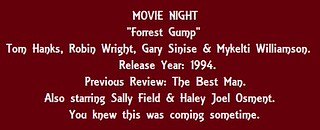
Movie Night: Forrest Gump.


Review #581: Forrest Gump.

Cast
Tom Hanks (Forrest Gump), Robin Wright (Jenny Curran), Gary Sinise (Lt. Dan Taylor), Mykelti Williamson (Bubba Blue), Sally Field (Mrs. Gump), and Haley Joel Osment (Forrest Gump, Jr) Directed by Robert Zemeckis (#317 - The Polar Express and #352 - Who Framed Roger Rabbit)

Review
Forrest Gump is a movie that could be loved for its cheerfulness and epic way of storytelling or easily to deride for its over sentimental nature that make for an overrated movie (It could be argued by many that Pulp Fiction deserved the Best Picture Oscar more then this film, but that's neither here or there), but it is like a box of chocolates, you never know what you're going to get. For me this is an alright movie, a movie that is certainly interesting and certainly endearing, especially with its performances. But he best performance for me isn't by Hanks, it's by Gary Sinise. Why? Because Sinise's character development from a character with a so called pre-determined destiny to a bitter vet who still manages to encounter Forrest is interesting to watch and his speech about how Gump cheated him out of his destiny is very dark but perfect for Sinise. It's not that I don't like Hanks as Gump, but after a while it doesn't hurt to admit that Sinise brings a layer of needed darkness to the movie and that his character is certainly welcomed in a film such as this. The rest of the cast is fine and quirky, the characters are about as whimsical as you expect (Save for Wright and Sinise, which is a good thing because too much whimsical would probably kill the movie), but oh well. The movie is certainly appealing, and I recommend at least one viewing to see what all the fuss about. Or (again) to see who deserved the Best Picture award more, but at least watch the movie.

Overall, I give it 8 out of 10 stars.