Cast:
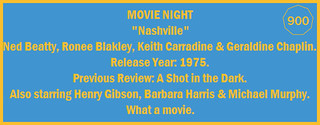
Carol Burnett (Gloria Burbank), Glenda Jackson (Isabella Garnell), James Garner (Harry Wolff), Lauren Bacall (Esther Brill), Paul Dooley (Dr. Gil Gainey), Donald Moffat (Colonel Cody), Henry Gibson Bobby Hammer), Diane Stilwell (Willow Wertz), MacIntyre Dixon (Fred Munson), Alfre Woodard (Sally Benbow), and Dick Cavett (Himself) Directed by Robert Altman (#900 - Nashville, #1433 - M*A*S*H, and #1890 - The Delinquents)
Review:
"HealtH could have only been made when it was made, and that was the end of the Carter era."
Somehow, at the end of this little blurb about talking about a film that did not get a proper release is a joke. But I'm sure you already came into that with a film made by a director as noted as Robert Altman that has the dubious achievement of having never received a proper home video release. You may or may not already know that Altman was an interesting presence amongst filmmakers you could say have their own style of filming. He may not have had the best of times with his initial feature efforts such as The Delinquents (1957), but his lengthy time spent in television work would shine well when he got to do regular film work after the massive hit of M*A*S*H (1970). Over the next ten years he would direct in a variety of genres that went from the Western (McCabe & Mrs. Miller) to horror (Images) to psychological drama (3 Women). Some films ended up better than others, as evidenced by Quintet (1979). Altman had at least one film released from the year of 1969 to 1980 that went from That Cold Day in the Park (1969) to Popeye. Now back to this film (sometimes referred to as HealtH or H.E.A.L.T.H.): it was shot in the Don CeSar Beach hotel in St Petersburg Beach, Florida for a number of months in 1979. He rushed the film to production just to make sure that it could be done for 20th Century Fox while Alan Ladd Jr was still around. He wrote the script in collaboration with Frank Barhydt and Paul Dooley. It was planned for a released in the winter of 1979, but changeover at the studio led to shuffling for test previews in the spring of 1980 with ideas of getting it seen in full by the summer (the aforementioned Popeye film somehow went better despite being filmed in 1980 for release in the winter, incidentally). It did not end well, and Altman had a falling out with personnel, particularly with one that didn't return his calls for weeks on end that led to being labeled as "scum" by the director. Long story short, there was no public release of the film until New York’s Film Forum showed in 1982, but there were enough film festival showings to account for a knowing of it. It certainly did not come from 20th Century Fox, who had decided the film was not commercially viable enough for release in 1980. So, what did they decide was a better candidate for release than an Altman film? Oh! Heavenly Dog.
I can't promise you a good punchline for the end of this review, but I thought it tickled me. There are two sides that can come with talking about a film not appreciated in its time: the part where you call it a hidden gem that deserves your attention or one that you believe was best left to rest in the dustbin. This is a film that at least one person liked watching on the Fox Movie Channel enough to record it and try to put it online. As for me, I enjoyed it about as much as I thought would happen for an attempt at a satire of politics of the time that is a frenzied hodgepodge of observations that come from looking at a health food convention that really is looking at the conventions that come with America. In other words: showmanship has run amok, and one can still see the carnival atmosphere that we call politics now more than ever. Granted, it isn't exactly packed with a developed story, and it definitely isn't on the same level as, say, Nashville (1975), but it really did deserve an audience to judge it for themselves rather than letting it being thrust into the shadows (for the decade of the 1980s, Altman was left with making films on small-scale budgets, with varying respect). To me, the movie stumbles around two timelines to make light of: the end of the Jimmy Carter era (beaten in a landslide by Reagan in the fall of 1980) and the Dwight Eisenhower-Adlai Stevenson elections of the 1950s that incidentally saw the candidate with vast media drawing Powe win each time. Life is messy, and Altman made a whole movie about the odd carnival of hucksters in health and beyond. The film isn't really wrapped in an involving plot of note, so it really does verge its entertainment on just how much you like the people involved in said film. This namely involves folks who can be pegged to sentence-descriptions such as Garner and his general huckster observer persona or Jackson in a spry and uptight impersonation of Stevenson right down to the speeches. Of course, those 50s elections didn't have a third-party worth mentioning, so Dooley is more just there as the ignored option, but I like Dooley and his huckster self that seems too much for these fellow hucksters, so it shouldn't surprise me that he had a hand in writing this. Woodard is probably the only sane observer of said proceedings, which includes a man of great bluster in Moffat or the always enduring presence of Gibson. Burnett is basically there as the wishy-washy presence that is mildly funny in tension, but one wonders if there was more one could do with this role (this reflects perhaps most on Cavett, who might as well be trying out a mild sedative). At least Bacall and her slogan-happy presence of feeling oneself is amusing in just how much of a puppet one can be with slogans (in being used and using others). It is interesting to make a film about two women running for president and have one of them go on to win to form a new leadership of sexless strength. As a whole, the movie is merely fine, but 20th Century Fox should have known better than to think that it was going to work out nicely to skip over releasing this film (one that cost $6 million!). It isn't a great sort of missing gem or far from easy to ignore, instead falling along the middle with a few amusing moments that with a proper release would've nurtured a possible cult favorite. As it stands now, the only way to enjoy it is for those who enjoy digging further into Altman films or for those who like to watch bootlegs. But hey, don't take my word for how the film worked when it came to satire and its targets, take it from Ronald Reagan, who was reported to have seen the film in 1982 and called it "the world's worst movie". That I think tells you all you need to know about Health.
Overall, I give it 7 out of 10 stars.