Showing posts with label Robert Shaw. Show all posts

July 4, 2025

Redux: Jaws.

Redux #480: Jaws.

Cast: 
Roy Scheider (Chief Martin Brody), Robert Shaw (Quint), Richard Dreyfuss (Matt Hooper), Lorraine Gary (Ellen Brody), Murray Hamilton (Mayor Larry Vaughn), Carl Gottlieb (Meadows), Jeffrey Kramer (Deputy Leonard Hendricks), Susan Backlinie (Chrissie Watkins), Lee Fierro (Mrs. Kintner), and Peter Benchley (Interviewer) Directed by Steven Spielberg (#126 - Close Encounters of the Third Kind, #168 - Raiders of the Lost Ark, #169 - Indiana Jones and the Temple of Doom, #170 - Indiana Jones and the Last Crusade, #302 - Indiana Jones and the Kingdom of the Crystal Skull, #351 - Schindler's List)

Review: 
You might wonder why I'm giving a revised review of a movie I covered before. Well, that review was nearly 12 years ago on November 11, 2013. Enjoy.

Like most great movies, it all started with taking a novel into one's hands. In early 1974, Peter Benchley's debut novel Jaws was published, which had seen him take inspiration from shark attacks and the exploits of Frank Mundus, a fisherman that once caught a shark weighing over 4,000 pounds off the New York shores. Benchley thought the book wasn't going to be a hit, mainly because it was a first novel and that it was "about a fish". The result was a novel that sold over five million copies in its first 18 months. Ironically, both Benchley and Mundus became conservationists in later years, with the former telling people that he could not write the book as it was in good conscience (for Mundus, he later called the movie "the funniest and the stupidest movie I've ever seen because too many stupid things happened in it.").  Benchley was tasked to write the first draft of the screenplay, and it was he would basically do the "mechanics" of the script more so than characterization, which most notably saw him excise the affair between Brody and Hooper (upon suggestion). Others delivered uncredited work such as Howard Sackler, John Milius, Matthew Robbins, and Hal Barwood; Carl Gottlieb, who was tasked to bring in "some levity", was given co-credit with Benchley on the screenplay. The director would be Steven Spielberg, who had two features to his credit at the time with the TV-film-turned movie Duel (1971) and The Sugarland Express (1974). 159 days of production were spent around Massachusetts and the Atlantic Ocean due to overruns that saw script refinement and a bit of cast strife. You probably already know Jaws was a phenomenon, but it still sounds fun to say it: Universal spent a good deal of money marketing the movie in a media blitz and a strategy that was still not as widely used now: releasing the movie on hundreds of theaters at once for opening week, with over 400 theaters seeing the movie on June 20. For two years, Jaws was the highest-grossing movie of all time and the TV premiere of the movie in 1979 saw over half of the total US audience watch it. Years later, Benchley was asked about a deal involving sequels to Jaws, with him stating, "I don't care about sequels; who'll ever want to make a sequel to a movie about a fish?" Jaws 2, with no Spielberg or Dreyfuss, came out in 1978 as directed by Jeannot Szwarc to mixed reviews. Jaws 3-D (1983) and Jaws: The Revenge (1987, with Gary returning because...) came out later to diminishing box office returns and little-to-no creativity. Benchley went on to write seven more novels, with a handful being adapted into films such as The Deep (1977) and The Island (1980); he died in 2006 at the age of 65.

I admit that I've seen Jaws roughly three times: once in 2013, another a few years later, and lastly just a few days ago with my mom. I wanted to re-live the experience of wondering what was so great about a movie like this, and what better time than in the summer and in July? Steven Spielberg is probably the seminal entertainer for direction in the past fifty years, but I really did want to figure out (at least, again) just how he did it. Whether thought of as an action thriller or as a horror movie (let's be honest, there are people who willingly choose to ignore the latter genre because of bias), there is just something so thrilling about how this movie pushes one's buttons so effectively in great adventure. Filmmakers could only dream to make a movie run as well as one can for two hours that has no bloat or demand for more that come across here, and this is for a film that wisely spaces out its tension until it absolutely becomes important to do what it has to do. To borrow from old me, there were plenty of "animals gone bad" movies before and after this movie such as say, Grizzly (1976), Piranha (1978; widely considered among the best of the Jaws ripoffs), Alligator (1980), and so on, but Jaws just has that enthusiasm and commitment to its tension. You have to remember that the movie characters are meant to be more likable than the book characters, which dealt with a subplot involving the Mayor being tied to the Mafia and the aforementioned affair between two characters. The funny thing is that it was easier to cast Brody with a perceived "tough guy" in Scheider than the other two key roles, which apparently were not cast until the last few days of pre-production that resulted in two people being cast with how good they were in other people's movies at the time: actor/writer Robert Shaw, who had worked on the recent Universal Pictures hit in The Sting (1973) for Quint and American Graffiti (1973) star Richard Dreyfuss for Hooper. They all are essentially perfect for what needs to happen for the film. Scheider in particular shines because he fits the everyman type like a glove, one with real worries and quibbles that sells for all who know the plight of being, well, a fish out of water.

Shaw was a man of the stage who happened to write on the side, so of course he can play the ultimate rugged captain (he was a Bond adversary, for heaven's sake, he could do anything). Every line of his has a certain type of timing and cadence that we find listening to intently that is rewarded with that one particular sequence in the "U.S.S. Indianapolis monologue" that he sells in such a soulful way that it almost doesn't matter just who (Shaw, Milius, Sackler, what have you) came up with what in writing it. Apparently, Dreyfuss thought that the movie was going to be a "disaster" because of the general boredom that came in waiting to film. There's the veneer of charm within a part that apparently was molded to be Spielberg's "alter ego" (debate on that), and Dreyfuss draws a few light chuckles even in the great admirer of, well, the routines in science. Bottom line: you care about these folks. It may interest you to know that this was the debut theatrical performance of Gary, who had done a handful of television performances. But it is Hamilton and his steely smarm in the art of evasiveness that probably sticks out the most now more than ever: a person in a position of power that hears of certain facts and doggedly moves forward with his own self-serving needs anyway. Evidently, there is actual footage of real sharks in the film, as Ron and Valerie Taylor shot footage in the waters of South Australia that had an actor in a mini shark cage. The look of the shark isn't what matters in the end, what matters is the fact that it could come when it comes to suspense that came from someone who honed their craft in suspense with Duel (1971) and plays with the audience just enough to where the climax will splatter in harrowing excellence. As a whole, Jaws is the phenomenon for monster movies one would hope to aspire to do. I'm not really sure exactly where it rests on the pantheon of entertaining Spielberg movies when considering his earlier work (and what's to come), but it sure has a hell of an argument for making a good time.

Overall, I give it 10 out of 10 stars.

June 16, 2020

The Sting.


Review #1445: The Sting.

Cast: 
Paul Newman (Henry "Shaw" Gondorff), Robert Redford (Johnny "Kelly" Hooker), Robert Shaw (Doyle Lonnegan), Charles Durning (Lt. William Snyder, Joliet P.D.), Ray Walston (J.J. Singleton), Eileen Brennan (Billie), Harold Gould (Kid Twist), John Heffernan (Eddie Niles), Dana Elcar (FBI Agent Polk), Dimitra Arliss (Loretta), Robert Earl Jones (Luther Coleman), and Jack Kehoe (Erie Kid) Directed by George Roy Hill (#962 - A Little Romance, #1178 - Slap Shot, and #1289 - Butch Cassidy and the Sundance Kid)

Review: 
"I find publicity is distasteful and I don't think it does the picture any good to focus on the director. I think it's only a very small group of the public that really pays attention to the director. Lately it's come around to that the director is more of a star than he was, but I've never wanted that."

There are just some movies that are destined to become great works to endure, whether for their style, or for their execution in writing, directing, or the actors. This is a film that has all of those attributes to make for one of the most well-crafted experiences for the 1970s. It should only figure that a well-crafted film would come from a craftsman like George Roy Hill. He had served as a pilot in both World War II and the Korean War as a Marine while having studied at Yale and Trinity College (studying music and literature, respectively). He made his debut in the stage of Ireland before moving to Broadway, where he would later shift his attention to directing. After nearly a decade of writing/directing for anthology television and Broadway (on and off), he made his debut in motion pictures with Period of Adjustment (1962, an adaptation of the Tennessee Williams play that Hill directed). Although Hill did not garner as much respect as other directors of his time (perhaps in part because of his reluctance for self-promotion), he would direct fourteen films in 26 years (retiring to teach at Yale) through his firm style of directing that made him a favorite for actors in films with varying success such as Thoroughly Modern Millie (1967), Butch Cassidy and the Sundance Kid (1969), and Slap Shot (1977, now considered a cult classic). The script came from David S. Ward, graduate of both UCLA and USC film schools, whose only writing credit at the time was Steelyard Blues (1973). He was inspired to make a film about confidence men because he had never saw one about them before, having researched pickpockets (despite this, David Maurer, writer of The Big Con - a 1940 book that detailed real life grifters such as Fred and Charley Gondoroff, sued for plagiarism, which was settled after the film's release to the disappointment of Ward).

One doesn't need to say how much power Newman and Redford have in chemistry together, both having come from Broadway to film to become icons by the time of this film, their second of two films together. They are quality stars that bask into a quality script that gives them room to engage in some amusement alongside setting up the audience in confidence for the big con that resonates as a wonderful emulation of 1930s films with great style. It is escapism of the highest order for all to see and hear. Redford proves as capable as ever in exuding confidence and care for a role worth having so much self assurance and timing to go with it, a set-up man with plenty of charm to go around. Newman proves just as alluring in traditional confidence that can be just as amusing as Redford with plenty of ways of building people up, such as when he engages in a poker game with Shaw while pretending to be drunk and getting the better of him through a few jokes and careful handling. Shaw (who also was a novelist and playwright when not in the theater or films) proves resilient as the heavy for the film, having a striking quality to him that makes him a perfect mark and contrast to the others in the film that lurks in our attention without turning into a caricature. Durning (a prolific character actor of stage, television, and film) proves the perfect foil authority, one with brute convictions that makes a perfect mark. Walston and Gould (both prolific character actors) make for quality acts to help set up the background of making the con go with class, while Brennan rounds out the focus points with care, whereas others get brief but meaningful moments (such as an allusive Arlisss or a warm Jones for the first con of the film). One never finds anything they see or hear to be a distraction, playing a long game in delivering entertainment for its audience with a mix of humor and caper style to tremendous effect, where the 129 minutes slip away with no trouble in following it all the way with details. It is interesting that the film works so well as a film attempting to look like the 1930s with its cinematography by Robert Surtees, editing from William Reynolds and costuming by Edith Head that goes with a music score (done by Marvin Hamlisch) that adapts early 20th century ragtime music from Scott Joplin (ragtime, although outdated by the 1930s actually experienced a revival in the 1970s, with "The Entertainer" being a great tune to listen to) to make for such an involving experience. Perhaps it isn't surprising that this film received numerous accolades as a tremendous hit for the time, with Hill, Ward, Reynolds, Head, Hamlisch each winning Academy Awards for their work (along with wins for Best Production Design and Best Picture). In the long run, this is one of the most entertaining films of its time, one that serves as a gem for Hill, Redford, and Newman in captivating a sharp winner that holds true in great craftsmanship and planning after over four decades to make for a grand legacy worth checking out.

Overall, I give it 10 out of 10 stars.

March 9, 2019

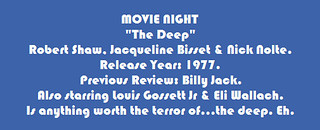
The Deep.


Review #1197: The Deep.

Cast: 
Robert Shaw (Romer Treece), Jacqueline Bisset (Gail Berke), Nick Nolte (David Sanders), Louis Gossett Jr. (Henri 'Cloche' Bondurant), Eli Wallach (Adam Coffin), Dick Anthony Williams (Slake), Earl Maynard (Ronald), and Bob Minor (Wiley) Directed by Peter Yates (#506 - Bullitt and #927 - Krull)

Review: 
Perhaps The Deep was destined to lurk in the depths of mediocrity due to riding on the coattails of Jaws, since both films were adaptations of novels by Peter Benchley, who also happened to co-write the screenplay for both features, doing this film with Tracy Keenan Wynn, although it was Tom Mankiewicz who provided a major re-write (while going un-credited for his help), with Shaw (in his third-to-last role before his death in 1978) having a main role for both movies. The best thing that can be said for this film is that while it isn't too particularly thrilling, it is at least a decent yarn that can be fine to look at and follow along with for a while if one has the patience to go through its 124 minute run-time. It isn't a classic by any means,in part because it doesn't really have much depth, but it probably works best as something to digest much in the same way one eats food from the fridge late at night, no matter how fresh or stale it seems.

The trio of Shaw-Bisset-Nolte is a decent one, carrying the film just fine at times, not being a particularly strong group by any means but being useful enough to serve the film and its shaky bumps. Shaw is fairly entertaining with his gruff mannerisms that serve to give exposition or to loosely interact with the others. Bissett does fine with her role, even if she only occasionally is given something interesting to say for the plot, which moves somewhat sluggishly. Nolte, starring in only his second theatrical role, is alright, but he doesn't really have much to do to give off more than a bare presence for a role that could've been played by near anyone. Wallach is okay in a brief role that doesn't prove to go too far within the plot. The weakest part of the film is the lack of a big presence of a villain. Sure, it is nice to see Gossett Jr on screen for a bit, but he doesn't really get much of a chance to bring menace to a kingpin role that probably could've done with a bit of re-tooling, with a bit of voodoo thrown in that doesn't really go anywhere. At least the little bits of exposition involving history prove intriguing. The characters feel drawn out from other adventure ideas, as if cut out from very thin paper that probably would've been made on the cheap in a previous decade. The stakes never feel too high, and at times the best thing going for it is the music from John Barry, with occasional success in water action, with an okay climax in the deep. This is not really a movie I can recommend, since it never really takes off into something truly spectacular on a consistent level, but it can serve as a bit of a curious sink of time, whether for some watery action or something deeper.

Overall, I give it 6 out of 10 stars.

November 5, 2012

Movie Night: From Russia with Love.


Review #278: From Russia with Love.

Cast
Sean Connery (James Bond), Daniela Bianchi (Tatiana Romanova), Pedro Armendáriz (Ali Kerim Bey), Lotte Lenya (Rosa Klebb), Robert Shaw (Red Grant), Bernard Lee (M), Walter Gotell (Morzeny), and Lois Maxwell (Miss Moneypenny) Directed by Terence Young (#150 - Dr. No)

Review
Dr. No was a big success, and so the studio would get a green-light for another Bond film, which was released 1 year after with Connery playing the role once again. How is it? It's good, I can tell you that. Whereas Dr. No suffered due to it being a bit slow with a villain of not exact threat, this is an improvement over it. I find this more defined as a film. It knows what it wants and Connery has more of the same charisma that helps this film out. At times it does indeed seem slow, but I find it still intrigues you into keep watching even in the dullest moments. The rest of the cast, including Bianchi and Shaw, are good. The action is relatively decent. In the end, out of the Bond films I've reviewed here (Dr. No, Goldeneye, Tomorrow Never Dies, The World Is Not Enough, Die Another Day, along with a parody - Casino Royale), this is the best so far of the films. So far being the emphasis here.

Overall, I give it 9 out of 10 stars.