Showing posts with label Lionel Atwill. Show all posts

March 10, 2020

To Be or Not to Be (1942).


Review #1358: To Be or Not to Be.

Cast: 
Carole Lombard (Maria Tura), Jack Benny (Joseph Tura), Robert Stack (Lt. Stanislav Sobinski), Felix Bressart (Greenberg), Lionel Atwill (Rawich), Stanley Ridges (Professor Alexander Siletsky), Sig Ruman (Col. Ehrhardt), Tom Dugan (Bronski), and Charles Halton (Dobosh) Directed and Produced by Ernst Lubitsch (#1026 - The Shop Around the Corner)

Review: 
Satire can be a curious thing. If you do it right, one will appreciate the humor and irony for years on end, regardless of how much time has passed (such as Gulliver's Travels). One would expect a war satire to come from brilliant directors (such as Charlie Chaplin with The Great Dictator the previous year), so it only makes sense for Ernst Lubitsch to make one as well. The German-born director had started as an actor in 1913. Although he appeared in roughly 30 films over the next seven years, he gradually shifted his attention to directing, making his debut with Shoe Palace Pinkus (1916). He made numerous movies in his native Germany with actors such as Pola Negri before leaving to Hollywood for good in 1922. He made films in numerous genres, ranging from comedy to bio-dramas to musicals, and he received an Honorary Academy Award in 1946, one year before his death from a heart attack. The story was done by Melchior Lengyel (who had co-written Ninotchka) while the screenplay was done by Edwin Justus Mayer (with un-credited work done by Lubitsch). Naturally, one would expect a star or two to headline the film, and one can't go wrong with Lombard and Benny. Lombard had started her career in 1921 (with a main debut in Marriage in Transit in 1925),  having small roles in films for Fox Film and Mack Sennett's short films before reaching her first high point with Twentieth Century (1934). It was the first of numerous screwball comedies that she became known for over the next few years. Tragically, this was to be her last film. She was killed in a plane crash after a war bond rally on January 16, 1942 (roughly a month before the film's release). Benny came into this film because Lubitsch wrote the film directly for him. He had originally done vaudeville for his violin playing before eventually deciding to do comedy with his act. In 1929, he had signed a contract with Metro Goldwyn Mayer and had his debut with The Hollywood Revue of 1929. While he made numerous appearances in film over the next few years, he became more well-known for his radio program, which ran from 1932 to 1955. 

The film is a wonderful one, dark and witty with its pursuit of making ridicule of a serious situation like the Nazis, in a time where World War II was in its third year and America had just entered the fight. There was a mixed reception among audiences and critics of the time, where even Benny's father initially was disgusted with the sight of his son in a Nazi uniform before being convinced otherwise (where he promptly saw it again and again). It is a keen movie with plenty of sharp observations and facial situations that rewards the viewer time and time again. The movie has a tremendous sense of timing, balancing comedy and drama with such deftness, which is helped with a prime screwball pairing through Lombard and Benny, who are both inspiring to watch either together or with others. The film doesn't repeat itself with tiring gags, knowing when to do something without needing to be prodded into it, where one could make a comedy-less version of the same basic story without finding trouble. Stack (who was reportedly terrified going into this role) does just fine with keeping up with Lombard and Benny with careful demeanor. The other actors pull off an inspired front in retaining interest, with Ruman doing the most well with bombast. It certainly is a timeless one to last among other comedies, and it even inspired a remake in 1983. The film moves with a dashing pace of 99 minutes, never seeming to wear itself out at any time with making a capable dark comedy that also serves as a romance and thriller with plenty to make light of with daring ambition and an especially capable director and stars at hand to make things shine in the dark. One can't go wrong with a Lubitsch picture, and this is no exception.

Next Review: The Invisible Man (2020).

Overall, I give it 10 out of 10 stars.

November 19, 2016

Sherlock Holmes and the Secret Weapon.


Review #873: Sherlock Holmes and the Secret Weapon.

Cast:
Basil Rathbone (Sherlock Holmes), Nigel Bruce (Doctor Watson), Lionel Atwill (Professor Moriarty), Kaaren Verne (Charlotte Eberli), William Post Jr. (Dr Franz Tobel), Dennis Hoey (Inspector Lestrade), Holmes Herbert (Sir Reginald Bailey), Mary Gordon (Mrs. Hudson), and Henry Victor (Dr. Joseph Hoffner) Directed by Roy William Neill (#846 - Frankenstein Meets the Wolf Man)

Review:
This is the fourth of the Holmes series with the Rathbone-Bruce duo (with the previous three reviewed here previously: #583 - The Hound of the Baskervilles, and #721 - The Adventures of Sherlock Holmes, #798 - Sherlock Holmes and the Voice of Terror), premiering in Los Angeles in late December 1942. This film uses elements of the Doyle story The Adventure of the Dancing Men (actually just the code, but still), while taking place during the War, though this one is more of a spy flick. On the whole, it's a standard kind of flick that entertains in part due to Rathbone and Bruce, but also a relatively good climax. Obviously it's not a film to watch for faithfulness to Holmes stories (literally watch any other Sherlock adaptation), but the charm of the two actors along with a relatively sane plot make for good entertainment. I especially like how Holmes goads Moriarty on to drain his blood slowly, which is one of a few good moments in a climax that moves at its own pace. Obviously the tones of the war are prevalent once again (with a bombing test in the middle of the film), but there is some room for some sort of mystery. Atwill plays Moriarty fairly decently, stated with a good deal of coldness for an actor very prevalent in this era. Moriarty had already been portrayed in the series before (by George Zucco in the second film), but I suppose it's part of the tradition to reuse (or "revive") villains. The rest of the cast is okay, with some comic relief by Hoey and Bruce (the former would star in five more Holmes films), though the real focus is how the movie goes through the motions with some grace and some logic, with no real twist this time around. On the whole, it's an average film that would be nice for anybody looking to kill some time at 68 minutes, or just someone looking for some fine standard fare, with a bit of adventure for the time.

Overall, I give it 7 out of 10 stars.

October 18, 2016

House of Dracula.


Review #849: House of Dracula.

Cast
Lon Chaney, Jr. (Lawrence "Larry" Talbot/The Wolf Man), John Carradine (Count Dracula / Baron Latos), Martha O'Driscoll (Milizia Morelle), Lionel Atwill (Police Inspector Holtz), Onslow Stevens (Dr. Franz Edelmann), Jane Adams (Nina), Ludwig Stössel (Ziegfried), Glenn Strange (The Frankenstein Monster), and Skelton Knaggs (Steinmuhl) Directed by Erle C. Kenton (#845 - The Ghost of Frankenstein and #847 - House of Frankenstein)

Review
This was the last of the monster mashup movies by Universal in a dramatic light, released a year after House of Frankenstein (#847). By this point, it seems they were running out of gas, with this film lasting only 67 minutes, which is the same length of The Ghost of Frankenstein (#845). I guess that is the case when you release four of these in three years (1942-1945). At least this time around Dracula is given something to do...in that he wants to be cured of being a vampire (sort of). This time, the theory about the Wolf Man is due to some form of "pressure around the brain", whatever that means. At any rate, continuity is thrown out the window and promptly steamrolled into the ground once again, which never ceases to amaze me. Once again, Dracula does not fight any of the monsters, though someone else does get turned into a vampire this time around. Footage is recycled (for some scenes with The Monster, including the climax from The Ghost of Frankenstein), which is disappointing but not exactly surprising considering the low budget and the time this was made. The movie isn't a clunker, but it really shows the decline of these monsters and it doesn't stick out in any real successful way. Chaney is fine as ever, though you could watch him in any other film with the Wolf Man, though at least he gets some closure to his arc. Carradine is given a bit more to do, but it doesn't really translate to anything too memorable. This was one of Lionel Atwill's final roles before dying four months later. Stevens gets to be interesting when he turns into a vampire over halfway through the film, because for one thing he doesn't just mosey on about like Carradine, with this vampire getting to do the crazy eyes and also attack someone, too, though that may be the highlight sadly. O'Driscoll and Adams are fine, but they can't help a movie undedicated to being anything other than a standardized experience. Instead of getting angry over it being what it is, I can only come up with an exasperated sigh. There isn't much mash to this "monster mash", and really there isn't much of anything to this, but I guess this could work as a way to kill an hour...or not. Honestly, stick to any other Universal horror film of the era previously reviewed here, or write your own Dracula/Frankenstein/Wolf Man story.

Overall, I give it 5 out of 10 stars.

October 14, 2016

House of Frankenstein.


Review #847: House of Frankenstein.

Cast
Boris Karloff (Dr. Gustav Niemann), Lon Chaney Jr. (Lawrence "Larry" Talbot/The Wolf Man), John Carradine (Count Dracula), J. Carrol Naish (Daniel), Elena Verdugo (Ilonka), Anne Gwynne (Rita Hussman), Peter Coe (Karl Hussman), Lionel Atwill (Inspector Arnz), George Zucco (Bruno Lampini), Sig Ruman (Bürgermeister Hussman), William Edmunds (Fejos), Charles F. Miller (Tobermann), Philip Van Zandt (Müller), Julius Tannen (Hertz), Hans Herbert (Meier), and Glenn Strange (The Monster) Directed by Erle C. Kenton (#845 - The Ghost of Frankenstein)

Review
Released one year after Frankenstein Meets the Wolf Man, House of Frankenstein not only brings in Dracula and a hunchback to the monster mix, but it also has Boris Karloff, now starring in a main role who gets more time on screen than the monster he had originally played less than a decade before. This time around, Glenn Strange (the fourth actor to play him) plays the Monster for a very brief amount of time, which I guess makes sense considering how much we've seen of the character in the past few films, only being in the climax. Karloff and Naish do go well together, having some fine banter along with seeming right for the roles. Chaney is good as ever, just like the effects. If you're looking for a Dracula meet up with Frankenstein's monster, you will be sorely dissappointed, as Dracula is killed off less than an hour into the film. It is funny that he was brought back to life only because Karloff's character removed the stake from his heart. Carradine is fairly decent, but he doesn't really seem to evoke any creepy charisma that Lugosi had in the role. Verdugo is not as interesting to watch, although her calling Naish's character "mean and ugly" (the whole exchange is pretty strange itself) is somewhat enjoyable cheesy. The characters aren't really anything too special, but it is fun at least to see the ways that everything tries to be set in place, even if it comes off as cheesy, though that can work for most. At least it isn't the Wolf Man fighting Frankenstein's monster again, though there really isn't a full on monster mash. At 71 minutes, it works okay enough to pass for at least somebody. I find it to not be as good as the previous film, but it is marginally entertaining.

Overall, I give it 6 out of 10 stars.

October 12, 2016

Frankenstein Meets the Wolf Man.


Review #846: Frankenstein Meets the Wolf Man.

Cast
Lon Chaney, Jr. (Larry Talbot/The Wolf Man), Ilona Massey (Baroness Elsa Frankenstein), Patric Knowles (Dr. Frank Mannering), Lionel Atwill (Mayor), Béla Lugosi (Frankenstein's Monster), Maria Ouspenskaya (Maleva), and Dennis Hoey (Inspector Owen) Directed by Roy William Neill.

Review
This was the first in the Universal franchise to utilize two monsters for a crossover film, although one could see this as a sequel to The Wolf Man (#260). Chaney is excellent once again as the Wolf Man, expressing the tragic nature of this character with ease, along with wonderful effects and transformation once again. Lugosi's performance is well known for having been butchered by the studio, to the point where you do not get to hear him speak, not get much context into his walking nature. It's not a movie where the monsters just fight each other (that happens briefly near the end), but it is a fairly engaging yarn to watch. The music number (yes, you read that) is somewhat amusing, in that you wouldn't really expect it to actually occur. Massey does a fine job as well. Knowles is okay, but nothing too special. Atwill returns once again, getting to play a mayor, which is a bit amusing in that this time he doesn't end up dying. The continuity is a bit strange (the Monster is found in ice. What exact time period is this set in? And why does the Wolf Man need to die like this instead of just getting shot by silver and buried deeper?), but there is at least a plausible set up to most of the events of the film. The climax is satisfying in that we get to see these two monsters meet and fight (briefly), which seals the fun aspect of a concept that could have been played out terribly but thankfully isn't.

Overall, I give it 7 out of 10 stars.

October 10, 2016

The Ghost of Frankenstein.


Review #845: The Ghost of Frankenstein.

Cast
Lon Chaney Jr. (The Monster), Cedric Hardwicke (Dr. Ludwig Frankenstein/Henry Frankenstein), Ralph Bellamy (Erik Ernst), Lionel Atwill (Dr. Theodore Bohmer), Béla Lugosi (Ygor), Evelyn Ankers (Elsa Frankenstein), Janet Ann Gallow (Cloestine Hussman), Barton Yarborough (Dr. Kettering), Doris Lloyd (Martha), and Leyland Hodgson (Chief Constable) Directed by Erle C. Kenton.

Review
The original three films (#072 - Frankenstein, #394 - Bride of Frankenstein, #844 - Son of Frankenstein) are all entertaining, with Boris Karloff making for a superb monster. This is the first film without Karloff playing the role, with Chaney (who we saw in #260 - The Wolf Man) now taking the role. His performance in this one isn't as interesting, mainly because he never speaks, mainly just lumbering around, more than he did in the last one. The monster this time is wearing a suit (unlike that fur coat from the last one...don't ask how he's back to the suit), and it's a shame that there isn't much to him, save from lifting a girl to try and get a ball midway through the movie. At least Lugosi returns once again, though it isn't as memorably creepy this time. The lines at the end where he talks about living forever are pretty chilling, though. It really a movie only interesting at the end, when the Monster gets some sort of brain surgery. It is a quick movie at 67 minutes, but there really aren't too many great moments to it. I do find it funny that there is another Frankenstein around to operate on the monster (and that the ghost looks like him, too), but also funny that when he looks at the original Frankenstein's notes that it shows clips from the first film. Hardwicke does okay, but he isn't as fun as the other two Frankensteins. The effects are adequate, but it is clear to note this was the first Frankenstein movie made as a "b-picture", with lower budgets and reuse of actors. It's not a bad flick by at means, but it really doesn't seem to do anything new, which is probably why the next film would be a crossover between a familiar monster...

Overall, I give it 6 out of 10 stars.

October 3, 2016

Son of Frankenstein.


Review #844: Son of Frankenstein.

Cast
Basil Rathbone (Baron Wolf von Frankenstein), Boris Karloff (The Monster), Bela Lugosi (Ygor), Lionel Atwill (Inspector Krogh), Josephine Hutchinson (Elsa von Frankenstein), Donnie Dunagan (Peter von Frankenstein), Emma Dunn (Amelia), Edgar Norton (Thomas Benson), and Perry Ivins (Fritz) Directed by Rowland V. Lee.

Review
After three years (or around 1214 days), I finally got around to seeing the third Frankenstein movie released by Universal. The previous one (#394 - Bride of Frankenstein) was an excellent follow up to the first film, with an excellent climax to boot, though the monster movie craze for Universal had declined by 1936. On August 5, 1938, the Regina-Wilshire Theatre showcased a double feature of Dracula and Frankenstein (with some also reporting that Son of Kong was also shown), which was a success. The successes from other theaters inspired Universal to rush this movie into production by late 1938, though without Colin Clive (who had died in 1937) and James Whale, with the focus now on the son of Dr. Frankenstein. I do wonder about how long this is set after though, since Atwill's character relates about having his arm ripped out of him when he was a young boy, or where Lugosi's Ygor was during any of those events since he didn't seem to be there before...but the movie is entertaining enough even with some quirks like that. Rathbone is excellent as ever, clearly getting into this role with enough believably. Karloff (in the last time playing the Monster for Universal) is fine, even if this time he doesn't have much to say, save for occasional growls. It is strange to see him in a fur vest, too. Lugosi is excellent as Ygor, having a haunting creepiness about him (particularly when revealing his neck wound from being hanged) that works in the movie's advantage. The effects and camera shots are also pretty wonderful to look at as well. On the whole, it's not as good as the other two films, but it is a serviceable monster movie that works well enough at 99 minutes.

Overall, I give it 8 out of 10 stars.

June 27, 2015

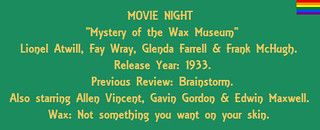
Mystery of the Wax Museum.


Review #719: Mystery of the Wax Museum.

Cast
Lionel Atwill (Ivan Igor), Fay Wray (Charlotte Duncan), Glenda Farrell (Florence Dempsey), Frank McHugh (Jim), Allen Vincent (Ralph Burton), Gavin Gordon (George Winton), Edwin Maxwell (Joe Worth), and Holmes Herbert (Dr. Rasmussen) Directed by Michael Curtiz (#125 - Casablanca and #416 - Yankee Doodle Dandy, #505 - The Adventures of Robin Hood, and #529 - Mildred Pierce)

Review
Remember House of Wax (#271) with Vincent Price? Mystery of the Wax Museum is the original version, made by the same studio (Warner Brothers) that would make the remake 20 years later, with this movie based off an unpublished story, The Wax Works. This movie utilizes two-color Technicolor, a unique system utilized in some films (like the 1925 version of Phantom of the Opera), although the reception to the system was lukewarm due to the perceived artificial qualities it projected. This was one of only three films that Warner Brothers had under this system, and the last. Anyway, the movie's color actually helps set the mood very nicely because its artificial quality here makes the movie seem creepy, which for a movie like this, works. It works for a mystery like this, which moves quickly and never seems padded, setting its characters up and their motivations just fine. Atwill and Wray are the highlights, both having good scenes, sometimes together. The movie is quickly resolved, and I'm impressed at how it managed to be just effective, without having to resort to much final thoughts. It's a movie that looks good in its own way while being a fine little mystery that can be good for anyone looking for a quick 30's film to watch.

Overall, I give it 8 out of 10 stars.

June 7, 2015

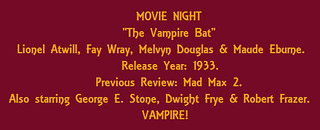
The Vampire Bat.


Review #708: The Vampire Bat.

Cast
Lionel Atwill (Dr. Otto von Niemann), Fay Wray (Ruth Bertin), Melvyn Douglas (Karl Breettschneider), Maude Eburne (Gussie Schnappmann), George E. Stone (Kringen), Dwight Frye (Herman Gleib), Robert Frazer (Emil Borst), and Rita Carlisle (Martha Mueller) Directed by Frank R. Strayer.

Review
Well, it's certainly a quick movie. At 63 minutes, this is a movie that was released just a month before another Atwill-Wray movie would be released (Mystery of the Wax Museum), but this one was released by Majestic Pictures, a studio known for cheap flicks made quickly. And since this is in public domain, you can find this movie anywhere on the Internet. But the question is would you want to? That depends. The sets look nice and scenic, fitting well with what the movie is trying to do so quickly. The characters are fine, save for Eburne's comic relief character, an anxious panicky character who almost ruins the balance that Wray and Douglas have with each other. Atwill is a good lead character (who pops up in numerous 1930's films). The ending is at least something different from most vampire films, though your reaction may vary on your level of disbelief. Extra points for having Dwight Frye as a supporting character, which is always welcome. If you're up for some quick cheap horror thrills, I'd say this movie is for you. Is it an old flick? As the old saying goes, 82 is the new 40. Or 30.

Overall, I give it 7 out of 10 stars.

May 18, 2014

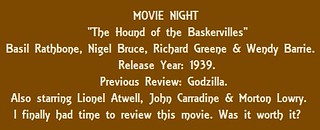
Movie Night: The Hound of the Baskervilles (1939)


Review #583: The Hound of the Baskervilles.

Cast
Basil Rathbone (Sherlock Holmes), Nigel Bruce (Dr. John H. Watson), Richard Greene (Sir Henry Baskerville), Wendy Barrie (Beryl Stapleton), Lionel Atwill (Dr. James Mortimer), John Carradine (Barryman), Morton Lowry (John Stapleton), Eily Malyon (Mrs. Barryman), and Barlowe Borland (Frankland) Directed by Sidney Lanfield.

Review
I had previously reviewed an adaption of the classic novel by Sir Arthur Conan Doyle (#272 - The Hound of the Baskervilles - 1959), which was excellent and such. So how does this film made 20 years beforehand fare? To be honest, I actually have read the novel (big shock, right?), and the movie manages to do a fine job in cramming the story into a small 78 minute window. The story flows well with the novel, not making drastic changes (The fate of the villain is left unknown, but leaving a little ambiguity as opposed to the novel doesn't hurt), and the landscapes look haunting and beautiful. The supporting cast is decent enough, but the main attraction is Basil Rathbone in his first movie as Sherlock Holmes, which he would play for 13 more films for seven more years alongside Nigel Bruce as Watson. Rathbone is certainly fun to watch deduce the crime, though it is debatable on whether if Bruce's somewhat bumbling performance is endearing enough to work or somewhat annoying. Whatever the case, the movie is simply excellent in its portrayal of the novel and manages to work on such a short time scale. Check this one out, then check out the 1959 film to see what all the fuss is about.

Overall, I give it 9 out of 10 stars.

October 19, 2013

Movie Night: Mark of the Vampire.


Review #470: Mark of the Vampire.

Cast
Lionel Barrymore (Professor Zelen), Elizabeth Allan (Irena Borotyn), Bela Lugosi (Count Mora), Lionel Atwill (Inspector Neumann), Jean Hersholt (Baron Otto von Zinden), Henry Wadsworth (Fedor Vincente), Donald Meek (Dr. J. Doskil), Ivan F. Simpson (Jan), Carroll Borland (Luna), and Franklyn Ardell (Chauffeur) Directed by Tod Browning (#071 - Dracula)

Review
Mark of the Vampire starts off well, though it is a bit of a surprise that this only runs 60 minutes, although apparently the studio cut 20 minutes out of the film, for reasons still not fully determined. The actors do a fine job, and Lugosi (Save for one scene at the end) does a great job because his menacing presence is different than how he was in Dracula: He resorts to walking around the sets, with makeup on the face, sometimes appearing out of nowhere, mostly accompanied by (accomplice?) another vampire, played by Carroll Borland, who reminds me of Wednesday Addams for some reason. The music is very effective, creepy and chilling. The sets look fine, and the film starts to gather steam around the 40 minute mark, when Barrymore (Who is never given a proper introduction scene, by the way) and the others are just about to go hunting for the vampire...And then come the last part of the film and the ending that derails it all. Whether you like twist endings or not, the ending...just seems like a big cop-out. To sum the ending (which I will color in black text, so just highlight the text if you want to know the ending) up is basically this:

To catch Baron Otto who apparently murdered Karell Borotyn, a Baron who died in the beginning, Zelen and Irena Borotyn, Karell's daughter hired actors to scare the Baron enough to get him hypnotized and get him to to do the murder to a look alike of the dead man, using a hot cup as a guise for the drained blood and a pincer for the marks on his neck. 

The ending shortchanges what was until up that point, the climax. Yes, I'm aware that this was a remake of an earlier film, London After Midnight (a 1927 lost film, one of the most sought after lost films), and I know it would've sounded cliche to have the vampires simply get eliminated, but the film still would've been very enjoyable nonetheless. The effects were nice, such as when Luna is shown arriving in the castle...with bat wings still on her. Browning does an okay job directing, but the film still could've been better. While it may cheat (or satisfy anyone liking twist endings) the audience, it's still a (mostly) decent film overall.

Overall, I give it 7 out of 10 stars.