Showing posts with label Woodrow Parfrey. Show all posts

September 16, 2026

Stay Hungry.

Review #2577: Stay Hungry.

Cast: 
Jeff Bridges (Craig Blake), Sally Field (Mary Tate Farnsworth), Arnold Schwarzenegger (Joe Santo), R. G. Armstrong (Thor Erickson), Robert Englund (Franklin), Helena Kallianiotes (Anita), Roger E. Mosley (Newton), Woodrow Parfrey (Uncle Albert), Scatman Crothers (William), Kathleen Miller (Dorothy Stephens), Fannie Flagg (Amy), Joanna Cassidy (Zoe), Richard Gilliland (Hal), Mayf Nutter (Richard Packman), Ed Begley Jr (Lester), John David Carson (Halsey), and Joe Spinell (Jabo) Directed by Bob Rafelson (#2159 - Head)

Review: 

Sure, let's hitchhike our way down to the other other other Bob Rafelson movie. Some might associate him with Head (1968), featuring The Monkees (of which he helped to develop), or perhaps with Five Easy Pieces (1970), or even The King of Marvin Gardens (1972), with the latter two featuring Jack Nicholson. After the release of Gardens, Rafelson found himself hitchhiking across the South. Rather than doing a movie about the slave trade (with countless time spent in libraries and apparently Ghana), he landed upon something suggested to him by a friend: a book by Charles Gaines called Stay Hungry. Sure, he didn't really care about making a straight adaptation of the book, but he felt that the "conclusions of his novel were not unlike the conclusions I had come to in both Five Easy Pieces and The King of Marvin Gardens" (of course, in the book, it ends with a death). Stay Hungry made a bit of money when it came out in April 1976, and you can safely say each of the three leads went on to bigger things. Incidentally, the actual Gaines was an interesting fellow - he was a writer and outdoorsman that could talk about the outdoors just as much as bodybuilding, and he served as one of the driving forces behind Pumping Iron (1977, as inspired on his 1974 book with George Butler), the docudrama featuring Schwarzenegger during the 1975 Mr. Olympia competitions*. Rafelson's next film was to be Brubaker, only to be fired due to having troubles with a certain studio executive (who he apparently socked in the jaw). Instead, he returned to the screen with The Postman Always Rings Twice (1981).

It's not every day you get a movie where someone decides, hey, let's steal a painting from a building for the hell of it, nighttime be damned. It's the kind of movie that makes you feel like you're on the road without actually travelling very far in any one direction. It's a freeform movie with plenty of episodes of things to go around, whether that involves the pursuit of bodybuilding (particularly at the end), bluegrass playing, hookers, women trying to do karate*, and dudes who really chase the hunger of the next thing rather than stay comfortable. That last point, wrapped in the eccentricities of what Rafelson loves to show in the "New" South makes for a movie that will please its admirers and annoy those who can't get into its 102-minute runtime. I thought it was mildly fun, mainly when it actually does find some footing with these people for warm fun, which mostly comes with Schwarzenegger*, who has a sweet sense of charm within his acceptance of being a big man in a world that likes to look (and use) big men like him for as long as they possibly could (not particularly sure what the costume worn for the workouts is supposed to really mean, but, well, that's something else). Bridges and Field have a certain type of casual nature together that sees both just dally around for the sake of dallying, where the former has to realize he needs something in his life, anything that sounds different than the usual hollow times in a big house (or drunk) while the latter can only help but speak her mind. These are folks who think that any type of different thing is better than whatever they have now (even if choosing a fling over barhopping is not particularly that effusive). Granted, this is also a movie that doesn't really paint a wide canvas of characters as you want it to do (I could take more time with whatever Kallianiotes is doing in karate, for example), but there are a handful of amusing little moments if you let the movie wash over. You get bits of wormy Spinell to go with a fairly youthful Englund, a fairly creepy (and timely) Armstrong and a climax that lets things hangout without too many definitive endings. It is a movie firmly wrapped in its time and place of a different type of South with Birmingham that moves on its own terms in ungainly but fascinating entertainment.  It's a movie for folks who want to make their own mark and think shooting the breeze might as well be the way over as long as the hunger burns. 

Overall, I give it 7 out of 10 stars.

*Did I mention that he was a co-creator of the sport of paintball? No, really. Incidentally, Schwarzenegger earned his one acting award for "Golden Globe for Best Acting Debut in a Motion Picture", mainly because they forgot that it actually wasn't his first film role: others may remember him, billed as "Arnold Strong" playing Hercules (albeit in a dubbed capacity) in Hercules in New York [1970]. He also appeared in a bit role in The Long Goodbye [1973].

*There is a rumor that Rafelson asked for Field to take off her shirt and kiss him (specifically Field said it in her autobiography). He denied this, although he subsequently did get divorced from his wife (and production designer) Toby Carr Rafelson soon after this film. So it goes.

*Orange belt as a kid, folks. Kinda fun.

June 30, 2026

The Outlaw Josey Wales.

Review #2554: The Outlaw Josey Wales.

Cast: 
Clint Eastwood (Josey Wales), Chief Dan George (Lone Watie), Sondra Locke (Laura Lee Turner), Bill McKinney (Captain Terrill), John Vernon (Fletcher), Paula Trueman (Grandma Sarah Turner), Sam Bottoms (Jamie), Geraldine Keams (Little Moonlight), Woodrow Parfrey (Percy Long), Joyce Jameson (Rose), Sheb Wooley (Travis Cobb), Royal Dano (Ten Spot), Matt Clark (Kelly), John Verros (Chato), Will Sampson (Ten Bears), William O'Connell (Sim Carstairs), Madeleine Taylor Holmes (Grannie Hawkins), John Quade (Ciril E. Forebaugh), Frank Schofield (Senator James Henry Lane), Buck Kartalian (Shopkeeper), Len Lesser (Abe), and Doug McGrath (Lige)

Directed by Clint Eastwood (#1252 - Space Cowboys, #1310 - Million Dollar Baby, #1476 - Pale Rider, #1501 - Unforgiven, #1550 - Gran Torino, #1638 - Bird, #1757 - Sudden Impact, #1831 - High Plains Drifter, #2487 - The Rookie)

Review: 

As we approach the Semiquincentennial of America, I suppose it only makes sense to cover a film that came across in the dawn of the Bicentennial fifty years ago. The movie was based on a book called The Rebel Outlaw: Josey Wales (titled Gone to Texas in later editions), which was published in 1973 with the writer being listed as Forrest Carter. He had sent the book unsolicited to Eastwood's office with a letter talking about "Eastwood's kind eyes", and go figure, producer Robert Daley felt it looked like a good idea to approach it to Eastwood, who soon agreed to work with optioning Carter's book. When Philip Kaufman looked at the book for the first time, he thought, well, that it was written by a "crude fascist". He co-wrote the screenplay with Sonia Chernus, which included the characters of Terrill and Fletcher that was not previously included in the book. It didn't help with filming, as disagreements with Eastwood in the shooting led to Kaufman's firing in favor of Eastwood, which he once said was "the worst moment of my life"*. It was his fifth film as a director, after the release of The Eiger Sanction (1975). The resulting film made over eight times its $3 million budget back with audiences when released (premiering in late June for a festival before going into release in July and August). As for Carter, he actually was born Asa Earl Carter, an Alabama-born segregationist who for whatever reason decided to try and rebrand himself as a writer with Cherokee background that lived in Abilene, Texas. Sure, there were rumbling questions about who Carter really as early as 1975 (only a few years prior, he ran a failed campaign for governor of Alabama), but Carter kept the facade on long enough to have written three further books, one of which was The Education of Little Tree (which was adapted into a film in 1997). He died at the age of 53, which apparently came after choking on his own vomit after a fight with his son. Plans to do a movie based on his second novel with the Wales character in The Vengeance Trail of Josey Wales (1976) did not come to pass with Eastwood involved. In 1986, Michael Parks directed and starred in The Return of Josey Wales, which dealt with confronting corrupt lawmen in Mexico.

Sure, you might wonder how it goes to make a movie about an ex-Confederate guerilla (incidentally, Jesse James was one of them), particularly with a person that believed that the "values of a civilization never died so long as they’re kept alive in legend.” Simply put, there are people who really thought there was a lost cause to a group of losers who never won a war, never deserved a monument to being traitors, and never did anything meaningful for the United States of America besides dying, because goddamn it, you should know the war was fought over slavery before you leave high school*. But, and this is the important part, it is such a worthwhile movie to see a tale of a man at war with himself that becomes whole again (besides, some people called Dirty Harry "fascist", it didn't stop them from making four more of those movies), or at least much as possible when the iron in his words is akin to the iron of a pistol. All he wants to do is move on and pick up what was broken in him from the war and move on. As Eastwood once said, man becomes his most creative in war, so you can only do so much to clean the blood stain from the tapestry. It isn't even that much of a revenge tale, because McKinney (and to a lesser extent in adversarial nature, Vernon) is not present in the movie as much as, say, George is for the 135-minute runtime, as if to suggest that it matters to see the frontier for what it really is beyond the cliches matters more than if one is going to rattle the sabre right into a man's heart, which, well, yes. It's a violent movie that also has plenty of offbeat moments, such as the moment where one says that hell is coming to breakfast. Everything collides for a reckoning of the soul, whether that's Eastwood and his ambivalence, George and his straightforward nature or otherwise. New order, old order, we thrive on the myths and tales we tell for ourselves, regardless of where they may spring from. As a whole, The Outlaw Josey Wales freewheels history and the usual conventions of the Western for a pretty solid result in offbeat entertainment that is expertly filmed and executed by Eastwood and company for a movie that reckons with community and what really matters to live or die on the frontier.

Overall, I give it 9 out of 10 stars.


*If one goes by this interview, Kaufman has never seen the film: Philip Kaufman: The Hollywood Interview | The Hollywood Interview

*If I remember correctly, my dad had a license plate cover of the Confederate battle flag. And yet, I turned out the way I did. 

July 12, 2025

Used Cars.

Review #2398: Used Cars.

Cast:
Kurt Russell (Rudy Russo), Jack Warden (Roy L. Fuchs / Luke Fuchs), Gerrit Graham (Jeff), Frank McRae (Jim), Deborah Harmon (Barbara Jane Fuchs), Joe Flaherty (Sam Slaton), David L. Lander (Freddie Paris), Michael McKean (Eddie Winslow), Michael Talbott (Mickey), Harry Northup (Carmine), Alfonso Arau (Manuel), Cheryl Rixon (Margaret), Al Lewis (Judge H. H. Harrison), Woodrow Parfrey (Mr. Chertner), and Dub Taylor (Tucker)

Directed by Robert Zemeckis (#317 - The Polar Express, #352 - Who Framed Roger Rabbit, #581 - Forrest Gump, #648 - Beowulf, #701 - Back to the Future, #747 - Back to the Future Part II, #748 - Back to the Future Part III, #1527 - Cast Away, #2229 - I Wanna Hold Your Hand)

Review: 
 “This movie is structured on a classic Frank Capra movie except that everybody lies.”

Look, sometimes movies don't get the right type of luck in reaching audiences. Or they just don't get it, who the hell knows. You might remember that Robert Zemeckis had his directorial debut with I Wanna Hold Your Hand (1978), that 1964 comedy involving teens and The Beatles that flopped on initial release. But Zemeckis continued on with Bob Gale on another production together two years later with Used Cars, which now had John Milius and Steven Spielberg serve as executive producers. Apparently, Milius was the one who came up with the idea of the movie with Spielberg that had thoughts of a Las Vegas used-cars salesman, which at one point had George Hamilton floated as a possible lead. Gale and Zemeckis did research at used car lots, as one does. The movie was shot around the Arizona area in the span of a month in 1979. On July 11, 1980, Used Cars was released in theaters and was a marginal success (it was made for substantially more money than Hand, for example). Apparently, the release was bumped up a month by Columbia Pictures (as led by a man that had sold cars at one point in his life) due to good test screenings, and yes, I said *good* screenings. As as a result, the movie came out just barely after the release of movies such as Airplane! (1980). The next movie directed by Zemeckis was Romancing the Stone (1984), which lit the match for his eventual breakthrough as a director. Incidentally, Used Cars (1980) was the only R-rated Zemeckis movie until Flight (2012).

I don't do car dealerships, but good god, I do love ensemble comedies. It is the kind of old-fashioned hokum that would've fit right at home in the days of Old Hollywood (as if it was an inverted A Wonderful Life), even if others might shudder at the thought of "crass" characters for a comedy. The thing is that they are *fun* and crass characters for a delightfully exploitative movie. What, have you never thought about a used car salesman going into politics? (as opposed to 70-year-olds running for president again and again) It wasn't like the previous decade was a normal one, what with people becoming president without the voters being involved. It is a barrage of crude brilliance that could only come from people who wanted to blaze a trail of humor at all costs and played it extremely cool in the process. Sometimes I wonder what makes Kurt Russell so good that he could've had his own fan club. I think it just is the fact that he seems to have the swagger to pull off nearly any performance with no sense of bullshitting you. He can do the action movie hero type (as one loves), he could do drama (I see Miracle [2004] every year), and most importantly, he can do comedy. Of course, this was his first film in five years, having moved away from Disney productions after The Strongest Man in the World (1975) that saw him do television and even play Elvis. With this movie, you need someone with a cocksure attitude, and you get that in spades with Russell, who is tremendously devious and tremendously funny for what clearly should've been the role to help see Russell as a legitimate talent*. He just rolls the hustle on his mind with no hesitation and the confidence that arrives in slippery likability, where one loves to watch what harebrained idea that he wants to peddle next. His time spent with Harmon is probably the only time he tries to really be honest (well, as much as one can when being around a dead person for a good chunk of the film), and even then it is still funny to see him squirm in chicanery. But the real focus is on folks you see around Russell like the superstitious (and funny) Graham or the slippery McRae or the lesser-shown McKean & Lander (who at that time were paired together on TV with Laverne & Shirley) in tech hijinks. But of course, Warden and his double role (for a time, one of them dies and is buried in an Edsel that is both touching and amusing) helps to seal the film as a real treat. He practically seems like the kid in a candy store in grousing humor that plays off the whole "one guy looks like this, the other guy acts like this" thing that makes me smile every time I see him on screen (one line in particular stands out about the "country going to the dogs" because when a politician was bought, they would stay bought). The cut-in sequences (where the boys decide the best way to raise awareness for their dealership is illegal cut-in commercials) are special standouts in ludicrous energy and audacity*, but the real show-stopper is the climax involving plenty of cars that might as well have been a cattle drive like Red River (1948) with such rousing spectacle and lunacy on display. In total, one doesn't see a cop out in a movie that looks at people and sees grifters all in line. As a whole, the screwy logic on display in salesmanship and outright lies to fill a hustle has managed to age spectacularly well for a movie that definitely deserved better in its time. But four decades (and a half) is still plenty of good milage for a director who got even better from here, so check it out.

Overall, I give it 8 out of 10 stars.
*He also tried to have a baseball career but suffered an injury. Is this the third film of the trinity of movies that people didn't get in the 1980s with The Thing and Big Trouble in Little China? Or would Tango & Cash make it a square? At least Escape from New York got him to righteous status.
*One scene has a naked lady in it, as one does when packed with an R-rating. Just be ready for breasts, as they say.

January 3, 2017

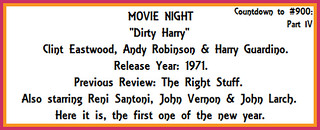
Dirty Harry.


Review #893: Dirty Harry.

Cast: 
Clint Eastwood (Inspector Harry Callahan), Andy Robinson (Scorpio), Harry Guardino (Lt. Al Bressler), Reni Santoni (Inspector Chico Gonzalez), John Vernon (The Mayor of San Francisco), John Larch (Chief of Police), John Mitchum (Frank "Fatso" DiGiorgio), Woodrow Parfrey (Jaffe), and Josef Sommer (District Attorney William T. Rothko) Directed by Don Siegel.

Review: 
I decided to use this film as the beginning point in part because the 45th anniversary (in late December) had passed on without notice, and it also seemed right to do this film, a hallmark of police films. This is certainly an excellently crafted film, right down from the style and action but also the way it presents its main character. Eastwood is excellent at conveying this loose cannon type of cop with the sort of cynicism and blunt edge without any kind of insincerity nor too overblown. The movie is at its best when showcasing the action (or in some cases, the sets used, such as Kezar Stadium), with a particularly excellent climax in a rock quarry. Besides the grit (and catchphrases) is a movie that does not try to hide its loyalties or thoughts on certain manners, especially with scenes regarding Vernon. Guardino and Santoni are serviceable, doing their roles without any kind of distraction. Robinson does a good job as the villain in part because of his mannerisms and how unassuming he seems. There is a perfect kind of imbalance that he conveys that work within the manners of the film. The movie seems to slow itself a bit around the middle, but it manages to have a good enough beginning and end that it doesn't really account for too much slog. It's obvious to say this isn't the kind of movie for anyone (especially for ones that aren't fans of violence), but it's also obvious to say this is a film that uses everything given to it (fine directing and a fine enough cast along with well conveyed action) and makes it a worth while time at 102 minutes. It isn't a standard kind of procedural and that's just the way it likes it to be.

Welcome to Season 7 (2017), folks: Countdown to #900: 10, 9, 8, 7...

Overall, I give it 9 out of 10 stars.