Showing posts with label Sterling Holloway. Show all posts

April 25, 2026

Professor Beware.

Review #2529: Professor Beware.

Cast: 
Harold Lloyd (Professor Dean Lambert), Phyllis Welch MacDonald (Jane Van Buren), Raymond Walburn (Judge James G. Parkhouse Marshall), Lionel Stander (Jerry), William Frawley (Snoop Donlan), Thurston Hall (Mr. Van Buren), Cora Witherspoon (Mrs. Pitts), Sterling Holloway (The Groom), and Mary Lawrence (The Bride) Directed by Elliott Nugent.

Review: 
In the year that Professor Beware was released of 1938, Harold Lloyd turned 45 and had made nearly 200 films (shorts, features) for over two decades, all with the delight of having laughs at seeing a bespectacled glasses character. With that film, incidentally, Lloyd was no long producing his own films (as he had done since 1924, at least until he sold the land of his studio to the Church of Jesus Christ of Latter-day Saints in 1937), as it was a production of Paramount Pictures with Lloyd as only a partial financier. The movie was directed by Elliott Nugent, who actually had done a handful of films as an actor before venturing into directing and being a playwright (most notably co-writing The Male Animal with James Thurber) for roughly two decades that saw him direct films with varying stars that ranged from Henry Fonda to Bob Hope. The screenplay was written by Delmer Daves, who was a few years away from being the director of such films as Destination Tokyo (1943) while Jack Cunningham and Clyde Bruckman were listed as doing an "adaptation" of a story as done by Crampton Harris, Francis M. Cockrell, and Marian B. Cockrell. The movie, made for roughly $800,000, was not a success with audiences at the time of release, and the fact that the film is the lone one not owned by the Lloyd estate meant that the movie lurked in the syndication circuit but hasn't really had much of a home media release (unless one likes, to, well, look for old movies on YouTube). Lloyd would produce a few films and do work in the radio before returning for one more starring role with The Sin of Harold Diddlebock (1947).

Okay, so what is the odd scenario encountered this time around: a professor is curious about the final missing fragment that tells the fate of an Egyptian from 3,000 years ago that had been buried alive for loving the daughter of the Pharoah...and the professor happens to look a bit like the Egyptian and believes that falling in love might make him go down the same path (in fairness, being buried alive does sound like a bummer). When the professor meets a girl through odd circumstances that result in him meeting public embarrassment, he sure believes he may be going the way of the Egyptian equivalent of the dodo. Lloyd and company wanted to fasten their machine of gags on the road to what they thought would be a good time. It is mildly successful in that regard...but it just seems tired, even with a runtime of 93 minutes, mainly because the gags only really get into gear for its climax, when the lead character corrals people to all follow him onto a boat by picking a fight. Lloyd aimed to get laughs from madcap situations but at a certain point watching him try to pull laughs from getting onto a rope from a moving train, it all seems that time is catching up to him. It may interest you to know this was the one and only movie appearance for Phyllis Welch MacDonald. She had made her debut on Broadway in 1935 with A Slight Case of Murder (coincidentally a play co-written by Runyon) and she moved to Hollywood after two years. Apparently, she signed a contract promising not to marry or be engaged for six months (otherwise pay $5,000) as part being in this film. The year after the film was released, she married and left acting to start a family while also being involved in children's theatre and even doing painted portraits on commission; she died in 2008 at the age of 95. Such a nice way to live life, as opposed to being stuck in further movies that may or may not have had better chances for her to actually do something besides be stuck with listless attempts at chemistry that remind you that movies on the road involving goofy encounters were just done better in It Happened One Night (1934). Stander and Frawley at least seem able to provide a chuckle. You might remember that previous sound efforts from Lloyd involved a would-be sleuth in Chinatown, a shoe salesman pretending to be successful, a movie-crazed wannabee, a mayor by accident that tries to reform a town, and a quick-paced comedy where a milkman goes to boxing contender. Some are better than others, most are at least semi-entertaining, but at least Lloyd had an idea of when it might just be time to go out on his terms.

Overall, I give it 6 out of 10 stars.


*For those curious (in link form) about the pursuit of Lloyd's feature films in order up to Professor Beware:


We will see The Sin of Harold Diddlebock in 2027.

December 1, 2021

Dumbo.

Review #1768: Dumbo.

Cast: 
Edward Brophy (Timothy Q. Mouse), Verna Felton (Elephant Matriarch / Mrs. Jumbo), Cliff Edwards (Dandy Crow), Herman Bing (The Ringmaster), Sterling Holloway (Mr. Stork), Margaret Wright (Casey Junior), and The Hall Johnson Choir [Crow Chorus: Hall Johnson (Deacon), James Baskett (Fats), Nick Stewart (Specks), Jim Carmichael (Dopey)] Directed by Samuel Armstrong, Norman Ferguson (#511 - The Three Caballeros), Wilfred Jackson (#178 - Peter Pan, #373 - Cinderella, and #683 - Alice in Wonderland, #810 - Snow White and the Seven Dwarfs), Jack Kinney (#511), Bill Roberts (#511), Ben Sharpsteen (#810), and John Elliotte.

Review: 
Dumbo is one of those timeless classic movies, pure and simple. Whether two or twenty-two or even one-hundred two, it manages to captivate its audience with a short run-time (64 minutes) while being a unique feature among the number of features that was created by Walt Disney Productions (with distribution by RKO Radio Pictures, who tried to get Disney to lengthen the film a bit), particularly when you look at the studio for just the 1940s or in the eight decades that followed the release of the film. Of course, Dumbo (1941) was released as the fourth animated feature film released by the studio that followed along the heels of 1940's Pinocchio and Fantasia, which while regarded well by critics were actually not major hits for the studio at the time, owing to a lack of distribution in Europe because of World War II, while Dumbo was made for less than a million dollars and became a modest hit for the studio. It would not be an easy production, however, since an animator strike would occur for a couple of weeks in the Disney studio (which was later immortalized by the clown characters in the film, who are depicted wanting to go to the boss for a raise). The film was the second-to-last feature film to be released by Disney in the decade, with Bambi (1942) was followed by six package features). The movie is based on the story Dumbo the Flying Elephant, which was written by Helen Aberson-Mayer and Harold Pearl (while having illustrations by Helen Durney), a married couple of writers that had sold the book to a company called Roll-a-Book in 1939, who in term sold the story to Walt Disney Productions that same year (no copies of it apparently exist, since the "roll-a-book" was a cardboard contraption with a little wheel on it, although Dumbo was turned into a softcover book later); Joe Grant and Dick Huemer were tasked to write a script outline over the course of a month in 1940, which Disney made into a feature rather than a short film, and Otto Englander would head a story team to turn the outline into sketches (as such, Grant, Huemer, and Englander were credited as story writers).

What can I tell you that you did not already know about it? I hadn't seen the movie for over a decade and yet it still managed to seem quite refreshing and meaningful regardless of that fact. It has a delightful pace and quality to it, one that is quite joyful and curious with its subject matter without becoming mired in too much cotton-candy sentimentality; in other words, it doesn't just go for "cute" with its animation or even its lead character, since there isn't a voice for him (one of the few times you can say that in an animated film). The folks that are present to speak prove right for the task of delivering right to the point when it comes to engaging atmosphere, whether that means smart-mouth do-gooders (Brophy, a character actor making his first and only voice role, which was both un-credited and memorable) or amusing folks that close the film with a song led by Edwards (a face and voice familiar for his roles within film and in music, most notably with Pinocchio) and the choir of Hall Johnson and company (familiar to folks who have heard Lost Horizon (1937), while Baskett would end up starring in Song of the South). Besides, finding a way to overcome an obstacle, such as say, being made fun of because of one's look, is a tradition like no other when it comes to honing a lively fable for everyone to enjoy. Well, that and showing folks up when it comes to provine oneself, although most would only dream to be as humble as a flying elephant. Everyone will have their own little favorite moments or sequences to chuckle or appreciate, whether that involves a little bit with a train engine, or as one might expect, a dazzling sequence involving pink elephants. The animation is exactly what you would expect from Disney's animators, crisp and effective in what needs to be seen on screen that can look as interesting on the first viewing to the next one, and I'm sure most would say this applies to the films as well when it comes to having variety (i.e. one can see where they have done in features since Snow White). By the time the film soars towards its conclusion, it sticks the landing with dazzling its audience with the art of seeing flight take place that doesn't diminish whether one was familiar with the subject matter or not (there will also be that one person who does not latch onto Disney films early). In essence, it is the movie for all kids at heart, ones who appreciate the fine touch of animation done by Disney's animators (most notably with Bill Tytla and Art Babbitt) that makes a sure winner anytime for all time.

Overall, I give it 10 out of 10 stars.

December 26, 2014

Movie Night: Alice in Wonderland (1951).


Review #683: Alice in Wonderland.

Cast
Kathryn Beaumont (Alice), Ed Wynn (Mad Hatter), Jerry Colonna (March Hare), Richard Haydn (Caterpillar), Sterling Holloway (Cheshire Cat), Verna Felton (Queen of Hearts), Pat O'Malley (Tweedledum and Tweedledee/The Walrus and the Carpenter/Mother Oyster), Bill Thompson (White Rabbit/The Dodo), and Heather Angel (Dinah, Alice's sister) Directed by Clyde Geronimi (#178 - Peter Pan, #373 - Cinderella, #511 - The Three Caballeros, and #660 - Sleeping Beauty), Wilfred Jackson (#178 and #373) and Hamilton Luske (#178 and #373)

Review
It's hard to make much judgement on a movie like this. On the one hand, it's an imaginative movie that also creates a world that makes no sense. The characters are drawn really well but are also insane. The movie is short but it also could've not have its ending be so abrupt. But on the whole, the movie is entertaining. Beaumont does a really good job as Alice due to watching how she responds to the inane world around her, which contrasts well, and she is a likable character. The other characters can be annoying and fun to watch, though remembering that the world they live in is figuratively nonsensical makes the movie more enjoyable. The Walrus and the Carpenter story is pretty funny, and I'm impressed it was one actor who did all the voice work for that short bit, Pat O'Malley, which is well done. If the movie had been a little longer it might've made for a little more story element (and perhaps an ending that isn't just "let's have some tea".), but the movie is fine nonetheless, and it is quickly enjoyable, and I'd recommend it. But of course I'd recommend the original novel by Lewis Carroll as well, either before or after watching this, so there you go.

Overall, I give it 8 out of 10 stars.

December 29, 2013

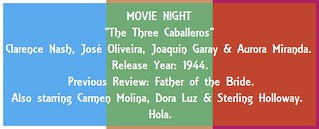
Movie Night: The Three Caballeros.


Review #511: The Three Caballeros.

Cast
Clarence Nash (Donald Duck), José Oliveira (José Carioca), Joaquin Garay (Panchito Pistoles), Aurora Miranda, Carmen Molina, Dora Luz, Sterling Holloway (Narrator - The Cold-Blooded Penguin), Frank Graham (Narrator), and Fred Shields (Narrator) Directed by Norman Ferguson, Clyde Geronimi (#178 - Peter Pan and #373 - Cinderella), Jack Kinney, Bill Roberts and Harold Young.

Review
The first thing I noticed is that Donald the Duck's birthday is on Friday the 13th. No wonder he encounters so much misery. This is the 7th Disney film (And the 2nd package film for Disney in the 1940s, along with Saludos Amigos, Make Mine Music, Fun and Fance Free, Melody Time, The Adventures of Ichabod and Mr. Toad), and it is a very colorful film to say the least, flashes of blue, green, red, pink, and so much more, making for a bright showstopper that has a good deal to show and say, with a few short stories and a few songs along the way. It's fun to watch and certainly fun to look at as well, Donald, Jose and Panchito are a very nice trio that do indeed make the best of their pairing. The fact that it runs only 70 minutes either hinder or helps the film, either because you want more adventure, or it keeps the film stay fresh and contained, making it relatively easy to watch and a treat as well.

Overall, I give it 8 out of 10 stars.

September 30, 2012

Movie Night: The Many Adventures of Winnie the Pooh.


Review #250: The Many Adventures of Winnie the Pooh.

Cast
Sterling Holloway (Winnie-the-Pooh), Bruce Reitherman, Jon Walmsley & Timothy Turner (Christopher Robin), John Fiedler (Piglet), Ralph Wright (Eeyore), Clint Howard & Dori Whitaker (Roo), Barbara Luddy (Kanga), Paul Winchell (Tigger), Junius Matthews (Rabbit), Hal Smith (Owl), Howard Morris (Rabbit), and Sebastian Cabot (Narrator) Directed by Wolfgang Reitherman and John Lounsbery.

Review
This film is a few adventures composed into one film based off the books by A. A. Milne (With the first book Winnie the Pooh, written in 1926 and The House At Pooh Corner written in 1928) The animation is a gem, resembling like the illustrations done in the original books by E. H. Shepard. The acting is good, it makes you feel that the books have literally come to life for this film, with lots of charm, lots of fun, and lots of skill. After 35 years, this film has stood the test of time. It has remained a classic that should be adored, no wait, is adored by almost anyone that loves the tale of a bear and the adventures that surround him. And that's it. 250 Reviews. It figures to review this at the end of the month, a month that had a countdown to a new milestone all in all. I'm glad about this, and there is more to come. Thanks.

Overall, I give it 10 out of 10 stars.