Showing posts with label Russ Tamblyn. Show all posts

August 21, 2025

The Last Movie.

Review #2413: The Last Movie.

Cast: 
Dennis Hopper (Kansas), Stella Garcia (Maria), Don Gordon (Neville Robey), Julie Adams (Mrs. Anderson), Peter Fonda (The Young Sheriff), Sylvia Miles (The Script Clerk), Samuel Fuller (Sam), Dean Stockwell (Billy the Kid), Russ Tamblyn (Charlie Bowdre), Tomas Milian (The Priest), Toni Basil (Rose), Severn Darden (The Mayor), Roy Engel (Harry Anderson), Henry Jaglom (The Minister's Son), Warren Finnerty (The Banker), Michelle Phillips (The Banker's Daughter), Kris Kristofferson (The Minstrel Wrangler), Michael Anderson Jr (The Mayor's Son), and Rod Cameron (Pat Garrett) Directed by Dennis Hopper (#1430 - Easy Rider).

Review: 
“I'm trying to say our lives are fragmented. That some people care and some people don't care and some don't know how to care."

Hey, remember Easy Rider (1969)? That was the movie where Dennis Hopper and Peter Fonda worked together on the counterculture movie to end all counterculture movies. The veracity of who wrote what with that movie (as also worked on by Terry Southern) is debatable, but what you saw with that movie was one directed by Hopper and starring him and Fonda that, well, yes, it was a hit. Hopper and Fonda would go into their own paths after the success of the movie because studios thought that they could replicate movies like that (cheap and "cool") for themselves. Paradoxically, the idea for what became The Last Movie came a number of years prior to Easy Rider, as Hopper, in the midst of finishing The Sons of Katie Elder (1965), came up with an idea during the wrap party under the influence of what else but pot that saw him come up with an idea about "making movies and the effect it has on people, and what they do when a movie company leaves town." Enter Stewart Stern. Hopper enlisted the services of the screenwriter (having done such scripts as Rebel Without a Cause [1955]), with each partaking in certain practices (namely blowing smoke down the snorkel of a scuba mask) that resulted in a script that would have a "far out" ending involving the culmination of a stuntman staying in a Latin American town and seeing the people react to a film company having shot a Western there. Long story short, the idea would go through several hands considered for producers and stars (Phil Spector was once thought to be involved as a producer alongside Jason Robards to star). The success of Easy Rider would make one think that the company led by Bert Schneider would back The Last Movie, but that was not to be. Instead, Universal Pictures dropped right in and even gave him final cut privileges as long as he did it on a tight budget. There are various roads that all seem to intersect with the making of the film, which started in Peru in 1970 and went through a road of drugs and other various substances behind the scenes (as captured in The American Dreamer, a documentary that followed Hopper around that at one point showed him carry a gun around), although the shoot itself was apparently not that chaotic. Funny thing about that script: Hopper basically junked it in favor of improvisation, not even bothering to shoot the ending (as noted by Stern, because Hopper asked him to come to New Mexico when he was editing it down). It eventually culminated in a disjointed print in 1971 (apparently, Alejandro Jodorowsky, director of films such as El Topo, had a hand in the editing process). The end result, after such strange sorrow, was a movie that barely made it into theaters and was essentially dropped by Universal with the energy of a wayward child being dumped onto a military school. Hopper (who took the movie on lecture tours as late as 1978) did not direct another movie until Out of the Blue (1980). The movie was not available on DVD for many years and a restoration of the movie only happened in 2018.*

Universal apparently had the belief that if you gave a couple of young directors a budget of $1 million, you would get something worthwhile. The result was the following: Douglas Trumbull made Silent Running, Monte Hellman made Two-Lane Blacktop, George Lucas made American Graffiti, Peter Fonda's The Hired Hand and the aforementioned Last Movie as made by Hopper. Honestly, the only way to view the movie is to just see it. You can't really get a great description of the movie that isn't just describing things that happen (such as "scene missing" or credits that pop up out of the blue). It wasn't exactly a critic favorite (Roger Ebert called it a "wasteland of cinematic wreckage"). It isn't even a movie you could watch for the acting, unless you want to see people improvise on the level just above dinner theater or to see the weird wacky weary world of one Dennis Hopper. It probably won't do many favors to those who thought Zabriskie Point (1970) was obtuse to watch. But it is quite the trip for 108 minutes to realize that reality and ritual can in fact collide for what you might call a new type of heaven or hell. One probably fades in and out about the same level as this movie does, complete with having an uncertain road close right from under one's skin. The whole movie could be called as one that gets under your skin: arrogant, free-wheeling, beautiful to look at (as shot by the famed László Kovács), rambling, pick any adjective you want. But there is something about it that is hard to resist when it comes to just calling it a mess. Hopper is a fascinating presence to be around even in the moments that might resemble a drifter on a stormy night. You'll see people come and go (yes, the director Samuel Fuller appears at one point alongside the film debut of the immeasurable Kristofferson) and that I suppose is just how it feels in our own lives to have people love and betray us in where they come and go (a chunk of this might sound like syrupy hokum, but life is bullshit enough before one goes around not saying what they think, don't you think?). Real or imagined, we live the life we make for ourselves and sometimes that can be a slice of heaven or a piece straight from hell. We see violence on TV and film and sometimes we just believe that it is something to slip by us with no muddling into our own lives but it does fester in us because that is just how things are as one of the supposed creatures of a certain power. It is a bit funny to see Universal foot the bill for such a weird movie. In truth, it took me a while to ponder what the hell I watched with this movie and the end result is that I found it to be a curious movie that exists in the realm of near-unrankability: you either will like it or you won't like it, but at least Hopper made something he could be proud of cultivating.

Overall, I give it 7 out of 10 stars.
*By sheer coincidence, that was the same year that The Other Side of the Wind (the movie where Hopper appeared in that was shot in the 1970s) came out.

June 29, 2024

Father's Little Dividend.

Review #2225: Father's Little Dividend.

Cast: 
Spencer Tracy (Stanley T. Banks), Joan Bennett (Ellie Banks), Elizabeth Taylor (Kay Dunstan), Don Taylor (Buckley Dunstan), Billie Burke (Doris Dunstan), Moroni Olsen (Herbert Dunstan), Richard Rober (Police Sergeant), Marietta Canty (Delilah), and Russ Tamblyn (Tommy Banks) Directed by Vincente Minnelli (#405 - The Reluctant Debutante, #510 - Father of the Bride, #620 - Lust for Life, #878 - The Long, Long Trailer, #986 - An American in Paris, #1031 - Meet Me in St. Louis, and #1397 - Gigi)

Review: 
Admittedly, covering sequels don't always fall by the wayside so hard like this. I was surprised to realize that I had watched the original Father of the Bride (1950)...nearly eleven years ago. Having to look back at a review made before I could even vote honestly makes me cringe, but I can reasonably defend my assessment of the film now and then as one that, well, has an "always fun to watch" Spencer Tracy. He was a versatile actor that really could run the gamut from drama to comedy, and it showed pretty well in that aforementioned Bride (as adapted from the 1949 novel of the same name that had been written by Edward Streeter) film in showing the road of a man that has seen his one daughter become a married woman (the result was an Academy Award nomination, go figure). Both that film and this one were written by Frances Goodrich and Albert Hackett (a regular couple that did stuff such as The Thin Man and later the play/screenplay of The Diary of Anne Frank) to go with the return of cast and crew for one of those early examples of a studio sequel. Apparently, the movie was shot in just a bit over three weeks as the film made by Vincente Minnelli when he was taking a break from An American in Paris (also released in 1951). The movie was a fair hit with audiences and also one you probably encountered on public domain because due to a failed copyright renewal, one can easily see the 82 minute on the Internet or, well, on a cheap DVD.

Well, it may be a rushed product of a sequel, but it is a lightly entertaining film. It is a family film of the 1950s through and through, in terms of the positive realization that comes in learning to say the words "I am a grandfather". Tracy does narration at times just like the previous film, which here is about the same level of effective on a slightly smaller scale. He apparently had a bit of reluctance to do the film, but it doesn't show here as he remains fairly committed to playing the lead in wry commitment, you'd expect in a patriarch like him. Bennett did not get to do as many films as one would expect after this one, probably because of a scandal where her husband (Walter Wanger) shot her agent in the groin because he thought they were having an affair that occurred the same year that this film was released. She does about as well as she did in the previous film in warm support. The Taylors still make a neat pairing together as pieces that maneuver (and are maneuvered) just as much as one sees with Tracy's character when it comes to routine married life. The film doesn't go too ga-ga on baby jokes and eventually finds some footing for its climax (what else but a christening) because it is hard to really grind cynicism over useful routine like this about maintaining sense in a sometimes sense-less place, family or not. In conclusion, it certainly shows a few seams of strain when it comes to being anything more than what you might find in a sitcom of its ilk, but there is a general warmth that comes through in terms of the commitment of its cast and an overall hopeful message of maintaining oneself even with the inevitable passage of time and family. 

Overall, I give it 7 out of 10 stars.

July 6, 2022

The Kid from Cleveland.

Review #1857: The Kid from Cleveland.

Cast: 
George Brent (Mike Jackson), Lynn Bari (Katherine Jackson), Russ Tamblyn (Johnny Barrows), Tommy Cook (Dan "The Kid" Hudson), Ann Doran (Emily Barrows Novak), Louis Jean Heydt (Carl Novak), K. Elmo Lowe (Dave Joyce), John Beradino (Mac), with Bill Veeck, Lou Boudreau, Tris Speaker, Hank Greenberg, Larry Doby, and many more. Directed by Herbert Kline.

Review: 
Let's be honest: the baseball material is the only drawing point of curiosity. That isn't to say that detailing the history of a young role for Russ Tamblyn is a bland experience, but one really does have to strain hard to not just immediately ask about how the Cleveland Indians (now known as the Guardians) got their own feature film. Well, I'm sure the answer is simply just Republic Pictures thinking that the 1948 club, who won the World Series over the Boston Braves, would possibly draw in a few local profits, complete with select footage utilized from the Series and bit lines from the stars on that team (along with certain moments with the 1949 team, who finished 3rd). Truthfully, the only reason I picked this movie was to talk about the 75th anniversary of Larry Doby making his debut in Major League Baseball, the second African American to play in the league and first in the American League. The Camden native had played five seasons for the Newark Eagles in black baseball before Cleveland owner/club president Bill Veeck signed him to a contract. The day of July 5, 1947 was three months after the debut of Jackie Robinson, and Doby's debut was serving as a pinch-hitter that saw him strike out on four pitches (contrary to Veeck's statement at the end of this film, Joe Gordon did not strike out after Doby to save face for his teammate, as Gordon was on base when Doby struck out). The next day, in the second game of a double-header, Doby started his first game in MLB at first base at Comiskey Park in Chicago, collecting his first hit and RBI. Doby had a tough first year, but he bounced back in 1948 to bat .300, and he was the first black player to hit a home run in the World Series in Game 4. Combining his statistics from his first season in 1942 to his last in 1959, he collected 273 home runs with 1,094 runs batted in while being named an All-Star eight times; after a long wait, Doby was named to the Baseball Hall of Fame in 1998, finally cementing his place as one of the best players of his era and certainly the most underrated player. 

The film was written by Herbert Kline and John Bright (a founder of the Screen Writers Guild). Born in Iowa, Kline started his career as an editor for a magazine called New Theater before moving to New York to join the Photo League. Over time, he did manage to make a couple of features alongside documentary work, such as his work involving covering political crises in Europe such as the Spanish Civil War; he once described himself as a "foreign correspondent of the screen". The Fighter (1952) and the aforementioned Cleveland film are likely his most noted features, owing to his blacklisting in the 1950s due to the House Committee on Un-American Activities. The movie went by "The Cleveland Story" and "Pride of the Indians" before finally settling on the title we know now, which is a pleasant snooze in all of the average ways possible. Did I mention that this is a movie about a troubled teenager that finds help from the baseball team? This seems like it could have been made about any random sports team, even with all of the location shots of Cleveland Stadium and bits of League Park sprinkled in (which only begs the question if someone would have gone with "The Kid from Boston" if the Braves had won the Series instead?). For me, I would rather be sitting at Cleveland Stadium watching six future Hall of Famers try to play actor (to go with more interesting baseball footage) than watching Tamblyn trying to play juvenile delinquent. This was his first credited role for the Los Angeles native, who was fifteen years old when this film came out, although it would be a couple of years before he didn't have to go by "Rusty" Tamblyn. At any rate, his performance isn't much to write home about, probably fit for a morality play or an unintentional comedy than this hodgepodge. Brent and Bari don't exactly lend a hand to help either, since neither really elevate the drama beyond first gear nor generate interest in the material that a broomstick would do. Doran and Heydt don't exactly move the needle either in parental figures to Tamblyn. One knows exactly what they are going for in 89 minutes with no real particular surprises present, no matter how they try to play the juvenile angle or the inevitable custody battle.

The reason to maybe see the movie is to see the Cleveland of yesteryear, to see a winning ball club that had star power with distinct names and faces, whether that involved player/manager Lou Boudreau, or star batter Joe Gordon, or Doby, or star pitchers Bob Feller (a Hall of Famer and also a guy who devised a sign-stealing plan with fellow legend Bob Lemon involving a telescope) and Satchel Paige (who is seen depicting his hesitation pitch for one scene). Of course, they come off pretty stiff when a camera is focused on them besides baseball, but maybe the curiosity factor about their baseball stories can forgive some of that. Bill Veeck, the revolutionary showman owner, is probably the most curious presence in the film, even if one knows they are watching a showman rather than an actor. As a whole, it is more interesting to talk around the movie known as The Kid from Cleveland than it is to actually watch it, which is not a ringing endorsement unless one is a sentimental Clevelander. Average may be better than a portion of bad movies, but it still isn't enough to recommend over other (better) baseball movies.

Overall, I give it 6 out of 10 stars.

May 7, 2020

West Side Story (1961)

Review #1407: West Side Story.

Cast: 
Natalie Wood (Maria), Richard Beymer (Tony), Russ Tamblyn (Riff), Rita Moreno (Anita), George Chakiris (Bernardo), Simon Oakland (Police Lieutenant Schrank), Ned Glass (Doc), William Bramley (Police Sergeant Krupke), Tucker Smith (Ice), Tony Mordente (Action), David Winters (A-rab), Eliot Feld (Baby John), Bert Michaels (Snowboy), David Bean (Tiger), Robert Banas (Joyboy), Anthony Teague (Big Deal), Harvey Evans (Mouthpiece), Tommy Abbott (Gee-Tar), Susan Oakes (Anybodys), Gina Trikonis (Graziella), Carole D'Andrea (Velma), and Jose De Vega (Chino), with Mami Nixon (singing voice for Maria), Jimmy Bryant (singing voice for Tony), Tucker Smith (singing voice for Riff for "Jet Song"), and Betty Wand (singing voice for Anita for "A Boy Like That") Directed by Robert Wise (#515 - Star Trek: The Motion Picture, #725 - The Day the Earth Stood Still, and #921 - The Haunting) and Jerome Robbins.

Review: 
"I think one of the major things a director has to do is to know his subject matter, the subject matter of his script, know the truth and the reality of it.”

Preperation can be key to a film's success, particularly one where there are many hands trying to guide it to being a success, whether involving producers, writers, stars, or most importantly the director. Robert Wise was one that could be depended on to deliver entertainment on a consistent basis over a career that spanned over half a century, which began in the shipping department at RKO in the 1930s. He had initially planned to enter journalism as a career, even writing columns for his high school newspaper and being part of the yearbook staff. However, the Great Depression curtailed his college ambitions, with his older brother David helping him get a job in Hollywood. He eventually shifted into editing by the mid 1930s. His most notable editing job was Citizen Kane (1941). His first assignment as director was with The Curse of the Cat People (1944), and he would do eight further films for RKO in the next five years, with The Set-Up (1949) being the last one for them along with being described as one of Wise's favorites to direct. Over the years he would do a variety of genres and find himself directing movies that still endure to this day from The Body Snatcher (1945) to The Day the Earth Stood Still (1951), to The Sound of Music (1965) to The Andromeda Strain (1971), and Wise would win Academy Awards for Best Picture and Director on two occasions each in his career.

The film was adapted to the screen by Ernest Lehman from the Broadway musical of the same name that was conceived, directed, and choreographed by Jerome Robbins while the book for the musical was done by Arthur Laurents and the music was from Leonard Bernstein to go along with lyrics by Stephen Sondheim. To add another name to all of this, the musical and film serves as a modern re-telling of the famed tragedy Romeo and Juliet by William Shakespeare (albiet with the fact that both romantic leads do not in fact die at the end). It had been a success upon premiering on Broadway in 1957 and London the following year, with numerous revivals occurring over the years. A remake is even set to occur this year, apparently with the intent to follow the musical more faithfully, directed by Steven Spielberg. Wise, directing his first ever musical, would direct the drama sequences while Robbins would direct the dance and musical aspects. The production soon turned to be a tough one to direct, in part because Robbins wanted to do everything exactly as done in the musical; he was described as one with plenty of ideas and great choreography talent but also an "insane perfectionist" that inspired fear and verbal abuse upon dancers when they did not meet his high standards. He shot four of the numbers before being fired by the studio due to a ballooning budget, with his assistants being tasked to help Wise in directing the remaining musical sequences.

I think this is one of those movies that reaches iconic status without necessarily being a great work of cinema, where one will find something to like within its lengthy 152 minute run-time and then decide that one viewing is enough for a life-time. It has a handful of highlights when it comes to the dancing and singing, including its snapping fingers opening, which ends up contrasting with actors who prove only fairly up to the task of holding the drama parts together. Wood gives off warmth as one could expect, the innocent amongst all the others that is compelling to a fault. Beymer, who described himself as coming out ridiculous in the film along with not being a "stereotyped leading man type", comes out okay in at least driving some sort of chemistry to follow with Wood that makes for adequate tragedy. Moreno and Chakiris end up being the most interesting standouts in the whole experience. Moreno, the famed Puerto Rican actress of stage, television and screen excels with passion that can sing and dance just as well as anyone on screen (although she wasn't spared being dubbed over in a number like others were, a decision that is present in other musicals of the time). Chakiris (a dancer, singer and actor reprising his role from the West End production) makes a fair presence to see in conflict, filled with fiery capabilities that make him useful to see engage in drama or in dance. The others do okay, but honestly the non-singers seem more interesting to think about, such as Oakland and Glass in their weary attempts at keeping calm at bay, regardless of whatever gang seems more interesting to follow. Perhaps it isn't surprising that the film wound up with an Academy Award for Best Picture, since it was the second of five musicals to win the award over a ten year span from 1958 to 1968, with each one winning at least five Academy Awards. It received ten awards, winning for supporting acting, art direction, cinematography, costume design, editing, original score, and sound, and Robbins ended up winning an Honorary Academy Award for his choreography. Of course not every one found the film to their liking, with Laurents describing the film as one with "bogus accents, bogus dialect, bogus costumes." It is ultimately an achievement of showmanship when it comes to the dancing and style for which to see said dance (and singing) numbers that make it worthwhile enough to make for a useful experience that doesn't quite overstay its welcome. Wise and Robbins managed to piece together a display of song and dance with some meaningful timely tragedy that can still reach an audience and show some life without being conscribed to the ravages of over five decades.

Overall, I give it 8 out of 10 stars.

October 29, 2018

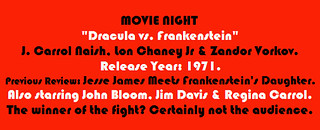
Dracula vs. Frankenstein.


Review #1154: Dracula vs. Frankenstein.

Cast: 
J. Carrol Naish (Dr. Frankenstein), Lon Chaney, Jr. (Groton), Zandor Vorkov (Count Dracula), John Bloom (Frankenstein's monster), Jim Davis (Sergeant Martin), Regina Carrol (Judith Fontaine), Russ Tamblyn (Rico), Anthony Eisley (Mike Howard), Anne Morrell (Samantha), Maria Lease (Joanie Fontaine), Angelo Rossitto (Grazbo the evil dwarf), Forrest J Ackerman (Dr. Beaumont), Greydon Clark (Strange), and Shelley Weiss (The Creature) Directed by Al Adamson.

Review: 
It really is better sometimes to just not take your time making a movie. This film took two years to make, with working titles such as Blood Freaks and The Blood Seekers. You may wonder if this film (written by William Pugsley and Samuel M. Sherman) was haphazardly put together with all of the random plot elements thrown together. Well, we've got Chaney playing an axe-wielding maniac, a doctor trying to cure his paralysis with a serum made from some sort of chemical in the bloodstream through the trauma of death (along with somehow curing his assistant and his evil dwarf), a part with bikers and hippies, and then there's Dracula (with some sort of grease paint and eye-shadow for makeup) somehow mixed in, who suddenly gets the idea to use the serum to give him immunity to the sunlight while bringing back the monster of Frankenstein (with the passing of a comet, no less), who looks like rotted clay. You know how classic movies seem to get re-made or done over and over again? I'm surprised no one has had a focus on improving terrible movies such as this one instead, since this would probably be a good one to make again, whether as a student film or just something for fun. Given how the film looks like it takes place in a big dark room, you might as well film everything in one big room. This is a 90 minute movie that manages to perplex its viewer with such random bits of odd moments - such as an dwarf who eats a dollar, or Vorkov and his ring that vaporizes people to ash. However, the pinnacle of lunacy comes with the fight sequence between Dracula and Frankenstein, which takes place just as the sun is coming up - although you can't really tell due to how dark everything seems to look due to the fact that they are fighting in an area with so much tree leaves and branches. The amazing thing is that they made a fight sequence that lasted less than five minutes that also proves to be incredibly one-sided and dull at the same time. Believe it or not, this was not the original intended ending for the film, which was meant to end with the two main leads (Carrol and Eisley) survived without a fight from the main villains. Instead, we are shown Dracula vaporizing "Mike", played by Adamson from the back as this scene was filmed after production had ended. Honestly, the sequence showing Dracula being melted by the sun is the only effect that sort of works, as if decay is the only thing the movie is good at showing. You may be wondering if this is the only Dracula vs. Frankenstein film out there. Technically, no. There exists a film called Los Monstruos del Terror (1970), which was known under Dracula vs. Frankenstein in the UK alongside other titles such as The Monsters of Terror and Assignment: Terror. There was also another film called Dracula contra Frankenstein (1971) that had several other titles it went by, such as Dracula, Prisoner of Frankenstein but also Dracula vs. Dr. Frankenstein. In fact, this film had several titles of its own, depending on the country, with my particular favorite being the reissue title in the US of Teenage Dracula - as if that makes Vorkov and his performance seem any less silly. In any case, always check your film titles, I suppose.

It should be mentioned that this was the last films for Naish and Chaney Jr, who both died two years after this film's release. It's pretty easy to see when Naish is reading off cue cards since you can see clear movement of said eyes at times when he is speaking, and the chattering of his false teeth can be heard at times - but at least he is somewhat amusingly hammy. Chaney doesn't have any lines, and he mostly just does a bunch of funny faces, but it definitely isn't him at his best. Vorkov (a pseydonym for his real name of Robert Engel, stockbroker thought of by Ackerman) is terribly wooden, invoking laughter instead of terror, particularly since there is an echo to the voice. None of the other castmates are too particularly memorable, aside from Tamblyn randomly showing up with no bearing on the plot. I do find the brief appearance of Ackerman (who serves as technical consultant) to be interesting, since he was a famed magazine editor (most notably Famous Monsters of Filmland), sci-fi writer/editor along with being a literary agent and avid collector of film memorabilia. Searching about him is far more interesting to think about than the film itself, honestly. Bloom, who played the monster for most of the film, was an accountant, but Weiss is the one with the job of fighting Dracula, lumbering his share for the schlock scene for a movie that does not have much shame. What can you expect from a production company named Independent-International Pictures? This is a terrible movie, filled with ridiculous scenes that make it a mockery among other horror films, particularly ones involving Dracula or Frankenstein - but it certainly will prove entertaining for people wanting campy schlock and not much else.

Overall, I give it 3 out of 10 stars.

March 31, 2017

The Haunting (1963).


Review #921: The Haunting.

Cast:
Julie Harris (Eleanor "Nell" Lance), Claire Bloom (Theodora), Richard Johnson (Dr. John Markway), Russ Tamblyn (Luke Sanderson), Fay Compton (Mrs. Sanderson), Rosalie Crutchley (Mrs. Dudley), Lois Maxwell (Grace Markway), and Valentine Dyall (Mr. Dudley) Directed by Robert Wise (#515 - Star Trek: The Motion Picture and #725 - The Day the Earth Stood Still)

Review:
The Haunting (based of the novel The Haunting of Hill House by Shirley Jackson) is a psychological horror film that uses its atmosphere and settings to make a a cohesively made movie with a good degree of terror over horror. Wise's direction, along with production design by Elliot Scott and cinematography by Davis Boulton, are the easiest standouts of the movie, all being good at letting the mood be chilling along with cleverly crafted. One of my favorites is the spiral staircase, which is used in numerous shots to great effect. The acting is also good, with Harris making this fragile character easy to root for along with useful to watch. There is just something about her and how she moves and how she talks to the others that really make this character readily compelling. Bloom is interesting, with a good deal of entertainment and alluring nature to her. The rest of the cast is also pretty good at their roles, whether it be scientific (Johnson) or slightly strange (Crutchley). The way that they interact with each other goes with the mood, where numerous characters talk at the same each other, with later scenes having the benefit of sound effects when it is required. The movie is as scary as one lets it be; it doesn't rely on any real horror, but it works on a psychological kind of level of terror that works for the most part. The climax is a fairly interesting one (using some of the aforementioned set pieces), though admittedly Maxwell's character almost derails it (though obviously it matters to the plot), before an ending that closes acceptably enough. It isn't a quick burn to get some chills, but it definitely has enough moments to make it all worth it.

Overall, I give it 9 out of 10 stars.