Showing posts with label Scott Paulin. Show all posts

October 25, 2024

Cat People (1982).

Review #2290: Cat People (1982). 

Cast: 
Nastassja Kinski (Irena Gallier), Malcolm McDowell (Paul Gallier), John Heard (Oliver Yates), Annette O'Toole (Alice Perrin), Ruby Dee (Female), Ed Begley Jr (Joe Creigh), Scott Paulin (Bill Searle), Frankie Faison (Detective Brandt; dubbed by Albert Hall), Lynn Lowry (Ruthie), and John Larroquette (Bronte Judson) Directed by Paul Schrader.

Review: 
"Cat People wasn’t successful. It really fell between two stools: it was an attempt to have things both ways, which is to have a classy film and a horror film. Well, the horror audience went and said, ‘Hey, this doesn’t look like a horror film, it’s not for us’, and the sophisticated audience went and said, ‘Hey, this is just a horror film.’ So it wasn’t really satisfying to the audience."

Sure, give a few decades and you can just remake a movie right then and there. The 1942 Cat People had been a team effort that had DeWitt Bodeen write the screenplay as based in collaboration with producer Val Lewton, director Jacques Tourneur, and editor Mark Robson. The process of remaking the film was first brought up by Milton Subotsky before Universal Pictures eventually got the rights and made their own push that took several years of the 1970s (Robert Vadim was interested to direct at one point). You might recognize the screenwriter in Alan Ormsby, the co-director and writer of Deranged (1974) and a variety of other writing projects. Universal tapped Paul Schrader (who once labeled the 1942 rendition as one that he didn't find very good) to direct the film, with most knowing him for his work on scripts such as Taxi Driver (1976) before becoming a director with Blue Collar (1978); he claimed that he had contributed to the writing of the film in terms of its prologue and the ending to make it more distinct from the original, although Ormsby claims otherwise. The movie was a mild success with audiences at the time, or at the very least managed to accomplish the goal of not inspiring a filmmaker to try and do their own remake of a remake four decades later. Schrader has been quoted as saying that in his attempts to do a genre film as a "very salutary exercise" in not being about himself, he ended up making a movie that ranked up there as among his most personal.

The funny thing about the films is that it accomplishes one thing in particular: it sure is distinct on its own merit from the original that you won't mistake it as a copy because of its erotic elements within the perils of flesh. You might remember that the original dealt with a woman (played by Simone Simon) who thought they were descended from a tribe of, well, cat people that may or may not turn into black panthers when aroused (it basically had elements of the noir); the lady in that movie went the whole road to marriage without getting kissed. Here we have a woman who must confront the peril of really having a family tradition of were-cats that must kill in order to turn back. It just so happens to involve a few bits of skin and the mix of effects and cats in a movie best described as lurid curiosity for 118 minutes. If you asked me which movie called Cat People is the better among the two, I think I would throw my hands in the air and shrug at it basically being a dead heat because each are from accomplished filmmakers that represent their era quite well in overall enjoyment vs. rewarding the patience of those who are into what it is selling. Kinski practically lifts the film almost entirely to the realm of curious because of how she acts in the film without really even acting that much to begin with (apparently, she seemed to felt manipulated when it came to her assessment of the resulting film). Her grace really does have the instincts of a cat in frenzied timing that sells the plight of flesh. Whether you compare the two films or not, she sure exceeds Simon when it comes to worthwhile lead performances by a handy margin. McDowell may not be in the movie too long, but he sure is loopy enough to belong in weirdo enjoyment that he sells from the word "go", but I say that as someone who went with the film's peddling of ideas right then and there (you really should just see it right then and there rather than skimming the plot). Heard and O'Toole are fine, albeit on a smaller scale that only works some of the time in trying to do a would-be love triangle that only works for those who like the actors enough in the first place; Heard just happens to be the ideal guy to chase a girl like Kinski in strange pursuer/pursued, as opposed to the mild other. Besides, it is quite the curiosity to see Heard having to engage with the climax in a cathouse blues type of way that really will make or break the film for you when it comes to stupendous suspension of disbelief; I dont know if I would call the film "classy", but even "dedicated" is a better way to put it than,  say, "not fun horror". It is a movie that looks and sounds exactly on point of mystical curiosity, never turning itself off even when not going all-out for effects work (you get some blood anyway). As a whole, it is a strange sensual kind of sensationalism that one will either take right in for scintillating enjoyment or baffled disappointment. It feels good to be on the side of the former but have it your way among the creatures of the night.

Overall, I give it 8 out of 10 stars.

June 8, 2021

Pump Up the Volume.

Review #1686: Pump Up the Volume.

Cast: 
Christian Slater (Mark Hunter), Samantha Mathis (Nora Diniro), Mimi Kennedy (Marla Hunter), Scott Paulin (Brian Hunter), Cheryl Pollak (Paige Woodward), Annie Ross (Principal Loretta Creswood), Ahmet Zappa (Jaime), Billy Morrissette (Mazz Mazzilli), Seth Green (Joey), Robert Schenkkan (David Deaver), Ellen Greene (Jan Emerson), Andy Romano (Mr. Murdock), Anthony Lucero (Malcolm Kaiser), Lala Sloatman (Janie), and James Hampton (Arthur Watts) Written and Directed by Allan Moyle.

Review: 
“[Pump Up the Volume] is my favorite movie I’ve ever done. … It wasn’t a typical high school movie, and it really did get into some of the darker, more gruesome details of what it’s actually like to be a teenager in high school.” - Christian Slater
“I don’t know how to make a good movie, but I know how to make a bad movie, and that’s try to appeal to everybody.” — Allan Moyle

There are quite a few things one can be hard-pressed to admit when it comes to looking back on films like this from the era of the 1990s. Movies involving teenagers and angst or life seemed to take on a new phase that were different from ones made by John Hughes, even if there were a few outliers like Heathers (1988), which featured Christian Slater. Of course, the hard-pressed truth is that film is actually quite inferior in its teenage angst angle than this film, which actually manages to do better in every aspect from characterization (and actually sticking to it!) to music to gracing the ending (each move to the logical point one might see coming, but it seems more right with this). I kid you not, each film also would inspire a musical production. Each failed at the box office, but Heathers has had the cult following befitting an exploitation movie (at least the one it may or may not have ripped off) while Pump Up the Volume isn't even readily available on many release outlets (owing to music licensing). So be it. Besides, this film has the real angle of aiming for a message about free speech alongside its angle about finding one's voice as a teenager in a weird world that makes it an underrated gem. It is funny to consider that it came out from a director who had meant to stay retired. Allan Moyle was born in Shawinigan, Quebec, Canada. Moyle had a classmate in his high school that had an amateur printing press that would be used for offbeat papers to spread around school; the student took his own life, and it affected Moyle. In fact, the original script that Moyle wrote for what would be this film revolved around a pirate DJ saying that he will end it all with his final broadcast (...or will he?). Moyle had gotten into film writing with Montreal Main (1974) and directing with The Rubber Gun (1977). Times Square (1980) was his second effort, but the meddling of producer Robert Stigwood (who seemed to have aspirations for another film success like Saturday Night Fever) to the final cut meant that Moyle would swear off directing for a decade. Moyle wanted to only do writing, but it was the meeting with a producer in Sandy Stern that proved a key to directing again (he had grown up with radio shaping his teenage years). He saw the fairly green script by Moyle and brought himself to work on re-writing the script (mainly in that there wasn't an ending) for a year. At any rate, the film eventually found a production company with New Line Cinema, and the experience spent by Moyle and Stern was reportedly very cooperative (of course Moyle has often noted that he did not generally get to use his more experimental tendencies with his films).

Honestly, I am curious to what would have happened if the idea of the film had come around a decade later. Heck, if this was 2021, we might see a lead character that probably does a podcast in a shed. Teenagers not being taken seriously isn't exactly a new one, but Moyle has made a movie where self-awareness is a curse for the young or old when not being taken seriously. Of course, any soundtrack that has Leonard Cohen is on the money. Sure, folks might be more interested in hearing Sonic Youth or Beastie Boys, but there is generally a song for everyone when it comes to something that resonates with the beat of the film without feeling pre-packaged. So basically, it is a movie with plenty of chutzpah that is backed up by the presences of its actors. Slater is the easiest standout, because he is basically playing two sides of the coin of a performer in the persona that reflects against the one behind said voice. The rebel voice on the radio might not seem like a hard job to do, but eventually finds it to not just be a bit for easy crude jokes, because it gets balanced with the quieter man in the daylight (i.e. soft-spoken) that hits right at home for the supposed Generation X crowd (after all, how many movies are there existing to admire the 60s when compared to ones that tell the 60s to go stuff it?). In other words, it proves quite fit for the crowd at large without alienation or pap detected in those monologues. When it comes to that exchange involving someone troubled about how serious they are about a life-or-death decision, it still strikes a chord, one that is relevant to our day in its striking tone. Following along is Mathis, making her film debut (she had dabbled in television for two years). There is a certain kind of spark to her performance that is inviting in curiosity that goes quite well with Slater in interesting passion (of course it also can read as an offshoot of the figure/fan dynamic). Pollak and Morrissette stand out well among the teen-folk, whether that means in a preppie that lets it all it out or a punk kid having fun away from school. Kennedy and Paulin make for worthy parental figures for what is needed - well meaning without being caricatures, while Ross plays the adversarial adult figure with worthy patronizing charm; incidentally, the other standout figure is Hampton, who has a brief role in the end as an FCC man under siege by teenagers that is quite amusing. As a whole, the ending is probably the one thing that keeps it from really being a great movie (really what can one do when having kids on the run from the FCC?), but in a changing tide of teen movies, it sure packed a fun wallop. It is the kind of movie that would sneer at you for calling it ripe for the teenage vision of a new era, but there is something to enjoy for everyone in an experience that is generally aware of what it wants to say for 105 minutes with a cast and crew that seem ripe at home for a worthy gem of the era.

Overall, I give it 9 out of 10 stars.

December 31, 2016

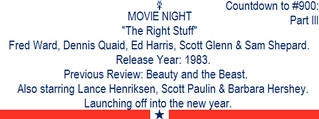
The Right Stuff.


Review #892: The Right Stuff.

Cast: 
Fred Ward (Gus Grissom), Dennis Quaid (Gordon Cooper), Ed Harris (John Glenn), Scott Glenn (Alan Shepard), Sam Shepard (Chuck Yeager), Lance Henriksen (Wally Schirra), Scott Paulin (Deke Slayton), Barbara Hershey (Glennis Yeager), Veronica Cartwright (Betty Grissom), Jane Dornacker (Nurse Murch), Harry Shearer and Jeff Goldblum (NASA recruiters), Kim Stanley (Pancho Barnes), Pamela Reed (Trudy Cooper), Charles Frank (Scott Carpenter), Donald Moffat (Lyndon B. Johnson), Levon Helm (Jack Ridley and Narrator), and Mary Jo Deschanel (Annie Glenn) Directed by Philip Kaufman.

Review: 
Watching epic movies (especially historical ones) can be interesting, provided that that the pacing and the subject matter make for good entertainment, with this being adapted from the non-fiction book of the same name by Tom Wolfe, which covered both the story of the Project Mercury astronauts (also known as the Mercury Seven) along with the pilots dealing with high-speed aircraft such as Chuck Yeager, ranging from his breaking of the sound barrier in 1947 to the launch of Mercury-Atlas 9 in 1963. Even with a 192 minute (over three hour) run time, obviously some liberties had to be taken in order to tell a story like this, and the end result is certainly satisfying enough, with spectacle and cast to boot. Even after Project Mercury is introduced by the first hour, it doesn't merely become about the crew, as it also continues to give time to Yeager, while also not being just a technical story. The two stories run parallel with each other very smoothly, while showing some wonderful effects and costumes. By the time Yeager's story ends, there is a sense of triumph that carries on to the end of the other narrative that make for exquisite viewing and an ambitious movie.

Ward does a fine job, along with Quaid, who make for entertaining scenes together. Harris (playing the recently departed John Glenn) stands out amongst the crew, likely due to his charm but also the determination he manages to show in someone as interesting as John Glenn was. Glenn (playing Alan Shepard) is pretty entertaining, having some quips along with some sort of charm. Shepard (playing Chuck Yeager) plays the role with a straight laced but ultimately interesting way.  The rest of the cast is also pretty good, with Moffat being quite entertaining as LBJ. As said earlier, the film takes liberties with certain events (such as the Mercury-Redstone 4's hatch cover blowing, with some implication toward Grissom being the cause and Jack Ridley being shown talking to Yeager after the former had died in 1957), but it does not detract too much from the story's flow. It never feels too long, nor out of its element in regards to showing these astronauts and their lives. One of the best scenes is them discussing with the scientists over installing a window, in part because you see how they see themselves more than just test subjects. On the whole, this is a movie that inspires curiosity along with excitement over an age long gone but not forgotten, with enough depth and skill to make for a tremendously entertaining experience.

On that note, I wish all of you readers at home a Happy New Year as we approach 2017, and in effect Season 7 of Movie Night. Season 6 had 116 reviews (with only one review in January to begin the season), as compared to the 90 in the previous season (2014). With any luck, Movie Night will keep trying to push the limit of the standard I hold myself when writing these reviews, along with trying to cover a diverse amount of movies, the good and the bad.

Thank you for reading, and I will see you in the new year. 10, 9, 8...

Overall, I give it 9 out of 10 stars.