October 31, 2019

Nosferatu the Vampyre.

Review #1292: Nosferatu the Vampyre.

Cast: 
Klaus Kinski (Count Dracula), Isabelle Adjani (Lucy Harker), Bruno Ganz (Jonathan Harker), Roland Topor (Renfield), Walter Ladengast (Dr Abraham Van Helsing), Dan van Husen (Warden), Jan Groth (Harbormaster), Carsten Bodinus (Schrader), and Martje Grohmann (Mina) Written and Directed by Werner Herzog.

Review: 
Horror films can leave an impact on us all. This is especially apparent with the great ones, which can endure in the hearts of curious audiences regardless of any subsequent attempts at remakes or further adaptations. But there are exceptions to this at times, even for films as haunting as F. W. Murnau's Nosferatu (1922). It is evident early on that care and appreciation has been taken by Herzog to make something that stands tall in delivering its own brand of chills that begin with its title character (both versions utilize certain characters from Bram Stoker's book, with the former using composites and this one using four of the character names). It does a tremendous job in making a quality horror film without being tied down to the traditions that banded so many other Dracula films before it.

This success is in part because of its depiction of the character, who is shown with such a striking pallor alongside long fingernails and features reminiscent of a rodent that grabs your attention just as much as the actor playing him, for which Kinski should be commended for. He had to endure four hour long sessions in makeup, with fresh latex ear pieces being made for each day of filming due to destruction of the pieces during their removal. He does a wonderful job in delivering a subdued yet chilling performance, a creature of the night that is as lonesome as he is immortal. He may stalk others with the thirst for blood, but it is a lonely quest that could go forever if he had his way, and Kinski delivers with such pathos that one could almost find him to be playing an antihero. He does have his moments in delivering chills much in the same vein that others had done with the character, but he does it with careful precision that makes for a riveting time. Adjani does just as well, quiet yet graceful in a role that desires it, where one is interested to follow along with her in a film that slowly devolves into madness. Ganz also does well with his material, one who fits the nature of the journey (with accompanying moods that run the gamut of madness) without seeming overshadowed by the other parts of the main trio. Writer-turned-actor Topor is quite right for Renfield, unsettling for whenever necessary with morbid excitement. Ladengast doesn't have as much to do, but he does what is necessary without fail. Undeniably, the music from Popul Vuh (a German collective that fell into genres such as ambient, psychedelic rock, and electronic) plays a great part in heightening the unsettling nature of the film, striking in its composition that consumes the film's soul in darkness. This extends to the camerawork and cinematography by Herzog and Jorg Schmidt-Reitwein, where certain shots from the original 1922 film are re-created, and one must give credit for the location work done in places that range from Czechoslovakia to the Netherlands to Guanajuato, Mexico (more specifically, a museum that houses mummies from a cholera outbreak in the 19th century, which is used for the opening). By the time it reaches its well-done climax, the film has already sealed itself as a morbid charmer for the ages. There were plenty of vampire films to go around for the year of 1979, particularly with a character as lonesome and evil as Dracula, with this being one of five films featuring the character in some way released in that year. The easiest one to note is Universal's updating of Dracula, which also switched the roles of Mina and Lucy around, which marketed itself as a love story with its own rendition of the lonely evil Dracula. In any case, Nosferatu the Vampyre stands tall as a great piece of film, doing wonders in stylistically updating what had been done before with its namesake while standing as an excellent horror film in its own right with delivering chills.

Next Review: Dracula (1979), as part of my feature week, Halloween - The Week After. I couldn't quite get to all of the films I wanted to do for the month despite fourteen reviews, so I decided to extend the horror spotlight until November 7th. 

Overall, I give it 10 out of 10 stars.

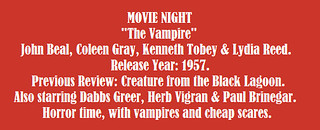
The Vampire (1957).


Review #1291: The Vampire.

Cast: 
John Beal (Dr. Paul Beecher), Coleen Gray (Carol Butler), Kenneth Tobey (Sheriff Buck Donnelly), Lydia Reed (Betsy Beecher), Dabbs Greer (Dr. Will Beaumont), Herb Vigran (George Ryan), Paul Brinegar (Willy Warner), Ann Staunton (Marion Wilkins), and James Griffith (Henry Winston) Directed by Paul Landres (#848 - The Return of Dracula)

Review: 
It does seem like a nice way to tie the month together with a generic-sounding horror film with a vampire, seeing how I started the month with another generic-sounding title film with a werewolf. The one thing that this film shares with that film (aside from being an independent movie) is its science-fiction take on a creature of the supernatural - in this case, a guy turned into a vampire because he accidentally took experimental pills dealing with vampire bat blood and regressing animal minds to a primitive state. The vampire himself doesn't show up for most of its 75 minute run-time (for good reason, as one might say), but at least it is somewhat compelling with its sci-fi/horror crossroad to make it a light curiosity. The acting does tend to do just fine, such as the vulnerable yet humble Beal, who one can at take at face value with his struggle, showing some anguish for a film that badly needs it. The other actors are okay, with Greer generally seeming the most interesting when interacting with our lead, especially when it comes to dealing with the possibility of a "vampire". It isn't so much that the film is boring or such, but it just doesn't have enough of a spark going consistently, particularly with scares. The addiction angle is at least an interesting take when it comes to vampires, but it is amusing to note that the same director, writer (Pat Fielder), and producers (Arthur Gardner and Jules V. Levy) would return to do another vampire film the following year with The Return of Dracula - that actually turned out a bit better when it came to handling its vampire lead, actually. The makeup for the vampire is a bit of a disappointment. It has a lumpy composition, where those big eyebrows and hands make it seem more of a take on Dr Jekyll and Mr. Hyde - of course it should be noted that this creature doesn't have any weaknesses that you would see in any other fictional vampires, where he gets taken down by bullets at the end. I suppose one can only do so much with a low budget (reported to around $110,000), but a tighter design would've gone a long way towards making this a bit more easy to take seriously. Actually, tighter pacing might have also been a big help as well, along with a better way to stage a climax that doesn't just have him just being shot in daylight (no, I am not saying a fight in a dark castle, although that amuses me more than suburban horror). On the whole, this is a film made on the cheap that will do the basic requirements needed that works best when found down the line on a dark cold night with not much else to do.

Happy Halloween. But the fun is not over yet...

Overall, I give it 6 out of 10 stars.

October 30, 2019

Creature from the Black Lagoon.


Review #1290: Creature from the Black Lagoon.

Cast: 
Richard Carlson (Dr. David Reed), Julie Adams (Kay Lawrence), Richard Denning (Dr. Mark Williams), Antonio Moreno (Dr. Carl Maia), Nestor Paiva (Captain Lucas), Whit Bissell (Dr. Edwin Thompson), Bernie Gozier (Zee), Henry A. Escalante (Chico), Perry Lopez (Tomas), Rodd Redwing (Luis), Sydney Mason (Dr. Matos), Ben Chapman (Gill-man - land), and Ricou Browning (Gill-man - underwater) Directed by Jack Arnold (#420 - The Incredible Shrinking Man and #464 - It Came from Outer Space)

Review: 
It should come as no surprise to encounter yet another Universal monster film for the season. There are plenty of films classified under horror in their catalog, where one can't go wrong with many of their efforts, such as The Phantom of the Opera (1925), or The Invisible Man (1933), where even the lesser ones are worthy of curiosity. The 1950s was the decade of television along with the decade of expanded kinds of horror. Whether it was space aliens, giant monsters, radiated mutants, or some sort of offbeat horror, it certainly must've proved a fun time to make something to try and get some sort of entertainment (or perhaps a cheap buck). Universal persisted with their own horror films as well during the decade, with the obvious standout being the Gill-man. Although he did not appear in as many films as say Frankenstein or Dracula, the creature was the only one with its own trilogy of films in the decade for Universal (unless one counts the Abbott and Costello series, which had three horror comedy features in this decade), with its sequels released in the following two years (Revenge of the Creature and The Creature Walks Among Us). In any case, the Gill-man is the last great Universal monster, an ancient amphibious creature of the sea that certainly draw a small bit of sympathy and interest. The monster was designed by former Disney illustrator Milicent Patrick, whose work was overshadowed by makeup artist Bud Westmore for decades; the costume was made by airtight molded sponge rubber for $15,000. It was filmed in 3D, with polarized light projection, which meant gray polarizing filters (as opposed to red-blue), with producer William Alland having originally being inspired by a story told to him by Gabriel Figueroa about a half fish/human myth in the Amazon, writing notes about a "Sea Monster", which was expanded on by writers Harry Essex and Arthur A. Ross, with story by Maurice Zimm. It is safe to say that this is a well-done classic, worthy of being in anyone's horror curiosity. The monster effects look pretty good, with an eerie quality about the way it looks that makes for such an interesting creature to spend time with, particularly with all those bumps and gills along with that face. The acting is fine, with Carlson and Adams carrying the ship okay in the sense that while not completely full-fledged, they each manage to fulfill the necessary things to give the film something other than a big water monster attacking random folks entering its domain. No one goes too off the deep end in camp nor too much seriousness, with the film generally having a reasoned atmosphere, where the monster looms for two environments and seems pretty formidable for 79 minutes, with Chapman and Browning proving well with portraying the monster when needed. The climax is pretty swift, with a little time spent involving the creature and his thing for the leading lady that goes over just fine, and it proved an inspiration for Guillermo del Toro that eventually resulted in The Shape of Water (2017). All in all, this is a pretty entertaining movie, capable of giving off a few scares and thrills with a solid creature and premise (while not falling apart in clichés) that has a sturdy foundation in its other aspects to make something useful in horror from the deep.

Overall, I give it 8 out of 10 stars.

October 29, 2019

Butch Cassidy and the Sundance Kid.

Review #1289: Butch Cassidy and the Sundance Kid.

Cast: 
Paul Newman (Butch Cassidy), Robert Redford (the Sundance Kid), Katharine Ross (Etta Place), Strother Martin (Percy Garris), Henry Jones (Bike Salesman), Jeff Corey (Sheriff Bledsoe), George Furth (Woodcock), Cloris Leachman (Agnes), and Ted Cassidy (Harvey Logan) Directed by George Roy Hill (#962 - A Little Romance and #1178 - Slap Shot)

Review: 
It never proves to be a bad idea to do watch a Western, especially when you have a dynamite trio of actors and a capable director willing to have some fun with a genre as familiar as this one. The 1960s certainly could turn a film genre on its head a bit, as was the case with The Wild Bunch - which was a violent shocking take on the genre released the same year. Really the best representation of this film and its vision of a Western could be the scene involving the sheriff and his attempts at rounding people up to apprehend the two leads, which leads to a salesman trying to push bicycles as the new way to get around instead of horses. William Goldman was inspired by the exploits of the real-life duo of robbers in part because of the fact that they had a second act (running off to Bolivia after their pursuit by the "superposse"); he wrote it as a screenplay between 1965-66, but it initially did not receive interest in part because of the departure to South America by the characters, and numerous actors rejected being the stars such as Steve McQueen, Warren Beatty, and Jack Lemmon. In any case, adapting an Old West legend into its own little tale isn't exactly a new thing, but this is a film that is fairly clever in its approach, being good-natured with where it wants to go without pushing its audience too hard in any one direction, having a bit of fun alongside other moments that make this a worthy Western for anyone. Both Newman and Redford are fun to be around with, with the former having plenty of charm and a sense of humor, which sticks out in most scenes, such as him riding a bicycle with Ross while "Raindrops Keep Fallin' on My Head" (which ended up winning an Academy Award for Best Original Song for its writers, Burt Bacharach and Hal David) plays in the background. Redford is just as dynamic when it comes to garnering a sardonic moment in a role that helped boost him to full-fledged stardom - for good reason. Ross proves interesting as well, making for a fine spark within a trio that holds the ship well. There isn't a big bad like one sees with other Westerns, but the film doesn't really need one to really drive things, where little moments with others work just as fine in giving the film something to tell an interesting yarn that doesn't need all the facts to be a capable Western. The 110 minute run-time proves alright, with its surrounding first and latter halves holding a bit more steady than its middle involving the departure to Bolivia. The action does work out pretty nicely, including one amusing moment with a train and its clerk. It stands out well with its good sense of humor and timing, a pleaser for the crowds that stands just as tall today as it did a half century ago.

Overall, I give it 8 out of 10 stars.

original image:


October 24, 2019

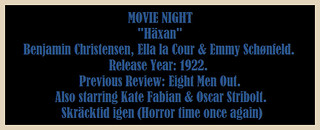
Häxan.


Review #1288: Häxan.

Cast: 
Benjamin Christensen (the Devil), Ella la Cour (Sorceress Karna), Emmy Schønfeld (Karna's Assistant), Kate Fabian (the Old Maid), Oscar Stribolt (the Fat Monk), Wilhelmine Henriksen (Apelone), Astrid Holm (Anna), Elisabeth Christensen (Anna's Mother), Karen Winther (Anna's Sister), Maren Pedersen (the Witch), Johannes Andersen (Pater Henrik, Witch Judge), Elith Pio (Johannes, Witch Judge), Aage Hertel (Witch Judge), and Ib Schønberg (Witch Judge) Written and Directed by Benjamin Christensen.

Review: 
Like goodness in heart, evil can exist anywhere. This proves true when it comes to witches and their part in culture, and how superstition can play a part in hysteria. Christensen had found a copy of Malleus Maleficarum, a late 15th century treatise on witchcraft that endorsed the extermination of witches while recommending inquisitorial practices to deal with them, such as torture. For two years, he spent his time studying manuals, illustrations and treatises on witches and the hunt, striving to make an innovative film that was not merely an adaptation of past material. Häxan (known as Heksen in Denmark) was expensive for its time, made for 1.5-2 million kronor. The film was a Sweden-Denmark co-production, where he used funding from Svensk Filmindustri to refurbish the Astra studio in Denmark; the movie spent over a year in production, where filming was done only at night or on a closed set, while post-production meant that it did not premiere until September of 1922 (in four Swedish cities at once). Its premiere in Copenhagen, Denmark two months later was accompanied by a 50-piece orchestra, complete with a bibliography in its original playbill (an American release did not follow until 1929). Although it is generally regarded as a documentary, it does invoke horror within its dramatized sequences, particularly with its imagery. It certainly is an imaginative work to look at, that much is for sure.

It is obvious to credit the craftsmanship done by Christensen with his third directorial effort (alongside writing and starring) that had begun in 1914 with The Mysterious X - he clearly made the effort to deliver a creepy panorama that seeks to deliver a lesson in the past that still stands tall for the present after nearly a century. He of course is not the only one meriting credit for the film's success, where he thanks the art director (Richard Louw) and cinematographer (Johan Ankerstjerne) for their work on the film. It sure is an unsettling movie to view, where its lecture on cultural history can blend fact and fiction so handily through the lens of a silent film, where patience can be the best virtue to enjoyment. The actors certainly seem game to roll with the weird yet captivating nature of what goes on in its 104 minute run-time, with their weary eyes resonating with its medieval settings (alongside later moments spent in the modern age, where the problem is now hysteria rather than accusations of witchcraft), with Christensen lurking quite well as the beast below without going for camp. Everyone plays it pretty straight, whether involving monks, old and young accused of witchcraft, or inquistors tasked to deal with such fears. One can still think of this film today as still being important to understanding the nature of superstition, fear, and what we hold on to when it comes to belief with fantasy and desire. We may not accuse people of being witches today, but it doesn't mean the real world is free of irrational things that bind us.

There have been a few re-releases and restorations over the years of various lengths. A 1940 Danish release had an extended introduction from Christensen with the inter-titles re-worded, a 1968 Metro Pictures release re-edited the film (now known as just Witchcraft through the Ages) to have narration from William S. Burroughs and a jazz score (lasting 74 minutes), and the Swedish Film Institute has restored the movie three times, beginning in 1976 (finding a decent quality print on the Internet is not too big of a challenge, however). To close it out, let me invoke some words that Christensen wrote for an article around the time this movie was being made: "I would like to know at this time whether a film is able to hold the public’s interest without mass effects, without sentimentality, without suspense, without heroes and heroines—in short, without all those things on which a good film is otherwise constructed. My films consist of a series of episodes that—as part of a mosaic—give expression to an idea.” I think he did just fine in that regard with a film basked in morbid realism that lines up just nicely for the horror season. It takes its time to get going, but when it does find its footing, it works up a storm of interesting imagery and a fine look and music to go along with quite a thrill to look at.

Overall, I give it 9 out of 10 stars.

October 22, 2019

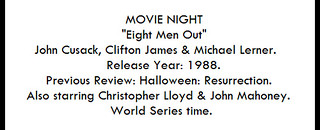
Eight Men Out.


Review #1287: Eight Men Out.

Cast: 
John Cusack (Buck Weaver), Clifton James (Charles Comiskey), Michael Lerner (Arnold Rothstein), Christopher Lloyd (Bill Burns), John Mahoney (Kid Gleason), Charlie Sheen (Happy Felsch), David Strathairn (Eddie Cicotte), D. B. Sweeney (Shoeless Joe Jackson), Michael Rooker (Chick Gandil), Don Harvey (Swede Risberg), and James Read (Lefty Williams) Written and Directed by John Sayles.

Review: 
Yes I know, not a horror film. However, today is the start of the World Series, which incidentally features my Houston Astros, so how could I resist covering a baseball movie? This one had been on my list for quite a while, so it only makes sense to do it now. Enjoy, and let's hope for a wonderful World Series result.

It is interesting to note the passing of 100 years since the Black Sox scandal, in which eight players of the Chicago White Sox were accused of throwing games in the 1919 World Series in conspiracy with gamblers. A public trial ensued in 1921, for which none of the accused players were convicted of any crime, although they were banned from playing professional baseball for the rest of their lives. A tale as old as time for baseball (a sport I adore) undeniably has inspired writers to adapt it into stories. Eliot Asinof wrote an account of the scandal in 1963, while W. P. Kinsella's wrote a magic realist novel with Shoeless Joe (1982, which was adapted into Field of Dreams the same year as this film). It isn't hard to say that baseball fans will certainly have interest in seeing this tale come to life in film while non-baseball fans will have a little harder time getting behind what this movie wants to show with this (questionably accurate) period drama. When it comes to baseball movies, this is probably safe middle ground stuff, doing just fine with its look and some of its ensemble moments while being a bit lacking when it comes to making everything really stick (particularly when it comes to some egregious liberties taken with real events, which is just as true with the novel and its combination of fictional characters into what is meant to be a non-fiction narrative). It clocks in at just a few seconds under two hours, for which the first half proves more favorable than the latter half (what better way to combine baseball cliches than courtroom cliches), seeming to have a few amusing moments with its cast. As such, the highlights include Cusack, Strathairn, Sweeney, and Rooker, with each actor of the conspiracy sticking out, such as Cusack and his bright disposition (even when faced with a bunch of crooked teammates), or the calmness of the others in their belief of that allure one calls more money. Minor highlights include James and Mahoney, making crucial points count just fine. How much guff can one give about accuracy about adapting the scandal to film with source material that took its own liberties with the facts (the Internet sure does help occasionally when it comes to finding tidbits of information, such as Society for American Baseball Research (SABR), who recently had made an article detailing numerous myths about the scandal, such as the White Sox actually having a high payroll (for 1919), or the gamblers being approached by the players (as opposed to the other way around), or the grand jury testimony being stolen (which they simply re-created later on anyway, which didn't have a big effect on the trial). If you really wanted to go further, the Internet is your friend for finding things to pick at (for better or worse). For me, it does tend to rankle me, in part because a film should know a little better about getting more than basic concepts right, especially stuff like Christy Mathewson (famed baseball legend) being the one that helped out the journalist investigation as opposed to Lardner (played by Sayles himself). In the end, I find that the film does best when letting the players speak for themselves along with its baseball action, with its foundation having quite a few cracks that can make this a hit-or-miss kind of movie. For me, it is a fair single, worth a look if one is curious enough for an old-timey but fair-minded day at an old ballpark.

Overall, I give it 7 out of 10 stars.

October 19, 2019

Halloween: Resurrection.


Review #1286: Halloween: Resurrection.

Cast: 
Busta Rhymes (Freddie Harris), Bianca Kajlich (Sara Moyer), Thomas Ian Nicholas (Bill Woodlake), Ryan Merriman (Myles "Deckard" Barton), Sean Patrick Thomas (Rudy Grimes), Tyra Banks (Nora Winston), Jamie Lee Curtis (Laurie Strode), Brad Loree (Michael Myers), Katee Sackhoff (Jennifer "Jen" Danzig), Daisy McCrackin (Donna Chang) Directed by Rick Rosenthal (#268 - Halloween II)

Review: 
"Ultimately, this is a Halloween product that only serves as a pale shadow of the original two films that should have served as the end for this series." Those are the words I said about Halloween H20: 20 Years Later (1998), which had the clearest way to defeat its main horror icon with a chop of an ax. So how does a sequel endure? (box office profits, really). Within the first five minutes of this film, it is explained that when Laurie had chopped Michael's head off, it was (get ready for this) actually not Michael in the mask, since he choked a paramedic and his larynx and had him put on the mask. It's nice to know that even in a mediocre Halloween film, its climax can still be shortchanged by some silly idea like its own sequel. It should only prove that Halloween is a scary time of year for horror films. This is especially true when it comes to horrifyingly bad films, as is the case here, which we should expect with a cliche title like Resurrection. Trust me, the shortchanging doesn't stop there, particularly with the end of the only living interesting character in this series in Curtis (who described the film as a joke, one that she was contractually obligated to do, for which she asked the character to be killed off) by the first 15 minutes. Maybe they really wanted to give a shock to the audience, but the only real scare is in how ridiculous everything turns out to be.

The characters are as cliche as they come, right down to the basic characteristics they all do. Yes, there really is a character that actually tries to apply "critical studies" theories to Michael. Guess how that works out. It isn't even worth the effort to call out the cliche things done here, because this is already ridiculous enough. Imagine casting someone slated to be the final survivor and they literally cannot scream. No joke, Kajlich had to be dubbed in post-production because she cannot actually scream. Nobody really delivers an interesting performance among the ones slated to participate in the "show", so one doesn't care all too much when they start dropping, which minimizes the tension.  Of course it also takes an hour before anybody watching might think that Michael might actually be in the house killing the contestants. If someone wanted to make a live internet horror film (complete with portable camera)s), perhaps it could've worked in making this franchise seem like it wants to do something different, as opposed to just changing the setting for where Michael hunts (which at least seems better than being at a boarding school, I guess). But the show within the film doesn't even seem that interesting to go with, what with the fake skeletons (in the midst of the shape already having killed some of the crew) and then a sequence of another person (take one guess) dressed up as Michael Myers. It is the funniest thing in the whole movie, for all the wrong reasons, where it takes the film into new lows on a horror level but raises the unintentional hilarity levels significantly. Actually, of all the people in this film, Rhymes is likely the one reason to watch this film. How many movies feature a kung-fu fight in fire? Plenty might exist, but none are as relentlessly silly as this turns out to be, which inspires plenty of snickers, particularly since this leads up to a lame cop out ending. Supposedly there were multiple endings considered, with one involving Myers popping out of a manhole and grabbing at someone. But I suppose they really needed to bait audiences further with Myers' eyes opening up suddenly. It didn't matter anyway, since despite the film making a profit (making over double its $13 million budget at the box office), a sequel did not come to pass. Instead, a remake was commissioned, done in 2007 (which was technically better). In the end, this is a movie that represents the last laugh of miserable sequels that does get one thing right: It's all being done for the money.

Overall, I give it 3 out of 10 stars.

October 18, 2019

Freddy vs. Jason.


Review #1285: Freddy vs. Jason.

Cast: 
Robert Englund (Freddy Krueger), Ken Kirzinger (Jason Voorhees), Monica Keena (Lori Campbell), Jason Ritter (Will Rollins), Kelly Rowland (Kia Waterson), Chris Marquette (Charlie Linderman), Lochlyn Munro (Deputy Scott Stubbs), Katharine Isabelle (Gibb Smith), Brendan Fletcher (Mark Davis), and Paula Shaw (Pamela Voorhees) Directed by Ronny Yu.

Review: 
Admittedly, the idea of two monster titans being featured together can still prove an interesting concept when done right. When it comes down to crossovers, one wonders how this compares to films like Frankenstein Meets the Wolf Man (1943), or even monster mashes like King Kong vs. Godzilla (1962). The result is something just a bit under those films, although at least it isn't a complete junk crossover like Dracula vs. Frankenstein (1970) in part because of the fact that it actually has the monsters fight in clear focus. Of course the plot isn't focused on doing anything meaningful besides the fight, as this is a movie beyond mediocre in every respect that ties right down to its bland foundations for things not named Freddy or Jason (complete with a lack of a real reason to bring back either monster). The idea of a fight between these two horror icons was teased ten years earlier at the end of Jason Goes to Hell: The Final Friday, with a gloved hand clawing at the mask of Jason down with the ground. Actually, the desire to make a crossover film had been discussed as early as 1987 (the same year that the third A Nightmare of Elm Street film came out), but the main thing to remember is the progression of each franchise in their films. I've only watched the first two Friday the 13th films, but one can certainly judge for themselves when it comes to the eight (!) installments that followed, with Jason X (2001) taking the character to space. It does seem fun to watch Englund return to the role for the eighth (and ultimately final) time, even if the script seems a bit less interesting for him than it was for the character in the last one, Wes Craven's New Nightmare (1994). Besides four sequels that declined in quality from the last one, the only real low point was the rising silly value for its titular character. At least Freddy vs. Jason isn't something you need total horror franchise familiarity to really go along with some basic horror scares.

Of course, the film itself is just not as interesting as it should be. I shouldn't be surprised that no cast-mates from either film franchise appear, not even to deliver plot exposition, although it should be noted that Betsy Palmer had rejected coming back to play the role of Pamela Voorhees after reading the script (she didn't like the first film's script either, but she did appreciate the pay - don't we all?). Most of the main core aren't unlikable, but they really do seem stuck in a bland high school drama more than a true horror film. Keena is okay, I suppose, in that she at least seems willing to go along with things to a point, whether that means possibly being the final girl or something else. Really the show is more fun when it goes to Englund, such as when he does a little recap in the beginning, which while not as scary as the previous film at least tries to return the character back to creepy roots. Kirzinger sure seems tall enough for such a big role, which I suppose is more than enough when it comes to a role like this. The only interesting thing to really talk about is when the two actually fight each other, complete with attempts at really getting the "action impact". It works alright for the most part, in the same way that it would've been nice to see more showdown fights between these two (or others) where the environments played a role, whether with the dreamworld or near water. Granted, the plot doesn't really do well with setting up how the main characters actually get to Crystal Lake from Springwood so fast, or how there's any sort of propane tanks of any kind at an abandoned place - but whatever. This film is the writing work of Damian Shannon and Mark Swift (at least the ones who ended up getting credit, anyway), who later went on to write the remake of Friday the 13th six years later (because every horror franchise needed a remake for the 21st century). There were numerous endings considered for the film. One of them involved one of the characters sprouting a claw like Freddy Krueger, while another involved an expansion of the dock explosion like before, with a lead-up to Pinhead (from the Hellraiser films) appearing to ask what seemed to be the problem, while another one teased that Freddy and Jason would be in a pit by the end fighting again. On the whole, if you want to see some slasher icons get together to fight, you might have a fine time with this one for the horror season. If you want just a little more from a horror film when it comes to a solid foundation, you might want to try something a bit better.

Overall, I give it 6 out of 10 stars.

October 17, 2019

Fight Club.


Review #1284: Fight Club.

Cast: 
Brad Pitt (Tyler Durden), Edward Norton (The Narrator), Helena Bonham Carter (Marla Singer), Meat Loaf (Robert Paulson), Jared Leto (Angel Face), Zach Grenier (Richard Chesler), and Thom Gossom Jr. (Detective Stern) Directed by David Fincher (#586 - Alien 3 and #705 - The Social Network)

Review: 
Two decades after its release, what can one say about a film like this? The polarizing adaptation of novel of the same name from Chuck Palahniuk certainly has quite a following in the time following a mild run in its initial box office run. One wonders what sort of expectation is to be expected for something like this, a dark satire that happens to have a few fights and a compact cast that make for a fine movie. Sometimes you do need a film that will make you squirm a bit, and this film sure does fine with making some useful points through a run of 139 minutes that runs the gamut without hesitation, never seeming to stumble in trying to deliver a quirky story that hits more often than not. One can appreciate the effort made to deliver something that resembles The Graduate and Rebel Without a Cause, with a conflict involving a generation of all-singing, all-dancing stuff of the world and themselves, where beating people to oblivion seems like a good release. That, or causing mayhem, but that's neither here or there.

Undeniably, the highlight of the film is its main trio of castmates, who are interesting to watch. Norton plays his part with sardonic relish, where his narration carries the story quite well, making for some satirical bite that makes him quite involving to be around, an everyman who happens to visit support groups just to feel something and go to sleep (better than crying or substances, I suppose). It's not hard to recognize something from this character in oneself or others (such as buying things to fill something within themselves is one example I could posit). Pitt is enjoyable, wild as a stick of dynamite that is relentlessly entertaining each time he shows up on screen, filled with marked charisma that does tend to blend well in roughness with Norton, as if it was a coin that always seems ready to land on its side more than anything (which is less of a metaphor than the fighting is, I admit). Carter does fine with the crude side of this triad; she doesn't have as much time on screen as the other two, but she proves worthwhile with dark charm that is somewhat amusing. I'll give credit to anyone who takes a role where you need to wear a bulky harness, especially if one is singer-turned-actor Meat Loaf, who does garner a laugh or two without seeming like a distraction (one of course could insert a reference about other harness performances here, obviously). It sure is striking to see Leto for the brief moments he is on screen in the film's second half. The visual look sure works itself out well, with plenty of unflinching violence alongside other moments. The film was written by Jim Uhls, with several un-credited contributors, including director Fincher and and the movie's co-stars Pitt and Norton. Palahniuk approved of the final product, which he felt kept intact most of the "convoluted plot" of the novel (for which the climax is significantly different) while liking the main three actors when it came to stepping into these characters alongside Fincher's directorial efforts. I can't disagree with that assessment, since the film is well-done in entertainment value while making a concentrated effort to have some sort of meaning beyond fighting or mayhem, where responsibility is the key path instead of some sort of self-serving freedom or something more toxic in its brand. The film is not a perfect one by any means, but I do find it to be an interesting one, holding itself quite well for its start while making its conclusions one to to think about after it ends over a round of discussion with others.

Overall, I give it 9 out of 10 stars.

October 11, 2019

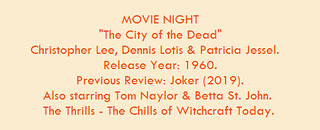
The City of the Dead.


Review #1283: The City of the Dead.

Cast: 
Christopher Lee (Alan Driscoll), Dennis Lotis (Richard Barlow), Patricia Jessel (Elizabeth Selwyn / Mrs. Newless), Tom Naylor (Bill Maitland), Betta St. John (Patricia Russell), Venetia Stevenson (Nan Barlow), Valentine Dyall (Jethrow Keane), Ann Beach (Lottie), Norman Macowan (Reverend Russell), and Fred Johnson (The Elder) Directed by John Llewellyn Moxey.

Review: 
Sometimes the most interesting little gems are the ones that come from England. Or perhaps ones from folks trying to make due with a small reasonable budget, which is the case here with this one from Vulcan Films. Two producers that worked on this film (Max Rosenberg and Milton Subotsky) later went on to form Amicus Productions (a British company headed by Americans) four years later, which dealt primarily in horror entertainment (which I've covered before with films such as They Came from Beyond Space and Tales from the Crypt), which generally had at least one name actor included in the film, which proves true with this one as well. Instead of gothic horror like fellow horror company Hammer, Amicus generally dealt its horror in the present day, with this being the story of a town wracked with a curse after having burned a witch at the stake in 1692. The film had its story done by Milton Subotsky (who also served as co-producer) while its screenplay was written by George Baxt, who eventually got into writing crime fiction. It was originally meant to serve as a pilot for a horror show with Boris Karloff (who would host two anthology series in the decade with Thriller and Out of This World).

The American version (known as Horror Hotel) notably omitted dialogue in the opening sequence involving the curse being a product of a deal by the witch to the devil. The version I watched is the original, which is generally easy to find in the public domain, so the film does roll along with fair ease. With a 76 minute run-time and a budget of 45,000 pounds, the film sure knows how to deliver a tense atmosphere early, with plenty of fog and black-and-white photography to make for a creepy time, complete with calm North American accents said by British people, which goes alright. The cast is fine to watch play out on screen, with Lee being capable as always, even when not needing to play a ham or someone with a few lines from time to time (the case for this one, although seeing his eyes go big when describing the witch burning is fun). Lotis and Naylor make for an okay duo, though the highlight generally falls to Jessel, who can give a chill or two along with the rest of this odd town. The look of the film (with encompassing fog on a compact soundstage) is a key highlight, where one can feel creeping terror in the air without having to ask for more. It has plenty of the horror tropes to follow along with that range from odd townspeople, mysterious disappearances, and other such weird things. It does so without needing to show much blood or anything really grisly, until around the climax anyway, evading being completely paint-by-the-numbers with fair craftsmanship. On the whole, this is a fairly imaginative little film, going by the motions with no problem while leaving its viewer with a fair bit of curiosity to go along with some creeps, which makes this a fine one to recommend.

Overall, I give it 7 out of 10 stars.

October 10, 2019

Joker (2019).

Review #1282: Joker.

Cast: 
Joaquin Phoenix (Arthur Fleck / Joker), Robert De Niro (Murray Franklin), Zazie Beetz (Sophie Dumond), Frances Conroy (Penny Fleck), Brett Cullen (Thomas Wayne), Douglas Hodge (Alfred Pennyworth), Dante Pereira-Olson (Bruce Wayne), Glenn Fleshler (Randall), Bill Camp (Garrity), Shea Whigham (Burke), Marc Maron (Gene Ufland), and Leigh Gill (Gary) Directed by Todd Phillips (#564 - Starsky & Hutch)

Review: 
I would not be the first to admit that this film picked up traction for curiosity in the months before its release. Actually, the interest for most probably was pretty much there from when it was announced back in 2017. It certainly seems to be the kind of film to have staying power, particularly in conversation over its merits as a different kind of comic book film (along with some other conversations about its tone possibly inspiring real word violence, which really does come off as a big joke that could only be done by hack writers repeating the same fear that did not transpire for other films, like Do the Right Thing). It surely has taken influence from films such as Taxi Driver and The King of Comedy, where it tries to ground itself in its look of a man from the other parts of society, where warmth seems like a commodity waiting to be crushed into the ground and chaos seems only fitting for a place like this. Phillips also co-wrote the screenplay with Scott Silver, which certainly likes to play itself as a creepy tense drama along with moments of humor, each of which work themselves well enough to a degree. For all the posturing one could do about the subject matter or its tone, the easiest thing to say in my mind is that Joker proved to be just fine. It isn't a masterpiece by any means (which is apparent if you compare it the two films I just mentioned or not), nor one becomes engulfed by mediocrity, which is certainly fun to say when it comes to having a good time and then having to think about exactly what they just saw.

This is a movie about a failed comedian who ends up turning to crime while dressed up as a clown, after all. If one can see the origin of Batman several times on film in the past few decades, why wouldn't there be an origin on his greatest foe? After all, each portrayal of the Joker (as created by Bill Finger, Bob Kane, and Jerry Robinson) on film has their own take of the criminal mastermind since Cesar Romero in 1966 (with most of them being pretty good, minus the previous one). It only makes sense to do an origin story (of sorts), where it isn't beholden to the outlines delivered by the comics featuring the character on-and-off over seven decades but instead makes its own path forward. In that sense, Phoenix is positively the one for this role, undeniably captivating to watch in seeing such a pained broken man, whether physically or through a matter or laughing. The others of the cast make their moments count fairly well for a film that tries to have its cake of commentary and its origin story with small moments for the supporting characters to grasp at. Beetz is fine, having a smooth quiet chemistry with Phoenix for what is needed, if that makes sense. De Niro playing a homage with a talk show host crossing paths with a failed comedian does work out alright for his few minutes on screen. Conroy and Cullen are just as alright for the needed moments, all things considered. It should come as no surprise that the film indulges itself in violence at times, to where one almost could see this as horror (bit of a stretch, but think about it) rather than a psychological thriller, but it doesn't come off as unnecessary or to the detriment of the film and its intent, which works itself out just fine. It verges as a sometimes thoughtful look on society and what could happen when one's binders to the world around them wears off. The film is a wild weird mess at 122 minutes, but I applaud the efforts to make a dark film out of a comic book, as it is the kind of bold film that will surely have plenty of fans and detractors to write screeds about, for better or worse. It is a movie that is dreary, cynical, riveting, and plenty of other descriptions that fits its title character as well as anyone could really expect.

Overall, I give it 8 out of 10 stars.

October 8, 2019

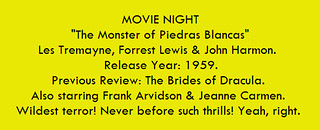
The Monster of Piedras Blancas.


Review #1281: The Monster of Piedras Blancas.

Cast:
Les Tremayne (Dr. Sam Jorgenson), Forrest Lewis (Constable George Matson), John Harmon (Sturges, the Lighthouse Keeper), Frank Arvidson (Kochek, the Storekeeper), Jeanne Carmen (Lucille Sturges), Don Sullivan (Fred), Pete Dunn (Eddie/the Monster), and Joseph La Cava (Mike) Directed by Irvin Berwick.

Review:
I suppose anything goes when it comes to monster movies, whether it involves silly costumes or some other silly aspect to accompany what you could count as horror. My first question was what Piedras Blancas actually was, since it doesn't exactly roll off the tongue, as opposed to those ones that are robots or brides. It actually refers to a light station (complete with its own point and lighthouse in its 19 acres) that is roughly five miles west by northwest of Sam Simeon in California (it also means white rocks in Spanish). Of course this film wasn't actually filmed in that location, instead being shot at a different lighthouse. One would think a film that wants to use a location for its film would actually shoot there, but this is certainly a movie lacking in other significant aspects anyway. Simply put, this is a lame little movie, harmless yet annoyingly mediocre. This was produced by Jack Kevan (in his only production effort), who did makeup work on several films (generally without credit), such as Creature from the Black Lagoon (1954), having supervising the manufacture of the suit used for the film. He created the monster costume for this film as well, which goes...not quite as well. This was released on a double bill with Okefenokee, a swamp movie that does Actually, what made me really amused is that one of the film posters shows the film "winning" a Shock Award from Famous Monsters of Filmland Magazine. If you can't trust posters that display the awards won before it even gets released, what can you trust? (this is where I would likely include a cynical response that lengthens this bland review by a few sentences, but I forgot to include one out of cynicism). One really can goof off when it comes to a film that really doesn't have much energy to it, particularly when it comes to its silly looking monster, which naturally shows up for a small amount of its 71 minute run-time and looks like a melted pig, which is funny since this is supposed to be a reptile. I wonder how I would've reacted to this if I had seen this film after Black Lagoon, but even "inspired" movies can still work if given enough to work with material. I can't even remember a single person from this film, where the acting seems too stiff to really make this seem big to go with. Imagine making a monster movie where the only interesting thing to think about is where you can find a lighthouse to visit just like the people do in this film. I take that back, actually, there is one interesting moment involving a head being carried around by the monster, which probably seems easy to stick out among films of its decade (unless one is Fiend without a Face, that is), so that sure is something. It isn't the kind of thing to move the needle heavily in the film's fate, but at least you can't say it is completely boring. When it comes to bland monster movies, this is easily the template film for that description, suited for a most boring and un-haunted night. Or in other words, a Tuesday.

Overall, I give it 5 out of 10 stars.

October 4, 2019

The Brides of Dracula.


Review #1280: The Brides of Dracula.

Cast: 
Peter Cushing (Doctor Van Helsing), Martita Hunt (Baroness Meinster), Yvonne Monlaur (Marianne), Freda Jackson (Greta), David Peel (Baron Meinster), Miles Malleson (Doctor Tobler), Henry Oscar (Herr Lang), Mona Washbourne (Frau Lang), Andrée Melly (Gina), and Victor Brooks (Hans) Directed by Terence Fisher (#257 - The Curse of Frankenstein, #258 - Dracula (1958), #272 - The Hound of the Baskervilles (1959), #469 - The Revenge of Frankenstein, #833 - Spaceways, #857 - Frankenstein Created Woman, #858 - Frankenstein Must Be Destroyed, and #859 - Dracula: Prince of Darkness)

Review: 
One wonders how to make a horror sequel that will properly live up to the scares delivered by the original, particularly when its title villain isn't even included. The film retains the same director and writer from the first film (Fisher and Jimmy Sangster), albeit with additional help in terms of re-writes from others such as Peter Bryan, Edward Percy, and an uncredited Anthony Hinds. The original idea (titled "Disciple of Dracula", naturally) was a focus on an acolyte of Dracula, who would make a cameo (and likely have just as much dialogue as the character would have in further sequels, no doubt). Lee was not big on appearing in the film in any case (one would have to wait six further years to see him as the title character again and six more years to see Cushing return as well), so re-writes had to be done, which meant including Van Helsing along other things. Even the ending was re-written, in part because of Cushing's objection to the idea of releasing bats through an arcane ritual, seeing it as against his character (one could wonder if there would be quite a cost in getting a whole bunch of bats to fly out at once too), which I admit is pretty correct. You want to know what their solution was? Moving a bunch of sails in a mill in a certain shape after having thrown holy water on him. It can't be called the silliest way to kill the vampire, seeing as I've watched these films go from the obvious way (sunlight) to running water, punctured by a cross from a converted atheist, and my particular amusing one: a hawthorn bush. With that in mind, how is the actual film? Honestly, it is a pretty okay film, considering the fact that its vampire is nowhere near as scary in presence as from before, with Cushing being the highlight as one would expect. It does fine with its runtime of 85 minutes in giving off a careful controlled pace that makes for a few scares without aiming for anything too ridiculous or pale in tone for too long. Sure, it can be silly at times (particularly when it comes to its lead vampire trying to romance others), but one can still have a nice time with where it aims to go without being frustrated at wanting something else on screen. Cushing sure can drive a film forward with calm energy, being as usefully entertaining as one should see from an actor like him, where cliches can do no serious harm. He can talk about vampires or some other force of nature any day of the week, really, and one can follow him anywhere. Monlaur does okay, generally being a mild contrast to the calmly grim presence of Hunt and Jackson, with each doing just well at keeping the film afoot at times. Peel is nowhere near as scary or as interesting as Lee when it comes to a vampire that can be so alluring yet so deadly, especially when it comes to his eyes, but at least one can watch him try to act against Cushing without reaching vigorously for the remote. It's an average affair all around, but it keeps its foundations mostly secure without going completely off the deep end and giving some interesting moments to go along with it. The passion that drives these films seem authentic, where seeing one of these kind of films doesn't make the next one irritatingly familiar. It doesn't compare greatly with its predecessor or its successor, but this film could prove just fine for anyone in the right spirit for some old fashioned (yet neatly crafted) horror from the folks at Hammer from a time long since passed yet highly welcome here.

Overall, I give it 7 out of 10 stars.

October 1, 2019

The Werewolf (1956).


Review #1279: The Werewolf.

Cast: 
Steven Ritch (Duncan Marsh), Don Megowan (Sheriff Jack Haines), Joyce Holden (Amy Standish), Eleanore Tanin (Helen Marsh), Kim Charney (Chris Marsh), Harry Lauter (Deputy Ben Clovey), Larry J. Blake (Hank Durgis), Ken Christy (Dr. Jonas Gilchrist), James Gavin (Mack Fanning), S. John Launer (Dr. Emery Forrest), and George Lynn (Dr. Morgan Chambers) Directed by Fred F. Sears (#255 - The Giant Claw, #265 - Earth vs. the Flying Saucers, and #671 - The Night the World Exploded)

Review: 
The film was certainly helmed by a few pros when it comes to making quick films for entertainment. This is the fourth film I've covered of Sears that was produced by Sam Katzman, who had produced films from 1934 to 1972 that ranged from a variety of genres such as adventure, jukebox musicals, and horror (Robert E. Kent, writer for the film, also wrote for some of Katzman's films), primarily done on the cheap. In a decade where science fiction could certainly mingle with horror on occasion, it shouldn't be surprising that this film tries to mix the two together (after all, this was released as a double bill with Earth vs. the Flying Saucers), with the cause of the lycanthropy this time around being irradiated wolf serum than anything supernatural. Also, he doesn't merely transform in the night-time only, he just turns into a wolf if he is under emotional stress. In any case, this turns out to a be a passably okay movie that does fine with entertainment if one does not have high expectations or just wants to have some sort of horror for the night, unless one could watch something like The Wolf Man (1941), of course. It doesn't have too much in terms of compelling drama, which clearly tries to shake things up with the wolfman actually having a wife and son - for which they share just one scene together. Of the group of actors here, Ritch is likely the highlight, and he proves just fine in showing some anguish, mostly because the rest seem a bit too stock to really make an impact. It moves at a careful pace for 79 minutes while being occasionally hokey, but at least the film looks like it wants to move frights forward. Honestly, if you take out the werewolf part, this could just be a fugitive film, complete without weirdo scientists who like to give people serums and do coverups. Imagine thinking the best way to survive an apocalypse is to give people radiated serum - was their second idea to give them super hemlock? At least the film doesn't skimp out on giving us a shot of the wolf in action (which isn't just only for the dark), which looks okay. It just seems that the wolf should really just be seen in the night, as opposed to a big fur man being seen out in the daylight. The fact that the climax shoots shots of the wolf in day-for-night doesn't really help, either. Naturally, in a film with a weird setup to get a werewolf, of course the creature is taken down by a bunch of bullets by a posse. I'm almost surprised he didn't just faint from exhaustion or something else. Sometimes you really need something weird to make it go. Ultimately, this is a pretty average movie, not quite a winner for my eyes, but it does enough on the horror angle to at least make it seem a worthy curiosity.

Overall, I give it 6 out of 10 stars.

September 28, 2019

Legal Eagles.

Review #1278: Legal Eagles.

Cast: 
Robert Redford (Tom Logan), Debra Winger (Laura Kelly), Daryl Hannah (Chelsea Deardon), Brian Dennehy (Cavanaugh/Joe Brock), Terence Stamp (Victor Taft), Steven Hill (Bower), Christine Baranski (Carol Freeman), Roscoe Lee Browne (Judge Dawkins), David Clennon (Blanchard), John McMartin (Forrester), Robert Curtis Brown (Roger), Grant Heslov (Usher), Sara Botsford (Barbara), and Jennifer Dundas (Jennifer Logan) Directed by Ivan Reitman (#026 - Ghostbusters, #031 - Ghostbusters II, #243 - Stripes, and #487 - Twins)

Review: 
It doesn't take too much time to think that this film could seem interesting. The original idea was to make a buddy film involving Bill Murray and Dustin Hoffman, but when those plans fell apart, Redford expressed interest in doing a romantic comedy, which inspired changes to a dynamic reminiscent of Katherine Hepburn-Spencer Tracy films. The screenplay and story were done by Jim Cash and Jack Epps, Jr, with Reitman contributing to the latter. In a sense, this film is a romance. Of course it also happens to have a sense of comedy, thriller, and courtroom drama packed into its two hour duration, which turns out to be a most unwieldy combination. It certainly seems too packed in to really make the impact it wants to make, which results in a thoroughly average film. It complicates itself too much without really getting a feel for the simple things that can make a film tick: just having fun. One instead sees something that is bound to certain excesses (namely its budget of $40 million) and not working as great whenever it tries shifting gears between rom-com and thriller. There either seems to be too many characters or not enough that actually seems worthy enough to invest in. At least the performances are fine to watch, with Redford and Winder coming out the best, since they at least seem like they are having some sort of chemistry together, whether when trapped in buddy scenarios like an exploding warehouse or some other odd scenario, like Redford and his character that likes to tap dance when unable to sleep (gee, where do you think they'll go with that quirk). Hannah and her performance artist-turned-accused robber/murderer does okay, giving off a laugh or two, but she seems stretched pretty thin in actually making her presence really count, odd but harmless. When she actually does try to romance Redford and his character, I'm just twiddling my thumbs more than anything. Dennehy does just fine, snide yet worth seeing. The other members of the cast don't have as much to really do, seemingly there just to fill time and plot, which is a shame. How does one make a buddy movie with lawyers seem so awkward? One cannot help but wonder if this film needed more or less re-working to really hit its mark (it most certainly needed a trimming down). Actually, there exists an alternate version in which Hannah's character is found to be guilty of one of the murders. I guess that could've proved interesting, though I wonder if that version had more focus. The film just comes and goes, whether in the courtroom or somewhere else. At least one might get some sort of enjoyment over spectacle for the film, what with a climax involving a burning building and all, but its setup doesn't really leave much to give investment over. Their fates never seem to be hanging too much in the balance, and guessing who the real culprit is gets to be pretty easy when the others start dying off. It just seems like a movie too safe to either be really funny or usefully dramatic, trying to get its hand in many genre jars and getting only crumbs in return. It's a bland movie, but at least one could probably come out of it without groaning too much for two hours. I can't call it a winner, but it could probably work as a lark if faced with nothing else to do.

Overall, I give it 6 out of 10 stars.

September 26, 2019

Ad Astra.


Review #1277: Ad Astra.

Cast: 
Brad Pitt (Major Roy McBride), Tommy Lee Jones (H. Clifford McBride), Ruth Negga (Helen Lantos), Liv Tyler (Eve McBride), Donald Sutherland (Colonel Pruitt), John Ortiz (General Rivas), Greg Bryk (Chip Garnes), Loren Dean (Donald Stanford), John Finn (General Stroud), and Kimberly Elise (Lorraine Deavers) Directed by James Gray.

Review: 
Admittedly, the interest for this film was fairly mild, with tinges of interest revolving around the approach of making a hostile space sci-fi movie, which one could probably see resembling Joseph Conrad's Heart of Darkness. If the film is at least halfway accurate to reality with regards to space, that also helps too. Really though, one film I did see some parallels with was First Man (2018) with its focus on a closed off astronaut who holds in his fear for an important mission. Then again, that film didn't have a lead that voiced over several parts of the film, wonderful shots of other planets, killer baboons, or moon pirates. Really, with all that in mind, this likely could have been one of the most interesting space adventure films to come out in the past few years (this said for someone who hadn't encountered Interstellar first). It sure turned out to be an unbelievable movie - one that is so unbelievably average to the point of frustration. This feels like a film that needed another re-draft (for a film co-written by its director alongside Ethan Gross), and this is for something that reportedly had re-shoots that drove its budget higher than the initial $80 million - but does one need to know the budget to care about a movie? No, but it sure helps to make a movie that looks good and entertains just as well too.

There are highlights to be found here, such as the opening sequence involving a free fall to Earth. It is quite mesmerizing, seeing someone fall and fall to the Earth, even if you know that they will come out of it in at least one piece. The lunar rover scene with pirates on the Moon (or in other words, star pirates) is pretty captivating, interesting to view through the lens of space. The film also does have plenty of wonderful shots of other worlds, including when it finally encounters Neptune and its lovely rings. It just so happens that the film nearly collapses with the parts besides the ones I just mentioned. The loneliness of space sure seems like an interesting concept to go with, a better concept would be to make one that has two consistent halves to it. It does roll just fine for its first half in setting up its one useful lead and getting to Mars, but it sure does seem to seem less steady after that point. The baboon fight beforehand should've proved a worry already, but it barely even inspires a concern that our hero (I guess) will come out of it alive. By the time the film trudges to its climax, its attempts at inspiring some sort of spark of hope through an undeniably bleak and cynical foundation comes off as an utter joke. This is a film that makes cracks at having restaurants on the Moon with pricey blankets for the flight over there. It also seems to have shock for its main character that he won't get to go from Mars to Neptune to actually confront his kooky father (take your pick on how he reacts to that). Pick one tone and stick with it, especially since it probably could have just shown some actual moments around the locations it wants to go. But no, one really needs to see the plight of the sad lone space man again and again. The benefit is that a less competent director might have made these seem downright maudlin as opposed to mildly sobering. You know what did better as a one-man space film? Moon (2009), which actually knew where to go with its main character and his own crisis within the human element for a sci-fi film.

Nobody delivers a terrible performance, but they sure look constrained by what the script requires, especially a criminally wasted Jones. His scraggly beard and weary nature beg for more to do than this. Oh sure, Pitt looks to be gnawing at the idea of a literal one-man show where you can see his stoic nature to space travel and accompanying voiceover over being alone just fine. One can only take so much before wanting to just find something else to view alongside him, especially since nearly every other character is hopelessly incompetent or a shadow. Jones may be wasted, but Tyler and Sutherland make their own captivating contention for being underused. You could take Tyler out of the film and barely anything would feel different. Sutherland only seems to be there just to spew plot points before his 20 minutes are up. Maybe I am being a bit too harsh on these folks, or perhaps this is exactly the kind of film that deserves better and should do better. Mediocre movies can be tiresome, high-priced ones that can't live up to their own premise without nearly poisoning its own foundations with a big d'oh are especially tiresome. On the whole, Ad Astra does deliver on some of its promises when it comes to spectacle and a decent one-man show from Pitt. It proceeds to bewilder and frustrate for two hours by being as ridiculously self-serious as it wants with such amusement that it almost becomes parody. Perhaps a re-watch could give a bit of clarity and understanding to what makes this film tick, but one could just re-watch other better sci-fi films of its ilk instead. On a ranking scale, it would get a C, but since I use numbers, I suppose it averages out to being one to recommend, if only by slim margins. It is watchable, if not one to grumble at sometimes.

Overall, I give it 7 out of 10 stars.

September 24, 2019

Mean Streets.


Review #1276: Mean Streets.

Cast: 
Harvey Keitel (Charlie Cappa), Robert De Niro (John "Johnny Boy" Civello), David Proval (Tony DeVienazo), Amy Robinson (Teresa Ronchelli), Richard Romanus (Michael Longo), Cesare Danova (Giovanni Cappa), George Memmoli (Joey), Martin Scorsese (Jimmy Shorts), David Carradine (Drunk) Directed by Martin Scorsese (#990 - Taxi Driver and #992 - The King of Comedy)

Review: 
"You don't make up for your sins in Church; you do it on the street; the rest is bullshit and you know it."

It is amazing sometimes to see where a director can go in their path from turning ambition (or someone else's ambition) into something worth being on screen. Scorsese developed a love for cinema from childhood while growing up in Little Italy in Manhattan (with his experiences living there inspiring this film's story), and he subsequently attended  New York University's Tisch School of the Arts, making a few short films before making his debut feature film with Who's That Knocking at My Door (1967), starring Zina Bethune and Keitel in his film debut, which dealt with Catholic guilt. This film also deals with guilt through the lens of a crime film. After serving as one of the editors for the acclaimed documentary Woodstock in 1970, he directed his second film Boxcar Bertha with producer Roger Corman two years later, he was encouraged by actor/director John Cassavetes to make something based on his own ideas, which led to this film (with Scorsese doing the story and co-writing the screenplay with Mardik Martin). Mean Streets was done in a period of 26 days, with Los Angeles being the primary location for all but six of those days (spent where the film was primarily set, New York). Incidentally, Corman offered to fund the film (which ultimately was made for around $500,000) at one point, albeit with an all-black cast. Scorsese found funding with tour producer Jonathan Taplin and eventual distribution from Warner Bros that meant he could do the film as he wanted.

Ultimately, this film is a testament to how someone can really make a film come alive with the right sense of passion and a dynamic cast behind it. It has endured for over four decades in part because of how much it still resonates as a crime drama with its dealings of guilt and sin in the streets. It surpasses its small budget in most areas alongside its surroundings to be something quite captivating in its style that captures plenty of grime through its 112 minute run-time without becoming overwhelming. It moves at its own pace with plenty of control that one could expect from a capable director who wants to make a story come alive without having distractions in the way. With Keitel and De Niro, one can't help but be interested in what happens next, both having an aura that is magnetic whenever either is on screen, the case being especially strong for the former. You can really see the conflict with Keitel pop out on screen without having to be spoonfed direction, where his ambitions and feelings hit their own sort of crossroads. De Niro is a wild fire that burns just as fast whenever he makes his impression, such as reacting to being called a "mook" in the middle of a friendly transaction that evolves into a friendly fistfight. The rest of the cast does just as well, with Robinson having a careful slice of chemistry with Keitel while also being quite watchable, and Proval and Romanus make for a good team with the others. In a film that doesn't have or need a clear hero or villain, the film more around with its own aims and aspirations, where the fights are more inward than anything (although its fistfight is pretty well done) and the spectacle is in how all the drama plays out. There are plenty of crime films to go around, but it doesn't mean that they can't still seem fresh to follow with, with this one seeming like a template for other films to follow (particularly with its use of period rock music). The film ends when and where it needs to end up while leaving its audience entertained and interested in discussing what they saw. It does fine with living up to expectations that one could expect from a director like Scorsese with his first major breakthrough, hitting most of its marks just fine. It aims for the real side of a life in the streets racked with guilt and crime and succeeds without compromise.

Overall, I give it 9 out of 10 stars.

September 21, 2019

Rambo (2008).


Review #1275: Rambo.

Cast: 
Sylvester Stallone (John J. Rambo), Julie Benz (Sarah Miller), Paul Schulze (Michael Burnett), Matthew Marsden (School Boy), Graham McTavish (Lewis), Rey Gallegos (Diaz), Tim Kang (En-Joo), Jake La Botz (Reese), Maung Maung Khin (Major Pa Tee Tint), Ken Howard (Father Arthur Marsh), and Supakorn Kitsuwon (Myint) Directed by Sylvester Stallone (#047 - The Expendables, #277 - Rocky II, #340 - Rocky III, #597 - Rocky IV, and #1163 - Rocky Balboa)

Review: 
It is interesting to come back to this series, which sprung to life with the adaptation of David Morrell's novel First Blood in 1982. In changing the nature of the character and his fate to make for a film like that one, sequels followed in the later part of the decade. Rambo: First Blood Part II (1985) was a pretty ridiculous experience, but it was a good adventure for what it was worth. Rambo III (1988) proved to be a hollow experience, but at least one didn't find themselves with a lingering taste of tiredness, silly but passable in the right circumstances. Two decades passed before a new film came out, due to Stallone not having a compelling story idea to return to the role, one that he felt was one of a man lost in the world and wandering it while hating the very thing he is. This isn't so much a curtain call for Stallone and his character as much as it is a revitalization of what made him such a compelling force to be reckoned with in the first place. It is a grim movie with plenty of (fake) blood that uses the real world conflict in Myanmar (Burma) for effect, if only because it just gives Rambo reason to just go all-out on faceless bad guys in his rescue mission once again (whether it happens to be POWs, his military commander friend, or this film with missionaries). There are two ways to look at this film: it can be pretty riveting with its action, dreary but watchable with Stallone at the helm that at least hasn't become a neutered shell of itself. On the other hand, it can be thought of as a brutal, ugly film that becomes more and more cynical before it decides to reward itself with cheap thrills that satisfy the basic need to see a whole bunch of blood and not much else. To me, each resulting sequel gets more and more ridiculous in their attempts at depth when compared to the original, but at least they stay watchable. Stallone stands his ground this time around, a burnt-out warrior who doesn't say much but doesn't really need to say anything that he can't do with a trusty weapon and a reason to persist on. With the passing of Richard Crenna five years earlier, who does one turn to as the main supporting character? The film pretty much leaves that empty, whether intentionally or not. Sure, you have scenes with Stallone speaking with others (which can be pretty much counted by an old stopwatch), but I never really seem to care about anybody other than the lead. It isn't so much a problem of likability as it is more a problem of them seeming more like composites than real people to go along with. In that regard, the acting is just okay all around, with Benz and McTavish making the most impression  The most memorable adversary, supporting character, and impact all still come from the same film - the first one. The most interesting sequence in the whole film is the bloodiest, involving a big machine gun, which complements the idea that these films only get rougher with age. Perhaps the sequence at the end where he goes to see his dad would've been the top one, if it didn't segue into the closing credits. On the whole, this is a film that just goes with the flow of what it think people want from a new 91 minute installment of a burnt out hero done by Stallone - brutal, with plenty of roughness to go around, for better or worse. I shrug my shoulders (and a coin) in the air, because some films really do just fall in the middle. In this case, I recognize the film for doing the basic requirements for an action film, give the film mixed credit for its surroundings, and then say that it would do just fine on the shelf with the other films. In other words, it's fine.

Overall, I give it 7 out of 10 stars.

September 19, 2019

First Knight.


Review #1274: First Knight.

Cast: 
Sean Connery (King Arthur), Richard Gere (Lancelot), Julia Ormond (Guinevere), Ben Cross (Prince Malagant), John Gielgud (Oswald), Liam Cunningham (Sir Agravain), Christopher Villiers (Sir Kay), Valentine Pelka (Sir Patrise), Colin McCormack (Sir Mador), and Alexis Denisof (Sir Gaheris) Directed by Jerry Zucker (#585 - Top Secret! and #664 - Airplane!)

Review: 
Making a medieval movie certainly is a familiar one, especially when it comes to the King Arthur legend. It seems irresistible to compare this film to Excalibur (1981), but there are key differences present in the script, with a screenplay from William Nicholson and a story from Lorne Cameron, David Hoselton and Nicholson that takes inspiration from the writings of Chrétien de Troyes regarding Lancelot and Arthur, which has an absence of fantasy elements. The age difference in this love triangle is also significant, with Ormond being out-aged by Connery and Gere by 35 and 15 years, respectively. But this really isn't a movie where one can just use the age as an easy out to give a critique. No, this is a film that is already pretty mediocre enough to sink itself, squandering its cast alongside an entertaining Jerry Goldsmith score with a film that doesn't have enough energy in the right places to make this a consistently worthwhile experience. When one thinks a battle sequence would help the film get going, the film eventually proves that seeing people fight with swords and mini crossbows doesn't quite pan out this time around. Connery takes 30 minutes to appear, which means one will spend quite a bit of time seeing the presumed seeds of chemistry between Gere and Ormond being planted, which really seem more like dollar-store seeds more than anything. If you had a part in making a King Arthur play in high school (or less generously, middle school), you would likely find more interest present between these two characters that actually resonate better than what is seen here. Even having Connery in the picture doesn't help this love triangle seem anything more than a badly written romance novel, as if one needs campiness to make this have a spark. Gere comes out of it the worst of the three, not seeming interesting enough to really drive things into suspense, whether with a sword or with a woman, while Connery seems so mildly interested in what the script says as a paragon of virtue nearing his end (nice to make a centuries-old spoiler), and Ormond manages to comes off okay. The two share just a kiss, as if any more passion would prove too shocking or riveting. Cross doesn't prove too well as a villain, perhaps because the film is too dull to really make him seem like an interesting one to follow around, especially when it comes to the final fight, notably done with CGI swords to make for faster movements. Gielgud makes a small appearance that works just as well as one could expect without being a mark of ridiculousness for the famed actor. There just happens to be too much baggage and not enough energy, honestly. If you don't have tension nor passion in a film like this, you have a disappointment that proves to be a utter frustration to sit through, where one can pick at its failings and still wonder what they missed. It isn't laughably bad, but it sure isn't a fun one to go through, whether one is big on the King Arthur legend or not.

Overall, I give it 6 out of 10 stars.

September 17, 2019

Sky Captain and the World of Tomorrow.


Review #1273: Sky Captain and the World of Tomorrow.

Cast: 
Jude Law (Joseph Sullivan/Sky Captain), Gwyneth Paltrow (Polly Perkins), Angelina Jolie (Commander Francesca "Franky" Cook), Giovanni Ribisi (Dex), Michael Gambon (Editor Paley), Omid Djalili (Kaji), Bai Ling (The Mysterious Woman), Julian Curry (Dr. Jorge Vargas), Trevor Baxter (Dr. Walter Jennings), Peter Law (Dr. Kessler), and Laurence Olivier (Dr. Totenkopf) Written and Directed by Kerry Conran.

Review: 
Influences can be a wonderful thing. On the one hand, the film takes inspiration from films/comics of the 1930s like Flash Gordon, but on the other hand it also has inspiration from designers of the 1939 World's Fair like Norman Bel Geddes. A decade before the film's release, Conran had started work on making a teaser trailer for his idea in his living room with a bluescreen, spending four years on the project. Eventually, there was enough interest to make the film come to life, albeit as an independent film with plenty of producers for $70 million (or at least that is the reported figure for it, but regardless the film was not a success with audiences upon release). There are numerous things to be said for the film when it comes to its effects, since it is mostly done on a digital backlot. If anything shines, it is likely the digital artists and the crew tasked with making this world come alive. This is a film being sketched out via storyboards (hand-drawn) to be re-created as an 3D animatic by computer. This is a sibling type of contribution, with Kerry serving as writer and director, his brother Kevin serving as concept artist, production designer, and costume designer while his sister Kirsten served as art director. I can certainly applaud the efforts done here for a film that is very ambitious but also a pretty average one. It isn't a laughable experience, in part because one does find some time to gaze at what is going on around the actors, such as giant robots, sky ships, and so on. There is certainly a wonderful look present here that springs to mind the styles of the past that even springs to the characters, which can be hit-and-miss. The story certainly seems like a blueprint for the modern movie era, where one can make a bunch of references that try to distract from its own familiar story; it at least isn't a self-aggrandizing kind of experience, goofy yet friendly to sit through its 106 minutes. Law is up to some of the tasks associated with an adventurer lead, having some charm that comes with the territory that makes him somewhat interesting to go around with. Perhaps the implied history he has with Paltrow's character should've been shown more (as opposed to sprinkling scenes where they talk about it throughout), since they barely have any kind of chemistry with each other. One could just describe their scenes as aloof, as if I need reasons for a reporter to come along to an investigation about missing scientists and giant robots that steal stuff. Paltrow is just okay. She is playing a mildly interesting but familiar type that she makes come out in bits and pieces.  It's amusing how mild these two are when it actually would be interesting to see the others more, such as a lingo-spewing, eye-patch wearing Jolie that proves useful for the five (or so) minutes she shows up, or the robot assassin in Ling that never speaks, or even just Ribisi with talking the tech of this odd world. One wonders what to say about the digitized appearance of Olivier (who had died in 1989) into the movie to serve as a hologram of someone who had (are you ready for this) died decades earlier. So yes, he is used to essentially play a ghost of a mad man, which is pretty amusing, really. It just means that there is no real villain to speak of, since all the other adversaries are just robots, all tasked to do a dastardly plan like this. Sometimes you really need a cackling over-the-top villain. I suppose at the end of the day one has to wonder if the film is worth spending time with. Does it serve as a fine experience with plenty of distractions fitting for sci-fi action/adventure films? In my mind, I shrug my shoulders and leave it up to you. Sometimes it proves good to say a movie is "fine", sometimes it doesn't. I guess that this works out in the movie's favor, playing well as a curiosity with mild expectations that won't be forgotten too hard among other sci-fi adventure films.

Overall, I give it 7 out of 10 stars.