February 27, 2019

Saturn 3.


Review #1194: Saturn 3.

Cast: 
Farrah Fawcett (Alex), Kirk Douglas (Adam), Harvey Keitel (Captain Benson; voiced by Roy Dotrice), and Ed Bishop (Harding) Directed by Stanley Donen (#137 - Bedazzled (1967), #227 - Singin' in the Rain, #346 - On the Town, and #1029 - Charade)

Review: 
Whether a film is good or not, even the terrible ones can have an interesting story to tell about how it came to be. John Barry was a production designer for hit films in the 1970s such as A Clockwork Orange (1971), Star Wars (1977), and Superman (1978). He had expressed an interest in making a film of his own, and he approached Stanley Donan with an idea that would be presented as a Gothic sci-fi thriller. Although Donan was not interested in directing the feature due to not having much interest in science fiction, he encouraged Barry to develop an outline, which he developed into a draft that he showed to Donan. He felt that the idea could work for Barry's directorial debut, albeit with a need for help with developing the screenplay. Martin Amis (writer of novels such as Dead Babies but who had no prior experience with screenplays) was enlisted to develop a draft, which was presented by Donan to Lord Lew Grade (producer of shows such as Thunderbirds and The Prisoner) in 1978 for consideration. While having the script in his possession on an airplane trip, Grade happened to be seated next to Fawcett and her representative; he showed her the script (under the working title The Helper), and she expressed interest, which led to her making a deal with Grade to be in the project. After signing Douglas and Keitel, the film had their prime trio and began production in late January 1979. Donen described the film at one point as “...both sensuous and sensual, full of chills, fright and horror. It’s science fiction, but not ‘comic strip’ SF....It’s something of a Frankenstein story, and meant to frighten audiences in a very unusual way.” Colin Chilvers dealt with the construction of the robot, which cost over $1 million to make, while Stuart Craig was charged with production design, such as the interior of the Titan research station - it should be noted that the Saturn 3 set took over four months to build while running a distance of 280 feet for a film with a final budget of $10 million, with production overruns from Raise the Titanic (ITC Entertainment's other big production at the time) resulting in cutbacks for this film.

As much I do not like to emphasize age when it comes to a film, it certainly is a bit odd to see Fawcett and Douglas as a couple, in part because of the 30 year age difference between the two. Originally the idea was to have Sean Connery cast in the role of the older male lead, but plans fell through for that, leading to Douglas being cast. Douglas had strife with Barry, whose time as director proved short. Two weeks into production, he left the production, with Donan stepping in as director. Donan stated that Barry's departure was due to Barry's lack of experience on a film set in dealing with actors and staging scenes (as said by Donan, while calling him a "terrific talent"). It should be noted that the film has a run-time of 88 minutes; at least fifteen minutes were cut out of the movie (reportedly due to Grade's objection to them), with one notable scene being cut out involving a dream sequence of Adam killing Benson after the two try some sort of space pill. It should be mentioned that there also existed a television cut of the film that was 96 minutes long that included extensions and additions while toning done some of the film's violence. The final little nugget of weirdness came when Keitel refused to post-synch his dialogue, leading to a re-dubbing of his character by Roy Doctrice. Imagine making a film relying on three main characters and having one of them not even use their own voice the whole time - it sure is a strange thing.

With all of that background, it is no wonder that this did not turn out to be a great film. It is a tremendous exercise in ridiculousness for the science fiction genre, having a hodgepodge of cliches that make the movie seem like a strange blend of numerous movies, such as Alien (1979), Forbidden Planet (1956), but also Demon Seed (1977) while being worse than all three. It is a strange little movie, having no real sense of tension or wonder while having one of the stranger love pursuits - this time with a nutty creep and his lumbering Frankenstein robot (powered by baby brains). It is pretty evident that this script must have gone through numerous revisions, which reminds me of the Infinite monkey theorem (a monkey hitting keys at random on a typewriter keyboard for an infinite amount of time will almost surely type any given text) and if it was like that, but with script doctors. How can anyone make dialogue such as "Your body is very beautiful. I'd like to use it" or scenes such as Douglas (wearing no clothes) choking out Keitel work without making someone cringe (or giggle)? Fawcett seems to come out of it with the least lost, in part because her warmth and charm works just fine that fits the horror type okay. Douglas is simply not the right guy for the part, but at least he is hammy enough to enjoy in his attempts to have chemistry with Fawcett. Keitel (or more specifically, Doctrice) is creepy, but he isn't too particularly interesting to go along with, not having enough menace to really make this seem worthy of chills. By the time the film tries to pull a shocker for a climax (at least I assume its supposed to be surprising), the film already has run out of air. At least the robot seems interesting, but it seems as if they really wanted to make something different involving this robot as some sort of innocent Frankenstein's monster type, but really it is not much more than a killer robot that inhabits passion for Fawcett. The effects are decent, and the sprawling set is interesting - but it can't elevate the movie and its material to anything captivating. What we have here is a movie that is occasionally weird to point and look at while perhaps having a laugh, but what we don't have is something that is actually any good. It is a middle-of-the-road kind of film that can't be trashed as all-around terrible (despite some efforts on the part of the film) nor one that merits much of a following. It could be worth it as a curiosity for someone looking for a ridiculous failure piece - or some groans.

Next Review - Raise the Titanic.
 
Overall, I give it 5 out of 10 stars.

February 25, 2019

Alita: Battle Angel.


Review #1193: Alita: Battle Angel.

Cast: 
Rosa Salazar (Alita), Christoph Waltz (Dr. Dyson Ido), Keean Johnson (Hugo), Mahershala Ali (Vector), Jennifer Connelly (Dr. Chiren), Ed Skrein (Zapan), Jackie Earle Haley (Grewishka), Jorge Lendeborg Jr. (Tanji), Lana Condor (Koyomi), Eiza González (Nyssiana), Idara Victor (Nurse Gerhad), Jeff Fahey (McTeague), and Rick Yune (Master Clive Lee) Directed by Robert Rodriguez.

Review: 
It is astonishing to see the amount of time that it took for a film to progress from concept to product. James Cameron was attracted to the idea and wanted to write and direct a film adaptation (with a domain name for the film being registered as early as 2000), although he held off doing the film for other projects such as Dark Angel and Avatar (2009) before deciding to focus his energy on making sequels to the latter. Cameron wrote a screenplay that was accompanied by hundreds of pages of notes, and he shared the script (which he co-wrote with Laeta Kalogridis) with Robert Rodriguez (director of films such as Desperado and Sin City) in order to see if he could help condense it into a working shooting script. Satisfied with his result, Cameron hired Rodriguez to direct the film, while serving as producer (along with Jon Landau). The film is based off the cyberpunk manga series Gunnm (also known as Battle Angel Alita) that was created by Yukito Kishiro that was run in Business Jump magazine from 1990 to 1995. I suppose the enjoyment level is much like when watching a comic book movie, complete with story beats that will occasionally feel familiar but still manages to generate excitement and entertainment. Sometimes you just need a movie with cyborgs beating each other to shreds (including one fighting with a legendary martial arts style), bounty hunters named Hunter-Warriors, and a gladiator sport in Motorball that feels like a hyper version of Rollerball (1975). It's a fun piece of spectacle that never really stumbles in its aspirations, even when its attempts at setting up further adventures can seem a bit clumsy. It feels just fine at 122 minutes, having a fine pace and balance.

Salazar (utilizing a motion-capture suit alongside big CG eyes) delivers a capable performance, being an interesting hero to follow in her journey, and she pulls off a well-done job in showing the growth of her character throughout the film without testing the audience's patience or feeling too sudden. Waltz, essentially playing the wise old man type, does fine with dealing with tech-spewing and such. Johnson is fairly effective in keeping up with the quickness of the film while also having a bit of chemistry of Salazar alongside some offbeat moments that eventually prove itself for its climax. Ali and Connelly play their conniving parts with relish when needed; Skrein and Haley are quite entertaining in their menace when playing off against Salazar that makes for some well-done action sequences together. Undeniably, the film is a winner in the visual department, with Weta Digital doing a great job in engineering a product that manages to balance itself into not abusing CGI into a crutch or being too glossy. The Motorball sequence is a clear fun example of that, being dazzling without feeling like a distraction or an excuse to show off without reason. The punches that the film tries to pull within its climax (or more specifically where it is trying to go) work just fine, particularly if you are into what the movie is trying to sell you on (again, much like a superhero movie trying to do some world-building). The film certainly has enough action to go around, with plenty of (blue) blood being spilled in its cyborg showdowns that prove one can really do anything with cyberpunk action if the budget (roughly over $150 million dollars) is right. On the whole, I wasn't at all familiar with the material that the film is based on, but it didn't interfere with what I found to be a pretty entertaining experience, filled with action and spectacle to go along with a neat little story that will prove a winner for people looking for something packing with action and science fiction in one package. Whether there is further adventures about Alita coming or not, I can say that it is one that certainly will merit an audience that appreciates the effort to bring itself on screen.

Overall, I give it 8 out of 10 stars.

February 23, 2019

The Vampire and the Ballerina.


Review #1192: The Vampire and the Ballerina.

Cast: 
Hélène Rémy (Luisa), Walter Brandi (Herman), Maria Luisa Rolando (Countess Alda), Pier Ugo Gragnani (Professor), Tina Gloriani (Francesca), Isarco Ravaioli (Luca), and Gino Turini (Giorgio) Directed by Renato Polselli.

Review: 
It isn't often I cover an Italian film. This is the sixth one I've covered as part of the World cinema run and the first since Star Odyssey last May (with this one having subtitles instead of dubbing). I hope you enjoy.

I suppose there really is no better way to show your appreciation (or influence) to vampire films than to make one that seems like a patchwork of other movies, such as Dracula (1958), for example. Granted, that movie didn't have multiple scenes of dancing (including a vampire dance), but it is clear to see where they may have gotten the idea to make a spooky little film with a bit of romantic appeal, one might say. The film may be too average to live up to that expectation, but it has its occasional moments. The film was written by Polselli, Giuseppe Pellegrini & Ernesto Gastaldi, with production being done in the span of three weeks in late 1959 in the castle of Artena. The best thing that the film has going for is the atmosphere, with cinematographer Angelo Baistrocchi managing to have some nice-looking shots that give off a creepy soothing tone (no doubt helped by being in black-and-white) that do help make some scenes seem interesting to go along with, even if the effects (such as the prosthetics on the vampire) can seem a bit hokey. Any vampire film can't be complete without a dynamic involving vampires and lust, with this one having some sort of master-slave dynamic between Brandi and Rolando (involving retaining youth through biting on the other), which is somewhat thoughtful to look at, at least.

The vampire action is brief and not too particularly inspiring, but it passes for basic entertainment. The story as a whole isn't too great, however, in part because the actors don't make these characters too particularly interesting to go with. Nobody does a terrible job in the film, but nobody really makes much of an impression without much too energy to them. You are basically waiting for the horror elements to show back up, where they may be, such as a buried-alive funeral with a window in the coffin, or the first appearance of the Countess. At 83 minutes, it isn't a complete chore, going through the cliches one might expect from a horror film along with some cursory moments involving dancers that is at least amusing, if not too particularly necessary. The ending is a bit abrupt, with the effect of a deteriorating face almost making up for the swift way the movie ends (with no sort of resolution even with a parting line). The effect was said by Polselli to be one where "We made a face cast with plaster, then the make-up artist and I molded an adhesive rubber mask over it. Our trick was to put a layer of ash between the plaster and the rubber." I felt the film was average and probably not seasoned enough to be quite a gem, but it is at least watchable without being interminable for someone looking for a bit of a horror thrill.

Overall, I give it 6 out of 10 stars.

February 20, 2019

Payback (1999).

Review #1191: Payback.

Cast:
Mel Gibson (Porter), Gregg Henry (Val Resnick), Maria Bello (Rosie), Lucy Liu (Pearl), Deborah Kara Unger (Lynn Porter), David Paymer (Arthur Stegman), Bill Duke (Detective Hicks), Jack Conley (Detective Leary), John Glover (Phil), William Devane (Carter), James Coburn (Justin Fairfax), Kris Kristofferson (Bronson), and Trevor St. John (Johnny Bronson) Directed by Brian Helgeland (#372 - 42)

Review: 
The strangest thing about films can be the ways that it can sometimes transition into numerous forms before a final shift into the form that goes to audiences. This film is a particular example of where a director's vision can verge differently from ultimately made it to the screen. Brian Helgeland was making his directorial debut after meeting up with Gibson on the set of Conspiracy Theory (1997), a film that he had written for. During the post-production stage for that film, Helgeland happened to have the script with him when Gibson inquired about the pages he had with him, for which he read the first act of. A few weeks later, Gibson agreed to finance the film with his production company Icon Productions provided they could shoot within 12 weeks. The film is as adaptation of the 1962 novel The Hunter by Richard Stark (pen-name for David E. Westlake), the first of 24 novels from 1964 to 2008 with the character Parker as the main lead. It had already been adapted a movie in 1967 as Point Blank, featuring Lee Marvin, and other novels had been given film adaptations.

Before I talk about the circumstances that led to Helgeland's dismissal from the film, let's talk about how the movie is first. For a neo-noir, it certainly is a decently entertaining one. It maybe a bit routine in terms of its story and action, but it is a road worth walking onto in part because of its dark charm, which in some ways feels like a guilty pleasure. Gibson is certainly up to task in delivering a character worth following with a subtle grin in a film with oddball people basked in noir types. Henry is fairly adept at showing menace for his time shared with Gibson. Bello does fine with her material, sharing her time with Gibson quite well. Liu (playing a dominatrix) is quite quirky. Paymer plays his role with a good deal of sleazy ooze that is pretty amusing. It is amusing to see Coburn briefly, but interesting to see Kristofferson all of a sudden in the film appear; he isn't really too menacing as the big bad but he is at least neat to watch. The movie moves with a dynamic pace to try and garner up excitement along with a chuckle, and it works out fine for the most part, playing to the noir type handily. It is sometimes a bit wobbly with its plot motivations (and its action violence on occasion), but the final product works out mostly because it manages to distract itself enough to where while you can see where "producer's notes" may have stepped in, you can at least find something to watch without too much disapproval. It has a bit of fun with its aspects of revenge without being too demanding.

Helgeland's version of the film was felt to be too dark for a mainstream audience in terms of story, tone, and look. he was fired from the project, which occurred two days after winning an Academy Award for Best Adapted Screenplay for his work for L.A. Confidential (1997). Thirty percent of the film was re-shot (with new material written by Terry Hayes), with John Myhre (production designer) doing un-credited directorial work. Helgeland would have his version of the film (referred to as Straight Up: The Director's Cut) released on DVD in 2007. His version differs from the theatrical version in several ways, such as a shorter length (90 minutes as opposed to the 101 in the theatrical), a female Bronson un-seen by the audience that is voiced by Sally Kellerman, the removal of the narration by Gibson, and the restoring of the look of the film from a bleached tone to one more normal. Honestly, the look is okay as is (even if sometimes it may seem better in black-and-white by simply taking the color out of the screen manually), but at least there exists two versions to compare. I don't have too much interest in watching the other cut, but if you are curious about what makes a movie go in different directions, I'm sure it is right up your alley. The film as is just fine, not being any kind of big statement as a neo-noir action flick, but it will serve just alright for the tastes of people wanting some entertainment.

Overall, I give it 7 out of 10 stars.

original image:


February 18, 2019

The Lego Movie 2: The Second Part.

Review #1190: The Lego Movie 2: The Second Part.


Cast:
Chris Pratt (Emmet Brickowski / Rex Dangervest), Elizabeth Banks (Lucy / Wyldstyle), Will Arnett (Batman), Tiffany Haddish (Queen Watevra Wa'Nabi), Stephanie Beatriz (General Sweet Mayhem), Charlie Day (Benny), Alison Brie (Princess Unikitty), Nick Offerman (MetalBeard), Jadon Sand (Finn), Brooklynn Prince (Bianca), Maya Rudolph (Mom), Will Ferrell (President Business), and Richard Ayoade (Ice Cream Cone) Directed by Mike Mitchell (#209 - Shrek Forever After, #890 - Surviving Christmas, and #1107 - Sky High)

Review:
The first film was an interesting film experience when it first came out five years ago. Phil Lord and Christopher Miller (who return to co-write the screenplay and the story) managed to deliver something that had plenty of humor alongside a charming story and captivating look that certainly made for a clear winner that kids and adults could enjoy (particularly if one was into playing with their bricks). In the years that have passed since its release, two spin-offs have followed (The Lego Batman Movie and The Lego Ninjago Movie) alongside a sequel at last to the original. Most of the cast returns to portray their characters while playing off the last scene from the previous one (involving Duplo blocks). The easiest thing to say is that the film is interesting to look at, with Animal Logic (provider of the animation for the four Lego Movie films) continuing to make for something that has a fun pallate, where nothing seems to be out-of-step while helping to make for some big ideas try to come to life, such as a dystopian wasteland (appropriately named "Apocalypseberg") or the big birthday cake. When it wants to be colorful, it looks pretty good with doing so, and it never feels unnecessary to look at. For the most part, the cast do a solid job, with no real weak element. Pratt does well with playing dual roles, continuing to make the former one have plenty of charm and being as lively as ever while making the latter role (based on roles played by Pratt in recent years) rugged and amusing. Banks also does a fine job, generating a few laughs while playing well with Pratt at times. The group of returning actors from the first film (Arnett-Day-Brie-Offerman) don't have as much to do aside from a few choice scenes (namely involving a song or two), but they do their parts just fine. Haddish is alright, giving a few laughs when needed. The brief moments in the real world with Sand, Prince, and Rudolph are fine (having one neat joke involving feet on a brick), even if Farrell only appears as a voice.

The film aims for more singing than before (including a take on the "Everything is Awesome" song from before), such as about a character not being evil or one about a song that will get stuck in your head; while I can appreciate the time and effort done to orchestrate musical-style numbers for these songs (and the others), I feel that their attempt to out-do themselves in the music department goes a bit too overboard at times, where it almost feels like noise instead of something really pleasurable. The jokes and gags work adequately enough, even if it isn't as funny as before, being goofy as ever but not quite executing as consistently with the lines. Perhaps it is the fact that it is a sequel that harms it more than anything, where they are trying to capture the magic again. Since the previous one had a twist that as executed in a pretty clever way (to where the second film builds on that by changing it from father-son to brother-sister), this one attempts to have its own kind of narrative shift, although it comes off as one that is a little easier to figure out, not having as much depth. Both films are driven on imagination (as a good film usually is), but I feel that this one is a bit more shaky with its message, particularly during its final act. In going for some goofy fun alongside its message of playing together, the ultimate result is something that is fine and dandy for its target audience with a fine 107 minute run-time. Perhaps it isn't as interesting as the previous one, but it will serve just fine for someone looking for some entertainment alongside their toys.

Overall, I give it 7 out of 10 stars.

February 16, 2019

Gor.


Review #1189: Gor.

Cast: 
Urbano Barberini (Tarl Cabot), Rebecca Ferratti (Talena), Jack Palance (Xenos), Paul L. Smith (Surbus), Oliver Reed (Sarm), Larry Taylor (King Marlenus), Graham Clarke (Drusus), and Janine Denison (Brandy) Directed by Fritz Kiersch.

Review: 
You may be wondering what exactly is Gor? Well, it refers a planet on the other side of Earth's orbit from the Earth that serves as the setting for sword and planet adventure novels written by John Norman, the pen name of John Frederick Lange, Jr (who serves as a professor of philosophy. Since writing the first installment of the series with Tarnsman of Gor in 1966, there have been 34 books that Norman has written and had published. In a decade with fantasy films like Conan the Barbarian, Willow, and several others, this manages to be just as laughable as one would expect from something that manages to make Red Sonja (1985) seem tolerable by comparison. Simply put, this is a miserable little movie to sit through, flailing around with ridiculous production value and actors that aren't too particularly interesting to follow along with, particularly with its lead. This is especially apparent in the first scene with a cheap-looking ring that serves important to the plot (for the beginning and ending, anyway) while having a socially awkward professor make his way to Gor by a car crash and lightning strike. Barberini would at first seem like the kind of guy suited more for action sequences than anything dealing with plot. This is erased by the fact that no one really is too particularly good with making convincing (or at least interesting) fight scenes. The character type of him having to learn to become a hero is done pretty silly, since he gets his training in one quick sequence. I barely noticed that he was supposed to have chemistry with Ferratti, honestly. The only one worth looking at is Reed, who mostly understates his lines (for better or worse) while having to wear a ridiculously framed costume that doesn't help him at all; his flailing for his death scene with an arrow to the neck is amusing, and he's the only sort of highlight in this clunker. Palance is given a high billing despite being in the film for less than five minutes in an attempt at sequel-bait (there was a sequel the following year named Outlaw of Gor released on video). The screenplay from Rick Marx and Harry Alan Towers (under the pseudonym Peter Welbeck) never feels epic in any sort of way, particularly when faced with a low budget and locations in South Africa that has a bunch of sand to it and not much else. It has the cliches from other, better movies, but it is a tiresome kind of movie that makes one aspire for any other kind of film, whether released by Cannon Films or someone else.

You would actually be better off watching plastic sword fighting in the neighborhood jungle gym (complete with sand doubling as fire) with a bunch of random music blaring in the background than this. There are movies that can use a low budget or modest cast to make an interesting adventure, but this is not one of them. It fails people looking for fantasy and it fails people looking for something daring with adventure.

Overall, I give it 3 out of 10 stars.

February 11, 2019

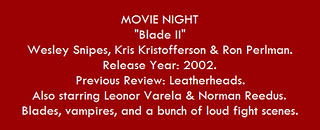
Blade II.


Review #1188: Blade II.

Cast: 
Wesley Snipes (Eric Brooks/Blade), Kris Kristofferson (Abraham Whistler), Ron Perlman (Dieter Reinhardt), Leonor Varela (Nyssa Damaskinos), Norman Reedus (Scud), Thomas Kretschmann (Eli Damaskinos), Karel Roden (Karel Kounen), Luke Goss (Jared Nomak), Matt Schulze (Chupa), Danny John-Jules (Asad), Donnie Yen (Snowman), Marit Velle Kile (Verlaine), Darren "Daz" Crawford (Lighthammer), Tony Curran (Priest), and Santiago Segura (Rush) Directed by Guillermo del Toro (#425 - Pacific Rim and #1061 - The Shape of Water)

Review: 
The cheapest way I think I could describe the film would be that if you liked the first film, you'll be fine with the sequel. It isn't wrong, however. It's a movie that has plenty of loud action, ridiculous moments, and a continuing winning combo of Snipes and Kristofferson. Its plot and some of its characters may be a bit shaky, but in the long run there is just enough here to make something worth a watch for entertainment. It isn't a particularly great comic book film, but it tries to have a balance of action and horror that makes it stick out a bit, not being too much of a copy from its predecessor, which was also written by David S. Goyer. I can't really say it is a better film, in part because of the story, which is okay in getting to its spectacle parts but sometimes ridiculous when giving deep thought to some of its motivations. The initial idea of the film (which sounds like Blade crossed with the Dirty Dozen but with vampires that call themselves the Bloodpack) is a curious one, although it is amusing in execution, since if this so-called pack were trained to supposedly terminate Blade at some point in time, I imagine they would've probably been beaten senseless in less than a hour. Obviously the movie doesn't reply on the ability of this pack to be able to beat Blade, but their lack of characterization besides Perlman and Varela, with the others feeling like fodder. Even though they do fine jobs, they are characters who can sometimes feel one-note, with the former being a bully with watchable qualities and the latter being okay but not invoking as much interest when it comes time to the plot or when with Snipes. Reedus is okay and charming, and Kretschmann is occasionally creepy, but these are cursory moments. Even Goss can't really deliver too much as a villain, perhaps because he doesn't really have much to say (which doesn't help when compared to Stephen Dorff and his villain from the original), and the Reapers (as interesting as they look) seem a bit muddled when compared to Blade; the action is fine and dandy, but after a while the film can't quite find a way to wring itself to anything other than just going through the motions between going from one dialogue piece to another before an action sequence comes in. At least it doesn't feel like an endless cutscene (although the CGI can be a bit dodgy sometimes). The climax is alright for spectacle, although it doesn't really have too many surprises. The film suffers a bit when comparing it to the first film, which felt more flexible with balancing its action and mythology without too much trouble. As okay as the film is with its execution, it still invites curiosity for anyone looking for some vampire action horror that can deliver in the end.

Overall, I give it 7 out of 10 stars.

Special Note for 2019 only: In an error best described as "counting sheep wrong", the review count for Movie Night had been miscounted since review #1168, which was Firewall (2006). Somehow, it was never properly cataloged into my records (which I keep for things such as ratings of each film, release year, etc), while the reviews that followed were. The numbering was done correctly for #1169 (About Schmidt), but the next review of Futureworld was mislabeled as #1169 instead of the correct #1170. This means that the reviews that followed up to now were the wrong number. The review numbers have been corrected and things are fixed, but I wanted to make sure that there is no confusion. Enjoy.

February 4, 2019

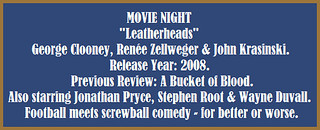
Leatherheads.


Review #1187: Leatherheads.

Cast: 
George Clooney (Jimmy "Dodge" Connelly), Renée Zellweger (Lexie Littleton), John Krasinski (Carter Rutherford), Jonathan Pryce (CC), Stephen Root (Suds), Wayne Duvall (Coach Frank Ferguson), Keith Loneker (Big Gus), Malcolm Goodwin (Bakes), Matt Bushell (Curly), Tim Griffin (Ralph), Robert Baker (Stump), and Nick Paones (Zoom) Directed by George Clooney (#851 - The Monuments Men)

Review: 
Perhaps the appeal of football is all spectacle. You really do have to be a bit crazy to play a game where the point is try to score points and avoid getting tackled and suffer injury - although you could probably apply that to other sports (namely, hockey). Still, the amount of hype for professional football gets from its stars to its halftime shows can be a bit absurd, depending on the amount of patience one has with football. While football has evolved over the past decades, this can apply to films as well, where now there exists a screwball comedy with 1920s football in the background. The original script was done by Duncan Brantley and Rick Reilly (of Sports Illustrated fame) in the early 1990s, languishing for over a decade before Clooney re-wrote the material to fit as a screwball comedy (going un-credited for the work). The story took inspiration from the exploits of John "Johnny Blood" McNally and the signing of Red Grange to the pros in 1925. One thing that the movie does do well is capture the look of the decade it wants to portray with plenty of production value, and the music from Randy Newman is a fair standout. However, the film feels a bit too muddled into trying to be funny that it never really takes off, falling along the lines harmlessly. You would be better off with The Freshman (1925) when it comes to football and comedy, honestly. The film relies on the trio of Clooney-Zellweger-Krasinski to try and deliver laughs, and they do provide a few chuckles, but after a while you are essentially waiting for the movie to move along, as if watching quirky 20s football (and the offbeat people playing it) would actually serve for more of a focus. While the film may feel a bit too bloated in length in 114 minutes when it gets to its climax with the football game, it is somewhat of a relief.

Admittedly, the best person in the film is Clooney, who seems to be having fun with a role reminding me of a buccaneer for football, not being above using tricks to try and win (or have fun), which I can certainly go along with to a point. Zellweger is fine, and Krasinski is okay as well, but they don't really have much to go on in terms of personality that makes them resonate beyond a cursory glance. The football supporting cast (along with Pryce) seem to generate more interest than the love story, having more energy to it while going through its own type of routines. One film I did think about when watching was Slap Shot (1977), which embraced its old-time approach to its sport while having a charismatic lead that led to better laughs and overall a more entertaining time without needing to try to have it both ways (screwball and sports). The football stuff might have made for a TV miniseries or maybe even just a sketch, but as is this is simply just an average movie that doesn't quite fufill all of its aspirations but will prove just okay if you're into what it tries to sell you.

Overall, I give it 7 out of 10 stars.

January 31, 2019

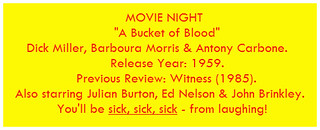
A Bucket of Blood.


Review #1186: A Bucket of Blood.

Cast: 
Dick Miller (Walter Paisley), Barboura Morris (Carla), Antony Carbone (Leonard de Santis), Julian Burton (Maxwell H. Brock), Ed Nelson (Art Lacroix), John Brinkley (Will), John Herman Shaner (Oscar), Judy Bamber (Alice), Myrtle Vail (Mrs. Swickert), and Bert Convy (Lou Raby) Directed by Roger Corman (#368 - The Little Shop of Horrors, #684 - It Conquered the World, #852 - The Terror, #931 - Not of This Earth, #1007 - Attack of the Crab Monsters, #1039 - Five Guns West, #1042 - War of the Satellites, #1136 - Gas-s-s-s, and #1147 - X: The Man with the X-ray Eyes)

Review: 
Horror and comedy films are generally entertaining on their own, but mixing the two genres together can certainly invite the possibility of something really interesting, particularly if you have a good set of hands on and behind the camera. Roger Corman and an handy ensemble cast are sure up to the task. Unsurprisingly, the budget and time to shoot for this film was fairly low - $50,000 and five days (shooting under the working title of "The Living Dead"). The sets themselves were leftovers from another AIP film, Diary of a High School Bride (1959). Fittingly, the sets would be re-used for The Little Shop of Horrors the following year. Miller, although he was happy with the story and humor from the finished product, wasn't too happy with the production values, noting the mannequins used for the statues and the fact that they didn't put plaster on him (instead using grey makeup) for the last scene. Corman and screenwriter Charles B. Griffith spent a day drifting around beatnik coffeehouses, using observations of the scene along with ideas and reactions to make the basic story, which in some ways resemble Mystery of the Wax Museum (1933).

In any case, this is a pretty enjoyable little movie, shining fairly well with a good degree of black humor and occasional scares that prove efficient for a 66 minute run-time. Perhaps a longer film might've resulted in the characters being fleshed-out a bit more (or perhaps a bit more emphasis on horror), but the material involving the beatniks is pretty funny anyways, as one might expect from people with a bit of pseudo-intellectualism and offbeat nature. Miller does well making this hapless yet ambitious lead interesting to view the film through - after all, he is basically playing a serial killer (with a calling card, no less), but he manages to have the right kind of presence the film needs to go on. The other cast-mates don't have as much time, but they each do decently with their roles when needed, such Morris and her encouraging nature or Burton and his offbeat poetry. The movie has its limits with money and time, but it manages to carry itself with some dark charm through some magic with silly lines and a game cast that make for a good time. Like with other Roger Corman films, this is certainly one to advise for anyone with a curiosity towards some fun that makes for quite a delight.

Rest in peace to Dick Miller, who died yesterday. He was a noted character actor who appeared in several films over six decades of work - appearing in films such as The Terminator (1984) alongside over a dozen films for Roger Corman.

Overall, I give it 8 out of 10 stars.

January 28, 2019

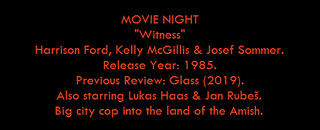
Witness (1985).


Review #1185: Witness.

Cast: 
Harrison Ford (Det. John Book), Kelly McGillis (Rachel Lapp), Josef Sommer (Chief Paul Schaeffer), Lukas Haas (Samuel Lapp), Jan Rubeš (Eli Lapp), Alexander Godunov (Daniel Hochleitner), Danny Glover (Lt. James McFee), Brent Jennings (Sgt. Elton Carter), Patti LuPone (Elaine), Angus MacInnes (Fergie), Frederick Rolf (Stoltzfus), Viggo Mortensen (Moses Hochleitner), and Timothy Carhart (Zenovich) Directed by Peter Weir (#960 - The Year of Living Dangerously)

Review: 
Witness is an interesting crime thriller, standing out for its well-done structure and story (which won an Academy Award for Best Original Screenplay) with plenty of entertainment value and a game cast. The story was written by Pamela Wallace, Earl W. Wallace and William Kelley, with the latter two doing the screenplay. Kelley had contributed to scripts for Gunsmoke in the 1970s while Wallace served as executive story consultant, and it was the development of an outline for the show that resulted in a film script, originally named Called Home. The script (consisting of 182 pages originally) languished for years, with 20th Century Fox rejecting it due to the fact that they didn't make rural movies. A re-write of the screenplay resulted in Ford expressing interest in doing the movie, and eventually the film found its studio in Paramount Pictures. Weir was hired to do the film after funding for The Mosquito Coast (which was made the following year with Ford) fell through, and this was his first film made in America after several features made in his native Australia.

In any case, it is interesting to see a movie set within the community of the Amish, particularly with the differences shown between the kind of life lived by Ford's character as opposed to the Amish characters and how he adapts to spending some time there. It comes off as more than a crime thriller at times, having moments of passion and romance between Ford and McGillis that helps give the film plenty of energy to go around. Ford is superb, playing his role as if he was in a modern Western drama (and not in a usual action kind of film), resourceful in his pursuit for justice while also taking note of the people around him and how he stands out quite clearly from them. This is particularly notable in one scene near the climax, where he stands up for one of his fellow Amish when they are harassed by town-folk who seem to view them as a curiosity or something to pick at, particularly when mocking their committal to nonviolence in war. McGillis shines as well, being a warm graceful presence with a degree of curiosity, whether when interacting with Ford or with Haas, who does fine for his scenes. The other members of the cast have their moments to shine, such as Sommer and his quiet but lurking presence or Rubeš and his wise and thoughtful presence. It is interesting to see Glover playing against type, although he doesn't have too much on screen. The film never feels flat at 112 minutes, having a fine balance between drama and action that never feels overwrought or disrespectful. You never get the sense of boredom at any real point, with each scene having a real sense of purpose and a well-made look from cinematographer John Seale. The movie has its fun moments, such as the barn-raising sequence or when Ford is trying to get the kid to identify the suspect through a ride-along. The climax is certainly effective enough with a quiet ending that wraps things up just fine. On the whole, this is a gripping tale that has its elements of thriller and romance wrapped within a community story that makes it stick out from other films in an captivating and entertaining way that is a solid pick worth recommending.

Overall, I give it 9 out of 10 stars.

January 23, 2019

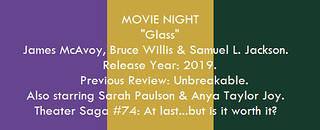
Glass (2019).


Review #1184: Glass.

Cast: 
James McAvoy (Kevin Wendell Crumb / The Horde), Bruce Willis (David Dunn / The Overseer), Samuel L. Jackson (Elijah Price / Mr. Glass), Sarah Paulson (Dr. Ellie Staple), Anya Taylor-Joy (Casey Cooke), Spencer Treat Clark (Joseph Dunn), Charlayne Woodard (Mrs. Price), Adam David Thompson (Daryl), and Luke Kirby (Pierce) Directed by M. Night Shyamalan (#039 - The Sixth Sense, #902 - Split, and #1183 - Unbreakable)

Review: 
There is a certain absurdity to the fact that this film exists, acting as a sequel to two different movies while being the final part of a trilogy labeled by some as the "Eastrail 177 Trilogy" that are fairly different from each other in tone from film to film. Unbreakable (2000) was a mystery kind of thiller, Split (2016) was a horror thriller, and this film certainly feels like a psychological thriller. I suppose the tradition must follow that the last installment is the one that helps deliver satisfaction and/or answers to its audience that makes it stick out from the previous ones. Well, there are certainly answers given in this film...along with more questions. What can one expect from something that resembles One Flew Over the Cuckoo's Nest (1975) for comic books? It is the kind of movie that clearly has ambition to inspire discussion and interest over a variety of things (specifically within human nature) while trying to play with the expectations of the audience within the script, which ultimately plays into a flawed but interesting result. It definitely feels like the weakest of the three films, but I did find something worth watching, even if it perhaps took a bit longer than it should have, particularly with something that lasts 129 minutes. There are clear highlights on a technical level such as Mike Gioulakis and his cinematography (which certainly shows off a variety of colors) and West Dylan Thordson with the music, and Shyamalan does manage to make something worth inspiring curiosity in, even if he can't quite resist trying to trick the audience perhaps one too many times with twists.

In the long run, the film rests on the shoulders of McAvoy, who is the shining light among the others, managing to once again showcase the numerous personalities of the character he plays with effectiveness and no touch of tiresomeness. He inspires his share of terror and humor while keeping the movie rolling, and his scenes with Jackson or Willis are an enjoyment. If you thought that Willis was bit too subdued before with Unbreakable, then I suppose you will have quite the experience in seeing how subdued he is here, since he doesn't have as much presence (or lines) to speak of, although at least the climax does give him something to do. Jackson finds his footing and voice gradually, and it is interesting to see him to try and pull the strings as a take on the brilliant mastermind that works fairly well. The others don't have as much strength to their presence or as much interest. It is the character (and narrative) that Paulson plays that don't stir as much enthusiasm, since I am more interested to see her consequence for the idea that one can simply lock up super beings (the cliche of believing they can't escape is even present here) than what makes her tick. The returning three characters from the previous parts of the series are okay in the small amount of time they have. It is nice to see Clark return to reprise a role from nineteen years ago, but he doesn't really have too much to do before the last half. Taylor-Joy is fine, but the dynamic between her and McAvoy takes some time to get used to again, and the last scene is a bit of a weird sell. Woodard is alright in her small role. Honestly, this is an okay movie, but it is certainly one that require patience and some understanding to really help get a foothold on its thought process, one that likes to deconstruct the tropes of the hero and villain, which has its share of potential. It just so happens that the twists that occur within said narrative that make the true payoff a bit muddled but also one to give thought to. If one is expecting a big showdown for a climax, they won't get exactly what they may expect - but they may instead get something a bit more interesting if not offbeat. Time will tell what will occur to the reputation of this film as a whole - after all, the first film managed to develop a cult following over time. I can't say it is as consistent or as entertaining as the other two films, but this film does at least serve its purpose for a trilogy about super beings without serving as a letdown.

Overall, I give it 7 out of 10 stars.

January 22, 2019

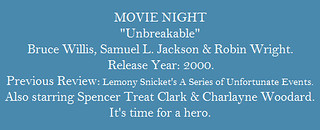
Unbreakable.


Review #1183: Unbreakable.

Cast: 
Bruce Willis (David Dunn), Samuel L. Jackson (Elijah Price/Mr. Glass), Robin Wright (Audrey Dunn), Spencer Treat Clark (Joseph Dunn), Charlayne Woodard (Mrs. Price), Eamonn Walker (Dr. Mathison), Leslie Stefanson (Kelly), Michaelia Carroll (Babysitter), Whitney Sugarman (Physical Therapist), Bostin Christopher (Comic Book Clerk), Elizabeth Lawrence (School Nurse), and Chance Kelly (Orange Suit Man) Directed by M. Night Shyamalan (#039 - The Sixth Sense and #902 - Split)

Review: 
What would the world be like if a super human suddenly existed? Unbreakable (the fourth film directed and written by Shyamalan) puts forth the possibilities of what could happen through its own take on the superhero origin story that has stood out in the years following its release. When it was released in November of 2000, films involving superheroes (with their respective origins) were not as vast as they are today, particularly one like this that takes itself seriously as a mystery thriller and make it work for the most part while having its parallels to the three-part structure of a comic book story.

Undeniably, it is the performances from Willis and Jackson that really dominate the film, whether when by themselves or when they act against each other. Willis delivers a subtle performance, being easy to follow along with his pursuit of meaning without needing to make a quip or feeling bland. On the other side of the coin, Jackson does well with his performance with a good degree of subdued nature that is interesting to watch. One particular favorite scene of mine involves him arguing with a customer wanting to buy a comic book drawing for his 4-year old son, as one can see his point (in some way) about being insulted at the idea that his collection is like a toy store in his delivery of said lines. Clark is certainly one to take time to get used to, but he does a fine job with acting opposite Willis as an on-screen son that drives the points for the film home handily. This can be applied to Wright as well, who shows off a human element for her parts on screen.

The movie doesn't rely on action to drive its point home, relying on music from James Newton Howard and cinematography by Eduardo Serra to carry a mood of suspense, with only one fight sequence occurring near the end, which is quiet but effective in its own way. Admittedly, the part that doesn't stand quite well as the other aspects of the film is the nature of the ending. I find that the twist is fairly clever and that it likely works just as well upon a re-watch, but it is the sudden nature of the ending (complete with a title card) that makes the execution feel a bit abrupt. The best thing that can be said is that at least the problem isn't that there needed to be a big grand climax to make this tale more interesting, since the movie works just fine without needing too many effects. With the entertainment that the film delivers, it is no wonder that the film eventually received a follow-up, although not certainly in the way one expected. Although the film was a moderate success that made back three times its $75 million budget, no direct sequels followed for over a decade. Sixteen years later, Split snuck into theaters as a psychological horror thriller through the eyes of a super-villain (who had a presence in early drafts for this film before being dropped) with a subtle connection to this film that eventually resulted in a sequel (and the third part of what is considered a trilogy) named Glass (2019). In any case, this is a rewarding movie with an interesting story and characters that is light on spectacle but filled with perspective on the human element for a superhero tale.

Next Review: Glass (2019).

Overall, I give it 8 out of 10 stars.

January 21, 2019

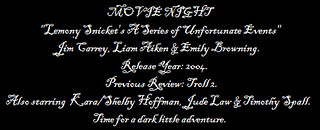
Lemony Snicket's A Series of Unfortunate Events.


Review #1182: Lemony Snicket's A Series of Unfortunate Events.

Cast: 
Jim Carrey (Count Olaf), Liam Aiken (Klaus Baudelaire), Emily Browning (Violet Baudelaire), Kara and Shelby Hoffman (Sunny Baudelaire), Jude Law (Lemony Snicket), Timothy Spall (Mr. Poe), Billy Connolly (Dr. Montgomery), Meryl Streep (Josephine Anwhistle), Catherine O'Hara (Justice Strauss), and Cedric the Entertainer (the Constable) Directed by Brad Silberling (#267 - Casper)

Review: 
When it comes time to turn books into film, I suppose the best ones to use are the ones meant for children, particularly ones with entertaining qualities that will give plenty for the audience to go for - this book series certainly has some of that, along with a defining dark mysterious feel throughout the thirteen book series done by Daniel Handler (under the pen name Lemony Snicket). With so many books to adapt, it's pretty easy to see why one would combine the first three books (named The Bad Beginning, The Reptile Room, and The Wide Window) when making a feature film, although perhaps the best way to adapt these books would be through television (which occurred a decade later). The film obviously intends to replicate the dark style of the series with its look, using only a small range of colors (such as green or black) while being filmed on sound-stages, which certainly is an interesting way to give the film something to stick out. It certainly reminds me of a Tim Burton film with its look, and at one point he was considered to direct the feature (along with Barry Sonnenfeld) - in fact, Handler was hired to write a script for the film, but setbacks (such as concerns over the budget, which ultimately was over $140 million) and delays led to an eventual change from Handler (who had done numerous drafts) to Robert Gordon for the screenplay.

With all of that in mind, the film that comes from it is an okay product that reaches entertainment level more often than not, but it ultimately is a muddled movie that perhaps needed a bit more focus to really reach its full potential. It seems the film works best when it actually is trying to have a plot than with some of its offbeat characters. Honestly, the highlight of the movie is Carrey, who chews as much scenery as one could possibly do under makeup (done by Valli O'Reilly and Bill Corso, who ended up winning an Academy Award for it) without falling too much into self-parody, in part because he is pretty amusing with a good touch of sinister nature to him that keeps the film moving at times. Aiken and Browning are fairly decent, although I wonder if they would've been more interesting with further portrayals for more adaptations. Law is alright in the occasional moments that he chimes in with his voice. The adult characters (besides Carrey and Law) are each fairly silly, oblivious to the the plan of the villain (much like with how it worked with the books), but I feel that each don't really have the kind of presence to make them feel anything other than just okay, as if the episodic nature of the film makes the flow of the film a bit inconsistent, particularly with the end of the second story and the beginning of the third one (serving as the climax). At least the film seems to have a good touch of faithfulness to its source material, and it seems to work just fine at 108 minutes long, but it never really seems to be too comfortable with its tone, trying to do dark aspects with touches of humor that is okay at best. The style is nice and dandy, but the story perhaps needed something more. Perhaps if the film had inspired a desire to have further sequels (which did not come to pass despite being a moderate success), this one would've have came off a bit better, but as a whole this is just an okay if not too exceptional piece of entertainment, one that can be recommended for a fan curious for more from the series or perhaps someone wanting a bit of style within some mystery.

Overall, I give it 7 out of 10 stars.

January 16, 2019

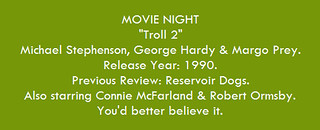
Troll 2.


Review #1181: Troll 2.

Cast: 
Michael Stephenson (Joshua Waits), George Hardy (Michael Waits), Margo Prey (Diana Waits), Connie McFarland (Holly Waits), Robert Ormsby (Grandpa Seth), Deborah Reed (Creedence Leonore Gielgud), Jason Wright (Elliot Cooper), Darren Ewing (Arnold), Jason Steadman (Drew), David McConnell (Brent), Gary Carlston (Sheriff Gene Freak), Ben Meyer (Bells), and Don Packard (Sandy Mahar) Directed by Claudio Fragasso.

Review: 
It is odd to admit how long it took to watch this film, in part because of the fact that it has quite the reputation for being so awful. How many movies can spawn a documentary (named Best Worst Movie (2009), naturally) detailing its creation and its aftermath years later? The best way to describe this movie is to say that it is a palate cleanser kind of film, as anything one watches before or after it will automatically feel much better in comparison, as if one needs to watch something horrid in order to appreciate film. In the long run, it isn't the worst film ever made or even the worst one ever watched, in part because of how ridiculous the final product manages to be. The Italian director-writer combo of Claudio Fragasso (under the pseudonym of "Drake Floyd") and Rossella Drudi (a married couple) wrote a screenplay that was in broken English. Calls by the actors to ad-lib the lines were denied by the director, who would later describe them as "liars" and "dogs" - take that for what you will. The script was apparently inspired by the frustration of Drudi's friends becoming vegetarians. What better way to mock your friends than with killer vegetarian goblins taking the place of vampires in a vampire story?

Some of the cast certainly had their own strange experiences with being in this film; one of the actors was actually out from a mental hospital at the time of his scenes being filmed, and another had their shoes screwed into the base of a tree pot that meant he had to stand inside the pot for hours on end. George Hardy was a dentist (who still maintains a dental practice) before being in this film. The villainous goblin queen's costume was designed by the actress playing her. The actors were only given the parts of the script scene by scene, with little context. How does one give the actors heavy criticism when they are stuck in something so ridiculous? Hardy is amusing, in the sense that he is playing a parent who sure takes his sweet time to realize the obviousness of the evil town. The "And you can't piss on hospitality! I won't allow it!" sequence is so amusing, and it is made even funnier in that it was the scene that Hardy did for his audition that was liked by the filmmakers enough to cast him. Stephenson is amusing, since he has to react to not only seeing visions of his dead grandpa, but also evil goblins without looking completely confused. Reed is amusing as the villain in a chew-the-scenery kind of way. Naturally, the "They're Eating Her!" sequence from Ewing (complete with fly on the forehead right before the big line) is one to be patient to giggle for. At least the actors don't seem completely stuck in a zombie state as one might think of something like Manos: The Hands of Fate (1966) or the Birdemic films (2012, 2013).

To the surprise of no one, this is not actually a sequel to the 1986 film Troll, as it was meant to called "Goblin", but distributors in America wanted to called it Troll 2 to try and garner success in markets. I guess "Attack of the Killer Vegetarian Goblins" or "A Nightmare on Nilbog Street" would've been a bit too on the nose. I will admit, I did not expect a scene where a kid figures out that the only way to stop his family from eating contaminated Nilbog food is to... urinate onto the food. Apparently, the script was originally intended to have the kid to simply act possessed and scream while on top of a chair, but this was changed by Fragasso when it came time to film. This is the kind of movie that surely has sincerity in its ridiculous plot decisions, whether with a romance scene with corn, ghostly interventions by a dead grandpa (including using a Molotov cocktail), a "Stonehenge Magic Stone" that gives the goblins their power, a double-decker bologna sandwich that saves the day, and so on. Despite all of these things, there is an amusement to be had with watching this film, where filmmakers who should have known better persisted on to make something they really thought would work out without being laughed at so much. It's a horror film with semblances of fantasy that surely thinks it is doing something worth making on the cheap. In a sea of awful movies, Troll 2 stumbles into place among other horrid pieces of the crop without question, with a 94 minute run-time that will certainly mesmerize a viewer in some way - for better or worse. Before we know it, this film will have celebrated three decades since arriving to stalk the halls of entertainment for groups that persist in watching dreck like this. I can only imagine how it will feel decades from now when it reaches half a century or more, having an ooze of charm that makes it memorable and makes one appreciate in a sense what it means to make or watch film.

Overall, I give it 1 out of 10 stars.

January 14, 2019

Reservoir Dogs.


Review #1180: Reservoir Dogs.

Cast: 
Harvey Keitel (Mr. White/Larry), Tim Roth (Mr. Orange/Freddy), Michael Madsen (Mr. Blonde/Vic Vega), Chris Penn ("Nice Guy" Eddie Cabot), Steve Buscemi (Mr. Pink), Lawrence Tierney (Joe Cabot), Randy Brooks (Holdaway), Kirk Baltz (Marvin Nash), Edward Bunker (Mr. Blue), Quentin Tarantino (Mr. Brown), and Steven Wright (K-Billy DJ) Directed by Quentin Tarantino (#638 - Kill Bill: Volume 1 and #639 - Kill Bill: Volume 2)

Review: 
Reservoir Dogs is the first major motion picture directed by Quentin Tarantino, who also wrote and co-starred in it. Tarantino had done a select amount of jobs beforehand, such as working at a video store or production assistant for an Dolph Lundgren exercise video. It was his meeting with producer Lawrence Bender in 1990 that helped elevate Tarantino to making this film on a much higher scale; Bender gave the script to his acting teacher, whose wife was a friend of Harvey Keitel. The signing of Keitel (who also serves as co-producer) helped in raising the budget for the film from the original intended amount of $30,000 to $1.5 million. There were a few films that influenced Tarantino, such as The Killing (1956) and Kansas City Confidental (1952), and it's not hard to see his love of films, which certainly comes through in a heist movie that is fairly entertaining in how it conducts itself, holding itself well enough through its dynamite cast. Keitel, Roth, Madsen & Buscemi are the main group that we follow throughout a film that utilizes plenty of snappy dialogue and choice use of violence that sprinkles itself throughout its 99 minute run-time, conducting itself out of order (without showing the heist itself) without feeling disjointed or too much like a chore to reach, never really having a period of sluggishness. It doesn't ever feel like a movie bogged down by heist cliches, but rather one that rolls with what it is without focusing too hard on falling in line with expectations. It may be a bit much for some with its style/violence, but there is still a valid amount of substance involved to make it work. Keitel shines the best, having a hard-edge to his character of a career criminal that is instantly one we can follow without reluctance, and he has some entertaining moments with the other members of the group. Roth finds time to shine with ease, and Buscemi is snappy but worthwhile when on screen. Madsen plays his role with a fine bit of ruthlessness and unpredictability that sticks out in various ways. Penn and Tierney (known for his previous portrayal of mobsters and tough guys in films prior) round out the main cast, and each play their respective parts handily without trouble. The film clicks itself pretty early with its opening sequence, inviting you into a look of these folks through an amusing conversation and music choices that work to give the movie some flavor. The film works out enough to not go off the rails in its climax because it keeps a fine level of thrills and tension going that make for a worthwhile debut for Tarantino.

Overall, I give it 8 out of 10 stars.

January 9, 2019

The Black Sleep.


Review #1179: The Black Sleep.

Cast: 
Basil Rathbone (Sir Joel Cadman), Akim Tamiroff (Udu the Gypsy), Herbert Rudley (Dr. Gordon Ramsay), Patricia Blake (Laurie Munroe), Phyllis Stanley (Daphnae), Lon Chaney Jr. (Dr. Munroe aka Mungo), John Carradine ("Bohemund"), Bela Lugosi (Casimir), and Tor Johnson (Mr. Curry) Directed by Reginald Le Borg.

Review: 
With horror films, there surely is an expectation for terror and suspense with some sort of capable cast of characters to make something worth watching as entertainment. With this film, that statement isn't too particularly true, since the only thing that drives the film is its cast. It has an occasional shocking moment or two, but there isn't enough energy present in its story to make something other than just a fairly forgettable piece in a decade filled with films with frights and schlock that stand out much clearer. When the most interesting thing to view is one shot of an exposed brain seeping cerebral fluid (second place going to Rathbone's hand double used for the surgery being an actual neurosurgeon), perhaps your movie needs a bit more noteworthy things to go around. Undeniably, the one thing that does shine above all else for this feature is Rathbone, who manages to give his role a fair bit of dignity that goes past being just the madman scientist who values results over things such as not operating on living patients and their brains, balancing a bit of tragedy with scientific ambition. Alas, not even he can save this film from falling into the world of blandness. Perhaps the story from Gerald Drayson Adams and screenplay by John C. Higgins (both of whom were mostly writers for adventure or mystery films) is to blame a bit. The dilemma involving the use of live brains would probably work better for a film with a bit more action to it, or at the very least would work better in a film that had a more compelling second lead than Rudley. He isn't too particularly interesting, and his chemistry with Blake is cursory at best, so there isn't too much driving drama (or much suspenseful horror, for that matter) besides occasional moments with Rathbone until the climax. It doesn't help that Chaney is tasked to simply growl, either. Lugosi appears in the film, although he has no spoken lines. Sadly, this was the last film of his to be released during his lifetime, as Lugosi died on August 16, 1956, just two months after the film's premiere. Tamiroff, playing a role originally intended for Peter Lorre (prior to disputes over salary rates) is alright, but he falls into the background for a good chunk of it. When the film finally decides to arrange an ending, what better way than to have Carradine chew a bit of scenery as a character who believes he is a legendary crusader from the 11th/12th century? It may be a bit ridiculous to see him (along with Johnson and another actor playing people affected by the brain surgery) run amuck on the people doing the experiments, but at least it is something to give the film a bit of a jolt, even if it is a bit on the over-the-top side, what with Carradine chanting "Kill!" and all. On the whole, it isn't a terrible experience, and the 82 minute run-time isn't too interminable to go through, but it really is only worth it for people willing to look past the lack of suspense and look more at the atmospheric moments and a fairly game performance from Rathbone. I don't think that the film does enough to prove a winner, but it is at the least a curious little horror film that serves its purpose better than some other horror films of its time (such as The Beast of Hollow Mountain (1956) for example), so take it for what it's worth.

Overall, I give it 6 out of 10 stars.

January 2, 2019

Slap Shot.


Review #1178: Slap Shot.

Cast: 
Paul Newman (Reggie 'Reg' Dunlop), Strother Martin (Joe McGrath), Michael Ontkean (Ned Braden), Jennifer Warren (Francine Dunlop), Lindsay Crouse (Lily Braden), Jerry Houser (Dave "Killer" Carlson), Andrew Duncan (Jim Carr), Jeff Carlson (Jeff Hanson), Steve Carlson (Steve Hanson), David Hanson (Jack Hanson), Yvon Barrette (Denis Lemieux), Allan F. Nicholls (Johnny Upton), Brad Sullivan (Morris Wanchuk), Stephen Mendillo (Jim Ahern), Yvan Ponton (Jean–Guy Drouin), Matthew Cowles (Charlie), and Kathryn Walker (Anita McCambridge) Directed by George Roy Hill (#962 - A Little Romance)

Review: 
Minor-league hockey must seem like an interesting experience to play in or watch (whether at home or not), whether one lives in the Midwest or in Texas. The screenplay by Nancy Dowd was inspired by her brother Ned (appearing as Ogie Ogilthorpe in the film's climax) and his experience in playing this type of hockey. One of the teams that Dowd had played on was the Johnstown Jets, who had played in four different leagues before folding in 1977 (coincidentally the same year this film was released), with some of the players from earlier teams such as the Carlson brothers serving as the basis for characters in this film, as Nancy Dowd traveled with the team for a month. One of the slogans for the team was "Aggressive Hockey is Back in Johnstown", which certainly applies to this film as well. The film was shot in numerous locations, one of them being Johnstown, Pennsylvania along with three New York areas with accompanying hockey arenas. It is certainly obvious that the film embraces its hockey roots, from the usage of hockey goons (and accompanying fights) to its citing of "old-time hockey" greats such as Toe Blake to its hockey action along with a small-town charm (along with owners who seem to think of teams as a "tax write-off"), along with a few dated things (namely players without helmets).

Slap Shot is a wonderfully entertaining movie, having plenty of raunchy and silly humor while also shining well in its hockey action to make a fairly solid experience headed by a wonderfully game Newman. There is something wonderful about him in this film, having a fun sense of humor and clearly enjoying himself. He has fun in trying to give himself (and his team) something to play for again while showing off some sly charm in balancing his hockey life and his personal life with Warren, who matches him just finely with some amusement. McGrath does well with his time on screen showing some cheesy charm in trying to manage (and recruit) a colorful group like this while having to do such wonderful promotional things for the team such as having them do fashion shows. Ontkean is okay, but the conflict between the old-time/goon hockey styles certainly could have done with a bit of re-tooling, since I find myself getting lost in the admittedly silly nature of the latter style of play more than I care about if he plays dirty or his conflict with his on-screen wife in Crouse, although at least he makes up for it for the most part in the climax with quite a show on the ice. The group of players are pretty amusing, with the Hanson trio (based on the real brother trio of Jeff-Steve-Jack Carlson) being a treat each time they are on screen, whether when seeing them play with toy cars or when watching them on the ice. The gags certainly work more often than not, and while the violence can certainly feel a bit much at times, there is at least some realism to go around to make things not feel too much like a cartoon. The film builds up to a ridiculous but fairly satisfying climax (complete with gestures and a show) that helps make it feel worthy. On the whole, the film is full of ridiculous hockey action along with some salty remarks that certainly still sticks out in the four decades since the film's release, standing as an entertaining hockey movie worth a watch.

Welcome to 2019 and Season Nine, folks. I hope this year results in some enjoyable and interesting films and reviews - can't promise anything too concrete in what to expect, but hopefully there are some interesting surprises in store.

Overall, I give it 8 out of 10 stars.

December 31, 2018

Tombstone.


Review #1177: Tombstone.

Cast: 
Kurt Russell (Wyatt Earp), Val Kilmer (Doc Holliday), Sam Elliott (Virgil Earp), Bill Paxton (Morgan Earp), Powers Boothe ("Curly Bill" Brocius), Michael Biehn (Johnny Ringo), Charlton Heston (Henry Hooker), Jason Priestley (Billy Breakenridge), Jon Tenney (Sheriff Johnny Behan), Stephen Lang (Ike Clanton), Thomas Haden Church (Billy Clanton), Dana Delany (Josephine Marcus), and Paula Malcomson (Allie Earp), with narration by Robert Mitchum. Directed by George P. Cosmatos (#818 - Rambo: First Blood Part II)

Review: 
On October 26, 1881, a shooutout occurred between lawmen and outlaws near the O.K. Corral in Tombstone, Arizona, resulting in three deaths. It later became known as one of the most famous shooutouts of the Wild West, in part due to Stuart Lake's biography Wyatt Earp: Frontier Marshal, written in 1931 that told the tale of one of the participants. Although it is now known as largely fictional by researchers, it served the basis for films such as My Darling Clementine (1946) while helping to elevate Earp into a mythic icon. In any case, Kevin Jarre was slated to write and direct this film to tell the tale of the gunfight alongside the people involved in the shootout. However, a month into production he was fired from the directing chair due to falling behind in the shooting schedule. Cosmatos was hired to replace him, while scriptdoctor John Fasano helped in trimming the story to focus more on the Wyatt-Doc dynamic. It may interest you to know that six months after the release of the film came Wyatt Earp (1994), which starred Kevin Costner that wasn't as successful. The best thing that can be said about this movie is that it has plenty of entertainment value for a Western, having a good balance of action and story to make a solid experience. The ensemble cast is up to the task of making these characters come alive without feeling generic or getting lost in the shuffle. The music from Bruce Broughton (composer of a film previously covered in Silverado) also stands to the task of swift adventure. Russell shines fairly well, being quite capable at giving his role a fair sense of depth that makes him feel more than just a lawman, particularly when conversing with his on-screen brothers (Elliot and Paxton, who are efficient) or with Kilmer. I particularly like the sequence when he deals with an unruly gambler (played by Billy Bob Thornton) without even having to shoot a gun. Kilmer (complete with a Southern drawl) is quite excellent as well, being quite watchable with plenty of charm to go around. Boothe shines well as one of the adversaries the movie presents, but it is Biehn who also proves efficient in making a worthy opponent for the final showdown. The supporting cast is fine, although the movie's key strength relies more on Earp in action than when he is sharing time with either of the women in his life. The film works well before and after the Corral gunfight, keeping interest through its 130 minute runtime with minimal moments of tedium. The film seems to have plenty of craftsmanship and effort done to make something that doesn't feel like a manufactured tale made for a cheap thrill, having a finely told story with plenty of interesting things to go around. It isn't a great Western classic, but it is a well made and well done movie that can work for anyone looking for an old legend put to film.

Happy New Year folks. Hoping 2019 is just as productive as 2018 was.

Overall, I give it 8 out of 10 stars.

New Year's Evil.


Review #1176: New Year's Evil.

Cast: 
Roz Kelly (Diane "Blaze" Sullivan), Kip Niven (Richard Sullivan), Chris Wallace (Lieutenant Ed Clayton), Grant Cramer (Derek Sullivan), Louisa Moritz (Sally), Jed Mills (Ernie Moffet), Taaffe O'Connell (Jane), Jon Greene (Sergeant Greene), and Teri Copley (Teenage Girl) Directed by Emmett Alston

Review: 
I suppose what the world needed was a slasher film set on New Year's Eve - after all, there exists slashers for other holidays such as Halloween (1978), or Home Sweet Home (1981), or Black Christmas (1974), so why not make one about the culmination of a new year by culling elements from slashers such as those while not having as much substance or entertainment value? What should I expect from a movie produced by Golan-Globus, although perhaps the ridicule should be directed towards the one who decided to have the villain call himself "Evil" with a ridiculous voice modifier facing off against a punk rock new wave show host who will be hunted down by a killer who hunts off a person hour by hour to reflect the changing of the year by time zone. Undeniably, the easiest problem with this movie is that there isn't really any tension or energy to the whole affair, being a horror film as bland as it gets. Kelly isn't particularly interesting to follow along with, not having much charm to go around. Niven, playing a villain that is obvious midway through (in part because we see his face when he goes around trying to hunt people down) isn't really noteworthy, with the twist in the end not helping to drive the movie to actually have some tension. The other members of the cast (such as the obligatory detective played by Wallace) aren't too useful, and there isn't even anyone trying to play for laughs or over-the-top nature, so the 90 minute run-time feels like a chore at times when there really isn't anyone with a sense of humor or a sense of interest to make this feel anything other than low-budget. The screenplay by Leonard Neubauer and story by Alston and Neubauer only manages to have a body count to drive things forward, along with some choice music picks, but there isn't anything here that you haven't really seen before (Black Christmas comes to mind for me) or really care to see. By the time you get to the climax and the film's final pull on the strings of what it calls suspenseful horror, the yearning for the credits is more preferable. On the whole, it is a pretty routine horror flick that will only serve to make its audience look for something more preferable more out of disappointment than anything.

Overall, I give it 4 out of 10 stars.

December 27, 2018

Aquaman.


Review #1175: Aquaman.

Cast: 
Jason Momoa (Arthur Curry / Aquaman), Amber Heard (Mera), Willem Dafoe (Nuidis Vulko), Patrick Wilson (King Orm), Dolph Lundgren (King Nereus), Yahya Abdul-Mateen II (David Kane / Black Manta), Nicole Kidman (Atlanna), Temuera Morrison (Tom Curry), Ludi Lin (Captain Murk), Michael Beach (Jesse Kane), and Randall Park (Dr. Stephen Shin) Directed by James Wan.

Review: 
I will admit that I did have mild expectations for Aquaman, much in the same way that I try to hold for most superhero films, where I hope for some fine entertainment along with at least some sort of storytelling or substance. It isn't an exceptional film by any means, but it does have plenty of entertainment value and a fair bit of charm to make a solid feature with enough spirit of adventure to prevail. It fits squarely in the middle with other superhero films in recent years, being just as fine as other features such as Black Panther (2018) for example but also being particularly better made than other films adapted from DC Comics such as Justice League (2017). Honestly, the best way to make a superhero film is to just have fun with the material while not making a mockery out of what makes a hero what they are, while having interesting secondary characters to go with it. In that regard, Momoa is up to the task handily enough, giving plenty of dignity and charm while handling himself just fine for the action sequences. Heard does fine with her role, although the chemistry between her and Momoa isn't too noteworthy. The others in the cast stand to do their parts just fine, although having two villains in Wilson and Abdul-Mateen II seems a bit much. Lundgren seems to be having fun with his kingly role at least. The dialogue certainly doesn't help too much with giving these characters too much life, having more splashes of delivering exposition; in that case it is no wonder the film runs at 143 minutes, which can feel a bit long at times, although at least the action scenes do help to cover some of the slack. The film also has time for humor amidst the spectacle - where else can one see an octopus do a drum solo? Undeniably, the film hinges quite a bit on the execution of its effects, since a majority of the movie takes place underwater. For the most part, it looks fairly convincing, and I can only imagine the effort it took to make the actors seem like they were in water. The action works well, not being too jerky or blurry for the eyes. The climax is fine and dandy. The film has a bunch of people pulling the strings behind its execution in writing, with David Leslie Johnson-McGoldrick and Will Beall being behind the screenplay while Geoff Johns, Wan, and Will Beall are credited with doing the story for the film. On the whole, this proved to be a good fashioned crowd-pleaser kind of movie, doing what it aspires to do without too many bumps. The film works more often than not in trying to give its main hero a place for the big screen through good fun and a decently patched story that allows the possibility for more with this character that can only go up from here.

Overall, I give it 8 out of 10 stars.