March 28, 2019

Us (2019).


Review #1203: Us.

Cast: 
Lupita Nyong'o (Adelaide Wilson / Red), Winston Duke (Gabriel "Gabe" Wilson / Abraham), Shahadi Wright Joseph (Zora Wilson / Umbrae), Evan Alex (Jason Wilson / Pluto), Elisabeth Moss (Kitty Tyler / Dahlia), Tim Heidecker (Josh Tyler / Tex), Yahya Abdul-Mateen II (Russel Thomas / Weyland), Anna Diop (Rayne Thomas / Eartha), and Cali and Noelle Sheldon (Becca and Lindsey Tyler / Io and Nix) Directed by Jordan Peele (#909 - Get Out)

Review: 
When Jordan Peele made his directorial debut with Get Out two years ago, I certainly did not know what I was expecting exactly, but I figured that it would prove just fine in delivering some kind of horror. It certainly proved to be a success - how many other horror films win (much less get nominated for) an Academy Award for Best Original Screenplay? Undeniably, his next venture into horror can prove enticing, with him once again serving as director, writer, and producer, with an increased budget and some inspiration from The Twilight Zone (more specifically, "Mirror Image") this time around. The idea of being stalked by someone that looks like you certainly can prove creepy, particularly if you and your whole family meet them up close. In the long run, the film presents an assortment of interesting concepts encompassed in a horror film that works itself out just fine. Perhaps it doesn't hold up as much as it really should with its plot, but it is at least handy to deliver some scares and a few laughs without being distracted too much with tonal disconnect. It will please people wanting something that don't want too much blood but are fine with some creepy imagery and atmosphere, that much is certain. The film takes its time to get the ball rolling in suspense, but you never feel too particularly bored with the main group during its 116 minute run-time. It is the chemistry that the main four have with each other - whether dealing with family stuff or suspenseful moments that make the film work as well as it does, with no weak point in the cast as a whole. Nyong'o proves up to the task of dual roles when needed, showing resolve in the face of danger while dealing with past demons and conversely showing anguish and terror - albeit with aid through a pained croak that takes some time to get used to. Duke shines finely enough, with Joseph and Alex proving effective for the course in playing off the main menace with resilience (and vice versa in a sense for the doubles). Moss and Heidecker provide a bit of levity for their moments on screen. Describing the film and its plot in much detail would spoil the fun (at least for me, anyway) in actually experiencing its frights and tricks without real warnings - although I can at least say it isn't the kind of film that trips over its own hype and story (for the most part). The climax is fairly clever in its own machinations (with some help from Michael Abels and his music), but I feel that its method of exposition dump (or whatever you describe it as) does tend to be a bit silly. It isn't so much that I don't care for things in a film to be explained or not (as is the case sometimes with horror films or their sequels, anyway) - it just seems a bit forced in view of its placement within the film and it messes with its illusions in some way; it certainly will provoke a bit of thinking with what it says about what it means to be oneself, which is fine by me. Regardless of how one may feel with how the film deals with its motivations, the movie itself is an interesting and well-made horror film, having a solid cast and capable guiding hands from Peele. He certainly knows how to make his film stand out on their own as interesting pieces to get thrills from through the tropes of horror without so far succumbing to being bogged down in overextending himself too much. I imagine whatever his next venture into horror (or whatever it might be) will certainly provide curiosity to follow into its web of interest.

Overall, I give it 8 out of 10 stars.

March 25, 2019

Invasion of the Star Creatures.


Review #1202: Invasion of the Star Creatures.

Cast: 
Robert Ball (Pvt. Philbrick), Frank Ray Perilli (Pvt. Penn), Gloria Victor (Dr. Puna), Dolores Reed (Prof. Tanga), Trustin Howard (Sergeant), and Mark Ferris (Colonel Thomas Awol) Directed by Bruno VeSota.

Review: 
Sometimes you just know a film is going to be trouble with the credits. What should I really expect from "R.I. Diculous Presents"? Believe it or not, the script (known under titles such as "Monsters from Nicholson Mesa") was written by Jonathan Haze, star of The Little Shop of Horrors (1960) who was originally intended to also star in the film - although this did not come to pass. Perhaps Haze (and b-movie director VeSota, who also starred in Roger Corman productions such as Attack of the Giant Leeches) should have thought hard about what they were getting into before deciding to go for comedy, since the only achievement that they have done is that they made a comedy that garners less laughs than films not going for laughs on purpose. If A Bucket of Blood is entertaining for its balance of horror and black comedy, perhaps this film is that one's dopey cousin that likes to daydream about silly gags and alien women that you can get to love you by kissing them. After all, one of the producers is Samuel Arkoff, whose company American International Pictures helped distribute both features. This was actually released on a double-bill with The Brain That Wouldn't Die - it is actually hard to tell which is worse. Having either fact only makes it easier to recommend literally any other AIP film than this one. Ball and Perilli are our main duo for 70 minutes (80 for the television version), and it occurs fairly quickly that they will prove tiresome, since they are tedious to follow along with not being too particularly funny to boot. This is a film that thinks that a sergeant talking in beatnik slang will surely get the laughs going. By the time the alien women appear on screen, it seems like a sigh of relief - having different faces to watch that aren't torturing the masses with lame gags. Victor and Reed aren't exactly given much to do besides tower over the bumbling duo and occasionally talk about their (supposedly) devious plot; perhaps a campy action sci-fi film would've made for a better use of their time, although they wouldn't be helped by their alien accomplices, involving guys in carrot costumes. Perhaps they thought they were being funny with the costume use, but the movie is such a dud that it doesn't really matter how they really look - they might as well have been dressed as killer clowns or sunflowers. It is a bland movie packed with jokes best suited for the grand art of making strangers on the street groan while trying to make them be your friend. This film has no friend except for late night showings by people who like to loathe themselves for an hour or need something to be on when checking their phones or reading a book. In other words, the film sucks.

Overall, I give it 3 out of 10 stars.

March 21, 2019

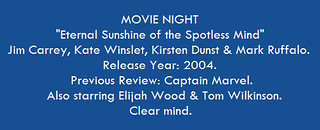
Eternal Sunshine of the Spotless Mind.


Review #1201: Eternal Sunshine of the Spotless Mind.

Cast: 
Jim Carrey (Joel Barish), Kate Winslet (Clementine Kruczynski), Kirsten Dunst (Mary), Mark Ruffalo (Stan), Elijah Wood (Patrick), Tom Wilkinson (Dr. Mierzwiak), Jane Adams (Carrie), David Cross (Rob), and Deirdre O'Connell (Hollis Mierzwiak) Directed by Michel Gondry (#451 - The Green Hornet)

Review: 
Memories are a funny thing. Whether they are ones that we prefer to reminisce about or ones that we look back on with a tinge of regret, this is a film that likes to play with memory while dealing what it means to live with emotions that can come from a relationship - whether it involves pain or pleasure. Imagine a person in your life that you loved or cared for at one point in time and having them disappear from your memory just like that; the film certainly creates a world where it feels pretty routine (with one line involving someone trying to have the procedure for a third time in a month), where people map out memories of someone, go to sleep and then awaken to the disappearance of the heartache and faded memories left behind. With different hands, one could probably have made a horror film with the concept of erasing someone from your mind (or perhaps a straight-forward romcom), but it is the handiwork of Charlie Kaufman, Michel Gondry and Pierre Bismuth that make such a clever and original story worth spending time with. It plays itself into numerous genres, such as romance, science-fiction, and comedy-drama. It is a fascinating film to watch play out, particularly with its main performances from Carrey and Winslet. It plays with the audience and their expectations without feeling like a cynical (or sappy) cheat, having plenty of emotion alongside a few interesting effects and a bit of improvisation. Carrey, playing against type, does a wonderful job, being quite entertaining to watch in a shy yet capable role that never seems too sullen or annoying to be around. Winslet is quirky, unpredictable, unfiltered, and quite right for her role, having plenty of range and intensity to her performance, whether when interacting with Carrey in memories or beyond; their chemistry is what makes the film work as well as it does, being snappy and interesting without falling prey to cliches or being undeserving of its moments, particularly with its final scene. The rest of the cast is also quite good, with Dunst and Ruffalo being charming in their scenes together (such as when they jump on the bed in the middle of the memory procedure; Wood and Wilkinson are fine to watch, both handling their parts in memory erasure with varying results that make them handy to see. What makes the film stick out is its willingness to play with its structure and unfold the way it wants and have the audience make sure to pay attention and not simply let things pass by. It doesn't present high stakes, but that is because it wants to aim for something engaging in actuality - to paraphrase from a quote from the film, it is looking for its own peace of mind. Films can often inspire debate and discussion over its meaning or intent, and this is an easy one to inspire exploration for. Fifteen years after its release (which resulted as a mild success with audiences and an Academy Award for Best Original Screenplay), Eternal Sunshine of the Spotless Mind is a wildly entertaining ride that proves just right for numerous types of curiosities and tastes, tugging with emotion without going overboard in all the right places to make a winner.

Overall, I give it 9 out of 10 stars.

March 18, 2019

Captain Marvel.


Review #1200: Captain Marvel.

Cast: 
Brie Larson (Carol Danvers / Vers / Captain Marvel), Samuel L. Jackson (Nick Fury), Ben Mendelsohn (Talos / Keller), Djimon Hounsou (Korath), Lee Pace (Ronan the Accuser), Lashana Lynch (Maria Rambeau), Gemma Chan (Minn-Erva), Annette Bening (Supreme Intelligence / Mar-Vell / Dr. Wendy Lawson), Clark Gregg (Phil Coulson), and Jude Law (Yon-Rogg) Directed by Anna Boden and Ryan Fleck.

Review: 
There have now been 21 films produced by Marvel Studios that is part of their cinematic universe, for which they have managed to set stages for the rise of numerous heroes for the past decade. Just as the era seems to possibly reach its peak with the final Avengers film comes another hero to join the fray, barely a month before said release. The film has certainly taken its time to get to the finish line, moving from an initial script done in 2013 to eventually enlisting a director/writer duo in Fleck and Boden in 2017, who had previously done films such as Mississippi Grind (2015) along with work on television programs. How many times can one make a superhero origin movie full of effects and action held together through a formula that seems as familiar as ever? I find myself liking these type of films just fine, but there is likely a point where the product doesn't resonate as entertainment, and it will likely be when the story and themes can't be held up from its main hero, when one just doesn't care about the stakes. I don't usually re-watch films often, and I can't particularly say that I really go back to these comic book films too much either (regardless of what brand is behind it). Perhaps it would be best to say that while I did find the film to be just fine, I would hope that a future installment manages to give its lead character a bit more conflict, particularly with its main threat.

Granted, there is plenty of galactic action to go around, but it doesn't have as many compelling levels as it probably should. There isn't a bad performance in the bunch, with Larson, Jackson, and Mendelsohn being keys to giving the film a steady balance. Larson does seem at first to be like a blank slate to fill details in gradually, which goes okay. As is the case with most heroes, it is nice to see her put a suit on and beat some enemies, even if the story that surrounds her is just alright for the course. It is nice to see Jackson (albeit with some digitally de-ageing that takes some time to get used to) deliver some enjoyment and a few laughs in a part that feels just fine for a buddy cop movie. Mendelsohn is also fairly amusing to stick around with, particularly when in his human disguise. The other members of the cast are okay, although they don't feel too particularly developed with much to do, such as Law or Bening. At least the 90s references are amusing without being obnoxiously self-aware. Comparing the film to more recent films of its ilk (such as Wonder Woman or Spider-Man: Into the Spider-Verse, for example) does tend to make the film seem a bit average. It is surprising to see how many films can persist on in showing people with their newly found heroic powers and the responsibility that comes with it - some do better with showing conflict and adventure than others. The film takes its 124 minute run-time and runs just fine with showing spectacle while trying to make sure its story has a few connections for its audiences without gasping for relevance, which delivers decent results. It may not be unique with its motivations (or its character types), but it sure pushes itself amiably. This one will check the boxes for people already in line for these kind of movies, and while it may not be as interesting as it could have been (in terms of its story and pace), it is at least something you can take without many regrets.

Overall, I give it 7 out of 10 stars.

March 14, 2019

Poltergeist III.

Review #1199: Poltergeist III.

Cast:
Tom Skerritt (Bruce Gardner), Nancy Allen (Pat Gardner), Heather O'Rourke (Carol Anne Freeling), Zelda Rubinstein (Tangina Barrons), Lara Flynn Boyle (Donna Gardner), Richard Fire (Dr. Seaton), Nathan Davis (Reverend Henry Kane), and Kipley Wentz (Scott) Directed by Gary Sherman.

Review:
Was there really a big desire to make another Poltergeist film? The previous films were successes with audiences (with the first making ten times its budget and the second making double), so why not make a cheap sequel - complete with O'Rourke and Rubinstein being the only ones returning, with a reduced budget of $9.5 million, roughly less than half of the sequel's budget. Sherman (who directed and co-wrote the film with Brian Taggert) thought that the setting of the film being a building was a scary one, stating that "there are people on the other side of the wall, and no one cares that you are in trouble". Perhaps that could have proven true, but the final result is a movie that proves to be just another disappointing Poltergeist sequel. The film sure tries to make sure you won't forget who Carol Anne is, since characters in the film keep saying her name. I lost count after about the tenth time Kane (or someone else) said it, and it sure seems more like something to ridicule than be terrified of.

I do appreciate the in-camera effects, which were done live on the stage, with some highlights including a corpse being clawed out of at one point, and some of the mirror effects are a bit spooky. They can't save a movie that seems to meander in cheese. Nobody in the film does a terrible job, but they can't really give this film any sense of suspense or sell this as something worth using much effort over. Skerritt and Allen are okay at least, although the tonal shift for Allen's character near the climax feels abrupt and tacked on in order to deliver tension. O'Rourke does a fine job with her role once again, just as captivating and watchable as before in her final film. Rubenstein is just as offbeat as ever with giving exposition and occasional amusement, such as when she interrupts her session of tea and drops everything to fly on a plane after sensing danger for Carol Anne. Boyle and Wentz are okay, but their characters don't really have much to do other than just play the teenagers in a horror film (with the latter being forgotten about when it came to the ending). The angle involving the family and O'Rourke doesn't really hit as well when compared to the family angle from the previous two films. Fire is pretty annoying, but it is a bit hard to really make a skeptic in a horror film (particularly a sequel) seem anything other than just one to make for conflict, and he isn't really too interesting to follow with in any case. Davis (or more specifically, Corey Burton in a recording booth smoking a bunch of cigarettes to get that proper raspy voice) doesn't make for much of a villainous presence, perhaps in part because it is strange to even see Kane again in the first place. They might as well had just made up a new villain anyway, since his return is just as strange, seeing as Carol Anne was doing a bunch of hypnosis sessions while attending some sort of school for the gifted - complete with a skeptic doctor who believes it is all a product of mass hypnosis (which is pretty stupefying, actually). I guess getting stabbed with a spear just isn't enough closure. In any case, the film just doesn't have a real big scare up its sleeve besides occasional tricks for its 98 minute run-time.

The ending of the film is a letdown, particularly with its stinger that actually tries to sequel-bait. The film had its ending changed in post-production, which was actually more optimistic than what eventually made it onto the screen. Both endings keep the sacrifice made by Tangina, but while the original ending simply had the family return to the real world, the revised ending includes the John Hancock Center having two lightning bolts strike it (the only visual effect added in post-production) while Kane's laughter is heard; Metro-Goldwyn-Mayer wanted to punch-up the ending, which I suppose they valued more than a real ending. It should be noted that the re-shoot (done months after production ended) occurred without O'Rourke, who tragically died on February 1, 1988 from misdiagnosed intestinal stenosis. Four months later, the film was released, with the movie not being as successful with audiences - in part due to reduced marketing by MGM, who wanted to avoid being thought as exploitative, to the point where Skerritt and Allen did not do interviews for the film, lest they get asked questions about O'Rourke. In any case, the film is just not that scary, feeling just as pale of an imitation as the original, with only occasional bits of interest sprinkled in. If you were into the sequel and want to see a further supernatural tale involving some of the characters from before, this may work for you. Anybody looking for a quality follow-up to just the original or one wanting a proper close to the series will probably be disappointed.

Overall, I give it 5 out of 10 stars.

March 13, 2019

Poltergeist II: The Other Side.

Review #1198: Poltergeist II: The Other Side.

Cast: 
Craig T. Nelson (Steven Freeling), JoBeth Williams (Diane Freeling), Heather O'Rourke (Carol Anne Freeling), Oliver Robins (Robbie Freeling), Zelda Rubinstein (Tangina Barrons), Will Sampson (Taylor), Julian Beck (Rev. Henry Kane), and Geraldine Fitzgerald (Jessica Wilson) Directed by Brian Gibson.

Review: 
The original Poltergeist (1982) was an entertaining supernatural horror film that had plenty of chills and atmosphere within direction from Tobe Hooper with a story from Steven Spielberg. Four years later, a sequel followed, albeit with some differences. Hooper and Spielberg did not return, although the two writers that helped co-write the screenplay with Spielberg (Michael Grais and Mark Victor) did return, and they also served to produce the feature. Most of the family cast (except Domnique Dunne, who was murdered months after the original film's release) return this time around along with Rubenstein. Admittedly they do try to make the material seem passable and not too hokey, but the film as a whole isn't quite up to par with generating scares. Nelson and Williams seem to just go with the flow, for better or worse. O'Rourke and Robins are fine to watch as well. Rubenstein doesn't have too much to do, with Sampson (in his second-to-last role before his death in 1987) taking the role of "spiritual advice", which he does fine with. The film is best at showing how hard it is to make a horror sequel, particularly one that tries to build on the plot from the previous film, particularly with its main terror of The Beast. It was described in the first film as a "terrible presence...So much rage, so much betrayal." 

Now the Beast is explained to be a cultist preacher. Beck, a co-founder of The Living Theatre in his final role before his death from stomach cancer in 1985, is an okay villain, but I feel that the ominous presence from the original delivered more effective chills than having to rely on one singular figure, although at least the porch scene is a bit creepy. I do find it amusing that they turned the old house location into a paranormal digging excavation, alongside the fact that traveling to the other side apparently made the mom and the daughter clairvoyant. In trying to build and follow the original, this sequel feels flat and not too particularly interesting, not having as many dark elements that resonate while feeling a bit silly with some of its motivations. The only real memorable sequence involves a worm, brought on by drinking of a certain substance that the Beast somehow possesses, which makes for a slightly disturbing (if not also slightly ham-handed) sequence with a big ugly worm.  It may have less of a run-time than the original, but it somehow still feels a bit sluggish. The film had an original running time of 131 minutes before being edited down to 91 minutes. It isn't too hard to see elements of a rushed production from Metro-Goldwyn-Mayer, particularly with the final battle, which last all of two minutes that serves to bring the whole film to a letdown. On the whole, there just isn't much of a spark to drive this film towards suspenseful entertainment, serving as the kind of horror sequel that in attempting to build on previous foundation manages to flounder too many times to really work out. It isn't the kind of film you would regret ever watching, but it also isn't one that really merits too much curiosity unless you are really big on supernatural stories with occasional scares.

Overall, I give it 6 out of 10 stars.

March 9, 2019

The Deep.


Review #1197: The Deep.

Cast: 
Robert Shaw (Romer Treece), Jacqueline Bisset (Gail Berke), Nick Nolte (David Sanders), Louis Gossett Jr. (Henri 'Cloche' Bondurant), Eli Wallach (Adam Coffin), Dick Anthony Williams (Slake), Earl Maynard (Ronald), and Bob Minor (Wiley) Directed by Peter Yates (#506 - Bullitt and #927 - Krull)

Review: 
Perhaps The Deep was destined to lurk in the depths of mediocrity due to riding on the coattails of Jaws, since both films were adaptations of novels by Peter Benchley, who also happened to co-write the screenplay for both features, doing this film with Tracy Keenan Wynn, although it was Tom Mankiewicz who provided a major re-write (while going un-credited for his help), with Shaw (in his third-to-last role before his death in 1978) having a main role for both movies. The best thing that can be said for this film is that while it isn't too particularly thrilling, it is at least a decent yarn that can be fine to look at and follow along with for a while if one has the patience to go through its 124 minute run-time. It isn't a classic by any means,in part because it doesn't really have much depth, but it probably works best as something to digest much in the same way one eats food from the fridge late at night, no matter how fresh or stale it seems.

The trio of Shaw-Bisset-Nolte is a decent one, carrying the film just fine at times, not being a particularly strong group by any means but being useful enough to serve the film and its shaky bumps. Shaw is fairly entertaining with his gruff mannerisms that serve to give exposition or to loosely interact with the others. Bissett does fine with her role, even if she only occasionally is given something interesting to say for the plot, which moves somewhat sluggishly. Nolte, starring in only his second theatrical role, is alright, but he doesn't really have much to do to give off more than a bare presence for a role that could've been played by near anyone. Wallach is okay in a brief role that doesn't prove to go too far within the plot. The weakest part of the film is the lack of a big presence of a villain. Sure, it is nice to see Gossett Jr on screen for a bit, but he doesn't really get much of a chance to bring menace to a kingpin role that probably could've done with a bit of re-tooling, with a bit of voodoo thrown in that doesn't really go anywhere. At least the little bits of exposition involving history prove intriguing. The characters feel drawn out from other adventure ideas, as if cut out from very thin paper that probably would've been made on the cheap in a previous decade. The stakes never feel too high, and at times the best thing going for it is the music from John Barry, with occasional success in water action, with an okay climax in the deep. This is not really a movie I can recommend, since it never really takes off into something truly spectacular on a consistent level, but it can serve as a bit of a curious sink of time, whether for some watery action or something deeper.

Overall, I give it 6 out of 10 stars.

March 4, 2019

Billy Jack.


Review #1196: Billy Jack.

Cast: 
Tom Laughlin (Billy Jack), Delores Taylor (Jean Roberts), Clark Howat (Sheriff Cole), Victor Izay (Doctor), Julie Webb (Barbara), Debbie Schock (Kit), Teresa Kelly (Carol), Lynn Baker (Sarah), Stan Rice (Martin), David Roya (Bernard Posner), John McClure (Dinosaur), Susan Foster (Cindy), Susan Sosa (Sunshine), and Bert Freed (Mr. Stuart Posner) Directed by Tom Laughlin.

Review: 
You may perhaps wonder what exactly is Billy Jack? Well, it sure seems to think it is an action/drama, and its main character is a half-Native American (just go with it) Vietnam veteran that happens to be a Green Beret along with an expert in hapkido who decides to help defend a hippie-themed Freedom School from the other people in town. It sounded a bit ridiculous when I first heard of the premise, and the final product proves to be a strange curiosity, even if it is wildly uneven. Laughlin utilized three different pseudonyms in place of credit for his work as director, producer, and writer (for which he co-wrote with his wife Delores Taylor). Laughlin wrote the screenplay for the film in 1954, inspired by the treatment of Native Americans in Taylor's hometown of Winner, South Dakota. He served as an actor on numerous television programs sprinkled with starring roles such as The Delinquents (1957) before his first directing job with The Young Sinner (1965). He spent years on running a Montessori preschool in Santa Monica, California before it went bankrupt before finally getting a chance to bring the character of Billy Jack to the screen in 1967. The Born Losers was a motorcycle gang movie that took advantage of the popularity of outlaw biker films of the time that was distributed by American International Pictures; the film proved to be a hit, earning millions in rentals. It tries to tell the story of a pacifist loner who tries to hold in his violent urges but can't resist when dealing with prejudice - responding with violence and beating tons of guys with his feet. The film had distribution problems, with AIP and 20th Century Fox both dropping out of distributing the feature before Warner Bros. stepped in. Despite that, Laughlin felt the marketing of the film was not satisfactory, so he decided to re-release it himself in 1973. Made on a budget of $800,000, the movie ultimately turned out to be a success, making millions and being popular with portions of the youth, which led to two sequels (The Trial of Billy Jack and Billy Jack Goes to Washington) released in the decade, although the latter did not have a wide release.

If one is expecting an action flick, they may find themselves a bit disappointed. It is more of a heavy handed piece on numerous issues of the time that seems more designed for the PBS crowd (for which I occasionally call myself part of). It is a film that basks itself in a mix of cynicism and optimism that makes for an uneven experience, as if the passion to make a big statement issue piece outweighed the ultimate result on an entertainment level. I can't say that it actually is a film I can really recommend as something good, but it could serve as a curiosity piece for people wanting something different. It's hard to bash the acting, since some of the actors were amateurs (one of whom being a babysitter for the family prior to being hired for the film); Laughlin is nice to see with his loner character, although he isn't really in the film too much, with the school having more of an emphasis, for better or worse. At least the hapkido sequence is fun. Sure, the shot of him smacking a guy's face with his foot is actually Master Bong Soo Han doing the kick, but it is a pretty amusing sequence nonetheless. Taylor is fairly interesting, being quietly effective while playing the other side of the coin of the pacifism the film shows (or at least tries to show). Roya is alright as the only real main adversary shown through the film, and even then the film doesn't really have much of a hero-villain conflict. For a movie that sure likes to have focus on the kids of the school, it doesn't really have a character worth spending much attention on. I do wonder how the first film is in comparison to this. It is a free-spirit kind of movie that goes all over the place, from having sequences involving a town hall meeting moving into them going to the school and doing some improv to Billy Jack compelling someone to drive their car into a lake by fear to the ultimate climax, which feels very soft with its resolution by the time of the last minute of the 114 minute run-time. This is a strange film, having a message splintered throughout numerous soapboxes that try to grab the attention of its audience that surely had its captivating allure back in the 1970s for certain groups. For me, I just see a movie that is okay, doing fine with some of its intentions while also sometimes feeling like a chore, with its action parts (although perhaps a bit cliche) sticking out just as well as the parts where it tries to espouse about non-violence - for better or worse. If you're big on having a different time with movies by people outside the usual fare of dramas with sprinkles of action, you might have something worth going on. I can find an appreciation for someone who persists on to make a film in their vision (whether with a budget to spare or not), even if I find the film to be a bit unwieldy with its ambitions as is the case here

Overall, I give it 6 out of 10 stars.

March 2, 2019

Raise the Titanic.


Review #1195: Raise the Titanic.

Cast: 
Jason Robards (Admiral James Sandecker), Richard Jordan (Dirk Pitt), David Selby (Dr. Gene Seagram), Anne Archer (Dana Archibald), Alec Guinness (John Bigalow), Bo Brundin (Captain Andre Prevlov), M. Emmet Walsh (Master Chief Vinnie Walker), J.D. Cannon (Captain Joe Burke), and Norman Bartold (Admiral Kemper) Directed by Jerry Jameson.

Review: 
What film can best be summed up by a quote from its producer other than this one: "It would have been cheaper to lower the Atlantic." With a budget of over $40 million (which would be roughly over $120 million in 2019) and an ultimate box office finish of $7 million, this was another of Lord Lew Grade's failures for the year of 1980, where production overruns and story re-writes doomed a film to fail beyond belief. The film is based off the novel Raise the Titanic! (1976) by Clive Cussler, the third book in his series of adventure books involving the character Dirk Pitt, for which he has currently written 24 of since 1973. Grade saw potential in Cussler's books to adapt to film and make a series much like with the James Bond films. The intent was to have Stanley Kramer as director, although he quit as pre-production began due to creative differences, with the brunt of the budget's spiraling being due to making models (alongside re-writes for the script); a fifty foot scale model was built for the climatic raising of the ship that required a 10 million-gallon tank to accompany its size. Larry McMurtry (writer of novels such as The Last Picture Show and Lonesome Dove) claimed to have worked on the screenplay alongside sixteen other writers, although he was the only one who did not petition for writing credit, although the final credits list Eric Hughes for story and the screenplay credit for Adam Kennedy.

As ridiculous as it may sound, the idea of making an adventure film set around raising the Titanic could have had potential, albeit one that would have to rely on charm and effects instead of tight logic to really work. Keep in mind, the Titanic was not proven to have been broken up into two pieces (as opposed to the theory that it simply sunk intact) until 1985. Unfortunately, the final product is not particularly interesting to watch, managing to squander its premise with plenty of padding surrounded by one pure highlight. Jordan doesn't spring too much interest as the main hero, perhaps in part because there really is nothing for him to go on in terms of personality. I suppose him and Selby are supposed to be an interesting pair to see interact and bicker with, too bad they don't really click well. Robards is okay. The actors besides him really seem to just say the lines very mildly. Honestly, the only one who seems interesting is Guinness, playing a survivor of the Titanic who exists just to say exposition about the mysterious person who just happened to put the "byzanium" in a vault before the ship sank. He's in the film for one scene, looking perfectly like someone waiting to cash a check, but at least it means he isn't stuck in the feature for very long. Archer has slightly more screen-time, yet her character (and her motivations for being in the plot) fade halfway through the film. There isn't even a real villain worth mentioning, and the only real menace in the entire film is boredom over the water scenes, which don't really give the film much in terms of spectacle for 114 minutes of run-time.

Comparing it to Grade's other boondoggle in Saturn 3 is amusing, since both films have such strange differences yet still manage to both be ridiculous in their own ways due to their cast, story and use of effects. In this regard, the earlier film is somehow a bit better, perhaps because it doesn't feel so long. Undeniably, the only shining part of the film is composer John Barry (known for his work on Born Free and the James Bond films) and his score, which is entertainingly majestic, fitting quite well for the film, particularly when dealing with the climatic raising. In a less flawed film (i.e. one that works better), the scene of the Titanic rising the depths would prove to make the film ultimately feel worth it, as it is a nice sequence even after over three decades since its release. Understandably, Cussler was not happy with the results of the film, saying that they had turned the plot into a hollow shell of the original along with not liking the cast. He refused to give permission for any more film adaptations of his books, with the only other film adaptation of his books in Sahara (2005) also being a tremendous failure with audiences. In any case, this is a strangely terrible flick, being occasionally watchable but also being something that doesn't quite elevate itself to serviceable entertainment, unless one likes to watch an adventure film sink itself.

Overall, I give it 5 out of 10 stars.

February 27, 2019

Saturn 3.


Review #1194: Saturn 3.

Cast: 
Farrah Fawcett (Alex), Kirk Douglas (Adam), Harvey Keitel (Captain Benson; voiced by Roy Dotrice), and Ed Bishop (Harding) Directed by Stanley Donen (#137 - Bedazzled (1967), #227 - Singin' in the Rain, #346 - On the Town, and #1029 - Charade)

Review: 
Whether a film is good or not, even the terrible ones can have an interesting story to tell about how it came to be. John Barry was a production designer for hit films in the 1970s such as A Clockwork Orange (1971), Star Wars (1977), and Superman (1978). He had expressed an interest in making a film of his own, and he approached Stanley Donan with an idea that would be presented as a Gothic sci-fi thriller. Although Donan was not interested in directing the feature due to not having much interest in science fiction, he encouraged Barry to develop an outline, which he developed into a draft that he showed to Donan. He felt that the idea could work for Barry's directorial debut, albeit with a need for help with developing the screenplay. Martin Amis (writer of novels such as Dead Babies but who had no prior experience with screenplays) was enlisted to develop a draft, which was presented by Donan to Lord Lew Grade (producer of shows such as Thunderbirds and The Prisoner) in 1978 for consideration. While having the script in his possession on an airplane trip, Grade happened to be seated next to Fawcett and her representative; he showed her the script (under the working title The Helper), and she expressed interest, which led to her making a deal with Grade to be in the project. After signing Douglas and Keitel, the film had their prime trio and began production in late January 1979. Donen described the film at one point as “...both sensuous and sensual, full of chills, fright and horror. It’s science fiction, but not ‘comic strip’ SF....It’s something of a Frankenstein story, and meant to frighten audiences in a very unusual way.” Colin Chilvers dealt with the construction of the robot, which cost over $1 million to make, while Stuart Craig was charged with production design, such as the interior of the Titan research station - it should be noted that the Saturn 3 set took over four months to build while running a distance of 280 feet for a film with a final budget of $10 million, with production overruns from Raise the Titanic (ITC Entertainment's other big production at the time) resulting in cutbacks for this film.

As much I do not like to emphasize age when it comes to a film, it certainly is a bit odd to see Fawcett and Douglas as a couple, in part because of the 30 year age difference between the two. Originally the idea was to have Sean Connery cast in the role of the older male lead, but plans fell through for that, leading to Douglas being cast. Douglas had strife with Barry, whose time as director proved short. Two weeks into production, he left the production, with Donan stepping in as director. Donan stated that Barry's departure was due to Barry's lack of experience on a film set in dealing with actors and staging scenes (as said by Donan, while calling him a "terrific talent"). It should be noted that the film has a run-time of 88 minutes; at least fifteen minutes were cut out of the movie (reportedly due to Grade's objection to them), with one notable scene being cut out involving a dream sequence of Adam killing Benson after the two try some sort of space pill. It should be mentioned that there also existed a television cut of the film that was 96 minutes long that included extensions and additions while toning done some of the film's violence. The final little nugget of weirdness came when Keitel refused to post-synch his dialogue, leading to a re-dubbing of his character by Roy Doctrice. Imagine making a film relying on three main characters and having one of them not even use their own voice the whole time - it sure is a strange thing.

With all of that background, it is no wonder that this did not turn out to be a great film. It is a tremendous exercise in ridiculousness for the science fiction genre, having a hodgepodge of cliches that make the movie seem like a strange blend of numerous movies, such as Alien (1979), Forbidden Planet (1956), but also Demon Seed (1977) while being worse than all three. It is a strange little movie, having no real sense of tension or wonder while having one of the stranger love pursuits - this time with a nutty creep and his lumbering Frankenstein robot (powered by baby brains). It is pretty evident that this script must have gone through numerous revisions, which reminds me of the Infinite monkey theorem (a monkey hitting keys at random on a typewriter keyboard for an infinite amount of time will almost surely type any given text) and if it was like that, but with script doctors. How can anyone make dialogue such as "Your body is very beautiful. I'd like to use it" or scenes such as Douglas (wearing no clothes) choking out Keitel work without making someone cringe (or giggle)? Fawcett seems to come out of it with the least lost, in part because her warmth and charm works just fine that fits the horror type okay. Douglas is simply not the right guy for the part, but at least he is hammy enough to enjoy in his attempts to have chemistry with Fawcett. Keitel (or more specifically, Doctrice) is creepy, but he isn't too particularly interesting to go along with, not having enough menace to really make this seem worthy of chills. By the time the film tries to pull a shocker for a climax (at least I assume its supposed to be surprising), the film already has run out of air. At least the robot seems interesting, but it seems as if they really wanted to make something different involving this robot as some sort of innocent Frankenstein's monster type, but really it is not much more than a killer robot that inhabits passion for Fawcett. The effects are decent, and the sprawling set is interesting - but it can't elevate the movie and its material to anything captivating. What we have here is a movie that is occasionally weird to point and look at while perhaps having a laugh, but what we don't have is something that is actually any good. It is a middle-of-the-road kind of film that can't be trashed as all-around terrible (despite some efforts on the part of the film) nor one that merits much of a following. It could be worth it as a curiosity for someone looking for a ridiculous failure piece - or some groans.

Next Review - Raise the Titanic.
 
Overall, I give it 5 out of 10 stars.

February 25, 2019

Alita: Battle Angel.


Review #1193: Alita: Battle Angel.

Cast: 
Rosa Salazar (Alita), Christoph Waltz (Dr. Dyson Ido), Keean Johnson (Hugo), Mahershala Ali (Vector), Jennifer Connelly (Dr. Chiren), Ed Skrein (Zapan), Jackie Earle Haley (Grewishka), Jorge Lendeborg Jr. (Tanji), Lana Condor (Koyomi), Eiza González (Nyssiana), Idara Victor (Nurse Gerhad), Jeff Fahey (McTeague), and Rick Yune (Master Clive Lee) Directed by Robert Rodriguez.

Review: 
It is astonishing to see the amount of time that it took for a film to progress from concept to product. James Cameron was attracted to the idea and wanted to write and direct a film adaptation (with a domain name for the film being registered as early as 2000), although he held off doing the film for other projects such as Dark Angel and Avatar (2009) before deciding to focus his energy on making sequels to the latter. Cameron wrote a screenplay that was accompanied by hundreds of pages of notes, and he shared the script (which he co-wrote with Laeta Kalogridis) with Robert Rodriguez (director of films such as Desperado and Sin City) in order to see if he could help condense it into a working shooting script. Satisfied with his result, Cameron hired Rodriguez to direct the film, while serving as producer (along with Jon Landau). The film is based off the cyberpunk manga series Gunnm (also known as Battle Angel Alita) that was created by Yukito Kishiro that was run in Business Jump magazine from 1990 to 1995. I suppose the enjoyment level is much like when watching a comic book movie, complete with story beats that will occasionally feel familiar but still manages to generate excitement and entertainment. Sometimes you just need a movie with cyborgs beating each other to shreds (including one fighting with a legendary martial arts style), bounty hunters named Hunter-Warriors, and a gladiator sport in Motorball that feels like a hyper version of Rollerball (1975). It's a fun piece of spectacle that never really stumbles in its aspirations, even when its attempts at setting up further adventures can seem a bit clumsy. It feels just fine at 122 minutes, having a fine pace and balance.

Salazar (utilizing a motion-capture suit alongside big CG eyes) delivers a capable performance, being an interesting hero to follow in her journey, and she pulls off a well-done job in showing the growth of her character throughout the film without testing the audience's patience or feeling too sudden. Waltz, essentially playing the wise old man type, does fine with dealing with tech-spewing and such. Johnson is fairly effective in keeping up with the quickness of the film while also having a bit of chemistry of Salazar alongside some offbeat moments that eventually prove itself for its climax. Ali and Connelly play their conniving parts with relish when needed; Skrein and Haley are quite entertaining in their menace when playing off against Salazar that makes for some well-done action sequences together. Undeniably, the film is a winner in the visual department, with Weta Digital doing a great job in engineering a product that manages to balance itself into not abusing CGI into a crutch or being too glossy. The Motorball sequence is a clear fun example of that, being dazzling without feeling like a distraction or an excuse to show off without reason. The punches that the film tries to pull within its climax (or more specifically where it is trying to go) work just fine, particularly if you are into what the movie is trying to sell you on (again, much like a superhero movie trying to do some world-building). The film certainly has enough action to go around, with plenty of (blue) blood being spilled in its cyborg showdowns that prove one can really do anything with cyberpunk action if the budget (roughly over $150 million dollars) is right. On the whole, I wasn't at all familiar with the material that the film is based on, but it didn't interfere with what I found to be a pretty entertaining experience, filled with action and spectacle to go along with a neat little story that will prove a winner for people looking for something packing with action and science fiction in one package. Whether there is further adventures about Alita coming or not, I can say that it is one that certainly will merit an audience that appreciates the effort to bring itself on screen.

Overall, I give it 8 out of 10 stars.
February 23, 2019

The Vampire and the Ballerina.


Review #1192: The Vampire and the Ballerina.

Cast: 
Hélène Rémy (Luisa), Walter Brandi (Herman), Maria Luisa Rolando (Countess Alda), Pier Ugo Gragnani (Professor), Tina Gloriani (Francesca), Isarco Ravaioli (Luca), and Gino Turini (Giorgio) Directed by Renato Polselli.

Review: 
It isn't often I cover an Italian film. This is the sixth one I've covered as part of the World cinema run and the first since Star Odyssey last May (with this one having subtitles instead of dubbing). I hope you enjoy.

I suppose there really is no better way to show your appreciation (or influence) to vampire films than to make one that seems like a patchwork of other movies, such as Dracula (1958), for example. Granted, that movie didn't have multiple scenes of dancing (including a vampire dance), but it is clear to see where they may have gotten the idea to make a spooky little film with a bit of romantic appeal, one might say. The film may be too average to live up to that expectation, but it has its occasional moments. The film was written by Polselli, Giuseppe Pellegrini & Ernesto Gastaldi, with production being done in the span of three weeks in late 1959 in the castle of Artena. The best thing that the film has going for is the atmosphere, with cinematographer Angelo Baistrocchi managing to have some nice-looking shots that give off a creepy soothing tone (no doubt helped by being in black-and-white) that do help make some scenes seem interesting to go along with, even if the effects (such as the prosthetics on the vampire) can seem a bit hokey. Any vampire film can't be complete without a dynamic involving vampires and lust, with this one having some sort of master-slave dynamic between Brandi and Rolando (involving retaining youth through biting on the other), which is somewhat thoughtful to look at, at least.

The vampire action is brief and not too particularly inspiring, but it passes for basic entertainment. The story as a whole isn't too great, however, in part because the actors don't make these characters too particularly interesting to go with. Nobody does a terrible job in the film, but nobody really makes much of an impression without much too energy to them. You are basically waiting for the horror elements to show back up, where they may be, such as a buried-alive funeral with a window in the coffin, or the first appearance of the Countess. At 83 minutes, it isn't a complete chore, going through the cliches one might expect from a horror film along with some cursory moments involving dancers that is at least amusing, if not too particularly necessary. The ending is a bit abrupt, with the effect of a deteriorating face almost making up for the swift way the movie ends (with no sort of resolution even with a parting line). The effect was said by Polselli to be one where "We made a face cast with plaster, then the make-up artist and I molded an adhesive rubber mask over it. Our trick was to put a layer of ash between the plaster and the rubber." I felt the film was average and probably not seasoned enough to be quite a gem, but it is at least watchable without being interminable for someone looking for a bit of a horror thrill.

Overall, I give it 6 out of 10 stars.

February 20, 2019

Payback (1999).

Review #1191: Payback.

Cast:
Mel Gibson (Porter), Gregg Henry (Val Resnick), Maria Bello (Rosie), Lucy Liu (Pearl), Deborah Kara Unger (Lynn Porter), David Paymer (Arthur Stegman), Bill Duke (Detective Hicks), Jack Conley (Detective Leary), John Glover (Phil), William Devane (Carter), James Coburn (Justin Fairfax), Kris Kristofferson (Bronson), and Trevor St. John (Johnny Bronson) Directed by Brian Helgeland (#372 - 42)

Review: 
The strangest thing about films can be the ways that it can sometimes transition into numerous forms before a final shift into the form that goes to audiences. This film is a particular example of where a director's vision can verge differently from ultimately made it to the screen. Brian Helgeland was making his directorial debut after meeting up with Gibson on the set of Conspiracy Theory (1997), a film that he had written for. During the post-production stage for that film, Helgeland happened to have the script with him when Gibson inquired about the pages he had with him, for which he read the first act of. A few weeks later, Gibson agreed to finance the film with his production company Icon Productions provided they could shoot within 12 weeks. The film is as adaptation of the 1962 novel The Hunter by Richard Stark (pen-name for David E. Westlake), the first of 24 novels from 1964 to 2008 with the character Parker as the main lead. It had already been adapted a movie in 1967 as Point Blank, featuring Lee Marvin, and other novels had been given film adaptations.

Before I talk about the circumstances that led to Helgeland's dismissal from the film, let's talk about how the movie is first. For a neo-noir, it certainly is a decently entertaining one. It maybe a bit routine in terms of its story and action, but it is a road worth walking onto in part because of its dark charm, which in some ways feels like a guilty pleasure. Gibson is certainly up to task in delivering a character worth following with a subtle grin in a film with oddball people basked in noir types. Henry is fairly adept at showing menace for his time shared with Gibson. Bello does fine with her material, sharing her time with Gibson quite well. Liu (playing a dominatrix) is quite quirky. Paymer plays his role with a good deal of sleazy ooze that is pretty amusing. It is amusing to see Coburn briefly, but interesting to see Kristofferson all of a sudden in the film appear; he isn't really too menacing as the big bad but he is at least neat to watch. The movie moves with a dynamic pace to try and garner up excitement along with a chuckle, and it works out fine for the most part, playing to the noir type handily. It is sometimes a bit wobbly with its plot motivations (and its action violence on occasion), but the final product works out mostly because it manages to distract itself enough to where while you can see where "producer's notes" may have stepped in, you can at least find something to watch without too much disapproval. It has a bit of fun with its aspects of revenge without being too demanding.

Helgeland's version of the film was felt to be too dark for a mainstream audience in terms of story, tone, and look. he was fired from the project, which occurred two days after winning an Academy Award for Best Adapted Screenplay for his work for L.A. Confidential (1997). Thirty percent of the film was re-shot (with new material written by Terry Hayes), with John Myhre (production designer) doing un-credited directorial work. Helgeland would have his version of the film (referred to as Straight Up: The Director's Cut) released on DVD in 2007. His version differs from the theatrical version in several ways, such as a shorter length (90 minutes as opposed to the 101 in the theatrical), a female Bronson un-seen by the audience that is voiced by Sally Kellerman, the removal of the narration by Gibson, and the restoring of the look of the film from a bleached tone to one more normal. Honestly, the look is okay as is (even if sometimes it may seem better in black-and-white by simply taking the color out of the screen manually), but at least there exists two versions to compare. I don't have too much interest in watching the other cut, but if you are curious about what makes a movie go in different directions, I'm sure it is right up your alley. The film as is just fine, not being any kind of big statement as a neo-noir action flick, but it will serve just alright for the tastes of people wanting some entertainment.

Overall, I give it 7 out of 10 stars.

original image:


February 18, 2019

The Lego Movie 2: The Second Part.

Review #1190: The Lego Movie 2: The Second Part.


Cast:
Chris Pratt (Emmet Brickowski / Rex Dangervest), Elizabeth Banks (Lucy / Wyldstyle), Will Arnett (Batman), Tiffany Haddish (Queen Watevra Wa'Nabi), Stephanie Beatriz (General Sweet Mayhem), Charlie Day (Benny), Alison Brie (Princess Unikitty), Nick Offerman (MetalBeard), Jadon Sand (Finn), Brooklynn Prince (Bianca), Maya Rudolph (Mom), Will Ferrell (President Business), and Richard Ayoade (Ice Cream Cone) Directed by Mike Mitchell (#209 - Shrek Forever After, #890 - Surviving Christmas, and #1107 - Sky High)

Review:
The first film was an interesting film experience when it first came out five years ago. Phil Lord and Christopher Miller (who return to co-write the screenplay and the story) managed to deliver something that had plenty of humor alongside a charming story and captivating look that certainly made for a clear winner that kids and adults could enjoy (particularly if one was into playing with their bricks). In the years that have passed since its release, two spin-offs have followed (The Lego Batman Movie and The Lego Ninjago Movie) alongside a sequel at last to the original. Most of the cast returns to portray their characters while playing off the last scene from the previous one (involving Duplo blocks). The easiest thing to say is that the film is interesting to look at, with Animal Logic (provider of the animation for the four Lego Movie films) continuing to make for something that has a fun pallate, where nothing seems to be out-of-step while helping to make for some big ideas try to come to life, such as a dystopian wasteland (appropriately named "Apocalypseberg") or the big birthday cake. When it wants to be colorful, it looks pretty good with doing so, and it never feels unnecessary to look at. For the most part, the cast do a solid job, with no real weak element. Pratt does well with playing dual roles, continuing to make the former one have plenty of charm and being as lively as ever while making the latter role (based on roles played by Pratt in recent years) rugged and amusing. Banks also does a fine job, generating a few laughs while playing well with Pratt at times. The group of returning actors from the first film (Arnett-Day-Brie-Offerman) don't have as much to do aside from a few choice scenes (namely involving a song or two), but they do their parts just fine. Haddish is alright, giving a few laughs when needed. The brief moments in the real world with Sand, Prince, and Rudolph are fine (having one neat joke involving feet on a brick), even if Farrell only appears as a voice.

The film aims for more singing than before (including a take on the "Everything is Awesome" song from before), such as about a character not being evil or one about a song that will get stuck in your head; while I can appreciate the time and effort done to orchestrate musical-style numbers for these songs (and the others), I feel that their attempt to out-do themselves in the music department goes a bit too overboard at times, where it almost feels like noise instead of something really pleasurable. The jokes and gags work adequately enough, even if it isn't as funny as before, being goofy as ever but not quite executing as consistently with the lines. Perhaps it is the fact that it is a sequel that harms it more than anything, where they are trying to capture the magic again. Since the previous one had a twist that as executed in a pretty clever way (to where the second film builds on that by changing it from father-son to brother-sister), this one attempts to have its own kind of narrative shift, although it comes off as one that is a little easier to figure out, not having as much depth. Both films are driven on imagination (as a good film usually is), but I feel that this one is a bit more shaky with its message, particularly during its final act. In going for some goofy fun alongside its message of playing together, the ultimate result is something that is fine and dandy for its target audience with a fine 107 minute run-time. Perhaps it isn't as interesting as the previous one, but it will serve just fine for someone looking for some entertainment alongside their toys.

Overall, I give it 7 out of 10 stars.

February 16, 2019

Gor.


Review #1189: Gor.

Cast: 
Urbano Barberini (Tarl Cabot), Rebecca Ferratti (Talena), Jack Palance (Xenos), Paul L. Smith (Surbus), Oliver Reed (Sarm), Larry Taylor (King Marlenus), Graham Clarke (Drusus), and Janine Denison (Brandy) Directed by Fritz Kiersch.

Review: 
You may be wondering what exactly is Gor? Well, it refers a planet on the other side of Earth's orbit from the Earth that serves as the setting for sword and planet adventure novels written by John Norman, the pen name of John Frederick Lange, Jr (who serves as a professor of philosophy. Since writing the first installment of the series with Tarnsman of Gor in 1966, there have been 34 books that Norman has written and had published. In a decade with fantasy films like Conan the Barbarian, Willow, and several others, this manages to be just as laughable as one would expect from something that manages to make Red Sonja (1985) seem tolerable by comparison. Simply put, this is a miserable little movie to sit through, flailing around with ridiculous production value and actors that aren't too particularly interesting to follow along with, particularly with its lead. This is especially apparent in the first scene with a cheap-looking ring that serves important to the plot (for the beginning and ending, anyway) while having a socially awkward professor make his way to Gor by a car crash and lightning strike. Barberini would at first seem like the kind of guy suited more for action sequences than anything dealing with plot. This is erased by the fact that no one really is too particularly good with making convincing (or at least interesting) fight scenes. The character type of him having to learn to become a hero is done pretty silly, since he gets his training in one quick sequence. I barely noticed that he was supposed to have chemistry with Ferratti, honestly. The only one worth looking at is Reed, who mostly understates his lines (for better or worse) while having to wear a ridiculously framed costume that doesn't help him at all; his flailing for his death scene with an arrow to the neck is amusing, and he's the only sort of highlight in this clunker. Palance is given a high billing despite being in the film for less than five minutes in an attempt at sequel-bait (there was a sequel the following year named Outlaw of Gor released on video). The screenplay from Rick Marx and Harry Alan Towers (under the pseudonym Peter Welbeck) never feels epic in any sort of way, particularly when faced with a low budget and locations in South Africa that has a bunch of sand to it and not much else. It has the cliches from other, better movies, but it is a tiresome kind of movie that makes one aspire for any other kind of film, whether released by Cannon Films or someone else.

You would actually be better off watching plastic sword fighting in the neighborhood jungle gym (complete with sand doubling as fire) with a bunch of random music blaring in the background than this. There are movies that can use a low budget or modest cast to make an interesting adventure, but this is not one of them. It fails people looking for fantasy and it fails people looking for something daring with adventure.

Overall, I give it 3 out of 10 stars.

February 11, 2019

Blade II.


Review #1188: Blade II.

Cast: 
Wesley Snipes (Eric Brooks/Blade), Kris Kristofferson (Abraham Whistler), Ron Perlman (Dieter Reinhardt), Leonor Varela (Nyssa Damaskinos), Norman Reedus (Scud), Thomas Kretschmann (Eli Damaskinos), Karel Roden (Karel Kounen), Luke Goss (Jared Nomak), Matt Schulze (Chupa), Danny John-Jules (Asad), Donnie Yen (Snowman), Marit Velle Kile (Verlaine), Darren "Daz" Crawford (Lighthammer), Tony Curran (Priest), and Santiago Segura (Rush) Directed by Guillermo del Toro (#425 - Pacific Rim and #1061 - The Shape of Water)

Review: 
The cheapest way I think I could describe the film would be that if you liked the first film, you'll be fine with the sequel. It isn't wrong, however. It's a movie that has plenty of loud action, ridiculous moments, and a continuing winning combo of Snipes and Kristofferson. Its plot and some of its characters may be a bit shaky, but in the long run there is just enough here to make something worth a watch for entertainment. It isn't a particularly great comic book film, but it tries to have a balance of action and horror that makes it stick out a bit, not being too much of a copy from its predecessor, which was also written by David S. Goyer. I can't really say it is a better film, in part because of the story, which is okay in getting to its spectacle parts but sometimes ridiculous when giving deep thought to some of its motivations. The initial idea of the film (which sounds like Blade crossed with the Dirty Dozen but with vampires that call themselves the Bloodpack) is a curious one, although it is amusing in execution, since if this so-called pack were trained to supposedly terminate Blade at some point in time, I imagine they would've probably been beaten senseless in less than a hour. Obviously the movie doesn't reply on the ability of this pack to be able to beat Blade, but their lack of characterization besides Perlman and Varela, with the others feeling like fodder. Even though they do fine jobs, they are characters who can sometimes feel one-note, with the former being a bully with watchable qualities and the latter being okay but not invoking as much interest when it comes time to the plot or when with Snipes. Reedus is okay and charming, and Kretschmann is occasionally creepy, but these are cursory moments. Even Goss can't really deliver too much as a villain, perhaps because he doesn't really have much to say (which doesn't help when compared to Stephen Dorff and his villain from the original), and the Reapers (as interesting as they look) seem a bit muddled when compared to Blade; the action is fine and dandy, but after a while the film can't quite find a way to wring itself to anything other than just going through the motions between going from one dialogue piece to another before an action sequence comes in. At least it doesn't feel like an endless cutscene (although the CGI can be a bit dodgy sometimes). The climax is alright for spectacle, although it doesn't really have too many surprises. The film suffers a bit when comparing it to the first film, which felt more flexible with balancing its action and mythology without too much trouble. As okay as the film is with its execution, it still invites curiosity for anyone looking for some vampire action horror that can deliver in the end.

Overall, I give it 7 out of 10 stars.

Special Note for 2019 only: In an error best described as "counting sheep wrong", the review count for Movie Night had been miscounted since review #1168, which was Firewall (2006). Somehow, it was never properly cataloged into my records (which I keep for things such as ratings of each film, release year, etc), while the reviews that followed were. The numbering was done correctly for #1169 (About Schmidt), but the next review of Futureworld was mislabeled as #1169 instead of the correct #1170. This means that the reviews that followed up to now were the wrong number. The review numbers have been corrected and things are fixed, but I wanted to make sure that there is no confusion. Enjoy.

February 4, 2019

Leatherheads.


Review #1187: Leatherheads.

Cast: 
George Clooney (Jimmy "Dodge" Connelly), Renée Zellweger (Lexie Littleton), John Krasinski (Carter Rutherford), Jonathan Pryce (CC), Stephen Root (Suds), Wayne Duvall (Coach Frank Ferguson), Keith Loneker (Big Gus), Malcolm Goodwin (Bakes), Matt Bushell (Curly), Tim Griffin (Ralph), Robert Baker (Stump), and Nick Paones (Zoom) Directed by George Clooney (#851 - The Monuments Men)

Review: 
Perhaps the appeal of football is all spectacle. You really do have to be a bit crazy to play a game where the point is try to score points and avoid getting tackled and suffer injury - although you could probably apply that to other sports (namely, hockey). Still, the amount of hype for professional football gets from its stars to its halftime shows can be a bit absurd, depending on the amount of patience one has with football. While football has evolved over the past decades, this can apply to films as well, where now there exists a screwball comedy with 1920s football in the background. The original script was done by Duncan Brantley and Rick Reilly (of Sports Illustrated fame) in the early 1990s, languishing for over a decade before Clooney re-wrote the material to fit as a screwball comedy (going un-credited for the work). The story took inspiration from the exploits of John "Johnny Blood" McNally and the signing of Red Grange to the pros in 1925. One thing that the movie does do well is capture the look of the decade it wants to portray with plenty of production value, and the music from Randy Newman is a fair standout. However, the film feels a bit too muddled into trying to be funny that it never really takes off, falling along the lines harmlessly. You would be better off with The Freshman (1925) when it comes to football and comedy, honestly. The film relies on the trio of Clooney-Zellweger-Krasinski to try and deliver laughs, and they do provide a few chuckles, but after a while you are essentially waiting for the movie to move along, as if watching quirky 20s football (and the offbeat people playing it) would actually serve for more of a focus. While the film may feel a bit too bloated in length in 114 minutes when it gets to its climax with the football game, it is somewhat of a relief.

Admittedly, the best person in the film is Clooney, who seems to be having fun with a role reminding me of a buccaneer for football, not being above using tricks to try and win (or have fun), which I can certainly go along with to a point. Zellweger is fine, and Krasinski is okay as well, but they don't really have much to go on in terms of personality that makes them resonate beyond a cursory glance. The football supporting cast (along with Pryce) seem to generate more interest than the love story, having more energy to it while going through its own type of routines. One film I did think about when watching was Slap Shot (1977), which embraced its old-time approach to its sport while having a charismatic lead that led to better laughs and overall a more entertaining time without needing to try to have it both ways (screwball and sports). The football stuff might have made for a TV miniseries or maybe even just a sketch, but as is this is simply just an average movie that doesn't quite fufill all of its aspirations but will prove just okay if you're into what it tries to sell you.

Overall, I give it 7 out of 10 stars.

January 31, 2019

A Bucket of Blood.


Review #1186: A Bucket of Blood.

Cast: 
Dick Miller (Walter Paisley), Barboura Morris (Carla), Antony Carbone (Leonard de Santis), Julian Burton (Maxwell H. Brock), Ed Nelson (Art Lacroix), John Brinkley (Will), John Herman Shaner (Oscar), Judy Bamber (Alice), Myrtle Vail (Mrs. Swickert), and Bert Convy (Lou Raby) Directed by Roger Corman (#368 - The Little Shop of Horrors, #684 - It Conquered the World, #852 - The Terror, #931 - Not of This Earth, #1007 - Attack of the Crab Monsters, #1039 - Five Guns West, #1042 - War of the Satellites, #1136 - Gas-s-s-s, and #1147 - X: The Man with the X-ray Eyes)

Review: 
Horror and comedy films are generally entertaining on their own, but mixing the two genres together can certainly invite the possibility of something really interesting, particularly if you have a good set of hands on and behind the camera. Roger Corman and an handy ensemble cast are sure up to the task. Unsurprisingly, the budget and time to shoot for this film was fairly low - $50,000 and five days (shooting under the working title of "The Living Dead"). The sets themselves were leftovers from another AIP film, Diary of a High School Bride (1959). Fittingly, the sets would be re-used for The Little Shop of Horrors the following year. Miller, although he was happy with the story and humor from the finished product, wasn't too happy with the production values, noting the mannequins used for the statues and the fact that they didn't put plaster on him (instead using grey makeup) for the last scene. Corman and screenwriter Charles B. Griffith spent a day drifting around beatnik coffeehouses, using observations of the scene along with ideas and reactions to make the basic story, which in some ways resemble Mystery of the Wax Museum (1933).

In any case, this is a pretty enjoyable little movie, shining fairly well with a good degree of black humor and occasional scares that prove efficient for a 66 minute run-time. Perhaps a longer film might've resulted in the characters being fleshed-out a bit more (or perhaps a bit more emphasis on horror), but the material involving the beatniks is pretty funny anyways, as one might expect from people with a bit of pseudo-intellectualism and offbeat nature. Miller does well making this hapless yet ambitious lead interesting to view the film through - after all, he is basically playing a serial killer (with a calling card, no less), but he manages to have the right kind of presence the film needs to go on. The other cast-mates don't have as much time, but they each do decently with their roles when needed, such Morris and her encouraging nature or Burton and his offbeat poetry. The movie has its limits with money and time, but it manages to carry itself with some dark charm through some magic with silly lines and a game cast that make for a good time. Like with other Roger Corman films, this is certainly one to advise for anyone with a curiosity towards some fun that makes for quite a delight.

Rest in peace to Dick Miller, who died yesterday. He was a noted character actor who appeared in several films over six decades of work - appearing in films such as The Terminator (1984) alongside over a dozen films for Roger Corman.

Overall, I give it 8 out of 10 stars.
January 28, 2019

Witness (1985).


Review #1185: Witness.

Cast: 
Harrison Ford (Det. John Book), Kelly McGillis (Rachel Lapp), Josef Sommer (Chief Paul Schaeffer), Lukas Haas (Samuel Lapp), Jan Rubeš (Eli Lapp), Alexander Godunov (Daniel Hochleitner), Danny Glover (Lt. James McFee), Brent Jennings (Sgt. Elton Carter), Patti LuPone (Elaine), Angus MacInnes (Fergie), Frederick Rolf (Stoltzfus), Viggo Mortensen (Moses Hochleitner), and Timothy Carhart (Zenovich) Directed by Peter Weir (#960 - The Year of Living Dangerously)

Review: 
Witness is an interesting crime thriller, standing out for its well-done structure and story (which won an Academy Award for Best Original Screenplay) with plenty of entertainment value and a game cast. The story was written by Pamela Wallace, Earl W. Wallace and William Kelley, with the latter two doing the screenplay. Kelley had contributed to scripts for Gunsmoke in the 1970s while Wallace served as executive story consultant, and it was the development of an outline for the show that resulted in a film script, originally named Called Home. The script (consisting of 182 pages originally) languished for years, with 20th Century Fox rejecting it due to the fact that they didn't make rural movies. A re-write of the screenplay resulted in Ford expressing interest in doing the movie, and eventually the film found its studio in Paramount Pictures. Weir was hired to do the film after funding for The Mosquito Coast (which was made the following year with Ford) fell through, and this was his first film made in America after several features made in his native Australia.

In any case, it is interesting to see a movie set within the community of the Amish, particularly with the differences shown between the kind of life lived by Ford's character as opposed to the Amish characters and how he adapts to spending some time there. It comes off as more than a crime thriller at times, having moments of passion and romance between Ford and McGillis that helps give the film plenty of energy to go around. Ford is superb, playing his role as if he was in a modern Western drama (and not in a usual action kind of film), resourceful in his pursuit for justice while also taking note of the people around him and how he stands out quite clearly from them. This is particularly notable in one scene near the climax, where he stands up for one of his fellow Amish when they are harassed by town-folk who seem to view them as a curiosity or something to pick at, particularly when mocking their committal to nonviolence in war. McGillis shines as well, being a warm graceful presence with a degree of curiosity, whether when interacting with Ford or with Haas, who does fine for his scenes. The other members of the cast have their moments to shine, such as Sommer and his quiet but lurking presence or Rubeš and his wise and thoughtful presence. It is interesting to see Glover playing against type, although he doesn't have too much on screen. The film never feels flat at 112 minutes, having a fine balance between drama and action that never feels overwrought or disrespectful. You never get the sense of boredom at any real point, with each scene having a real sense of purpose and a well-made look from cinematographer John Seale. The movie has its fun moments, such as the barn-raising sequence or when Ford is trying to get the kid to identify the suspect through a ride-along. The climax is certainly effective enough with a quiet ending that wraps things up just fine. On the whole, this is a gripping tale that has its elements of thriller and romance wrapped within a community story that makes it stick out from other films in an captivating and entertaining way that is a solid pick worth recommending.

Overall, I give it 9 out of 10 stars.

January 23, 2019

Glass (2019).


Review #1184: Glass.

Cast: 
James McAvoy (Kevin Wendell Crumb / The Horde), Bruce Willis (David Dunn / The Overseer), Samuel L. Jackson (Elijah Price / Mr. Glass), Sarah Paulson (Dr. Ellie Staple), Anya Taylor-Joy (Casey Cooke), Spencer Treat Clark (Joseph Dunn), Charlayne Woodard (Mrs. Price), Adam David Thompson (Daryl), and Luke Kirby (Pierce) Directed by M. Night Shyamalan (#039 - The Sixth Sense, #902 - Split, and #1183 - Unbreakable)

Review: 
There is a certain absurdity to the fact that this film exists, acting as a sequel to two different movies while being the final part of a trilogy labeled by some as the "Eastrail 177 Trilogy" that are fairly different from each other in tone from film to film. Unbreakable (2000) was a mystery kind of thiller, Split (2016) was a horror thriller, and this film certainly feels like a psychological thriller. I suppose the tradition must follow that the last installment is the one that helps deliver satisfaction and/or answers to its audience that makes it stick out from the previous ones. Well, there are certainly answers given in this film...along with more questions. What can one expect from something that resembles One Flew Over the Cuckoo's Nest (1975) for comic books? It is the kind of movie that clearly has ambition to inspire discussion and interest over a variety of things (specifically within human nature) while trying to play with the expectations of the audience within the script, which ultimately plays into a flawed but interesting result. It definitely feels like the weakest of the three films, but I did find something worth watching, even if it perhaps took a bit longer than it should have, particularly with something that lasts 129 minutes. There are clear highlights on a technical level such as Mike Gioulakis and his cinematography (which certainly shows off a variety of colors) and West Dylan Thordson with the music, and Shyamalan does manage to make something worth inspiring curiosity in, even if he can't quite resist trying to trick the audience perhaps one too many times with twists.

In the long run, the film rests on the shoulders of McAvoy, who is the shining light among the others, managing to once again showcase the numerous personalities of the character he plays with effectiveness and no touch of tiresomeness. He inspires his share of terror and humor while keeping the movie rolling, and his scenes with Jackson or Willis are an enjoyment. If you thought that Willis was bit too subdued before with Unbreakable, then I suppose you will have quite the experience in seeing how subdued he is here, since he doesn't have as much presence (or lines) to speak of, although at least the climax does give him something to do. Jackson finds his footing and voice gradually, and it is interesting to see him to try and pull the strings as a take on the brilliant mastermind that works fairly well. The others don't have as much strength to their presence or as much interest. It is the character (and narrative) that Paulson plays that don't stir as much enthusiasm, since I am more interested to see her consequence for the idea that one can simply lock up super beings (the cliche of believing they can't escape is even present here) than what makes her tick. The returning three characters from the previous parts of the series are okay in the small amount of time they have. It is nice to see Clark return to reprise a role from nineteen years ago, but he doesn't really have too much to do before the last half. Taylor-Joy is fine, but the dynamic between her and McAvoy takes some time to get used to again, and the last scene is a bit of a weird sell. Woodard is alright in her small role. Honestly, this is an okay movie, but it is certainly one that require patience and some understanding to really help get a foothold on its thought process, one that likes to deconstruct the tropes of the hero and villain, which has its share of potential. It just so happens that the twists that occur within said narrative that make the true payoff a bit muddled but also one to give thought to. If one is expecting a big showdown for a climax, they won't get exactly what they may expect - but they may instead get something a bit more interesting if not offbeat. Time will tell what will occur to the reputation of this film as a whole - after all, the first film managed to develop a cult following over time. I can't say it is as consistent or as entertaining as the other two films, but this film does at least serve its purpose for a trilogy about super beings without serving as a letdown.

Overall, I give it 7 out of 10 stars.