Showing posts with label Stan Shaw. Show all posts

August 7, 2024

Cutthroat Island.

Review #2240: Cutthroat Island.

Cast: 
Geena Davis (Morgan Adams), Matthew Modine (William Shaw), Frank Langella (Douglas "Dawg" Brown), Maury Chaykin (John Reed), Patrick Malahide (Ainslee), Stan Shaw (Glasspoole), Rex Linn (Mr. Blair), Paul Dillon (Snelgrave), Chris Masterson (Bowen), Jimmie F. Skaggs (Tom Scully), Harris Yulin ("Black" Harry Adams) and Angus Wright (Trotter) Directed by Renny Harlin (#016 - Die Hard 2, #670 - Cliffhanger, #745 - A Nightmare on Elm Street 4: The Dream Master and #2163 - The Adventures of Ford Fairlane)

Review: 
Not all failures are created equal, but I'm sure you already know that. It isn't so much that the film was hated by audiences (barely anybody saw it), it was the fact that you don't get that many films labeled as "studio killers". The original idea for the film was sprung by James Gorman and Michael Frost Beckner, who had wanted to make a modernized pirate genre film involving hunting down folks for pieces of a map for adventure. That idea was presented and bought by Carolco Pictures. You might remember that Carolco (as originally founded by Mario Kassar and Andrew G. Vajna) was the production company involved in films such as First Blood (1982) and Terminator 2: Judgement Day (1991) but they had bet badly on their spending to the point of teetering debt. Cutthroat Island would be their last big-budget gasp (after selling the rights to other films in production such as Showgirls (1995), strangely enough), and it came out in the winter of 1995, one month after the studio filed for bankruptcy protection. It should be noted that six writers were credited by the time the film was finished (Bruce A. Evans & Raynold Gideon for the story alongside Gorman & Beckner to go with Robert King & Marc Norman for the screenplay). Any chance for a well-adjusted budget feature of swashbuckling with stars went right down with hiring Renny Harlin, who actually was running on the heels of films such as Cliffhanger (1993). It was he who casted his wife (Academy Award winner Geena Davis) into ideas of being an action-adventure star that managed to turn the idea of pairing her with Michael Douglas (who did not want to play second fiddle) into one where she was instead paired with Matthew Modine (he can fence!). This, alongside massive delays in shooting (Oliver Reed was supposed to do a cameo, take one guess what happened) and re-writes and you have the recipe for a movie that maybe, maybe not, deserves to be looked at under the hood beyond just saying it is a flop.  

Take this with a grain of salt: it is about exactly what you think would be in a pirate film for the kid at heart. It is right in the sweet spot of having craftsmanship show in each scene when it comes to crafting sequences with the look (sword fight or otherwise) ...but I'll be damned if I can really defend the movie beyond shrugging my shoulders and saying, "it worked for me". Pirate films just aren't the thing I really do much of (one has the choice of "Treasure Island" adaptations, or something based on theme parks), but I can say that the swashbuckler level is on the level I was hoping for. It may be hokey, it may be silly, but it doesn't bullshit itself in acts of contortion (i.e. the film has folks that at least look like they don't want to crawl into a hole and stay there). I will give the credit to Davis (and others who had to do stunts, when possible, clearly) when it comes to rolling along with the punches of serviceable pulp that is right at "looks like they can kick someone's ass" type of home. The nicest thing to say about Modine is that at least some of the quips are tolerable, but if you imagine that the role was supposed to be a riff on flipping the usual "rescue time in adventure" thing, it kind of works better. Undeniably, Langella shines above the rest because he is clearly having a ball with such an over-the-top villainous role (sure, he may have killed a few relatives, but at least he wasn't the one cutting someone's scalp...for a map piece). Who else could play a scene involving cutting down mouths to feed on a ship by just casually blasting a guy away than Langella (and his pleasant timing)? His coarse nature is at least the setup to a useful conflict with Davis when it comes to "PIRATE-fight" for the climax, and I think you get exactly what you pay for with the ending, which has a magnificent exploding ship. The other castmates are fair and fine for what is needed, although it amuses me that most of the folks that face peril or death are either in cameo form or in the case of certain folks are just flayed. John Debney's music score (particularly in the opening) might actually be the best thing of the whole film, which really does get the ball rolling in a positive direction. I can't say the movie does anything completely new for its genre, but I found myself chuckling with it in those familiar setups and payoffs because it clearly has a zest to just run. I never found it trying my patience or packed with any big detracting marks on it, and I would say that makes for a relatively comfortable experience. It's a neatly flawed movie that could mark the spot for worthwhile entertainment if one is hooked by the end result of timbers shivered, which I think is the case here. 

Overall, I give it 7 out of 10 stars. 
Next up: No joke, Radioland Murders.

February 22, 2022

The Bingo Long Traveling All-Stars & Motor Kings.

Review #1805: The Bingo Long Traveling All-Stars & Motor Kings.

Cast: 
Billy Dee Williams (Bingo Long [P]), James Earl Jones (Leon Carter, All-Star [C]), Richard Pryor (Charlie Snow, All-Star [RF] / "Carlos Nevada" / "Chief Takahoma"), Stan Shaw ("Esquire Joe" Calloway, An All-Star [CF]), Tony Burton (Issac, All-Star [CF]), Rico Dawson (Willie Lee Shively, All-Star [RF]), Sam "Birmingham" Brison (Louis Keystone, All-Star [SS]), Jophery Brown (Emory "Champ" Chambers, All-Star [3B]), Leon Wagner (Sam "Fat Sam" Popper, All-Star [1B]), John McCurry (Walter Murchman, All-Star [LF]), DeWayne Jessie (Rainbow, All-Star [Batboy]), Ted Ross (Sallison Potter [Owner]), Mabel King (Bertha Dewitt [Owner]), Ken Foree (Honey), and Carl Gordon (Mack) Directed by John Badham (#088 - Short Circuit, #1293 - Dracula (1979), #1456 - Saturday Night Fever, #1610 - WarGames)

Review: 
If you didn't already know about the Negro leagues when it comes to baseball, you really should. Oh sure, I will get to the review of the film soon, but I figured that this matched perfectly with this particular month in black history. Baseball, as we all know, is a great game. However, it was not a perfect game when it came to handling color, as the line between white and black players arose in the late 19th century that excluded the latter from league play. In 1887, the first black league was created, but independent play was the norm until the 20th century. In 1920, the Negro National League was formed by the legendary pitcher/manager Rube Foster, and it became the first definitive major league for black baseball. Six other leagues would come and go in the next two decades that featured many great players and managers all across the country, such as Satchel Paige, Josh Gibson, Willie Wells, Turkey Stearnes, Candy Jim Taylor, Vic Harris, and plenty more. Integration of Major League Baseball occurred in 1947 with Jackie Robinson and Larry Doby, which turned the Negro leagues into a barnstorming unit (most notably with the Indianapolis Clowns); Robinson would be the first black player to become a member of the Baseball Hall of Fame in 1962, but it was only nine years later that a committee was formed to induct players that were involved in the Negro leagues, starting with Paige. Although numerous great players have been honored from this era, it was only in 2021 that MLB made a decision to recognize those seven leagues as major leagues. To tie all this together with how Negro league baseball inspired folks, consider the fact that John Badham grew up in Birmingham, Alabama, where the Black Barons played in the era. Badham (in his directorial debut) seemed like the ideal director to adapt the 1973 novel of the same name that was written by William Brashler. Hal Barwood and Matthew Robbins did the screenplay for the film, while Berry Gordy (known for his work in Motown Records) served as one of the producers.

Honestly, there are ingredients for a great piece of entertainment, one that could have really been a tremendous period comedy that took inspiration from the famous names that starred in the Negro leagues. Some of this is present here when it comes to antics reminiscent of players such as Paige (who liked to call in the outfield in an inning to strike out the side on occasion) and Gibson (a power-hitting catcher) with a little bit of Jackie Robinson (of course, the film is set in 1939, which makes the ending of the film curiously out-of-place). Of course, by the time one finishes its 110-minute runtime, they will find a film that is...more of a long single rather than a home run, shall we say. It might sound dissapointing, but one does want a bit more from a baseball movie than just one that plays for a few laughs. There is something begging to be told about the story of players who toil to make a few bucks while dealing with both the realities of that time in America, but one seems to see more antics than foundational points. The baseball action is also just okay, since a good deal of it is meant to be charming in the style of the Harlem Globetrotters than say, The Pride of the Yankees. Charming, sure, but one can see where perspective might have helped when it comes to seeing people struggle to make a living within segregated baseball. 

At least one can say Williams and Jones are at their best here. Incidentally, Williams, who grew up in New York City, used to watch Negro league (and Cuban) players play in Central Park before he developed dreams of becoming a painter and actor. He proves engaging in a charming role filled with confidence that is quite infectious. Jones accompanies him with solid chemistry while essentially playing the straight man in a film with a handful of chuckles to go around, which works fine for him. Pryor is technically the third star of the film, even if he really only has four scenes to show for it, with two of them involving him impersonating a Cuban and Native American. He does fine schtick, I guess. Shaw does fine as the essential leader of the supporting cast (which includes a dwarf ballplayer), while Ross seems suited for more scenes to chew on as the heel (King is also interesting, but she is mainly used for a one-note joke). To me, the movie is most interesting when one sees the baseball diamond and the history it invites more than a few sly jokes (the firecracker bit being the best), but it generally manages to be charming enough to make the final result worth it. With a suitable cast and a fair foundation behind it, I would say this makes for a decent baseball movie and decent one to pick out for encouraging further research in black history.

Overall, I give it 7 out of 10 stars.

Next Time: Friday.

February 12, 2021

Harlem Nights.

Review #1639: Harlem Nights.

Cast: 
Eddie Murphy (Vernest "Quick" Brown), Richard Pryor (Sugar Ray), Redd Foxx (Bennie Wilson), Danny Aiello (Phil Cantone), Michael Lerner (Bugsy Calhoune), Della Reese (Madame Vera Walker), Berlinda Tolbert (Annie), Stan Shaw (Jack Jenkins), Jasmine Guy (Dominique La Rue), Vic Polizos (Richie Vento), Lela Rochon (Sunshine), David Marciano (Tony), Arsenio Hall (Reggie), and Thomas Mikal Ford (Tommy Smalls) Written and Directed by Eddie Murphy.

Review: 
It goes without saying that Eddie Murphy was a prime comedic star for the 1980s. It sure is something that one can be the headline presence in nine feature films in that era and have only one of them be an outright stinker (Best Defense, although the jury will be out on The Golden Child, another one that Murphy detested, until I actually get around to it...). He had various influences growing up that ranged from Richard Pryor to Bruce Lee, but it is the former that he most aspired to be most like. After all, Murphy thought he was going to be famous from a young age, but it was listening to one of Pryor's albums that made him think about doing comedy. And...you know the rest, but there is one thing to state about this film: it is the only time he has directed his own film, for which he also served as executive producer. The film ultimately turned out to be a mixed result. On the one hand, Murphy and the others did enjoy themselves quite a bit, to which Murphy described it as a blur that was amazing for coming together - at least in recent times, since he also called it part of his bizarre periods that catered to what he thought would please everybody while plagued with adulation, where the funny stuff seemed to be more offstage than in the film. One apparent inspiration was the real life conflict between gangsters involving Harlem, as Dutch Schultz and Bumpy Johnson had a conflict in the mid 1930s. Strangely enough, Johnson had been used as the inspiration for a variety of films with gangster characters, such as Shaft (1971) and The Cotton Club (1984). 
It can certainly be said that this is a weird vanity project, one that has a labor of love for wanting to work with inspirations that result in a wild up-and-down film. It was a mild success with its $30 million budget, but it also received mostly derisive attention for its time that has only slightly molded down into the box of "cult classic" from others. In other words: a mixed bag, one that can either be the equivalent of a good time spent for amusement, or one that can be thought of as too familiar or vulgar to work in either action or comedy. For me, I thought it was just fine - cliché period piece or not, there was still something for me to enjoy, even though it obviously isn't the best way to make one's own vanity piece (believe me, The Postman (1997), vanity piece or not, was far more embarrassing to go through). If a regular film student had done this basic premise, we would probably think of it as average fluff, but Murphy being the driving force basically magnifies everything to 10. Of course, the obscenities don't help, but am I really going to be the one to cry about swear words in a film? Class and bawdiness are the yin-and-yang of any time period, really (at least the ones that people want to live in instead of their own). Truthfully, the film works best when trying to not strain for a joke, where it allows itself to enjoy the crisp look that one will either tolerate as something they've seen before or wish they were watching another film about switcheroos (once one does The Sting (1973), can one really ever go back?). In that sense, while Murphy likely should have had someone else direct or had a script polishing, he does a fair job in balancing himself out, being semi-funny with a few quips in a generally warm-headed performance that anyone would be fine with in having mentors around while blowing folks away. On the other side of lead actors, this one was near the close of Pryor's career. He had suffered a variety of health problems (having been diagnosed with multiple sclerosis in 1986, for which he said got worse in 1990) alongside doing a selection of wide-ranging comedy work (which ranged from Jo Jo Dancer, Your Life Is Calling to Superman III), and this was his third-to-last starring role. He had his own reservations about his performance, one that he toned down from script-to-screen that seemed (to him) to be bothered by his MS diagnosis, and he felt that he never connected with Murphy and his "mean" comedy. Honestly, it is a fine performance, one that obviously is trying to play that line of weariness in being a mentor and also an adept player to what is needed - it results in a few amusing moments.  This was the last film role for Foxx, who incidentally would star alongside Reese in a Murphy-produced television show with The Royal Family (1991), which ended up being Foxx's last project prior to his death at the age of 68. He still seems to have the spark needed in wiry background amusement, and one can see a useful duo between him and Reese. Not to be forgotten for their own contributions in being a name for themselves before filming is Reese, who was known for her jazz and gospel singing for three decades alongside vast work in television. The film suits her well for a variety of amusing moments of bombast, with the sequences between her and Murphy (one of which involving a fight in an alley) proving a worthy highlight. Aiello and Lerner each make useful adversaries (cliché, but still), riding the line of imposing threat in each line of focus (whether as a beleaguered boss or a jealous cop in a hovel) that fits the standard needed. Others make appearances here and there that in theory could lead somewhere (such as a subdued Guy), but it ends up with Hall being the most interesting one to see in a short role, playing the crying game of mayhem pretty well. As a whole, 116 minutes of run-time is either too long for a film of this caliber or curious enough to want to see it all the way through. It is nobody's idea of a great crime comedy, but Harlem Nights could be worth your while if you find the sum of its parts enough to satisfy your curiosity. 

Next Time: The first film on my mind for this project - Boyz n the Hood.

Overall, I give it 7 out of 10 stars.

December 18, 2018

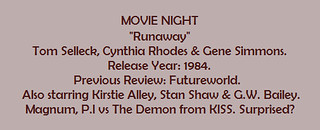
Runaway (1984).


Review #1171: Runaway.

Cast: 
Tom Selleck (Sgt. Jack R. Ramsay), Cynthia Rhodes (Karen Thompson), Gene Simmons (Dr. Charles Luther), Kirstie Alley (Jackie Rogers), Stan Shaw (Sgt. Marvin James), G.W. Bailey (Chief of Police), Joey Cramer (Bobby Ramsay), and Chris Mulkey (David Johnson) Directed by Michael Crichton (#988 - Westworld)

Review: 
Runaway was the fifth film that Michael Crichton directed and wrote for, and I suppose there must've been a yearning for him to make a sci-fi action thriller film with a look at machines. It certainly invites some comparisons to the technology present over thirty years since its release, that is for sure. There certainly are some things present here that are interesting to look at, such as smart bullets or robot spiders with acid. For a movie with no real terrible performances, how does the end product manage to be just mediocre? I suppose this comes due to the fact that there also isn't too much from what the movie offers that differs from other cop movies besides occasional moments with tech, particularly with its climax in a unfinished building. It manages to have a bunch of the cliches that you might expect from something like this, such as a new partner, greedy bad guy, someone involved in double-crossing the villain, hostage exchanges, etc, having a fair bit of predictability by the time the film moves towards its climax  For a movie that is about cops taking care of wayward machines, I feel that the premise isn't really executed too well, feeling a bit too casual with its approach. Honestly, you probably could've made a comedy with this material, as if the Geek Squad suddenly became cops in the future. Selleck (playing a cop who happens to be a expert on robots) is fine and pleasant, but the material doesn't really give him much to do besides a few stiff moments trying to establish chemistry with Rhodes and occasional moments trying to play off Simmons that begs for something a bit over-the-top. The oddest scene is where he takes down a robot that shocks you without protective gear to help a woman to safety because...he just wants to impress her I suppose, although I don't know how much she'll like him beating the thing with a bat. Rhodes is fine, having a bit of charm on occasion. Simmons (in his first feature role) is somewhat interesting in this slimy role, at least. Perhaps the material needed to give him a bit more to do to make it really have more impact. His fight with Selleck at the end feels a bit lacking, but at least there's a few killer spiders to go around and plenty of heights. Alley is fine, but she isn't really in the film too much to make much of an impact. The film doesn't really have any character that sticks out too greatly, being an okay but not special action flick with occasional moments of robot stuff. In a year with hit films such as Beverly Hills Cop and The Terminator, this movie did not prove to be a hit with audiences, making just over six million at the box office on an eight million budget upon release in late December. On the whole, the movie isn't anything to point and pick at, but it also isn't anything too great to write home about either. It exists on the scale of average, teetering between interesting and forgettable. Would I recommend it? I can't say it won't waste your time too much, but I also can't say that it really will prove to be too beneficial for certain tastes and patience, seemingly fitting only when there aren't too many choices to pick from.

Overall, I give it 6 out of 10 stars.