February 26, 2018

Bloodsport.


Review #1053: Bloodsport.

Cast: 
Jean-Claude Van Damme (Frank Dux), Bolo Yeung (Chong Li), Donald Gibb (Ray Jackson), Leah Ayres (Janice Kent), Norman Burton (Helmer), Forest Whitaker (Rawlins), Ken Siu (Victor Lin), Roy Chiao (Senzo Tanaka), Michel Qissi (Suan Paredes), and Philip Chan (Inspector Chen) Directed by Newt Arnold.

Review: 
This film was released 30 years ago on this day today. So why not do a review for it? That's my best justification for doing this movie. Hopefully you enjoy the review.

What can I say about this movie? What is there to write about a film starring "international martial arts sensation" Jean-Claude Van Damme that doesn't end in some sort of laughter or amazement that it exists (and naturally fitting for the 1980s)? The best thing to say is that at least it is a movie filled with some fair moments of action, although it is not accompanied by much in terms of story nor acting. This was the second feature role for Van Damme, who had appeared in No Retreat, No Surrender (1986) along with minor roles in other films (such as Breakin' in 1984), and while the easy thing to do would be to simply make fun of him for his performance (as one could do with the film), I will state that there is a certain level of intrigue that Van Damme inspires (for better or for worse) that keeps the movie from becoming a bore, mostly because he doesn't become a victim to the plot, as thin and preposterous as it gets. Gibb is enjoyably over-the-top, giving me a few chuckles (take that for what its worth). Yeung plays his adversary role with a fine polish that doesn't give him much dialogue but does manage to make him at least look the part of the big bad. Ayres does okay, although I can't say the romance subplot with her and Van Damme is anything too special. Burton and Whitaker prove to be an odd duo to pursue the main character that don't click too particularly well with the film, but at least they don't derail the movie. The rest of the cast isn't too noteworthy, but they do their parts reasonably fine.

When asked about the film (with relation to Frank Dux, whose exploits had been covered in the magazine Black Belt in 1980), co-writer Sheldon Lettich stated that he had known Dux months prior to thinking up the idea for the film, stating that he "told me a lot of tall tales, most of which turned out to be bullshit. But his stories about participating in this so-called "Kumite" event sounded like a great idea for a movie." It should be noted that Dux served as fighting coordinator for the film, putting Van Damme through a three month training program. I will state the action sequences (along with Van Damme's splits) are reasonably impressive at times, managing to have a good amount of spectacle that makes the movie seem worth it during its 92 minute run-time. Whether one puts much weight on Dux's "kumite experiences" is up to the viewer, but does it get in the way of enjoying the movie? No, partly because I doubt anyone watches the movie expecting this "true story" to be anything other than a tall tale that would likely make Paul Bunyan blush. Take this film for what it is: a ridiculous, but uninsulting piece of work that doesn't try to overextend itself beyond just attempting to be entertainment. Do I like it? No, but I can see why someone else would.

Overall, I give it 6 out of 10 stars.

February 23, 2018

Miracle (2004).


Review #1052: Miracle.

Cast: 
Kurt Russell (Herb Brooks), Patricia Clarkson (Patti Brooks), Noah Emmerich (Craig Patrick), Sean McCann (Walter Bush), Kenneth Welsh (Doc Nagobads), Eddie Cahill (Jim Craig), Patrick O'Brien Demsey (Mike Eruzione), Michael Mantenuto (Jack O'Callahan), Nathan West (Rob McClanahan), Kenneth Mitchell (Ralph Cox), Eric Peter-Kaiser (Mark Johnson), and Bobby Hanson (Dave Silk) Directed by Gavin O'Connor.

Review: 
Congratulations to the United States women's national ice hockey team, who won the Olympic Gold medal over Canada earlier yesterday, which also served as the 38th anniversary of the Miracle of Ice. In any case, I hope you enjoy this review.

What is there to say about the Miracle on Ice that hasn't already been said over the past 38 years? Particularly for the people that weren't alive to watch on February 22, 1980? Admittedly, there was a television movie based on the events that was released the following year (with starring Karl Malden in the main role), utilizing footage and original commentary from the game itself. The story of how the United States managed to beat the mighty power of the Soviet Union for the first time since winning gold in 1960 is an interesting one for people who dig into sports (which I do from time to time, particularly Of Miracles and Men (2015), which told about the Miracle on Ice through the eyes of the Soviet team members), but can it make for an entertaining film? The answer is yes, in part because of Russell, but also because the movie is honest enough to tell its tale without embellishing itself in too many cliches or anything too fancy. The film focuses itself on Russell and his moments in trying to portray a coach as honest and yet complex man who we find to be an interesting person to watch throughout. He just fits in so naturally, without any doubt to the way he plays it. Oddly enough, the only thing that wasn't particularly accurate was Brooks being friendly with the players (shown by him being at the Christmas party), with one player saying: "We respected him, but I wouldn't say that we liked him". The film's 135 minute pace feels satisfactory enough without being suffocating, and the film certainly has a correct feel that never looks suspiciously off-putting nor distracting.

There is time given to show some of the twenty hockey players that made up the roster, with Cahill and Demsey being fine standouts among the bunch. The players certainly look the part, with the hockey action being quite energetic and intense, looking fairly convincing without any resorting to anything too flashy, with accompanying commentary from Al Michaels and Ken Dryden (who had done the commentary for the original game, with all but the final ten seconds being recreated by the two). Clarkson isn't given too much to do, but she does her part convincingly enough. Emmerich does a fine time with the part he has, feeling fairly useful along with right for the part. McCann and Welsh do alright with the small amount of time they have to speak, but they serve as fair pieces to the film. A slight bit of time is given to show the Soviets, but the movie doesn't resort to trying to make them out to be villainous, instead just showing them and their dominance simply and naturally (except for the final, of course). This is a fine piece of entertainment, striving for satisfaction and achieving its goal without straining itself too hard in part because of a satisfactory cast with Russell doing a highlight job and hockey action that serves as tools to showcase the Miracle on Ice, being as majestic as it must've felt back then that still works now. It isn't anything too great, but it satisfies everything required with flying colors and that is more than enough.

Overall, I give it 8 out of 10 stars.

February 21, 2018

Cleopatra (1912).


Review #1051: Cleopatra.

Cast: 
Helen Gardner (Cleopatra - Queen of Egypt), Mr. Howard (Pharon), Charles Sindelar (Mark Antony), James R. Waite (Venditius - A Roman soldier), Mr. Osborne (Diomedes), Harry Knowles (Kephren - Captain of the Guards to the Queen), Mr. Paul (Octavius - A Triumvir and General), Mr. Brady (Serapian - An Egyptian priest), Mr. Corker (Ixias - Servant to Ventidius), Pearl Sindelar (Iras - An attendant), Miss Fielding (Charmian - An attendant), Miss Robson (Octavia - Wife of Antony), and Helene Costello (Nicola - Child) Directed by Charles L. Gaskill.

Review: 
You may notice that there is quite a bit of history citing in this review that I think helps give a bit of context to the film and its historic nature that I hope informs you without being detracting to the quality of the review. 

It is quite an achievement to note the age of a film like this, which as of this year is 106, with this being the oldest movie ever covered by me on Movie Night along with being the 11th from the 1910s. It is one of the earliest feature films, with examples of feature length movies (in this case being ones that lasted nearly or longer than a hour) including L'Inferno (1911) from Italy, Defence of Sevastopol (1911) from Russia, and Richard III (1912), a French-American production that had been released a month prior to this film (here is a fun fact: the first dramatic feature movie was The Story of the Kelly Gang (1906) that was made in Australia). This was produced by The Helen Gardner Picture Players (one of the first film production companies set up by a woman) that was adapted from the 1890 play Cléopâtre by Victorien Sardou, and the movie has a stagey feel to it that isn't surprising to say the least. Admittedly, this is more of a curiosity piece than anything, but is there anything wrong with wanting to see a capsule of something from an era long gone? Particularly one that has managed to survive to this very day, unlike the 1917 version of Cleopatra (which starred Theda Bara while being an adaptation of a novel of the same name), which was lost after the Fox studios vault fires of 1937, with Gardner's film being re-released the following year in order to compete with that edition, with two inter-titles being subjected to cuts by censorship boards: "If I let you live and love me ten days, will you then destroy yourself?" and "Suppose Anthony were told that she had just left the embraces of the slave Pharon", so make of that what you will.

In any case, this film begins with a title card that states that certain stage traditions haven't been considered when making this movie, as the director's goal is to insure naturalness while making a romantic atmosphere, with the Author's goal being to try and capture the qualities of the woman "devotedly loved by Julius Caesar", with freedom being taken in the adaptation. I can't say I've read that kind of title card before. Gardner is the most noteworthy person in the film, and she manages to do a good job in keeping our interest, and it should be noted that she designed her costume herself along with serving as editor (imagine an actor/actress doing that in this day and age), which is certainly interesting. The rest of the actors do the kind of job you'd expect, somewhat stagey but never too boring to watch on screen. The camerawork isn't any too special, but for the time it was made it is fairly respectable. The title cards (of which there are dozens of) lend a hand to telling the story that manages to feel useful without being too intrusive. If there is anything that can be said about this film, it can be that this is a fairly ambitious product of its time, being quite an achievement for the era that it was made in without becoming a relic not worth looking over. This was a movie that played in theatrical roadshows and even opera houses. It isn't a hard film to find due to being in the public domain, though I will state that it is best to make sure to watch one with a music score (obviously). Is it primitive? In some ways you could say that, but for 1912, I'm sure it must've been quite the charmer in terms of entertainment. I can't say that this is anything too great nor anything too awful, but I can definitely say that it is something that is worth checking out, even if only to see something that manages to have some appeal after a century since its release.

Overall, I give it 7 out of 10 stars.

February 19, 2018

Black Panther.


Review #1050: Black Panther.

Cast: 
Chadwick Boseman (T'Challa / Black Panther), Michael B. Jordan (Erik Killmonger), Lupita Nyong'o (Nakia), Danai Gurira (Okoye), Martin Freeman (Everett K. Ross), Daniel Kaluuya (W'Kabi), Letitia Wright (Shuri), Winston Duke (M'Baku), Sterling K. Brown (N'Jobu), Angela Bassett (Ramonda), Forest Whitaker (Zuri), Andy Serkis (Ulysses Klaue), Florence Kasumba (Ayo), and John Kani (T'Chaka) Directed by Ryan Coogler (#760 - Creed)

Review: 
The Marvel Cinematic Universe films have had a scope and quality to them that make for a consistently entertaining series of movies, and it is hard to believe that it has been ten years since the release of the film that started it all, Iron Man (#135). While it can be argued that these comic book films do tend fall along traditional formulas, it is the tweaking of certain aspects that make for the successes that have occurred, whether with a tinge of humor or with a tinge of humanity to it. After all, this is the 18th film in the franchise, and while you could equate them to products in a line, at least they are fairly solid products. In the case of Black Panther, this is a good movie that pushes most of the right buttons to make for a solid winner. The best quote that can be said about the movie comes from itself: "Just because something works doesn’t mean it can’t be improved".

As mentioned in my review for Blade (1998), the film had originally been slated for development with Wesley Snipes in mind in the 1990s, although it languished in development for two decades, with Chadwick Boseman eventually being cast in the role in 2014. Black Panther (based off the comic book series of the same name that was originally created by Stan Lee and Jack Kirby) had already been showed on the big screen prior to his own film, as he was introduced in Captain America: Civil War (#796) two years ago, and I remember he had made a fine impression on me. Obviously this film gives Boseman more time to show his character off, and he excels, managing to be an interesting hero with enough gravitas that manages to holds his own in a cast with a good deal of variety. Jordan does a great job, managing to show a good deal of charisma along with fury that makes for an interesting villain that stands out, particularly for a film universe that has not had the best of villain portrayals. Nyong'o and Gurira manage to provide capable performances that are fairly strong along with interesting to watch on screen, each having their own respective moments to shine. Freeman doesn't have much time on screen, but he does provide a satisfactory enough performance. Kaluuya doesn't have a lot to do with his character, but he does the best of what he can. Wright does a fine performance, having some clever charm along with characteristics reminding me of "Q" from the James Bond series while also having some amusing scenes with Boseman. Serkis manages to have a good scenery chewing time, for the time that he gets on screen anyway. The rest of the cast do a fine job in their respective roles and functions, such as Duke and his adversarial but crucial role or Whitaker and his mystical nature.

The themes of the film work to the film's advantage, presenting its arguments without being ham-handed in approach. There are other things deserving praise, such as Rachel Morrison and her cinematography and Ruth E. Carter's costume design, both working fairly well to complement the film, making for a worthy atmosphere to watch. The action sequences are fairly hit and miss; while I do appreciate some of the fight sequences, there are times when it feels a bit too standardized, with the climax serving as mild entertainment when not utilizing too much effects, and the resolution to the film is fairly satisfactory, with its 134 minute run-time being acceptable enough for me. I do appreciate that the movie doesn't try to tie itself to other films of the comic franchise too much (aside from a flashback or so), being a film that is interesting in just showing itself off without lingering too much on little details. Ultimately, this is a film that is a pretty good success, achieving its goals well without betraying its principles.

Overall, I give it 8 out of 10 stars.

February 17, 2018

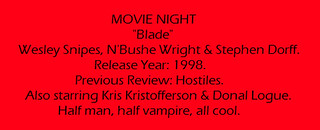
Blade.


Review #1049: Blade.

Cast: 
Wesley Snipes (Eric Brooks / Blade), N'Bushe Wright (Dr. Karen Jenson), Stephen Dorff (Deacon Frost), Kris Kristofferson (Abraham Whistler), Donal Logue (Quinn), Udo Kier (Gitano Dragonetti), Sanaa Lathan (Vanessa Brooks), and Arly Jover (Mercury) Directed by Stephen Norrington.

Review: 
Blade was the sixth film that was based off a product from Marvel Comics (although it was only the second to be released widely in America, besides Howard the Duck in 1986), adapted off the comic book series created by Marv Wolfman and Gene Colan. The film began its development earlier in the decade, with LL Cool J expressing interest in playing the lead role before Snipes signed onto the role in 1996 (it is interesting to note that Snipes had plans to make a film about Black Panther, although that movie languished in development for over two decades until this year). In any case, this is an interesting take on the vampire film that generally hits more than it misses while notably being Marvel's first box office success.

There is just a certain level of excitement and style that makes the film ride consistently enough that comes in large part due to Snipes and his performance. He just manages to make the material feel believable and useful that might've sound silly with a lesser actor. Wright does a fine job, although I find that she doesn't particularly stand out too much. Dorff proves to be a quirky but fairly entertaining villain, having an unhinged manner to him that gels well on screen at times. Kristofferson manages to stand out pretty well with his rugged charm that clicks despite not having too much time on screen. The rest of the cast do their parts fairly well, not going too overboard nor too serious either. The action sequences are gripping and intense, managing to make for a quick tone that is fairly effective while not being disorientating. The plot isn't anything to be desired, but the film keeps itself entertaining enough to erase some of the nagging problems that would've become more noticeable for a film without as much enthusiasm or fun. The effects (with numerous sequences involving blood) look a bit wonky, but they don't distract too awfully as they probably could've been. The original cut (which lasted 140 minutes) had Dorff turn into a big mass of blood instead of the sword fight that does happen in the final cut, and upon seeing both versions of the fight, I can definitely say that they made the right decision in not using the big mass. At 120 minutes, the movie has a serviceable length that works without too much drag to it. On the whole, Blade is a strange mix of energy and slick filmmaking that works in the right places to make a solid piece of entertainment.

Overall, I give it 8 out of 10 stars.

February 14, 2018

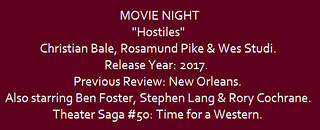
Hostiles.


Review #1048: Hostiles.

Cast: 
Christian Bale (Captain Joseph J. Blocker), Rosamund Pike (Rosalie Quaid), Wes Studi (Yellow Hawk), Ben Foster (Sergeant Charles Wills), Stephen Lang (Colonel Abraham Biggs), Rory Cochrane (1st Sergeant Thomas Metz), Jesse Plemons (Lieutenant Rudy Kidder), Timothée Chalamet (Private Philippe DeJardin), Jonathan Majors (Corporal Henry Woodson), Adam Beach (Black Hawk), and Q'orianka Kilcher (Elk Woman) Directed by Scott Cooper.

Review: 
Admittedly, it is interesting watch a Western like this in our day and age, one that is brutal but fair in its approach that ultimately feels like a solid winner. The film (which premiered at the Telluride Film Festival in September of last year before going into limited release in December and general release on January 26th) is based off an manuscript from the late screenwriter Donald E. Stewart, who had written for numerous films such as Missing (1982) and The Hunt for Red October (1990 - #080), among others. Undeniably, the most appealing aspect of the film is Bale, who delivers a tremendous performance. There is just something about the way that he commands the movie and shows numerous layers within his character that makes for a hauntingly good role. That's not to say that the other actors don't go a great job, with Pike and Studi also standing out in their own ways. Pike manages to interact with the harrowing world that she is thrust into with the right sense of emotion and timing. Studi also provides a fine performance, managing to complement Bale and his character with his own actions that he conveys in a convincing manner. Notably, a good part of the film features the speaking of dialogue through the Cheyenne language, which comes off as satisfactory to the film's benefit. The other actors do their parts well enough, particularly Cochrane, who plays the weary solider in the film rather convincingly. Another highlight of the movie is its look, with cinematographer Masanobu Takayanagi doing a fine job in capturing the locations utilized in the movie that give a crisp but useful feel. This is a redemption story through and through, and it manages to capture a feel of the Old West without feeling too hollow. The narrative isn't always the most consistent, but the parts that are manage to ring true enough, with the 133 minute run-time being forgivable. I'd recommend it, particularly if you are a fan of the genre and want something that is harsh but also arguably beautiful as well.

Overall, I give it 8 out of 10 stars.

February 13, 2018

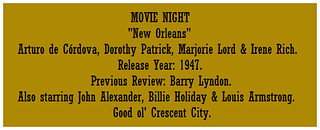
New Orleans.


Review #1047: New Orleans.

Cast: 
Arturo de Córdova (Nick Duquesne), Dorothy Patrick (Miralee Smith), Marjorie Lord (Grace Voiselle), Irene Rich (Mrs. Rutledge Smith), John Alexander (Col. McArdle), Billie Holiday (Endie), Louis Armstrong (Himself), Richard Hageman (Henry Ferber), Jack Lambert (Biff Lewis), Bert Conway (Tommy Lake), Joan Blair (Constance Vigil), with Woody Herman and His Orchestra, Zutty Singleton (Drums), Barney Bigard (Clarinet), Kid Ory (Trombone), Bud Scott (Guitar), Red Callender (Bass), Charlie Beal (Piano), Meade Lux Lewis (Piano), and Mutt Carey (Trumpet) Directed by Arthur Lubin.

Review: 
A film with Louis Armstrong and Billie Holliday? Admittedly, that is a pretty good way to attract interest in a film, particularly one that titles itself after the city that help create jazz. However, if you are looking for a good musical showcase, you may find yourself a bit disappointed. The film is a love story - between a high society girl and a casino owner, while being a fictionalized version of the rise of blues. The biggest problem with the movie is that it falls prey to relying on its conventional story parts more than its musical talents. It's not so much that the main two leads (de Cordova and Patrick) are awful or anything, it's just that they aren't particularly inspiring people for the energy that the movie looks like it should have. Holiday (in her only film role) and Armstrong (who had appeared in numerous films prior to this one) prove to be more entertaining than the duo in part because they aren't bound down to the plot-line so heavily.

I'm reminded of Stormy Weather (1943, #841), which also featured African American performers. In that film, the plot wasn't anything too particularly inspiring, but it also never managed to find itself in the way of showing the musical talents. One could also cite other musicals that featured numerous talents with plots that weren't as flimsy as what New Orleans does. It could've been a love letter to jazz, but it instead feels like a half-hearted note. For a film that is as mediocre as it gets, the musical parts with Armstrong and Holiday are top-notch, being quite beautiful and engaging. The film runs at 90 minutes, which isn't a bad length. Would I recommend it? I suppose that if one can recommend watching awful movies in order to see it to believe it, I guess that recommending this for its musical bits and not much else is okay. It won't garner a positive review, but it will merit a honorable mention at least.

Happy Mardi Gras folks.

Overall, I give it 6 out of 10 stars.
February 12, 2018

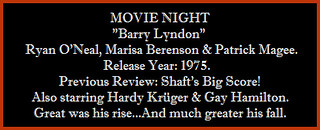
Barry Lyndon.


Review #1046: Barry Lyndon.

Cast: 
Ryan O'Neal (Redmond Barry), Marisa Berenson (Lady Lyndon), Patrick Magee (Chevalier du Balibari), Hardy Krüger (Captain Potzdorf), Gay Hamilton (Nora Brady), Godfrey Quigley (Captain Grogan), Steven Berkoff (Lord Ludd), Wolf Kahler (Prince of Tubingen), Marie Kean (Belle), Murray Melvin (Reverend Samuel Runt), Frank Middlemass (Sir Charles Reginald Lyndon), Leon Vitali (Lord Bullingdon), and Michael Hordern (Narrator) Directed by Stanley Kubrick (#044 - Full Metal Jacket, #065 - The Shining, #093 - 2001: A Space Odyssey)

Review: 
The film was based off the 1844 novel The Luck of Barry Lyndon by William Makepeace Thackeray, with a few significant changes from the novel, such as utilizing a narrator over having Lyndon narrating. Barry Lyndon was Stanley Kubrick's tenth feature film, being released between A Clockwork Orange (1971) and The Shining (1980). It could be argued that this film isn't as well known as other films directed by Kubrick, with the film not being too much of a success on general release, although it has had a rise in reputation in recent years. When asked about his favorite Kubrick film, director Martin Scorsese said this about the film: "I'm not sure if I can have a favorite Kubrick picture, but somehow I keep coming back to Barry Lyndon." I can't say that this is my favorite film of his, but I will admit that this is a fairly neat gem that merits some respect. The best aspects of this film is its technical qualities and its finely constructed narrative, although it likely isn't the film for everyone. I can't say that O'Neal doesn't do a great job in the main role, but I also can't say that his performance isn't one of the weaker ones in the film, and it stems from his arc in the film. I think he does a fine job when it comes to trying (and failing) to fit in to the social ladder, but there are certain moments when he comes off a bit wooden, although he is never awful to watch on screen nor frustrating to see, capturing a nonredeemable man fairly well. Berenson does a fine job in her role, having a stillness and convincing nature to her that works to her advantage. Magee is a fair standout. The rest of the cast do their parts fairly satisfactory, fitting in with the look of the film without being distracting, like portraits in a museum. The narration by Michael Hordern is a key highlight, being quite fitting when he speaks that fits the moment quite well. This was a departure from the novel, which tells the events in first person through Barry. When asked about why he made the change, Kubrick stated that "[it] worked extremely well in the novel but, of course, in a film you have objective reality in front of you all of the time, so the effect of Thackeray's first-person story-teller could not be repeated on the screen." In any case, the narration works well for the mood and pace of the film.

The film won four Academy Awards, winning for Best Art Direction (given to Ken Adam, Roy Walker, Vernon Dixon), Best Cinematography (done by John Alcott), Best Costume Design (Milena Canonero, Ulla-Britt Söderlund) and for Best Original Song Score or Adaptation Score to Leonard Rosenman, for his arrangements of music of Franz Schubert and George Frideric Handel. Of note is that there are sequences in the film that were shot without resorting to simply using electric light, with special lenses being utilized for the film that had been developed for use in the Apollo moon landings, allowing scenes to be lit with actual candles, with other shots using certain lighting to try and mimic natural light. There are also numerous lengthy wide angle long shots that assist in the film having a static but fitting quality. The 187 minute run-time could be a bit of a deal breaker for someone looking for something a bit less slow, but others will find it to be a fine price to pay to appreciate the beauty in the film. On the whole, this is a magnificent film in its scope and its scale, having a certain quality to it that merits a watch.

Overall, I give it 9 out of 10 stars.

February 10, 2018

Shaft's Big Score!


Review #1045: Shaft's Big Score!

Cast: 
Richard Roundtree (John Shaft), Moses Gunn (Bumpy Jonas), Drew Bundini Brown (Willy), Joseph Mascolo (Gus Mascola), Kathy Imrie (Rita), Wally Taylor (Johnny Kelly), Julius Harris (Capt. Bollin), Rosalind Miles (Arna Asby), and Joe Santos (Pascal) Directed by Gordon Parks (#610 - Shaft (1971))

Review: 
The original Shaft movie was described by me as one with an "epitome of cool", in part due to its title character, action sequences, and its music. It had a style to it that is hard to beat and even harder to replicate, although that doesn't mean the sequel isn't any good. Shaft's Big Score! is fairly entertaining fare, with a cast that does its job with flying colors and some interesting action sequences to push this over the top for the most. Admittedly, the story is a bit sketchy at times with its execution and the pacing isn't as rip-roaring, mostly because the film seems a bit muddy with its motivations (even the title seems to be a bit strange considering what occurs in the film), but it's not a terribly boring movie. Roundtree is the key standout, retaining the confident charisma from the original while also being fairly hip and fairly consistent, resembling James Bond but without the gadgets.

Gunn also returns, although he isn't given too much to do. Taylor also does a pretty fine job in an adversarial role that doesn't go too over the top. Mascolo is the main villain (with Taylor also serving as an adversary), but it takes probably a bit too much time to introduce him and thus his performance is merely just okay. The rest of the cast do their jobs fairly well. The film retains the same director from the original, Gordon Parks (who also provides the music due to Issac Hayes being unavailable) along with Ernest Tidman, writer (along with producer) who had written the book that Shaft was based off of and cinematographer Urs Furrer. The climax scene, which goes from land to sea to air, manages to stand out fairly well due to having a gritty but riveting feel that is executed pretty well. This is the kind of film that has a certain energy and click that is absorbing for a blockbuster like this. On the whole, the movie is a bit uneven at times, but it also is an entertaining kind of action flick that makes for a useful good time.

Overall, I give it 7 out of 10 stars.

February 8, 2018

The Kid Brother.


Review #1044: The Kid Brother.

Cast: 
Harold Lloyd (Harold Hickory), Jobyna Ralston (Mary Powers), Walter James (Jim Hickory), Leo Willis (Leo Hickory), Olin Francis (Olin Hickory), Constantine Romanoff (Sandoni), Eddie Boland ("Flash" Farrell), Frank Lanning (Sam Hooper), and Ralph Yearsley (Hank Hooper) Directed by Ted Wilde and J.A. Howe.

Review: 
The Kid Brother was the tenth feature film to star Harold Lloyd, released nearly nine months after For Heaven's Sake (#727). The film attempts to carry numerous elements together, such as comedy, romance, and drama, and it manages to do fairly decent while being consistent with its gags. The basic story isn't too particularly deep, but it is one that makes for good entertainment (much like the other Lloyd films) that is more than enough. The film credits two directors (Wilde and Howe, with the latter given a "co-director" credit), although apparently there was also uncredited work done by Lloyd and Lewis Milestone (previously reviewed on Movie Night for his direction of The Racket (1928) - #901). In any case, there is quite a good amount of gags and intertitles to go around, such as the laundry shuffling sequence, or the climax involving a massive ship and one mischievous monkey. The cast all do a fine job in the roles they are assigned to play. Lloyd plays his role with a bit of bashfulness as the youngest Hickory yet he also doesn't underplay his cleverness either, with Lloyd being adept at rolling with the situations that go on in the film. Ralston is charming as ever, doing an acceptable job in her final film with Lloyd. The rest of the Hickorys are brimming with confidence and stature, and each of the three (James, Willis, and Francis) do a good job in their scenes, especially with Lloyd. Romanoff, Boland and Yearsley prove to be fairly decent adversaries as well. This is a movie that comes and goes with amusement and a bit of sharpness that you'd expect from a film with Lloyd, but it is done in a way that it doesn't come off as standard fare or repetitive. There is a certain enjoyment to the situations and how it is executed that make this a fair winner. At 84 minutes long, the movie is just the right kind of length for reasonable enjoyment for most fans of silent films or ones looking for a good laugh.

Overall, I give it 8 out of 10 stars.

February 5, 2018

The Naked City.


Review #1043: The Naked City.

Cast: 
Barry Fitzgerald (Detective Lt. Dan Muldoon), Howard Duff (Frank Niles), Dorothy Hart (Ruth Morrison), Don Taylor (Detective Jimmy Halloran), Frank Conroy (Captain Donahue), Ted de Corsia (Willie Garzah), House Jameson (Dr. Lawrence Stoneman), Anne Sargent (Mrs. Halloran), Adelaide Klein (Mrs. Paula Batory), Grover Burgess (Mr. Batory), and Mark Hellinger (Narrator) Directed by Jules Dassin.

Review: 
It is interesting to see a film noir like this, one with a semi documentary kind of style that depicts an investigation of a murder case step by step. In an interesting coincidence, I had already reviewed a police procedural film that has the same kind of semi-documentary style that also happened to be released in 1948, He Walked by Night (#947). Both movies stand on their own when it comes to detailing crime investigation, so it's hard to say which is the better of the two. Admittedly, the film has aged a substantial bit due to time along with the countless amounts of crime dramas that have followed (and continue to follow) after the film's release 70 years ago, although that doesn't mean the film isn't fairly well packaged. The film was produced and narrated by Mark Hellinger, who served as a journalist prior to becoming a producer, and he certainly contributes to making the film feel particularly effective in the story it wants to weave. The film was filmed on location in New York City, and there is certainly an interesting atmosphere that the film makes interesting to watch. The cinematography was done by William H. Daniels and the editing was done by Paul Weatherwax, with both receiving Academy Awards for their respective work in the film, and they certainly have standout moments, with Daniels' shots looking particularly good with action sequences or nighttime shots. The acting is acceptable for the movie and what it's going for, particularly from Fitzgerald and Taylor, who work fairly well together as the police leads, clicking without much struggle. The other cast members are a bit subdued, but they do their parts well, such as de Corsia in his adversarial role that doesn't come off as too forced. The best quality the movie has is that the movie seems comfortable with what it wants to tell, being a capable thriller without adhering to going through all of the cliches for noirs, going straight-forward with a straight shot. This film has a good deal of entertainment value along with staying power even after all of these decades. I would check it out, particularly if you are interested in a good crime yarn.

Overall, I give it 8 out of 10 stars.

January 31, 2018

War of the Satellites.


Review #1042: War of the Satellites.

Cast: 
Dick Miller (Dave Boyer), Susan Cabot (Sybil Carrington), Richard Devon (Dr. Pol Van Ponder), Eric Sinclair (Dr. Howard Lazar), Michael Fox (Jason ibn Akad), Robert Shayne (Cole Hotchkiss), and Jered Barclay (John Compo) Directed by Roger Corman (#368 - The Little Shop of Horrors, #684 - It Conquered the World, #852 - The Terror, #931 - Not of This Earth, #1007 - Attack of the Crab Monsters, and #1039 - Five Guns West)

Review: 
Today happens to be the 60th Anniversary of the launch of Explorer 1, the first satellite launched by the United States. As such, I figured that it would make sense to a science fiction film involving space from that year, and thus this came up for viewing. Enjoy!

It is interesting to see how many space films one can encounter that attempted to benefit from the Space Age, with this one being an independent film (distributed by Allied Artist) from Roger Corman (who also has a small part in the film as a Ground Control member), who certainly makes films worth talking about, for better or worse. This was released on May 18, 1958, four months after the launch of Explorer 1 and seven months after the launch of Sputnik 1. This time around, the plot revolves around a mysterious group of aliens trying to stop humans from exploring space through exploding their satellites by some sort of space barrier. The title of the film is a bit strange considering that the film doesn't have any sort of war between satellites, but I digress. As a science fiction film, it isn't anything too special for the genre, but it isn't anything too patronizing nor anything too ridiculous, with a villain that has a few interesting moments. The characters aren't anything too developed, although the actors at least make them see fairly passable and useful to watch. Miller and Cabot make for a decent pairing, but a good part of the film utilizes Devon to a satisfactory effect. There isn't too much with the special effects, but they are fairly passable when on screen, such as the effect that is utilized for the healing of a hand wound that seems fairly clever. The sets (such as the ship's interior) are also fairly serviceable, making for something that doesn't come off as anything too cheap. The film doesn't go for anything too ridiculous or too schlocky, having a concentrated feel that is somewhat intriguing. It may have some of the cliches you might see in other sci-fi movies, but it at least makes an effort to gel those together to make something worth watching at least once. At 66 minutes, this is a fairly quick movie that will certainly satisfy anyone with tastes for some science fiction or something with a bit of entertainment to it, which this one does fairly well. If you're a fan of Roger Corman movies, or a fan of sci-fi in any kind of form (low budget or not), this one will fit fairly well for your standards.

Overall, I give it 7 out of 10 stars.

January 29, 2018

A Woman of Paris.


Review #1041: A Woman of Paris.

Cast: 
Edna Purviance (Marie St. Clair), Clarence Geldart (Marie's Father), Carl Miller (Jean Millet), Lydia Knott (Jean's Mother), Charles K. French (Jean's Father), Adolphe Menjou (Pierre Revel), Betty Morrissey (Fifi), and Malvina Polo (Paulette) Directed by Charlie Chaplin (#353 - Monsieur Verdoux, #599 - The Kid, #600 - City Lights, #759 - The Gold Rush, #775 - Shoulder Arms, #820 - Modern Times, #923 - The Pilgrim, and #1025 - The Circus)

Review: 
The film (sometimes referred to as A Woman of Paris: A Drama of Fate) begins with a preamble: "To The Public -- In order to avoid any misunderstanding, I wish to announce that I do not appear in this picture. It is the first serious drama written and directed by myself. Charles Chaplin." This was the first film that Chaplin distributed through United Artists, which he had founded with D. W. Griffith, Mary Pickford and Douglas Fairbanks in 1919; the film was released seven months after the release of The Pilgrim (#923) through First National Pictures. The film was meant to help boost Purviance's career, although this did not happen. This was her last starring role prior to her retirement from acting in 1927. At the time, Chaplin was well known for his comedic works, and despite Chaplin's statements over how one should enjoy this film as a drama, it didn't prove too appealing for audience and thus it was not a success. The film was re-issued in 1976 by Chaplin with a new musical score along with having a shorter run-time due to cuts, which shortened the run-time from 82 minutes to 78.

With all of that history that I mentioned, how is the film? I think that the movie is fairly well-made, much like other Chaplin-directed films that preceded and followed this film, being constructed fine enough within its drama. I wouldn't consider it any too great, but I'd say that it would likely fit as a hidden gem. The film doesn't fall prey to too many cliches with regard to its characters, having a bit of originality along with some clever touches. Purviance does a fine job with what she's given, having a bit of alluring nature to her while not falling prey to being too obvious with her movements. Miller does an okay job, giving a performance that isn't anything too special, but it isn't anything that ruins the mood. Menjou is the one who stands out the best, having an air of sophistication that works to his advantage in making an entertaining performance. The other cast members do fine jobs for what they are meant to do, with the parents being interesting contrasts to their offspring. It's a bit of a morality play, but at least it isn't any too overblown or too out of the bend, for lack of a better phrase. It may take a bit of time for the film to really get itself going, but it manages to have some sort of impact by the time it gets to its climax.

Overall, I give it 7 out of 10 stars.

January 27, 2018

The Scarlet Claw.


Review #1040: The Scarlet Claw.

Cast: 
Basil Rathbone (Sherlock Holmes), Nigel Bruce (Doctor Watson), Gerald Hamer (Alistair Ramson), Paul Cavanagh (Lord William Penrose), Arthur Hohl (Emile Journet), Kay Harding (Marie Journet), Miles Mander (Judge Brisson), David Clyde (Sgt. Thompson), Ian Wolfe (Drake), and Victoria Horne (Nora) Directed by Roy William Neill (#846 - Frankenstein Meets the Wolf Man, #873 - Sherlock Holmes and the Secret Weapon, #925 - Sherlock Holmes in Washington, #936 - Sherlock Holmes Faces Death, #1021 - The Spider Woman, and #1040 - The Scarlet Claw)

Review: 
The Scarlet Claw was the eighth film in the Sherlock Holmes series (and sixth released by Universal) that featured Basil Rathbone and Nigel Bruce. Although the film is not an adaptation of any of the stories by Arthur Conan Doyle, the film has some similarities with The Hound of the Baskervilles, which had already been adapted into a film (#583) with Rathbone and Bruce five years prior. Qualities that the two share involve a terror that is painted with phosphorescent but also a terror of the supernatural that inspires fear, an escaped convict on the loose, and drawing the killer out through making the villain believe that Holmes has left. In any case, the earlier film (and novel) are both better than this film, although this movie is actually fairly entertaining in its own right. It is usually cited by some critics as the best of the twelve Sherlock Holmes films released by Universal, and I can't really doubt that assessment. John P. Fulton provides the "special photography" for the movie, and the effect used to show the glowing figure that menaces in the mist for the first half of the film is fairly clever. The sets (meant to evoke a Canadian village) for the film do a fine job in making for a somewhat moody feel that feels a bit different from other prior films to the film's advantage. It's hard not to like Rathbone and Bruce in their roles as they just blend in fairly seamlessly. Hamer proves to be a decent villain for the film, and Cavanagh and Hohl also provide fair performances. The plot seems to be constructed well, managing to not have anything too out of the bend. At 74 minutes, this is an easy one to recommend for people, particularly for people wanting more adventures with Sherlock Holmes. It isn't anything too groundbreaking or great, but it will prove satisfactory for viewers on the whole.

Overall, I give it 7 out of 10 stars.

January 24, 2018

Five Guns West.


Review #1039: Five Guns West.

Cast: 
John Lund (Govern Sturges), Dorothy Malone (Shalee Jethro), Mike Connors (Hale Clinton), Robert Wright Campbell (John Candy), Jonathan Haze (Billy Candy), Paul Birch (J.C. Haggard), James Stone (Uncle Mike), and Jack Ingram (Stephan Jethro) Directed by Roger Corman (#368 - The Little Shop of Horrors, #684 - It Conquered the World, #852 - The Terror, #931 - Not of This Earth, and #1007 - Attack of the Crab Monsters)

Review: 
Admittedly, Five Guns West does not stand out too particularly well from other Roger Corman productions, but it does have the distinction of being Roger Corman's first film as director. Prior to this film, he had been involved in the production of three other films: Highway Dragnet (1954), which he contributed the story to, Monster from the Ocean Floor (1954), which he served as producer, and The Fast and the Furious (1955), which he provided the story and served as producer. Corman served as producer and director for this film, with Robert Wright Campbell providing the story and also starring in the movie, which was filmed in nine days for a sum of $60,000. The plot shares some similarities with The Dirty Dozen (#1014), involving outlaws being pardoned in order to perform a dangerous mission set near the end of the American Civil War. There isn't anything too terrible in this Western, although it definitely doesn't stand out much. This is a B-movie through and through, although it is fairly well-made and fairly competent, despite not having much in terms of big entertainment. It feels a bit talkative at times with its dialogue, but at least the words that are used aren't too wooden. Lund and Malone prove to be fairly useful leads, having a bit of chemistry with each other, although it isn't anything too special. The rest of the main group (Connors, Campbell, Haze and Birch) are not too bad, with their own little conflicts that aren't too shabby, although I can't say they really are much in terms of villainy, but I digress. The action is fairly decent stuff, having some gun action that works alright for the intent of the film. The look of the movie isn't too bad, either. At 78 minutes, the movie doesn't feel too long, so in that way it helps the movie feel a bit worthy for watch. There isn't anything that is great about the movie, but there also isn't anything that is terrible about the movie either. It falls in the middle in terms of quality, for better or for worse. It won't win any kind of honor, but it is a fairly okay film for people wanting to see something from Roger Corman, even if it is formula entertainment such as this.

Overall, I give it 6 out of 10 stars.
January 18, 2018

Cloverfield.


Review #1038: Cloverfield.

Cast: 
Michael Stahl-David (Robert "Rob" Hawkins), T.J. Miller (Hudson "Hud" Platt), Jessica Lucas (Lily Ford), Odette Yustman (Elizabeth "Beth" McIntyre), Lizzy Caplan (Marlena Diamond), Mike Vogel (Jason Hawkins), Ben Feldman (Travis), Billy Brown (Staff Sergeant Pryce), and Chris Mulkey (Lieutenant General Graff) Directed by Matt Reeves.

Review: 
I suppose it makes sense to review this film today on January 18, since it is the 10th anniversary of the film's release in theaters, so it is a perfect time to get to it along with giving you fellow readers a new review after a week since the last one. 

When asked about the film prior to its release, J. J. Abrams (who served as producer for the film) stated that he was inspired to make an American monster after seeing Godzilla toys in stores in Japan with his son, one that would be "insane and intense", which is certainly interesting. I was eleven years old when the film came out, but I don't particularly remember the marketing for the film, although I imagine that it must've been interesting for people on the Internet to focus a bit of time on (take that statement as you may). In any case, how is the movie itself? I find the movie to be fairly decent, although I can't say I really thought it was that scary or all too special. It is an interesting idea to make a monster movie that doesn't intend to go for only big entertainment spectacle destruction and instead goes for something that plays on fears and anxiety that people would have if a situation like this actually did arise; one scene in particular stands out, involving people taking out their phones after seeing the head of the Statue of Liberty fall right near them. I wish I could say the plot or the characters are as intriguing as the concept for the film, but that it is not the case here. The performances aren't terrible, but they aren't too particularly interesting. I will state that Miller does a pretty decent job, however. I found him to be more interesting to follow than the plot around the other characters, even if most of the time he is just the guy filming the things happening. Caplan also comes off a bit interesting when she is on screen.

The film has a look intended to resemble hand-held camera filming, including jump cuts that make it feel a bit like a home movie, although I will admit that the effect can feel a bit disorientating at times. Apparently, some viewers of the film during its release experienced motion sickness due to the film's cinematography, to the point that some theaters posted warnings about the film that stated it may "experience side effects associated with motion sickness similar to riding a rollercoaster". Sometimes the shots (and the shakes) worked in my view, but other times it felt a bit tedious. I imagine seeing this in a theater would be a significantly different experience than seeing it on a normal TV set. The visual effects were incorporated after filming, so the cast had to react to an unseen creature during their scenes, which I suppose is an achievement on their part in imagination. The monster (of what we see, anyway) is not too terrible, and it generally is one that feels pretty creepy and menacing. It doesn't have much of an origin, but that doesn't really feel too surprising. The film runs at 84 minutes, which feels alright considering the plot matter and the shaky-cam stuff. Ultimately, Cloverfield has an interesting premise that it plays around with a bit to fine effect, but on the whole it is a fairly decent monster/horror flick that stands alone as a curiosity if one has the patience for it.

Oh yeah, I probably should refer 10 Cloverfield Lane (#784), released eight years after this film. That film, while not a direct sequel, was a fairly interesting thriller that certainly played itself as a thriller neatly enough. Cloverfield doesn't exactly pale too badly in comparison with 10 Cloverfield Lane, but I felt that this needed to be mentioned in any case.

Overall, I give it 7 out of 10 stars.

January 11, 2018

Go West (1925).


Review #1037: Go West.

Cast: 
Buster Keaton (Friendless), Howard Truesdale (Owner of the Diamond Bar Ranch), Kathleen Myers (His Daughter), Ray Thompson (The Foreman), and Brown Eyes (Herself) Directed by Buster Keaton (#757 - Seven Chances, #762 - College, #805 - The Navigator, #877 - Three Ages, #908 - The General, #926 - Our Hospitality, and #941 - Sherlock Jr)

Review: 
Go West was the seventh feature film starring Buster Keaton, who also served as director (doing so for all except the first feature film that he starred in). This one features Keaton working at a cattle ranch, where he does things such as bronco-busting, cattle wrangling, and dairy farming, which go about as well as you'd expect, with Keaton forming a friendship with a cow. Admittedly, it is easy to say I enjoyed the movie, in part because it is a warm experience that has enough orchestrations and humor to make a relatively useful movie. It isn't a classic like some of Keaton's other works (such as The General or Sherlock Jr), but I will say that it is a fine little gem that serves its purpose of entertainment. Oddly, it is the dynamic between Keaton and the cow that drives the film forward, with numerous sequences between them are fairly useful and sweet in some way. The highlight of the film is the cattle stampede at the end, mostly because of how well it is orchestrated, from the reactions of the other actors to the way that the cattle move about, particularly with some of the sight gags that occur. The rest of the cast isn't too developed, but they serve their purposes well for the movie's standards. Keaton makes for a bumbling but always endearing lead, with a face made for silent era comedies like these, even if it may not fit the usual formula for his films. There isn't any sort of stunt-work that stands out too much, but I will say that there is some fun to be had with the movie and its goofiness with the premise that works out alright, with nothing too ridiculous or overdone. It takes its time to get rolling, but it sure feels worth it in the end. It has a runtime of 69 minutes, which I'm sure is nice enough for people to get a quick enjoyment.

Overall, I give it 7 out of 10 stars.

January 9, 2018

Gymkata.


Review #1036: Gymkata.

Cast: 
Kurt Thomas (Jonathan Cabot), Tetchie Agbayani (Princess Rubali), Richard Norton (Zamir), Edward Bell (Paley), John Berrett (Gomez), Conan Lee (Hao), Bob Schott (Thorg), Buck Kartalian (The Kahn), and Eric Lawson (Colonel Cabot) Directed by Robert Clouse (#587 - Enter the Dragon)

Review: 
You may be wondering to yourself the following question: "What is Gymkata?" Well, it is a mix of the skill of gymnastics with the kill of karate, as stated in the poster for the film, which apparently was based off the novel The Terrible Game by Dan Tyler Moore. Knowing either of those facts doesn't make the movie any much better, considering that this is a by the numbers terrible flick. The plot of the film is as follows: A gymnast is approached by special forces to participate in some sort of ancient game (called "The Game", naturally) in a fictional country in order to see if he can win this athletic competition that no outsider has won in over 900 years. The winner is granted a wish, and they want him to wish...for a US satellite monitoring station to be installed in the country in order to monitor all satellites in space so the "other side" can't. Yes, that is the premise. If you were shaking in your boots in anticipation for the movie, then all power to you. Honestly, this is a movie made to show off action sequences, and it does so with the scenery of Yugoslavia and no sense of energy aside from a few laughs at the film and its plot. The film is essentially something you'd see from someone who wanted to showcase action and take a bunch of cliches together, such as the jealous rival, the monarchy that the hero familiarizes with, the long-lost father, and so on. Nothing dates this film better than mentioning the "Star Wars" program, but then again who's surprised by this?

It may interest you to note that Kurt Thomas (with a size of about 5-4.5, which is a bit shorter than my size) was a world champion in numerous categories in gymnastics in 1978-79, with two gymnastic moves (the Flair and the salto) being named for him. In the sense of his sequences on the mat and in action, he does a fine job in his first (and only) film appearance. He doesn't do too great performance-wise, but that can apply to pretty much everyone else in the film, who don't exactly seem to have too much enthusiasm for the story, although I will admit that Norton certainly fits the bill as a silly villain for the hero to defeat. If you don't really care too much for characters, story, or general competency, then this is probably the movie for you. I can't really say I was surprised that this turned out to be a stinker, so how can I be mad? How can I be mad that this is an absurd and goofy piece of film when I knew that it was coming? As dated as the film is, I will date this review further by stating that I watched this on Turner Classic Movies (TCM), who showed this film (and the film reviewed earlier yesterday) on Saturday night as part of their "Underground" series. I will say that they certainly fit the bill as an example of a terrible pairing that also works well for their series, along with Movie Night, obviously. Sometimes you just need some bad flicks to truly remember what makes for good and bad films, and Gymkata is one of those films.

Let's not forget the ending where (spoilers) the first satellite monitoring station was installed after our hero wins the game. Truly it was important enough to note on the epilogue. I tried to check if there were many quotes for the film on IMDb and it turns out that there was one that was more than a whole sentence: "There are many sounds around us, each is slightly different. So small as to go un-noticed by the person who is unaware. Do not hear the wood split. Hear the only sound of axe, cutting air. Read the air itself. It has much say to you." Basically, the movie stinks. But it is the kind of stinker that you may get a kick out of, particularly if you dig movies that aim for cheap pulp action without any sort of illusion about what it wants to be. For all that I said about the movie, it is up to you the viewer to see what your interests are for this odd little flick...if you dare.

Overall, I give it 3 out of 10 stars.

January 8, 2018

Never Too Young to Die.


Review #1035: Never Too Young to Die.

Cast: 
John Stamos (Lance Stargrove), Vanity (Danja Deering), Gene Simmons (Carruthers / Velvet Von Ragner), George Lazenby (Drew Stargrove), Peter Kwong (Cliff), Ed Brock (Pyramid), John Anderson (Arliss), and Robert Englund (Riley) Directed by Gil Bettman.

Review: 
The best way to describe this movie is to call it a tacky 80s cliché, complete with ridiculous villains and even more ridiculous situations. It's a b-movie through and through, so at least I can say it is consistent in being odd, although that isn't saying much. Is it worth it for me to write many words on why this movie isn't good? No, but I will try to make a meaningful review that expresses some of why this movie is pretty terrible. Stamos (in his film debut) isn't particularly impressive in this lead role, likely because he just doesn't look like the kind of person right for the action adventure comedy that the movie wants to go for, although the acting isn't too wacky. His scenes with Vanity don't go as badly, although I can't say that they are anything too special. Vanity (real name Denise Matthews) does a bit better, although she is best suited for the action sequences (doing a bit better with that than Stamos). Easily, the one who stands out is Simmons, most likely because of how odd this villainous role is. I suppose if you ever wanted to see Dr Frank N. Furter as the villain in a mish-mash of James Bond and action-adventure, this is the one for you (I haven't seen The Rocky Horror Picture Show, but then again that statement isn't exactly a truthful compliment either). The action sequences aren't too bad, although it isn't anything too noteworthy. The climax is ridiculous, but it is entirely unsurprising if you give in to the movie's game that it plays, for better or worse. It is nice to see Englund and Lazenby, even if neither has much to do in the movie. Kwong is in the film briefly as a sort of "Q" figure, although that isn't saying much. There is nothing particularly impressive about anything in this movie, but there also isn't anything too awful about it either. This is ultimately a film that is best watched as something to laugh at, with nothing that is good to highlight but also nothing that is horrifying to note either. It's junk, but it's junk that is digestible for most people. Take this film for what it's worth...pennies or not.

Overall, I give it 4 out of 10 stars.

January 6, 2018

Bright Lights, Big City.


Review #1034: Bright Lights, Big City.

Cast: 
Michael J. Fox (Jamie Conway), Kiefer Sutherland (Tad Allagash), Phoebe Cates (Amanda Conway), Swoosie Kurtz (Megan), Frances Sternhagen (Clara Tillinghast), Tracy Pollan (Vicky Allagash), John Houseman (Mr. Vogel), Charlie Schlatter (Michael), David Warrilow (Rittenhouse), Dianne Wiest (Mrs. Conway), and Jason Robards (Mr. Hardy) Directed by James Bridges.

Review: 
Based on the novel of the same name by Jay McInerney, Bright Lights, Big City is a movie that seems to want to bask in going for the bottom with desperation and ambition mixed in with a film that can't exactly get itself all the way to the finish line. It's not a big disappointment, but it isn't anything too special, and part of that is likely due to the film's structure. It feel a bit aimless at times, and the fact that there isn't much energy in the cast doesn't help the movie grow. Fox is the main grab for the film, and its quality may very well depend on how you view his performance. For me, it's hard to not like Fox, but I don't think I can really say that he sells this performance as someone disillusioned enough with events in his life to turn to certain substances. At the very least, the movie isn't a Saturday school special kind of film with some sort of overbearing message, but it also isn't the kind of film that seems to show much passion for what it aims for.

The film seems to never really get itself down to some sort of rock bottom with its main character, nor does it ever become a movie with anything to tie itself together. It goes all over the place, from scenes with his job to scenes with his wife to scenes with his "party friends" to scenes with a potential love interest, and none of it ever really seems to click with enough energy. Sutherland does a decent job as the friend to all of this mania with substances with his own kind of responses, but I wonder if the film might've worked better if Fox and Sutherland had switched roles. Cates' role doesn't really seem to have much substance, minus the parts that exposits about her from dialogue, so it really isn't fair to say that she doesn't do a good job due to what it given to her. The rest of the cast isn't terrible, but they certainly don't give the movie much meat to work with. Robards stands out in his brief time on screen due to the way he towers over Fox in both mannerisms and demeanor. It isn't a boring movie, but I can't say it is a meaningful film, and that likely goes down to the dialogue, which seems to feel flaky at times, edging the lines between seriousness and cheese. There is some fine music in the movie (such as "Pump Up the Volume" by M|A|R|R|S), and I will say that the film does have a decent look to it, but that can't carry the movie to success. I can't imagine how the novel dealt with its subject matter, although it is interesting to note that the novel was written from the second person point of view (with the first line of the film being the first line of the book). On the whole, this is a movie with a fuzzy look on the dark side of nightlife in the fast lane of New York that is mildly entertaining to watch, but it just can't work itself to be a drama with much substance to be a clear winner.

Overall, I give it 6 out of 10 stars.
January 3, 2018

$ (Dollars).


Review #1033: $ (Dollars).

Cast: 
Warren Beatty (Joe Collins), Goldie Hawn (Dawn Divine), Gert Fröbe (Mr. Kessel), Robert Webber (Mr. North, Attorney), Scott Brady (Sarge), Arthur Brauss (Candy Man), Robert Stiles (Major), and Wolfgang Kieling (Granich) Directed by Richard Brooks (#871 - Cat on a Hot Tin Roof)

Review: 
Admittedly, the title sticks out pretty easily, because how many movies have a symbol as their title? In any case, $ (also known as Dollars and The Heist in the United Kingdom) is an interesting heist movie that certainly has its moments, along with having a fairly dynamic cast that makes for good entertainment, starting with Beatty and Hawn. Both of them do a fine job in the roles they have within the heist, rolling off each other with a kind of energy that is compelling in how they work off each other. Beatty does a fine job in selling this role with angles and cons throughout, being quite clever and quite charming to follow for the film. The same can be said for Hawn, who has a magnetic appeal that resonates with any scene that she is, whether when acting against any of the crooks or with Beatty. The film doesn't dwell much on how these two came together nor much on the specifics of the plan, but the way that it focuses on their approaches for getting this money and how much fun it is to see them do it is more than enough. Fröbe does a fine job as the bank president, showing some authority and class to the role that fits just neatly with the film. The adversary crooks also do a fine job, particularly Brauss, with a fine pair of shades and a voice to go along with his ruthlessness. Brady also does a fine job, showcasing some greed in his portrayal that has a fine payoff. The heist sequences and the climax are fairly satisfactory, having their respective high points, such as the chase sequence (filmed in Hamberg, Germany), quiet but effective. It is interesting to note that the Kunsthalle, the city's principal museum of art was utilized as the exterior for the bank. The film certainly has a good look to it, never coming off as anything too fake nor too unrealistic for the time. The soundtrack was composed by Quincy Jones, with performances by Little Richard, Roberta Flack and Doug Kershaw, featuring the Don Elliot Voices as well. It gives the movie a bit of a groovy kick that is certainly welcome for the movie. On the whole, this is a colorful kind of film that takes its time to get rolling, but it has a fine payoff that makes the two hour run-time worth it in the final result.

Welcome to 2018, the ninth year with at least one review by me, with this being the first review of what I term "Season 8". Hopefully there will be a fun amount of reviews throughout the year for all of you folks to enjoy. 

Overall, I give it 8 out of 10 stars.

December 29, 2017

Superbad.


Review #1032: Superbad.

Cast: 
Jonah Hill (Seth), Michael Cera (Evan), Christopher Mintz-Plasse (Fogell/"McLovin"), Bill Hader (Officer Slater), Seth Rogen (Officer Michaels), Emma Stone (Jules), Martha MacIsaac (Becca), Aviva Baumann (Nicola), Joe Lo Truglio (Francis), Kevin Corrigan (Mark), Dave Franco (Greg), and Laura Seay (Shirley) Directed by Greg Mottola.

Review: 
I will admit that this film had slipped under my radar for probably longer than it should have, probably because this didn't seem like something that had much priority to do. In retrospect, Superbad is a movie that is worth seeing, in part because of how amusing it proves itself to be. Loosely based on the high school experiences of writers Seth Rogen and Evan Goldberg, this is a film that is pretty raunchy through and through, but it is also a film that is cleverly built to be an entertaining piece that utilizes its actors and situations to make an excellent experience. It's the performances by the cast (or more specifically the main duo) that carry the movie consistently. Hill and Cera do a good job together, having numerous exchanges and moments that are pretty amusing along with compelling. They feel like real people because they don't feel like a cliche blank slate for raunchy things to happen to them just for raunchy's sake, having a degree of practicality that seems welcome. Mintz-Plasse does a pretty good job as well, having some good scene-stealing moments along with being fairly interesting to watch. Hader and Rogen prove to be an entertaingly fine supporting duo that make for some good laughs, particularly with Mintz-Plasse in the second half. The rest of the cast isn't as prominent, but it is interesting to see Stone in her film debut, and she definitely has a fine screen presence. The movie goes fairly consistently, not feeling like a drag even at 113 minutes for a comedy. It never becomes a movie with too much posturing for improvisation nor just a movie that is disgusting just for the sake of disgusting. The heart of the movie is Hill and Cera and their friendship, and it's an interesting one to watch because of the two; a weaker film would've just focused on merely getting alcohol (or getting rid of teenage angst, one might say) for the party without any focus on character, and it wouldn't have as much entertainment value. From beginning to end, this is a film that goes for laughs and succeeds wholeheartedly. It's a movie that is confident in what it wants to be and what it wants to say with its words (many of them being the kind one can't use in print) without sacrificing a good solid core of depth and care.

On this note, I would like to say that this is the last review for 2017 for Movie Night. Obviously I'll be back in 2018 to do more reviews, but it is nice to say that there was some fine consistency with the reviewing slate. This is the 140th review for 2017, or "Season 7", which by my count is a significant improvement from the 116 reviews from the year before and the 90 from 2015. It has been a fun ride doing these reviews and having some fun highlights, such as reaching landmark numbers such as 900 and the big 1000th review. It has also been fun to have watch numerous films at the movie theater (18) for this year, because that usually proves to be an interesting experience. In any case, thank you for reading these reviews, and I hope to see you in the next year.

Overall, I give it 9 out of 10 stars.