
August 20, 2020

Apollo 13.


Review #1509: Apollo 13.

Cast: 
Tom Hanks (Jim Lovell), Bill Paxton (Fred Haise), Kevin Bacon (Jack Swigert), Gary Sinise (Ken Mattingly), Ed Harris (Gene Kranz), Kathleen Quinlan (Marilyn Lovell), Mary Kate Schellhardt (Barbara Lovell), Emily Ann Lloyd (Susan Lovell), Miko Hughes (Jeffrey Lovell), Max Elliott Slade (Jay Lovell), Jean Speegle Howard (Blanch Lovell), Tracy Reiner (Mary Haise), David Andrews (Pete Conrad), Michele Little (Jane Conrad), and Chris Ellis (Deke Slayton) Directed by Ron Howard (#301 - How the Grinch Stole Christmas, #546 - Cinderella Man, #1085 - Willow, and #1095 - Solo: A Star Wars Story)

Review: 
"I've acted with all types, I've directed all types. What you want to understand as a director, is what actors have to offer. They'll get at it however they get at it. If you can understand that, you can get your work done."

When it comes to well-established directors in entertainment for over four decades, one key figure of versatility is Ron Howard. He was very familiar with show business from a young age, owing to his parents both being actors and his younger brother Clint also became a child actor (all three would appear in several of his films). Howard began acting from the age of five, and his first major role was in The Andy Griffith Show beginning in 1960, which ran for several years. Howard would credit the friendly environment of the production in allowing participation and curiosity over the role of the director's role in making the show what it was for getting him interested in becoming a director. Howard continued to act in his growing years in film and television (such as The Music Man, American Graffiti, and Happy Days) before venturing his way into making a film with the low-budget Grand Theft Auto (1977), which he starred in and co-wrote with his dad Rance. Since his breakthrough with Night Shift (1982), Howard has gone on to directing a variety of genres in a four-decade career, including comedy, adventure, and thrillers.

Howard became interested in doing the film when reading about the facts of the mission and realizing the interest sprang not so much in just making the audience experience space but also making a story of human triumph. The film first came into interest with the non-fiction account of the mission by its commander Jim Lovell that he co-wrote with Jeffrey Kluger in Lost Moon: The Perilous Voyage of Apollo 13, published in 1994. William Broyles Jr and Al Reinert would be behind the screenplay (with un-credited rewrites from John Sayles). What a fascinating film we have here, both on how it treats its subject matter and as an experience in entertainment. Its depiction of the "successful failure" of the Apollo 13 is one that has endured for over two decades because of how Howard and his crew managed to cultivate meaningful drama and spectacle into 140 minutes with near-perfect precision for what makes exploration and resilience so interesting. We look upon the Apollo missions with wonder for how they did those missions from the Earth to space and beyond with the technology of the time while not forgetting that the Apollo missions rode and fell in popularity over the years that followed landing on the Moon, as if one could see travel away from home as just typical, but this particular mission showed the resilience of people under pressure on Earth and off it to maintain themselves with failure not being an option.

Hanks, an affirmed lover of the space program, is naturally perfect here, having a natural charm and spirit that we care to see in his pursuit of travel with curiosity and nuance. Paxton follows him with well-followed spirit and a vivid presence worth viewing in the ship in the struggles that came for the mission. Bacon finishes the main trio of shipmates with earnest interest, while Sinise stands firm on the ground with conviction through those moments used in spurts throughout. Harris reins in respect and determination with a well-rounded performance that exudes confidence and professionalism each time he is on screen within Mission Control. Quinlan certainly seems right in her instinct for what is needed, with the real Lovell praising her as being fairly authentic to her own thoughts and feelings of the time. The others fill in the seams with no problem in keeping the interest and docudrama on the level. The interest in looking at history told through the lens of a film is where the accuracies and inaccuracies blend in with each other. In this case, there are certain quibbles that come with making a drama (such as for example Mattingly being more of a composite for several astronauts and engineers with regards to solving the power consumption problem for re-entry or the neglection of Glynn Lunney and his team in those crucial first hours of doom), but nothing comes across as contrived or illogical to ruin what is a fairly accurate movie, particularly in its look (noted in several parts by crew members, such as the Mission Control set). Think about this: this is a film that did not utilize documentary footage, rather instead going for re-creation of the whole experience through effects and sets, which would include the KC-135 (a fixed-wing aircraft that is used to train astronauts for weightlessness), which they could only use for filming in zero gravity for very brief intervals (25 seconds at a time). On the whole, one can find themselves wholly invested into the proceedings without needing much familiarity with the Apollo missions, and even those who know it will still find plenty to take interest in without seeming inevitable. It wins most of its moments in sentiment and tension with a clear-cut cast and well-done technique to make a solid enough winner for the era that remains timeless then as now as a portrait of the people that stood up when failure was not an option.

Overall, I give it 9 out of 10 stars.

The Usual Suspects.


Review #1508: The Usual Suspects.

Cast: 
Stephen Baldwin (Michael McManus), Gabriel Byrne (Dean Keaton), Benicio del Toro (Fred Fenster), Kevin Pollak (Todd Hockney), Kevin Spacey (Roger "Verbal" Kint), Chazz Palminteri (Dave Kujan), Pete Postlethwaite (Kobayashi), Suzy Amis (Edie Finneran), Giancarlo Esposito (Jack Baer), and Dan Hedaya (Sergeant Jeff Rabin) Produced and Directed by Bryan Singer (#008 - X-Men, #010 - X2, #584 - X-Men: Days of Future Past, and #1077 - Superman Returns)

Review: 
"I believe that as a writer and a director, you're only providing the skeleton of a character, and you're hiring actors to fill it out."

It's easy to make a film people remember when you have assembled a script worth thinking about. Christopher McQuarrie spent his first few years out of high school (spent with classmate Singer) doing some traveling and work in a boarding school and a detective agency. His first foray into film came with Public Access (which he co-wrote with Singer) in 1993, which he co-wrote with Singer and Michael Feit Dougan. The film did win some attention from critics (such as with the Sundance Film Festival), but it ultimately did not find much of an audience to play to. The thing that sparked interest in writing the film came about from seeing a title of a Spy magazine column that was "The Usual Suspects" (which also happens to be a classic line from Casablanca), and a casual conversation about doing a film with that title led later on to Singer asking if he could write a film for him with that in mind (since there was interest by investors interested in their last work for a $3 million project). McQuarrie, working at a law firm at the time, found inspiration in a small white room that looked like one used for interrogation, with this springing to mind a character who talks too much; names for some of the characters would come from stuff revolving around McQuarrie in his workplace, such as the interrogator (named for a office manager at the firm) and even Keyser Söze (although the last name was changed from real life).

The most interesting parts of the film involve those little moments of interaction between the core cast that we follow along with in its story, more so in the first half than the second. It is Byrne who we gravitate to in terms of interest, one who just grabs at you with a flickering intensity that certain inspires a certain kind of imagination as to what he really is, since he is the figure we see in the midst of events that had started the film anyway. Baldwin follows along with useful pacing that is quick on the trigger in high-temperedness. Del Toro does fine with a share of eccentricity that lends curiosity for what really seems to be a plain character on paper. Pollak proves worthy of a few cheeky smiles in short fused-temperament, while Palminteri proves a worthy one to contrast against the core group of seediness with coarse charm. Spacey is the key to plenty in the film, since he is the one we are listening to and viewing within the background of the perspective, and he does a fairly decent job in unassuming nature, useful to the film is what it shows without seeming like an extra presence, verbalizing himself with effective weaving.

You know those movies that people say they would like for you to see in how it plays out? There are some films that people can really, really get into, ones that can lend plenty of discussion for how something "just works", something far more than what one could assume from a noir mystery and so on and so on. Honestly, the one sticking point for me when it comes to this film is that I wish it was better than I expected. What was there to expect? The climax at the end isn't exactly spoiler-free from pop culture, but it generally does help to not read too much into an ending for a film before you watch it anyway (look, either Keyser Söze will be revealed to us in the end as either someone already established or he won't be at all, it isn't exactly more than a binary choice). The film relies on this twist because of its perspective that it wants to tell within its confines of a story that perhaps works for numerous viewings, one might say (it has been described as Double Indemnity meets Rashomon). Well, that doesn't really work if you don't find its shaggy dog kind of storytelling that particularly highly to begin with, a big trick to play on the audiences. The cast ultimately plays into part of how this film falls into what I like to call the "five stages of movie classic disappointment" (in which one does when they are faced with a movie people like but you don't, which obviously differs from the inverse of normal movie disappointment, namely in paragraphs). In this never-tested method, they would represent denial, in that I am believing that because they do pretty well, I cling to the idea that this really will be a great film. Anger (or in this case, frustration, because who really gets mad at being tricked by a film?) presumably kicks in right around when the story starts to teeter a bit too long in making me keep caring to the inevitable stop. Bargaining comes around in the whiny voice of consciousness that argues that wants me to compromise (in other words, not just immediately say this film isn't quite right without a little bit of digging) and think of it as "good, but not quite perfect" because maybe the climax really will prove itself. This leads to that fourth stage of depression (disappointment), where I just sit through the motions of how it really chooses to go the way it goes and sighing all the way, with that fifth stage standing right there practically mocking me when I finish that last train of thought.

This isn't to say I hated the film, because I actually did find it okay in making a fair piece of curiosity with a few highlights within conventional folks made fair through the actors (such as the scene where they all have to say a line in a police lineup), but in my view its magic trick leaves me feeling indifferent rather than astonishment. Pull that tablecloth from under the table all you want, but that doesn't make it a cool trick if I can see the way you "did it" coming.  Conventional can seem old hat and tired, but you know what was better in its portrayal of details and chase in the same year that this came out? Coincidence or not, that film is Seven (1995), which also happened to feature Spacey in a key role. Why stop there? Why not just chuck along a better film in dealing with stringed-together storytelling in Reservoir Dogs (1992)? Look, sometimes a film just doesn't have the reaching power it thinks it does, and that just falls to the perspective of the person who just saw it, and I just thought it was okay. I can understand the accolades and praise it received from certain audiences (which included an Academy Award for its screenplay, beating films of that year such as Braveheart and Toy Story) while also reaching the final stage of movie-classic-disappointment-grief: Acceptance that it just isn't completely what I think of when I think of a classic, and I move on to the next one.

Overall, I give it 7 out of 10 stars.

August 19, 2020

Heavenly Creatures.


Review #1507: Heavenly Creatures.

Cast:
Melanie Lynskey (Pauline Parker), Kate Winslet (Juliet Hulme), Sarah Peirse (Honora Parker), Diana Kent (Hilda Hulme), Clive Merrison (Dr. Henry Hulme), Simon O'Connor (Herbert Rieper), and Jed Brophy (John) Directed by Peter Jackson (#1486 - Bad Taste)

Review: 
"I was reading the script in the back of the car and I turned to my dad and yelled, "I've GOT to get this!". And he replied, "Then you will." And I thought, "Yep, that's it. I'm bloody well going to." And that was it. I was so determined."
"I always thought I'd be in New Zealand doing theater. Everything I've done is greater than my greatest dreams."

It's easy to do a fascinating film about history when it happens in your back yard, or shall we say in the Fourth World. This was the debut performance for both Lynskey and Winslet, with each having been picked after hundreds of auditions for each role and both having acted from a young age (each appearing in plays from a young age along with Winslet appearing in television). This proved an important development for Jackson, who had primarily done horror-comedy films before this (with Braindead being released two years prior). It was his partner Fran Walsh who brought the idea of doing a film about the murders, interested in the obsessive relationship of Parker and Hulme that ended up in one of the most infamous murders that gripped New Zealand in the 1950s. A large majority of the filming would be done at authentic locations in New Zealand, including Victoria Park where the events of that day of June 22, 1954 occurred. Jackson and Walsh did research on the story through interviews with people who knew about Parker and Hulme (both of whom had since long been living under different names) along with utilizing diary entries that the former had written about the friendship.

Ultimately, what we have here is a strikingly fascinating film, careful in its depiction of its outcast focuses with the right sense of understanding and tension to make a riveting psychological drama. Jackson and Walsh deserve credit for not springing into sensationalism or broad generalization, instead going for a sort of surreal treatment within its mixing of reality and fantasy that makes a sort of haunting growth story. The secret weapon of the film is the effects from WETA Limited, utilized to show the fictional kingdom of Borovnia in their latex plasticine glory for the fantasy sequences among other moments such as a morphing garden. It makes a world one could see perhaps sacrificing for in its mythic imaginative quality. In terms of performances, Lynskey and Winslet obviously prove up to the challenge. Lynskey serves herself with a quiet and sort of unassuming intensity, one that drives us in interest over what she is really thinking and saying in the contrast of her life with her parents compared to the growing world of imagination and other passions with her one true friend, which we can find palpable even while batting an eye at the extent of their fantasy. Winslet fits the other side of the coin with flourish and vulnerability that has a great deal of conviction within a role that would've proved challengingly shaky to get a hold of for a weaker actress but feels like putty for Winslet to make for brilliant obsession. They have an interesting bond with each other that springs along with efficiency in displaying their unusually strong bond that deals within macabre romanticism like sisters, which naturally makes the decision at the end all the more frightening. Peirse and Kent round the contrasting corner in parenting, doing well in showing the difference in their treatment of their offspring that lends plenty of repressed curiosity that makes for good tension that isn't one-dimensional. On the whole, what we have here is a fascinating period drama that builds its dark sensibilities with a good deal of understanding and determination that sticks out from what could have been a pure true crime flick, making a clear portrait of troubled imagination come out quite clear for a winner.

Overall, I give it 8 out of 10 stars.

The Shawshank Redemption.


Review #1506: The Shawshank Redemption.

Cast: 
Tim Robbins (Andy Dufresne), Morgan Freeman (Ellis Boyd "Red" Redding), Bob Gunton (Samuel Norton), William Sadler (Heywood), Clancy Brown (Byron Hadley), Gil Bellows (Tommy Williams), James Whitmore (Brooks Hatlen), and Mark Rolston (Bogs Diamond) Written and Directed by Frank Darabont.

Review: 
"I really don't think you can get tired of the kind of loving reaction that people have for this movie. It seems to have become its own ambassador to the world. It does mean something to people, and that's so fantastic to me. How many people have even one thing like that in their lives?"

Sometimes a film can have all the right pieces fall into all of the right places. Cast, writing, direction, and several other aspects are important to making something that one would hope will find an audience in some way, and The Shawshank Redemption is no different. The man responsible for doing the film in the way it is in script adaptation and direction is Frank Darabont, making his theatrical feature debut. He was inspired to venture into film through his youth after seeing THX 1138 (1971). He went from jobs at the Grauman's Egyptian Theatre to production assistant on small production films. He made his first attempt at filmmaking with the short film The Woman in the Room in 1983 (based on the short story of the same name written by Stephen King, who granted permission for him to make the film), which was later described by King "clearly the best of the short films made from my stuff." He dabbled in writing scripts alongside production work before getting a break with being asked to become a writing partner with Chuck Russell to try and develop a script remake of The Blob. After doing a script worthy enough to try and pitch to shop around, they were approached to quickly re-write a script together with Russell serving as director. That film, A Nightmare on Elm Street 3: Dream Warriors, proved a hit with audiences and helped them get further opportunities in films (such as the subsequent 1988 remake of The Blob). It was King's appreciation of what Darabont had done with his short story that helped in King giving him rights to do a film of one of his novellas (Rita Hayworth and Shawshank Redemption, written originally in 1982 as part of Different Seasons), although it would take a few years before Darabont would get around to developing the project (the script however took just a few weeks), with Castle Rock Entertainment serving to help in making the film. The founder of that company, Rob Reiner was deeply interested in doing the project for himself (with Tom Cruise in mind for one of the lead roles), but Darabont held firm to directing the film for himself.

I think most of us have a grasp on how well-regarded this film has become over the past 25 years. It wasn't the hugest hit with audiences at the time of release (this was the year of Forrest Gump and Pulp Fiction), but video release and numerous television showings have helped spread the film into a phenomenon that certainly seems suited for any curious audience viewer. It has an appeal that can seemingly reach any person that sees it because of how much of it can resonate with a viewer. We all have our moments when we need to seek out some sort of hope or redemption, whether through some sort of tough situation or for ourselves. Fear can keep us in line in many ways, but it is what we do with that challenge that makes life worth living to pull through. It has a great sense of sensitivity and movement that we can cling to almost immediately with the way it moves along with pace and sensibility to go along with some entertaining performances through its cast. Robbins moves with a shuffled pace that certainly stands different from the others in our main setting in how we observe him in his routine of endurance and capability to stroll through routine without fail. Freeman is our observer and eyes for the film (along with narrator) that we appreciate almost immediately in his terrific honesty and weary reflection that never wavers in conviction or in method. Gunton proves exquisite in his time handled on screen in perfectly controlled form of hypocrisy and manner of authority that sells his moments with Robbins or with others with no trouble at all. Sadler and Whitmore lend a supporting hand to the scope of the surroundings with charm and sobering stature, respectively (the latter's scene out of his prison at long last is likely one of the best poignant moments of the film). Brown rounds out the group with tremendous intimidating stature that is effective in driving the oppressive elements of the main setting down with ease. Beyond its great cast and well-done direction is a great look captured by Roger Deakins in cinematography to go with the sound stage sets (to go alongside exteriors of the real Ohio State Reformatory in Mansfield) that makes its message all the more useful and strong. With a 142 minute run-time that goes along like prose in building its atmosphere to all the points it desires with relentless honesty that makes its climax all the more rewarding. For some, it may very well be one of the greatest films ever, but it most definitely can be agreed by most to be one for the ages in hope and usefulness to view for themselves.

Overall, I give it 10 out of 10 stars.

August 18, 2020

Grumpy Old Men.


Review #1505: Grumpy Old Men.

Cast:
Jack Lemmon (John Gustafson Jr), Walter Matthau (Max Goldman), Ann-Margret (Ariel Truax), Burgess Meredith (John Gustafson Sr), Daryl Hannah (Melanie Gustafson), Kevin Pollak (Jacob Goldman), Ossie Davis (Chuck), Buck Henry (IRS Agent Elliott Snyder), and Christopher McDonald (Mike) Directed by Donald Petrie.

Review: 
"It was a very unusual relationship right off the bat, the very first day, because it clicked so totally and easily there was just nothing to it."
"Because it was about a couple of guys in the Midwest, snapping at each other, calling each other names, looking forward to that every day"

It just goes to show you could put almost any director with some name stars and it could work out nicely for itself. Oh sure, Donald Petrie isn't exactly a nameless one-time comedy director (thirteen films is a nice accomplishment for anyone, and this also served as the first screenplay for Mark Steven Johnson), but who are we are kidding here? This was the six of ten films involving actors (and friends) Jack Lemmon and Walter Matthau, which consisted of eleven overall films (nine where they starred together, one where they had no scenes together, and one where Lemmon directed Matthau). Both had lengthy careers of versatility that could spring into comedy or drama when needed, with highlights for each actor being films such as Mister Roberts (1955), The Fortune Cookie (1966), The Odd Couple (1968), and Save the Tiger (1973).

Look, sometimes one latches on to a film no matter how obvious it may or may not be about its intent. It has the appeal of an restaurant you return to after a couple of years removed from memories long since past, where you can still see the creaks and bumps that made it what it was, whether with yourself or with friends (good or bad, depending on loyalty) that we can't help but still care about in some sort of way. Whether or not it is like red meat for an older audience in terms of appeal, there is still some joy to be found within its established stars that one cannot help but like to see. I suppose anytime one wants to view actors banter with a mix of obscenities and nonsense could be interesting, but Lemmon and Matthau have the timing necessary to make it consistent in generating a chuckle without being stuck in bland sitcom-land material. Lemmon proves his ground in patience in the art of refined timing, careful in handling a thin story made to give him cheeky things to do, whether that involves a mad ride on a snowmobile or being out in the cold bantering with his fellow "putz". Matthau follows along with just as careful temperament in driving in a long feud together with snappy irascibility. Ann-Margret accompanies the proceedings with flourish and well-needed energy that drives along a few charming smiles. The true highlight among the supporting cast proves to be Meredith, who is quite amusing in small doses with rascally established charm. Hannah and Pollak prove fine in the careful confines of normal counterparts to parents having more fun in older life than they are. Davis does not really have much to do, but his scenes with Lemmon and Matthau are at least worth it. In any case, what we have here is a mostly-decent film that runs with a reliable 104 minute pace with likable characters and a few amusing moments that generally smooths over the creaky predictability and clichés with a decent heart to resonate in decency the whole family can generally get behind and smile just fine.

Overall, I give it 7 out of 10 stars.

August 17, 2020

Demolition Man.


Review #1504: Demolition Man.

Cast: 
Sylvester Stallone (Sergeant John Spartan), Wesley Snipes (Simon Phoenix), Sandra Bullock (Lieutenant Lenina Huxley), Nigel Hawthorne (Doctor Raymond Cocteau), Benjamin Bratt (Officer Alfredo Garcia), Denis Leary (Edgar Friendly), Bill Cobbs (Zachary Lamb), Bob Gunton (Chief George Earle), and Glenn Shadix (Associate Bob) Directed by Marco Brambilla.

Review: 
"I'm not handsome in the classical sense. The eyes droop, the mouth is crooked, the teeth aren't straight, the voice sounds like a Mafioso pallbearer, but somehow it all works."

There is a strange undeniable appeal to the films of Sylvester Stallone, one must admit. No matter how good or bad the material is (star or director/writer), there is a certain appeal to how he handles himself that has made him an interesting presence in film for over four decades, with Rocky (1976) and First Blood (1982) proving to be highlights that hold iconic status that stand well for themselves despite varying quality of further sequels. To accompany him as the second lead is Wesley Snipes, who had first expressed an interest in theatre and dance before being discovered for acting, which led to his debut in Wildcats (1986) and an eventual breakthrough in Major League (1989). The genesis of the film came from first-time writer Peter M. Lenkov, who took inspiration from the Lethal Weapon films along with an interest in cryogenics to make a spec script that was originally just a straight action film pitch. Several other writers would come in to do re-writes (with three credited in Lenkov, Robert Reneau, and Daniel Waters, as the former two did the story and the screenplay alongside Waters), while others such as Fred Dekker did un-credited re-writes (such as suggesting the opening scene in the past); Waters (writer of the considerably inferior satire Heathers) worked a span of roughly over two weeks to shift it from straight-action to one with attempt at humor, and Brambilla joined in helping with the script after being brought in as director, which would be his first directorial effort in film after a career spent doing television commercials (although this is his only major production, he is generally known for his video art installations).

It figures that a film involving peace without expression could prove so amusing. We aren't exactly living in a society like the one presented in the film, but there sure are a few itching similarities, particularly when it comes to the way we treat expression and government overreach (thankfully we have not done something as drastic and possibly ill-advised as trying to defund the police-I mean reduce them to not deal with violent crime), although at least spicy foods being banned is something I can live with. How could I resist such a strange little action film like this? It might prove as one of the best dumbest films one could ever watch, making a spectacle of itself within the confines of interesting action films from the era that work far better than it should because of its cast and execution. Stallone seems quite at home within the confines of a macho fish-out-of-water hero that rises above what might have been a leaded block of wood with a lesser actor (after all, Steven Seagal was originally thought of for the role) with a decent sense of timing and energy that one could expect from him. Snipes proves just as worthy as the other side of the coin, confident in madcap anarchy that is given time to let himself out of control with zippy lines. Bullock proves worthy in a early prominent role that lends a bit of cheeriness as the nostalgia-struck counterpart to Stallone that lends a hand for a few amusing moments. Hawthorne is adequate as the carefully-controlled peace man for the film while Leary proves exactly what one could expect of a cynic with the world on his mind. It has a decent pace of 115 minute that balances a wry sense of the future with some fun action moments that never seems dated or out-of-step with delivering entertainment worthy of curiosity as a feature of the time for another time.

Overall, I give it 8 out of 10 stars.

August 16, 2020

Dave.


Review #1503: Dave.

Cast:
Kevin Kline (Dave Kovic/President Bill Mitchell), Sigourney Weaver (Ellen Mitchell), Frank Langella (Bob Alexander), Kevin Dunn (Alan Reed), Ving Rhames (Duane Stevensen), Ben Kingsley (Vice President Gary Nance), Charles Grodin (Murray Blum), Faith Prince (Alice), and Laura Linney (Randi) Directed by Ivan Reitman (#026 - Ghostbusters, #031 - Ghostbusters II, #243 - Stripes, #487 - Twins, and #1278 - Legal Eagles)

Review: 
"Your job is not to make things funny. Your job is to tell the truth on a daily basis."

When the right director and stars are at hand, one could do something really interesting. Ivan Reitman had already cultivated a career for himself in directing/producing since the 1970s (after attending McMaster University for music while making short films and being hired and fired from CITY-TV in Toronto). He started directing features with Foxy Lady (1971) while also serving as producer for film such as Shivers (1975), but his first true successes came through the hands of soon-to-be comedian stars: Animal House (1978), featuring a variety of stars (which Reitman co-produced with Matty Simmons) was a major hit, while Meatballs (1979), featuring Bill Murray in the first of four collaborations with Reitman, proved to be one of the most successful films ever done in Canada. Reitman has directed seventeen films while continuing to serve as producer for a variety of films (such as serving as co-producer for this film with Lauren Shuler Donner who liked the concept provided by campaign worker-turned-screenwriter Gary Ross), and he became interested in doing this film through Warren Beatty, who was first thought for the lead role before eventually bowing out. The choice for stage and film star Kevin Kline as the star nearly fell through as well because Kline thought that Reitman wanted a performance similar to his acclaimed performance from A Fish Called Wanda (1988), although he soon grew to like the idea of the film as a "very delicate sort of romantic comedy."

The film certainly has a feeling of familiarity, such as Frank Capra's Mr. Smith Goes to Washington (1939) in its tone, or perhaps The Magnificent Fraud (1939) and Moon over Parador (1988), which both dealt with a look-alike becoming president of a country. It certainly helps in a film that is fairly light on its feet in trying to make a charming little film work piece by piece in clever amusement for a serious subject, a guy pretending to be President of the United States, the most prominent person in this great country. With different hands or a different set of actors not as talented as these prove to be, one could have had just a silly film and nothing else, but with Retiman, Kline, Weaver, and Langella at their places on and behind the camera, one can't go wrong here. Kline proves a wise leading man in balance, capable of stepping into any moment required of him without any kind of hesitation in timing or composition, sifting through scenes as an impersonator-in-chief with honesty that resonates in all the right ways needed, and his brief double act is fairly amusing to view. Weaver follows along with respective timing and grace that makes for a fine pairing with Kline (such as an improvised song on the street, for example). Langella proves a worthy foil to Kline, one that nibbles on the scenery with careful amusement in polished arrogance that fits within the confines needed in cynicism. Dunn and Rhames prove efficient support, while Kingsley and Grodin are neat in small moments (the sequence with the latter involving looking over the budget is a good indicator of that), and the cameos involving a mix of television and politicians lend a small hand to helping the film breeze through 110 minutes well. On the whole, there is a good sense of everyman warmth through its direction and script that hits most of its marks in a careful subtle way that make it a reliable comedy for its time that still works out now more than ever.

Overall, I give it 8 out of 10 stars.

August 14, 2020

Bram Stoker's Dracula.

Review #1502: Bram Stoker's Dracula.
Cast:
Gary Oldman (Count Dracula / Vlad the Impaler), Keanu Reeves (Jonathan Harker), Winona Ryder (Mina Harker/Elisabeta), Anthony Hopkins (Professor Abraham Van Helsing/Priest/Principal Narrator), Richard E. Grant (Dr. Jack Seward), Cary Elwes (Lord Arthur Holmwood), Billy Campbell (Quincey P. Morris), Sadie Frost (Lucy Westenra), Tom Waits (R. M. Renfield), Monica Bellucci (Dracula's Bride), Michaela Bercu (Dracula's Bride), Florina Kendrick (Dracula's Bride), and Jay Robinson (Mr. Hawkins) Directed by Francis Ford Coppola (#592 - Dementia 13, #1139 - Supernova, #1460 - Apocalypse Now, #1469 - The Outsiders)

Review:
"I used to be under the impression that in some kind of wanky, bullshit way, acting was like therapy: you get in and grapple with and exorcise all those demons inside of you. I don't believe that anymore. It's like a snow shaker. You shake the thing up, but it can't escape the glass. It can't get out. And it will settle until the next time you shake it up."

Not many directors can make a film worth pages of discussion in multiple decades with a variety of genres. And yet here we are, facing another Coppola film, with this following the end of the Godfather trilogy. It was Ryder who brought the script (done by James V. Hart) to his attention, as she was attracted to the emotional love story while Coppola had first read the book to kids as a teenager (while having seen Dracula movies with his brother as a youth) and was interested in some of the sensual aspects of the film. Oldman was attracted to the idea of doing a film with Coppola (whom he described as one of the great American directors), and this was in the midst of a developing career of versatility in the English-born actor.

It is entirely possible that Coppola really believed that his film would indeed be the definitive version of Dracula. After all, how many book adaptations have the author's name right there on the film title? Of course the main sticking point with that is the fact that the film reminds me as a more refined attempt at doing things others had done before, with mostly decent results more so on the visual level than anything. On one level, it is definitely better than the last high-profile Dracula adaptation by a major American studio in John Badham's cold-blooded flop from 1979 (which also had its own tinges of romance between Dracula and the lead, only much more ridiculous). On the other, it only just barely reaches levels that the Hammer adaptations did with less ridiculousness in refinement. There is such a strange mix of scenes that work with ones that come off as muddled, and it definitely doesn't reach as scary as it could have been. Perhaps it relies on first impressions, what with that opening involving Vlad the Impaler and that smooth red suit, which actually is a decent moment for the film...of course it also introduces the whole "lovers played by the same actress centuries apart" cliche, which believe it or not was actually already done before in a 1974 TV adaptation of the same name that also happened to share the Dracula / Vlad connection, which has been speculated by writers for decades.  That sure is one way to start your supposedly more-faithful book adaptation, make a ridiculous historical connection to a fictional character - why stop there, might as well make a film of The Mummy and have him be King Tut while you're at it. I did indeed crack a smile not long after that - the sight of seeing old man Dracula in a kimono and a long hairdo. It may not last long in the film, but it is highly amusing as the first little crack in the "let's take it seriously" approach.
 
No, having a love story with Dracula isn't exactly what I call an interesting and fresh take. Some things really are best left untouched, and having a Dracula film that actually proves scary is one of them. As much as I would like to resist the urge to compare it with other Dracula adaptations, it is inevitable to talk about relentlessly overblown it looks when compared to the films of the past in really sticking its landing in executing genuine suspense. Excess does not always win the day, no matter how many effects you might throw at it if the other parts are simply not right to go with it. If anything hasn't really changed from the old hammy Dracula films of the past, its the somewhat uneven acting of its main stars. All revolves around how one feels about Oldman in this role, one that seems to exist in contradictions that try to spring fear and passion within madness that in lesser hands would've been red meat material for mockery (try being a romantic antihero and then having to wear wolfman/bat makeup). Oldman does just fine with the role, but it is quite clear that he can only be at most third-best in a turn as Dracula and nothing more (Christopher Lee and Bela Lugosi are the obvious choices for when one thinks of a vampire), one who certainly has some blood in his veins for terror while having to sift through effects-work and campy undertones.  Reeves (chosen after Christian Slater declined the role) is an easy target for ridicule when it comes to that British accent, and both Reeves and Coppola have commented about their regrets in casting (the former describing himself as too tired from a busy schedule and the latter stating that they wanted a matinee idol type for a not-great part). For me, the accent is indeed silly, and it certainly would pale when compared to class acts like Oldman or Hopkins. And yet, Ryder only just does better in matching the others, a bit too quiet to really sell this dark passion between her and Oldman (the parts with Frost and a wolf-man Oldman raping her isn't exactly better in comparison). It would take quite a bit of conviction to win me over to the vampire would-be romance, and they just can't quite make it seem that relentless in interest, particularly with the maddening last meeting for the climax (sure, why not have Mina do the final blow). Hopkins seems to be doing just fine in stoking some dignity to the fire while having multiple roles (for some reason). I do appreciate seeing Grant with Elwes and Campbell, but they somehow don't seem to really make as much impression as when compared to the campy stuff ahead of them (or when faced with even more cofounding casting choices, like singer Waits as the somewhat insane Renfield).

I admire Coppola for his attempts at keeping his intention to use traditional effects, since when he approached his visual effects team in what he wanted from the film, they told him it couldn't be done without computers. With that response, he fired them and just had his son Roman do the effects instead, which involve stuff such as double exposure to show mist coming out of a window or other various camera tricks. There are quite a few moments where it really can feel claustrophic, and credit certainly goes to some interesting design work in costumes and makeup. Then I remember the supposed love story and the scares that die with it, and the film dips back and forth again between looking scary and then flailing around trying to act like it is. It certainly takes inspiration from the Dracula films of the past (ranging as far back as Nosferatu), but it falls firmly in the middle of the pack with them rather than above it all. If you want to make a film about some sort of sensual repression and the nature of love through the centuries, find another vampire to do that crock of shit with. Dracula has been dragged around the woodshed for some good and not-so good films for over a century, and this is one that is just fine for what it is.

Overall, I give it 7 out of 10 stars.

August 13, 2020

Unforgiven.

Review #1501: Unforgiven.

Cast: 
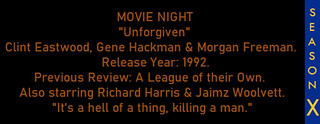
Clint Eastwood (William "Will" Munny), Gene Hackman ("Little" Bill Daggett), Morgan Freeman (Ned Logan), Richard Harris (English Bob), Jaimz Woolvett (The Schofield Kid), Saul Rubinek (W. W. Beauchamp), Frances Fisher (Strawberry Alice), Anna Thomson (Delilah Fitzgerald), David Mucci (Quick Mike), Rob Campbell (Davey Bunting), and Anthony James (Skinny Dubois) Produced and Directed by Clint Eastwood (#1252 - Space Cowboys, #1310 - Million Dollar Baby, and #1476 - Pale Rider)

Review: 
"Gene Hackman was interesting because I gave the Unforgiven script to his agent and he said no, he didn't want to do anything violent. But I went back to him and said, "I know where you're coming from. You get to a certain age and I'm there too, where you don't want to tell a lot of violent stories, but this is a chance to make a great statement"

It's easy to make a lasting great Western when it is going to be the last one you make after a long career defined by them. Eastwood had at least one defining Western that he was featured in, whether that involved television with Rawhide or with films such as A Fistful of Dollars, Two Mules for Sister Sara, or Pale Rider. This was his 17th directorial effort (and fourth involving the Western), and it surely proved a fitting last hurrah for Eastwood to declare as his last Western so as to not repeat himself or others (which has proven correct in for over two decades). The script for this film was written by David Peoples (who prior to writing had been a editor for TV and news programs) in 1976, with one development title being "The William Munny Killings", and one inspiration for him when it came to the depiction of violence was Taxi Driver. The script languished for years while Peoples wrote for other films such as The Day After Trinity (1980) and Blade Runner (1982), with Eastwood having waited around for years to do other projects first. Eastwood thought of making changes to the script, but he changed his mind because of how he saw the script was better without it (minus one thing, which involved having the opening having a text crawl rather than a voiceover). The result was two Academy Awards for Eastwood (for direction and Best Picture) and one for Hackman alongside one for editing.

At last, a Western great enough for the 1990s to deserve. It proves to be a riveting and somber ilm with its subversion of the Western and the myths that could make outlaws famous with whatever exploit could be covered fast enough. Sure, there have been quite a few films that have played with the clichés and traditions of what we saw in the Western in the classic era (with one slight resemblance being The Shootist, for example), but this one handles itself with a great elegiac quality in its direction, characters, and pace that make it one for the ages. It lives and moves with a great patience for making its surroundings resonate with its audience, with a false note never happening as more characters come and leave the picture as reflections of the time and place, whether that means a once-removed killer/farmer, or a savage outlaw, an outlaw with publicity, or even a sight-challenged kid with reputation. The easiest strength of the film lies within its main trio of actors, starting with Eastwood. No one ever fit the mythic mold of the Western hero ever so much in the last few decades of the 20th century film era like Eastwood did, who resonates in pained grit that reflects past and present with no contrived frills as a man with shades of gray. Hackman proves just as worthy in matching up to Hackman on the other side of the hill, tenacious and dedicated in intimidation and order (one of the people Hackman drew from was a police chief, for example) that lend excellence to small moments, such as a conversation with Harris and Rubinek involving the nature of fact and fiction with outlaws turning into a quiet showdown of chicken. Freeman (in the midst of a deserved rise in prominence with supporting and lead roles in the late 1980s) fills in the main details with resonating nerve and conviction that we come to depend on in a careful balancing act between him and Eastwood that make for useful time spent. Harris, despite being in the film considerably less than the others (and only having time with just Hackman and Rubinek) does a resoundingly good job in playing the part of the myth of a refined killer come out splendidly when faced with Hackman and his own interpretation of killers and those who write about them. Woolvett is the key supporting piece to encapsulate the film, brash but quite convincing as the lasting piece of the dealings of myth and reality when it comes to bits of amusement and action between him and Eastwood, never grating on one's patience. Rubinek and the others prove well in filling the town with interest and the dealings that come with conflicting view of justice and morality. What we have here is a film to stamp out the myths that came from films about a time as myth-inducing as the Old West with a wise one at the hand behind and in front of the camera in Eastwood to do wonders with for 131 minutes. This is a well-done piece of subversion and execution on a variety of levels that range from its cast to its look (done entirely in Alberta, Canada) that make the grand myth of outlaw one to look closer into and care about with flourish and satisfaction. It isn't the first Western one might view for themselves, but it sure is the one deserving of being up there to see time and time again among the classics.

Overall, I give it 10 out of 10 stars.

August 12, 2020

A League of their Own.

Review #1500: A League of their Own.

Cast: 
Tom Hanks (Jimmy Dugan), Geena Davis (Dorothy "Dottie" Hinson), Lori Petty (Kit Keller), Madonna (Mae Mordabito), Rosie O'Donnell (Doris Murphy), Jon Lovitz (Ernie Capadino), David Strathairn (Ira Lowenstein), Garry Marshall (Walter Harvey), Bill Pullman (Bob Hinson), Anne Ramsay (Helen Haley), Megan Cavanagh (Marla Hooch), Freddie Simpson (Ellen Sue Gotlander), Tracy Reiner (Betty "Spaghetti" Horn), Bitty Schram (Evelyn Gardner), Renée Coleman (Alice "Skeeter" Gaspers), and Ann Cusack (Shirley Baker) Directed by Penny Marshall.

Review:
"I hadn't worked with so many women before. I thought it was something I should do. But I wasn't doing it just to do a women's picture. The problems as they're presented in the movie apply to both men and women. It's about, "Don't be ashamed of your talents." It's a universal thing."

It should figure that at least one good comedy is featured here involving the Marshall family. Older brother Garry rose from joke writer to television that morphed into developing television programs, with such shows as The Odd Couple, Happy Days, and Laverne & Shirley before going into film direction. As for Penny, she had grown from a childhood of tap dancing to small parts on film and television before being given substantial work with Garry's teleivision series, with the most prominent being her starring role on Laverne & Shirley that ran from 1976 to 1983. Encouragement from her brother led to an interest in directing (starting with an episode of Working Stiffs along with a few episodes of her own show). Her first feature Jumpin' Jack Flash (1986) was a mixed hit, but Big (1988) proved a major critical and audience hit. Marshall was inspired by a 1987 documentary she had seen about the All-American Girls Professional Baseball League, which she had not heard of before. She sought out the creators of the work - Kim Wilson and Kelly Candaele (whose mother Helen Callaghan played for five years in the league) in developing the story while Babaloo Mandel and Lowell Ganz (responsible for scripts such as Splash and City Slickers) developed the screenplay.

Technically speaking, this is not a straight historical film about the AAGPBL, which went by various names that started with referring to it as softball (since the league was trying to draw on the popularity of women's softball, since both used underhand pitching) before adding and then removing professional from the title for a league that ultimately lasted from 1943 to 1954, which really did have the players play in short outfits along with tight restrictions on what they could do socially (imagine giving an athlete ettiquite classes today), with the famed Wrigley Field indeed serving as the initial tryout location in real life. True, there would be a sale by its head to an entrepenur who felt he could do just as well in operating the league as he did with advertising Philip K. Wrigley's products along with the league - Arthur Meyerhoff. Obviously the winner of the championship did not result from something as silly as a plate collision  - in fact, Racine won the title the first year over Kenosha in a sweep. The "induction" scene at the end involving the Baseball Hall of Fame is tricky - it wasn't so much an induction but just a permanent exhibit featuring players. Of course we aren't here to talk about history, the reason I had interest in the film is simple - my love of baseball, the definitive American sport for everyone, featuring actors that had to have at least some talent in baseball to participate in the film (injuries still happened from mishaps on the field, as one could expect). Where the film clicks best is in getting some laughs within its baseball trappings, which shine gradually over a film that while admittedly lengthy at just a bit over two hours is still a crowdpleaser. Hanks grabs the attention once the baseball action slides into the first quarter, and he does a pretty good job in lending tempered amusement with his natural treating of the dialogue (the crying in baseball one is the easiest to cite becuase of how catchy it is). Anyone who can lend a decent hand in acting and playing a decent game of baseball gets a nod in my book, so it figures Davis does the best job in that regard, confident and entertaining whether on the diamond or away from it that makes for spiriting/sparring moments with others like Petty or Hanks. As for Petty, she does well with the material, resoundant and interesting to see among others with brimming rivalry that she handles fine. Others in the cast prove fine with their moments, like a quirky Madonna and her pal O'Donnell or a solid bit from Lovitzl or resourcefulness from Strathairn and Marshall. It generally works best when dealing with building its baseball action with quirky lines about trying to play and live with these folks along with the rules that go with it, with the interpersonal stuff proving fine - we are talking about a fictionalized story with a real league, after all. As long as it generates interest in the true AAGPBL, it can do what it pleases. On the whole, it isn't a surprise that this proved a hit nearly three decades ago, as it proves diverting with humor and heart to generate a fine mix of fact and fiction that serves any audience well in good entertainment.

Overall, I give it 8 out of 10 stars.

August 11, 2020

The Man in the Moon.


Review #1499: The Man in the Moon.

Cast: 
Sam Waterston (Matthew Trant), Tess Harper (Abigail Trant), Reese Witherspoon (Dani Trant), Gail Strickland (Marie Foster), Jason London (Court Foster), Emily Warfield (Maureen Trant), Bentley Mitchum (Billy Sanders), Ernie Lively (Will Sanders), and Dennis Letts (Doc White) Directed by Robert Mulligan (#116 - To Kill a Mockingbird)

Review: 
"When I was little, I really wanted to be an actor, which was kind of weird because my mom and dad were both in the medical industry."
"Coming from Bronx Irish is hardly Southern. But there was that sense of the Irish storytellers, the fairy tales.”

When the doors of one film career closes, another career opens up for someone else. This was the last film directed by Robert Mulligan, who had started work in directing after serving in the US Navy and graduating from Fordham University in 1948. A messenger job at CBS led to directing in television in an era soon labeled as the "Golden Age of Television", directing for television programs starting in 1952 for shows such as Suspense, Studio One in Hollywood, and Playhouse 90. His one major award win was a Primetime Emmy Award for his direction of the television production adaptation of "The Moon and Sixpence" (1959). By that time, he had entered into the world of film with Fear Strikes Out (1957), with Alan J. Pakula as producer (the two would produce six more films with each other over the next eleven years). Despite not being known for having a particular personal vision with his films, he managed to cultivate a dedicated career for himself that reflected his attitudes towards honest storytelling, which resulted in notable films such as To Kill a Mockingbird (1962) and Summer of '42 (1971). As for a beginning, this was the debut film appearance of Reese Witherspoon. She had expressed an interest in acting from a young age, doing work in an advertisement for a flower store at age seven. She found herself interested in a casting call for this film hoping to win a teenage bit part but ended up cast as the lead role due to impressing Mulligan.

There is a fair sense of timelessness when it comes to this film, which generally reaches most of its melodramatic points with well-put flourish and a game cast that does not betray its homespun foundations for no good reason. There is a sharp atmosphere that is quite riveting in making an interesting coming-of-age story come through in various forms of careful moments of clicking energy within its young and traditional actors. Witherspoon proves a worthy focus to keep an eye on, wrapped with energy that moves from scene to scene with confidence for someone so young that springs well with any kind of useful scene with others, such as talking about having a first kiss or actually doing one. Waterston seems quite suited to lead the film on with careful honesty to his surroundings without having to say too much. Harper follows along in the same vein, doing fine with carrying the film in the little moments. London alongside Strickland represent the other side to focus on in the film, with the former providing an adequate interest to pair off with Witherspoon (or Warfield) with small bright moments that blend in with some conflict that he runs through without making a clunky note of. On that note, Warfield proves the final key to filling the cast with wandering grace that makes her bonds count fine. On the whole, the pace is kept on the level for 100 minutes with reasonable movements and careful planning in its story of growth and tragedy that proves a worthy winner for Mulligan to go out on and for Witherspoon to start out with.

Overall, I give it 8 out of 10 stars.

August 9, 2020

The Silence of the Lambs.

Review #1498: The Silence of the Lambs.

Cast:
Jodie Foster (Clarice Starling), Anthony Hopkins (Dr. Hannibal Lecter), Scott Glenn (Jack Crawford), Ted Levine (Jame "Buffalo Bill" Gumb), Anthony Heald (Dr. Frederick Chilton), Brooke Smith (Catherine Martin), Diane Baker (U.S. Senator Ruth Martin), Kasi Lemmons (Ardelia Mapp), Frankie Faison (Barney Matthews), Tracey Walter (Lamar), Charles Napier (Lt. Boyle), Danny Darst (Sgt. Tate), Alex Coleman (Sgt. Jim Pembry), Dan Butler (Roden), Paul Lazar (Pilcher), Ron Vawter (Paul Krendler), and Roger Corman (FBI Director Hayden Burke) Directed by Jonathan Demme (#1254 - The Manchurian Candidate (2004))

Review:
"I realized the actual bottom line truth of doing Silence of the Lambs, something I felt when I read that book. I thought, this could be the scariest movie ever, and I wanted to make that movie. I wanted to make a Psycho caliber fucking terrifying movie."

As the first (and so far only) horror film to win an Academy Award for Best Picture, the inevitability for covering this film was high, particularly since the character of Hannibal Lecter is particularly well-known across film and novels over the years. This is adapted from Thomas Harris' novel of the same name, originally published in 1988 as the follow-up work to Red Dragon, which had been adapted into a film by Michael Mann under the name Manhunter (1986). The follow-up book Hannibal (1999) and the other book would be turned into films with Hopkins as Lecter, while the prequel Hannibal Rising (2006) would be turned to a film with Harris as screenwriter, and a Hannibal series followed a decade after that. Fitting that a horror film like this would come from an acolyte of Roger Corman (who even cameos in the film) with Jonathan Demme. He met Corman while doing publicity for Von Richthofen and Brown, and Corman was interested in Demme to do work for him at New World Pictures. The result was Angels Hard as They Come, which Demme produced and co-wrote with Joe Viola. He then directed his first work with the studio as director with Caged Heat (1974). Over the years he had a steady career of films, such as Melvin and Howard (1980), Something Wild (1986), and Married to the Mob (1988).

Despite the failure with audiences at the time of Manhunter (now regarded as a cult classic), there was still interest in turning the next Harris novel into a film, although the initial plans was apparently going to have Gene Hackman directing/starring in it (various others were considered for both lead roles, such as Sean Connery and Michelle Pfeiffer). Hopkins came about in interest because of his doctor role in The Elephant Man (1980). With a dark sense of gravitas and two killer performances from Hopkins and Foster, it is no wonder why this proves to be a great classic. It finds a balance between suspense and horror that drives through every beat and procedure with relish and entertainment. It is amazing to think about how solid of a performance Hopkins draws from such an unsavory but relentlessly fascinating presence, particularly since he only occupies a certain amount of time in the film that doesn't even run to thirty minutes. And yet here we are, still captivated and engrossed by what we see of him (such as in the numerous close-up shots of his face) as the calmest and most brilliant terrors of the human mind. On the other side of such interesting conversations is Foster, who proves quite dedicated and useful in focus of the drive for curiosity with regards to the dark parts of the human mind. She makes a resourceful presence that never seems lost within the madness. Glenn proves just as sharp in reasoned authority, while Levine rounds out the main group with creeping finesse in his lurking moments, and the others prove worthy in keeping the stakes level. On the whole, while the sequences with Hopkins and Foster are easily the most memorable of the film, the film holds up just as well in driving one in pursuit and skin-crawling with no pretensions whatsoever. The thrills can be quite entertaining like any other movie, but it is in that chase that really gives one a good jolt in their seat, and it is easy to see why this became imitated and well-known. It has a capable director in staging scenes with useful impact to go with a game cast that makes the most of their surroundings for a good time of carefully executed thrills that prove as effective nearly three decades later.

Overall, I give it 10 out of 10 stars.

August 7, 2020

Dances with Wolves.

Review #1497: Dances with Wolves.

Cast:
Kevin Costner (Lt. John J. Dunbar/Dances with Wolves), Mary McDonnell (Stands with a Fist), Graham Greene (Kicking Bird), Rodney A. Grant (Wind In His Hair), Floyd Red Crow Westerman (Chief Ten Bears), Tantoo Cardinal (Black Shawl), Jimmy Herman (Stone Calf), Nathan Lee Chasing His Horse (Smiles A Lot), Michael Spears (Otter), Jason R. Lone Hill (Worm), Charles Rocket (Lt. Elgin), Robert Pastorelli (Timmons), Tony Pierce (Spivey), and Larry Joshua (Bauer) Directed by Kevin Costner.

Review:
"Real heroes are men who fall and fail and are flawed, but win out in the end because they've stayed true to their ideals and beliefs and commitments."

There have been plenty of great Westerns, both epic and not-quite-as-epic in scope over the past few decades, with a significant amount dealing in some way with Native Americans. When the time is right, it can come from any source, whether that means from an actor trying his hand at directing or somewhere else. Costner has stated that a screening of How the West Was Won (1962) helped formed his childhood, but he became interested in acting before he graduated from college. Costner had met screenwriter Michael Blake while starring in the film Stacy's Knights (1983), which was directed by Jim Wilson. Costner encouraged Blake to turn a spec script of his into a novel, and Dances with Wolves was published in 1988 after a few rejections from publishers. Costner (an established star with films such as Silverado and The Untouchables) soon lobbied for the screen rights after its publication (with Blake writing the screenplay and Costner co-producing with Wilson), although he would have to do it apart from the major studios, which did not find the long script and significant subtitling (as well as being a Western) to their liking, with a key difference being in the portrayal of the Sioux rather than the Commanche tribe. The film is noted for its usage of the Lakota language in several scenes, one of a certain group of features to utilize Native dialogue.

Of course, some movies are born to be epics and then some just don't quite turn out the way one expects. Part of me was interested in how the Western would turn out in another decade removed from it being the norm in conventional filmmaking, while the other side hoped it would not drag at three hours while wondering if it really deserved to rank highly for its era (or even its particular year). In the end, it turned out to be a bit of both, a film firmly in the "good, not great" department that is nice at times to sit through but ultimately not quite enough in strong centering depth to really pull all of its punches successfully. Credit must given to Costner however for his drive to make a film in South Dakota with a fine selection of actors of indigenous origin with plenty to look upon in the landscape and subtitles that do in some way drive a useful story. After all, he does deliver a fairly sensitive performance that draws upon curiosity and care (along with an occasional voiceover), so him operating a camera alongside being in front of it works out fine. McDonnell proves okay in following along in both worlds in care and frenzy, and Greene carries along with solemn interest that carries his part of the film handily with stature. John Barry does well with his musical score in setting a sweeping tone of emotion. The sequences involving a buffalo hunt and the battles are handled well as the highlights for the film as a whole.

I can see its ambition in bonding when it comes to trying to break the mold of the traditional Western, but it seems to nearly choke itself in sentiment that somehow seems lacking a certain kind of quality needed to really drive home a poignant epic. It has a decent heart behind it, but it is really a great Western? I can think of at least five Westerns that reach higher levels of interest and depth before this (Stagecoach, The Searchers, Shane, Hud, Once Upon a Time in the West), and none of them garnered as much high awards praise like this did three decades ago. It has the production value and some of the right notes behind it, but it just seems a bit flatfooted in driving its conflict and message of identity to full realization, where it seems like a slightly more sophisticated version of Broken Arrow (1950). There exists a four hour Special Edition of the film, which Wilson supervised to expand upon the relationship between Costner and McDonnell in addition to more parts with the wolf and the tribe. I did have the choice to pick either the regular or Special Edition, but I didn't really feel interested in having to spend even longer amounts of time (equivalent to Gettysburg (1993), basically) that could make me feel like I really am watching grass grow in the Dakotas. On the whole, this is a fairly good movie with its cast and ambition, but it ultimately is a test of how much one desires of a three-hour Western with an imperfect core and execution to make a curious effort of the modern Western.

Overall, I give it 8 out of 10 stars.

August 5, 2020

Goodfellas.

Review #1496: Goodfellas.

Cast: 
Robert De Niro (Jimmy Conway), Ray Liotta (Henry Hill), Joe Pesci (Tommy DeVito), Lorraine Bracco (Karen Hill), Paul Sorvino (Paulie Cicero), Frank Sivero (Frankie Carbone), Tony Darrow (Sonny Bunz), Frank Vincent (Billy Batts), Chuck Low (Morris Kessler), Frank DiLeo (Tuddy Cicero), Henny Youngman (Himself), Gina Mastrogiacomo (Janice Rossi), Catherine Scorsese (Tommy's mother), Charles Scorsese (Vinnie), Suzanne Shepard (Karen's mother), and Debi Mazar (Sandy) Directed by Martin Scorsese (#990 - Taxi Driver, #992 - The King of Comedy, #1276 - Mean Streets, and #1463 - Raging Bull)

Review: 
"You think you're doing something at the time, and that gets you through it. And maybe it changes over the years. A picture takes on a life of its own."

A great movie can come out of a little observation. In this case, a little bit of observation over the life of a mobster resulted in one of the best films of the 1990s, with others going farther in calling it one of the greatest ever made, with an influence that has reached across other media that took inspiration from its content and style, most notably with David Chase and his television series The Sopranos. The basis for the film is the 1985 non-fiction book Wiseguy: Life in a Mafia Family by Nicholas Pileggi, which was about the exploits of Mafia mobster-turned-informant Henry Hill over the course of 25 years, and the film would follow a majority of the beats covered by the book (aside from a few name changes and certain omissions, such as Hill's hustling while enlisted in the United States Army). Scorsese was first interested in the book while in production on The Color of Money (1986), liking its documentary-style writings of how the Mob worked while beginning it "like a gunshot and have it get faster from there". There is a natural way to how everything flows together in this film, where one feels at ease with time when viewing the life of these wiseguys, with a script (done by Scorsese and Pileggi) that had improvisation that one can see at key points in the film. For example, the "How am I funny?" sequence was actually based on Pesci's experience as a waiter serving an actual wiseguy in a restaurant, which was acted and rehearsed with Pesci and Liotta before being constructed by Scorsese from the transcripts (since this was not actually in the original script). Scorsese was inspired by Jules and Jim (1962) with its use of voiceovers, while deciding to do a mix of the traditional narrative that would start in the middle and move backward and forward. 

Although Hill was not directly involved with the film, De Niro talked to both him and Pileggi (who let them use research material not in the book) in preparation of the role from his walk to how he ate his food, while Liotta listened to tapes of Hill talking to Pileggi, which would be key in the narration in how dynamic it is to the story being told. This is a film with plenty of nuance that handles its subject with precise execution in its cast and direction that spring for several memorable moments mixed in with swift and clear-cut violence that make a fascinating look upon a unsavory-yet-captivating world of crime. It moves at an efficient pace that uses its 145 minutes to tell a well-cut story that has the classic Scorsese hallmarks of quick cuts alongside frantic style (in an attempt to show a "punk attitude", he stated) and key choices of music to go alongside key moments. Liotta is our focus (and voice) for the film, and he does a tremendous job with being our center of unflinching energy that draws us in as well to a certain lifestyle through his eyes with conviction. De Niro proves just as prepared, wrapped in relentless gravitas that carries the film with naturalness. The third leg of our trio is Pesci, who moves along with crazed unflinching energy that attracts us with that early question about a funny wiseguy that keeps you on your toes (the scene with him and C. Scorsese involving cutting a deer and a painting proves just as well in improvised morbid energy). Bracco goes along with the action with frenzied perceptive timing that carries the film with her own narration as someone who enters in the action and stays in that web of crime, even with such turbulent (but fascinating) chemistry with Liotta, such as the moment where she has him in bed with a gun on him. Sorvino rounds out the cast with a collected presence that has plenty of stature and coldness for one to fear and appreciate whenever on screen. The others in the cast (including real-life mobsters cast as extras) prove fine in lending presence and body language to the key moments of the film, which can lead to some tension or a bit of humor (including the famed one-liner comedian Youngman) that make the shifting from youth to adult crime for our lead all the more easier. It handles its moments of violence with cold-cut effienct, never shying from depicting the lifestyle it wants to show in all of its honesty (for a film at least) that runs the gamut of ambition, avarice, and paranoia in all of its unseemly glory. Three decades have only brightened the legacy of this film, an achievement for its cast and director in execution that has kept it in the public consciousness as a seminal crime film for the 1990s and beyond.

Overall, I give it 10 out of 10 stars.

August 3, 2020

Darkman.

Review #1495: Darkman.

Cast:
Liam Neeson (Peyton Westlake / Darkman), Frances McDormand (Julie Hastings), Colin Friels (Louis Strack Jr), Larry Drake (Robert G. Durant), Ted Raimi (Ricky), Nicholas Worth (Pauly), Dan Hicks (Skip), and Jessie Lawrence Ferguson (Eddie Black) Directed by Sam Raimi (#611 - Spider-Man, #1296 - The Evil Dead, and #1483 - Evil Dead II)

Review: 
"Some mornings you wake up and think, "Gee, I look handsome today." Other days I think, "What am I doing in the movies? I wanna go back to Ireland and drive a forklift".

There is a distinct difference to the superhero film from decade to decade that is particularly interesting to note, whether involving the era before Superman (1978, which namely involved serials), or the years that followed after the release of Batman in 1989. There were a group of heroes of comic and comic strip form that found their way into being turned into a film, for better or worse. However one thinks of the superhero genre as a whole, it is nice to see the stark differences between 1990 and 2020, and you can compare the pickings of what came from the former: Dick Tracy, Teenage Mutant Ninja Turtles, Captain America, and this film. It came about due to Raimi's desire to make a film based on The Shadow (which found itself adapted into a film four years later), with the failure to obtain the rights leading him to make a hero film of his own, which would be inspired by his love of the classic Universal horror films of the 1930s to have a man who lost his face that found a way to take on other faces. This was Raimi's next film after Evil Dead II along with his first studio film (fittingly with Universal Pictures), and it would go through numerous drafts that resulted in five credited writers: him (who also did the story), his brother Ivan, Daniel and Joshua Goldin, and Chuck Pfarrer (with twelve drafts reportedly being written before a script to shoot came about).

With a darker outlook toward the nature of what it means to wear a mask and fight for some sort of justice, Darkman is a fascinating film of the superhero genre, intense with frenzied ambition that makes a capable thriller. At the helm of its mix of horror and action is Northern Irish actor Liam Neeson, who had worked for several years in theatre and gradually-rising roles in film that liked the turmoil of the title role that mixed with Raimi's desire for an actor that could do acting within plenty of makeup (done by Tony Gardner) and charisma. Neeson delivers a well-done performance here, one with plenty of emotive charm that runs the gamut from sensitive to self-hatred with touches of The Phantom of the Opera that make it all work with finesse. McDormand follows along with fine sensitivity and focused grace that makes a solid performance that resonates with Neeson just fine. Friels proves adquately slimy, but it is Drake (known mostly for his work on L.A. Law) who proves the most adept at disturbing excellence, a quiet but gruesome intensity to appreciate. The atmosphere of the film is captured well in darkness with its designs and music from Danny Elfman without seeming schlocky or too familiar to other films. The film has a kinetic and pulpy feel to it with its pace of 96 minutes that does good with making an involving story of a troubled soul come across with some depth and believability (the effects do their part as well) that lend for some interesting moments that go with a servicable climax and bitersweet ending. On the whole, this is a fine achievement that pierces at the dark with solid performances and a carefully done style that blends thrills and horror capably enough to stand as its own kind of superhero story.

Overall, I give it 8 out of 10 stars.

August 1, 2020

Gremlins 2: The New Batch.

Review #1494: Gremlins 2: The New Batch.
Cast:
Zach Galligan (Billy Peltzer), Phoebe Cates (Kate Beringer), John Glover (Daniel Clamp), Robert Prosky (Grandpa Fred), Robert Picardo (Forster, chief of security), Christopher Lee (Doctor Cushing Catheter), Haviland Morris (Marla Bloodstone), Dick Miller (Murray Futterman), Jackie Joseph (Sheila Futterman), Gedde Watanabe (Mr. Katsuji), and Keye Luke (Mr. Wing), with Howie Mandel (Gizmo), Tony Randall (Brain Gremlin), and Frank Welker (Mohawk, Other Gremlins) Directed by Joe Dante (#007 - Looney Tunes: Back in Action, #096 - Gremlins, and #097 - Small Soldiers)

Review:
"It's the one time someone came to me and said: 'We want this movie and we don't care what it is. Do whatever you want, just give it to us by this date."

When it comes to underappreciated directors, Joe Dante certainly deserves consideration. He grew up with an interest in cartoons alongside watching matinee films as a youth. While a graduate of the Philadelphia College of Art, it was Roger Corman who Dante honed his craft into becoming a filmmaker, initially starting out in the trailer-cutting department at New World Pictures. He made his debut with Hollywood Boulevard (1976), co-directing with Allan Arkush along with editing the film. His first minor triumph was Piranha (1978), and The Howling (1981) helped get his foot in the door with Warner Bros. to make Gremlins (1984). The original film is a triumph of comedy and horror, dark and entertaining that had attracted attention for their effects (and of course, complaints from folks who managed to be fooled by the Christmas setting and critics of violence that don't know any better and are rightfully made fun of here) along with being a key force in the creation of the PG-13 rating. It is entirely possible that this is a sequel that was just a little too late to the party. It took six years for a sequel to Gremlins to arrive into theaters and its director Joe Dante had to be convinced to even do another film in the first place, and he was granted creative control and a bigger budget. Charlie Haas would take over in writing duty (the original had been done by Chris Columbus), who moved the action to New York City with satirical elements all throughout the film, such as the advent of cable television (most notably with Ted Turner) and sequels in general that was more cartoonish than dark, with Dante describing it as one of his most personal films.

It's a shame that this wasn't too successful on release, because I enjoyed it just as much as the original Gremlins. The quality is just about even here, replacing its dark sentiment for cartoonish anarchy that manage to resonate just as much in amusement. It touches upon elements of the original without being smothered by expectations or becoming too much of an effects show, and it does so without becoming dated. It does what one could want for someone with a clear interest in having a good time at the movies in a similar vein to someone like William Castle or even in cartoons with Chuck Jones (who provided the animation for the opening/closing titles). Galligan returns alongside Cates, and each prove just fine in providing continuity and some small moments of levity among themselves and some sort of Mogwai mayhem. Of course the real focus is on Glover, wrapped in spry curiosity that is very much in his element with a bit of camp enjoyment. Prosky, imitating Al Lewis' portryal of another famous horror Grandpa that hosted a horror TV segment, does just fine with mixing camp and care that does lend itself to some quick smiles. Picardo does fine with smarmy chuckles, but the true curiosity ineviably turns to Lee, with that solumn voice going just right with the cliches required for some momentary smiles. Miller and Joseph also return for a quick turn around with the creatures, while Morris and the Mogwai voices round out the cast just fine. Like before, there are quite a handful of cameos lurking around, most notably with Leonard Maltin being dragged away by unsatisfied viewer gremlins. The effects are always lurking in one's mind, and Rick Baker does a tremendous job with delivering some distinct creatures (with a mix of puppetry like before and also mechanical work and stop motion) that get to do a bit more madcap action, such as a bat gremlin for example. The plot threads verge a bit familar at times with its structure, but it makes up for it with some interesting tricks of offbeat humor (such as having the film be stopped and then re-started) that goes in the right direction to make a fun time worthy of further inspection as a quality sequel and an interesting film to highlight for the start of the 1990s.

Overall, I give it 8 out of 10 stars.

And now, the schedule for this month, a mix of familiar and new faces on and behind the camera as one approaches the end of the millennium.