January 11, 2020

The Sea Hawk (1924).

Review #1321: The Sea Hawk (1924).

Cast: 
Milton Sills (Sir Oliver Tressilian), Enid Bennett (Lady Rosamund Godolphin), Lloyd Hughes (Lionel Tressilian), Wallace Beery (Capt. Jasper Leigh), Marc McDermott (Sir John Killigrew), Wallace MacDonald (Peter Godolphin), Bert Woodruff (Nick), Claire Du Brey (Siren), Lionel Belmore (Justice Anthony Baine), Cristina Montt (The Infanta of Spain), Albert Prisco (Yusuf-Ben-Moktar), and Frank Currier (Asad-ed-Din) Directed by Frank Lloyd (#099 - Mutiny on the Bounty)

Review: 
It only figures one needs to build their own ships to really sell their adventure films. At least that is what director Frank Lloyd felt was the best way to approach his film when it came to ship action. At the cost of around $200,000, wooden exteriors were outfitted to existing craft by designer Fred Gabourie (whose best work was props for Buster Keaton silent films), which was soon utilized for scenes on the coast of Catalina Island in California. The footage of the ships in battle were re-used in 1940 for The Sea Hawk (a Warner Bros production with Errol Flynn that had its own distinctive plot as opposed to being a remake). What can one expect from a silent spectacle like this? Well, quite a bit, given that it is an adventure film with pirates, disloyal brothers, sea-slaves, and other various elements, all of which make for an adequate time at 123 minutes, where spectacle will sail the seas far more prominently than its attempts at romance, which in of itself is okay. It takes quite a bit of build-up before it finds itself on a ship, but it all proves to be worth it, mostly because it never seems too stagey or overblown to detriment. When it comes to headliners, Sills is a fair pick for such a rugged role. He had started his career in acting on a whim in 1906, inspired by a visit to the University of Chicago by stage actor Donald Robertson (who had his own stage company) while he was working as a professor (Sills had graduated from the university previously, studying psychology and philosophy on scholarship). In the span of eighteen years leading up to this film, he had found himself on Broadway and subsequent transition to film in 1914 with The Pit. It was this film that helped him find major status, although he would die of a heart attack at the age of 48 in 1930. In this respect, he does pretty well with displaying a rough-and-tumble nature without having to put all the emotion in silly gestures. Bennett walks through her role just as well, where one needs to balance a bit of passion and scorn without so much time on screen, with chemistry between her and Sills feeling pretty assured. Hughes plays off panic fine, although he is overshadowed not only by Sills and Bennett but also by Beery. One cannot resist a colorful rascal of a pirate when done right, and Beery does this in spades, as one would expect from the noted character actor (who would find further success in the following decade). The rest of the actors do just fine, where one needs to just make sure nothing incredibly hammy lurks in the way of the main stars. On the whole, it isn't too surprising to see why this was the audience favorite for 1924, as it is an interesting spectacle piece filled with ambition and useful components (notice in one scene the hand-coloring for the torches in a night scene) that make for a worthy curiosity piece to hold up over the decades. One can't really go wrong with adventure and a small bit of romance to go along with a viewing.

Next time: Battleship Potemkin (1925).

Overall, I give it 8 out of 10 stars.

January 10, 2020

The Covered Wagon.


Review #1320: The Covered Wagon.

Cast: 
J. Warren Kerrigan (Will Banion), Lois Wilson (Molly Wingate), Alan Hale (Sam Woodhull), Ernest Torrence (William Jackson), Tully Marshall (Jim Bridger), Ethel Wales (Mrs. Wingate), Charles Ogle (Jesse Wingate), Guy Oliver (Kit Carson), and Johnny Fox (Jed Wingate) Directed by James Cruze (#1263 - The Roaring Road)

Review: 
What is it about the Western that inspires such curiosity? What inspired so many directors and studios to make their own tales (or adapt works) about cowboys, gunslingers, and other various subjects that dominated the film landscape for over half of the 20th century, doing so from the very get go with the first one shot in the United States (and second overall) in The Great Train Robbery (1903), which captivated audiences with its action in such quick time at 12 minutes. The evolution of film production in the two decades that followed meant that at some point one would strive to make a big budget Western epic to hang their cowboy hat on, at least until someone made one that looked better. The honor of being known as the first big-budget Western epic (made for roughly over $700,000 from Paramount Pictures) falls to this feature, which is adapted from the novel of the same name by Emerson Hough. Expense was not spared when it came to research to get costumes and locations scoped out, particularly when it came to finding a herd of wild bison (alongside other animals like oxen and horses) to roam the plains, complete with authentic wagons. If that sounds daunting enough, try being an actor having to spend months in the desert of Utah, dealing with various weather elements alongside being fairly distant from railroads, with one sequence involving wagons fording a torrent being a risky one to film in part because they had to actually swim for it alongside the accompanying horses and oxen. Simply put, one can trace Western epics and the level of craftsmanship one must take in executing ambition from costumes to characters to this film, which manages to hold itself fairly well without becoming too much a thing of the past.

It is an honest spectacle, welcome of curiosity for those who seek out fair pleasures. It has exactly the kind of things you would expect from a Western, with a clear hero, romantic lead and heavy to follow, and one can take a guess as to how these pioneers will do in their journey from Kansas to Oregon for 98 minutes - as long as one does not find themselves checking their watch from time to time or peeking at what comes next, you should do fine. It is the journey that counts when it comes to films, and how one enjoys the ride or trip with these actors and views that counts most, and this one does fine with that in mind - you could probably see this and at have some sort of interest in wondering about the plight of the pioneer, whether that means trouble with just getting to where they need to go or in-fights and so on. The highlight proves to be Torrence and Marshall, giving a bit of amusement as the comic relief, while Kerrigan and Wilson prove adequate if not too memorable people to look at through the lens of a routine romantic Western. Regardless, it proved an audience hit, making roughly seven million dollars, exceeding films now regarded as classics for that year such as The Hunchback of Notre Dame and Safety Last!, which now can all be found in the public domain for one to eye with curiosity. This film may not stand too highly with some of the Westerns that would come to pass over the next decade and beyond, but it still holds ground as a resilient charmer when it comes to entertainment, and that surely will prove enough for those who want to seek it most.

Overall, I give it 7 out of 10 stars.

January 9, 2020

Robin Hood (1922).


Review #1319: Robin Hood.

Cast: 
Douglas Fairbanks (Earl of Huntingdon/Robin Hood), Wallace Beery (King Richard the Lion-Hearted), Sam De Grasse (Prince John), Enid Bennett (Lady Marian Fitzwalter), Paul Dickey (Sir Guy of Gisbourne), William Lowery (The High Sheriff of Nottingham), Willard Louis (Friar Tuck), Alan Hale (The Squire/Little John), Bud Geary (Will Scarlet), Lloyd Talman (Alan-a-Dale), and Billie Bennett (Servant to Lady Marian) Directed by Allan Dwan.

Review: 
Never let it be said that adventure films were content with being quiet affairs. When it comes to large-scale adventure films, this is a good case to highlight (copyrighted as Douglas Fairbanks in Robin Hood, I kid you not), with this one having a large castle set and village (all constructed at Pickford-Fairbanks Studio), with some designs done by architect Lloyd Wright (who went on to use its leftovers to design shells for the Hollywood Bowl). The budget has been reported to be around $900,000, which went into making such lavish sets, costumes, and even extras (with large moments reportedly having as many as a thousand present). The film is also noted for being shown as the first Hollywood premiere, doing so at Egyptian Theater in Hollywood (who you might recognize as one of the theaters developed by Sid Grauman). It wasn't the first film to feature the legend of Robin Hood on screen - there had been six productions involving the character, with the first being in 1908. Two of them were notable, with the 1912 version having big costumes and superimposition of animals to demonstrate their good/evil qualities, while Ivanhoe (1913) adapted the 1819 historical novel of the same name by Sir Walter Scott with the character present. Fairbanks was already a well paid and highly regarded star at the time of this film's release, and he helped formed United Artists alongside Mary Pickford, D. W. Griffith, and Charlie Chaplin in 1919 in order to help with artistic control and distributorships. The Mark of Zorro (1920) helped in creating a superstar image for its lead actor, and swashbuckling films owe a great deal to Fairbanks and the efforts he took in sparing no expense when it came to entertaining films, which continued with this feature that solidified the legend of Robin Hood in the eyes of the viewer alongside with solidifying the legend of Fairbanks as a whole.

It is a 127 minute grand spectacle that lands most of its merry advances, particularly when it comes to its action sequences (no photo trickery needed), which are fun to view when seeing how one can do such leaps and smile all the way through. It takes a bit of time to really get going, but it proves to be a useful reward that holds up to the edges of time fairly well after all these decades. Fairbanks (who had started acting just before the turn of the century and would turn turn 40 the following year after release) is clearly enjoying himself here, knowing where to go best, whether when needing to be coy or on the mark with someone else on screen. Beery makes for a fair supporting component to Fairbanks, while De Grasse makes for an adequate villain to encompass the film. Bennett and Dickey each do their own part to carry things respectively, as does the rest of the Merry Men. Two actors would later reprise their roles. Berry returned to his role the following year in Richard the Lion-Hearted, which was based on Scott's novel The Talisman, while Hale would reprise his supporting role twice - The Adventures of Robin Hood (1938) and Rogues of Sherwood Forest (1950). It may not be the greatest Fairbanks adventure film (he personally felt The Thief of Bagdad (1924) was his best), but it certainly ranks up there when it comes to fun memorable times with interesting heroes, that much is for sure. It is an easy film to find in the public domain (remember, the new year means that works from 1923 are now available), and it is easy to recommend finding the best looking print one can find, where one can see different hues of color (as opposed to just monochrome) and have adventure play out for wonderful curiosity.

Overall, I give it 9 out of 10 stars.

January 8, 2020

The Sheik (1921).


Review #1318: The Sheik.

Cast: 
Rudolph Valentino (Sheik Ahmed Ben Hassan), Agnes Ayres (Lady Diana Mayo), Ruth Miller (Zilah), George Waggner (Yousaef), Frank Butler (Sir Aubrey Mayo), Charles Brinley (Mustapha Ali), Lucien Littlefield (Gaston), Adolphe Menjou (Raoul de Saint Hubert), and Walter Long (Omair) Directed by George Melford.

Review: 
It is interesting to see where a career can go when it comes to a person's legacy. What does one think when they see the name of Rudolph Valentino? They see a matinee idol, a person who became a romantic symbol for Hollywood whose star rose like a comet and vanished just as quickly, with a leading career that lasted less than a decade. He had gotten his start in films as an extra after emigrating to the United States from Italy in 1913, with his debut allegedly being in a lost film named My Official Wife (1914). His major break was the film The Four Horsemen of the Apocalypse (1921), which occurred after June Mathis had discovered him during one of his extra appearances. In any case, the film proved to be a major success, making him into a star overnight. He appeared in four further films in that same year, but this is the one that would help seal his reputation and image as a "Latin lover" for the rest of his brief career. This was an adaptation of the 1919 romance novel of the same name by Edith Maude Hull and was adapted for the screen by Monte M. Katterjohn. It should be noted that James Kirkwood, Sr was the original choice for the title role before he declined due to salary concerns. Valentino had jumped studios to do this film (done at Paramount), feeling less than satisfied with Metro Pictures (who you may recognize from their 1924 merger with Goldwyn Pictures and Louis B. Mayer Pictures to make Metro-Goldwyn-Mayer).

In any case, one wonders how this desert romance holds up when looked at through the lens of a near century since its release. The immediate thought that went through my head before viewing it was "Stockholm syndrome" (involving someone developing a psychological alliance with captors during captivity). If one views it as a period piece, perhaps one can find a bit of surreal enjoyment, particularly for a film that even uses one of its final title-cards to say that its title character is actually European (English/Spanish, actually, but whose counting?). Look, the film is a bit weird. However, it cannot be denied that there is still a bit of fiery staying power for this film, having a hypnotically passionate Valentino that rises above being billed second to Ayres (whose career also started with small roles in 1914) to make something that keeps the eyeballs focused on something that teeters on corniness while trying to fit into escapism. Ayres does fine, although one might think the romantic angle was more of a tease than anything (the novel was far more controversial with its duo involving rape and plenty of stereotypes, so imagine the studio trying to be careful with the censor boards). The others are okay, in the same way that they certainly look like they want to be there making gestures and seem useful to something that seems mildly ready to inspire passion for 80 minutes. The film is fairly diverting enough to overcome its rickety foundations, where one can look at its main stars without it seeming completely off-putting or ridiculous. There were two more films involving the Sheik, with The Son of the Sheik (1926) starring both Valentino (in a double role that proved to be his last before his death that same year) and Ayres. A comedic role reversal named She's a Sheik with Bebe Daniels was released the following year. This is one of those unlikely films that finds a place in movie history. One wonders how it would've endured if was made in any other time other than the early 1920s, such as if it was made seven years earlier or later, but there is something mystical about it attracts attention even after nearly a century. Valentino may have lived as an idol for only five years, but his mark still comes through today as someone to look at on the screen.

Overall, I give it 7 out of 10 stars.

January 6, 2020

Way Down East.


Review #1317: Way Down East.

Cast: 
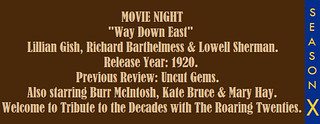
Lillian Gish (Anna Moore), Richard Barthelmess (David Bartlett), Lowell Sherman (Lennox Sanderson), Burr McIntosh (Squire Bartlett), Kate Bruce (Mother Bartlett), Mary Hay (Kate, Squire's niece), Creighton Hale (The professor), Emily Fitzroy (Maria Poole, landlady), Porter Strong (Seth Holcomb), Edgar Nelson (Hi Holler), and Mrs. Morgan Belmont (Diana Tremont) Directed by D. W. Griffith (#415 - America and #695 - Broken Blossoms)

Review: 
Welcome to Movie Night: Tribute to the Decades. While Movie Night always tries to review films from every sort of decade, inevitably the show is a bit slow to cover certain decades in more depth (the 1930s for example have just 45 reviews, with the last review being from December 2017). Given that Movie Night is celebrating ten years in 2020, why not do theme kind of year? As such, each month will have at least four reviews that cover a certain decade, with this month being for the 1920s (the third least-covered decade with 65). The idea is to pick films that are either repersentative of the decade or something worthwhile in some sort of way. Certain months will be preceded by announcements over what is to be covered, but I do hope that you folks enjoy.

The 1920s were a blossoming time for film, particularly when it came to making features. Hollywood was now the center of where films would be made, fit for a decade wracked with extravagance and glamour. There had been feature films released in the previous decade that stood out as successes for features, such as Traffic in Souls (1913, one of the earliest kinds of narrative films), Cabiria (1914, an Italian epic silent release), The Birth of a Nation (1915, a controversial landmark from Griffith that proved a huge commercial success), Intolerance (1916, Griffith's further epic with four parallel storylines, and Cleopatra (1917, lost but known for its lavish sets). It cannot be denied, however, that the 1920s would be the decade that feature films came into further prominence (while the two-reeler kind of films lingered before shrinking further in later decades). While the decade found itself with struggle of evolving from silent to sound, most of the prominent films of this decade would come from silents like the one seen here. It is an adaptation of the 1898 play of the same name by Charlotte Blair Parker. The play proved an eventual hit, with Phoebe Davies (wife of the person who revived the show after initial release, which she starred in) going on to play the lead role for over 4,000 performances. It had been adapted twice before for film, and a further adaptation followed in 1935 that featured Henry Fonda. Anyone familiar with Griffith films will appreciate seeing Gish and Barthelmess together again, particularly for a film that runs at 145 minutes (not surprising given Griffith's collection of work that I mentioned and what would come later, such as the 150-minute Orphans of the Storm, also featuring Gish). It definitely has the feeling of a play at times, although Griffith is certainly talented enough to make this romantic drama engaging enough that it makes the experience worth viewing through the lens of a century since its release.

Gish carries the film as well as she does because of the expressions she can pull when the moment is needed. The concept of an innocent lured into seedy trappings is a familiar one to draw upon, and Gish lives up to someone that we can relate to, one that we can care about whenever dealing with a "marriage" proposal or when with her newborn without a name. Barthelmess proves just as capable, a soulful kind of presence that led to him having a following among women for the decade. Sherman pulls the right kind of smarminess through the eyes that makes for a worthy counterpart for the feature. The rest of the cast do their part just fine, whether if they are a family patriarch or bumbling comedy relief. The film is noted for its climatic sequence with ice floes down a river towards a waterfall as a snowstorm raged on. The ice sequence was filmed in White River Junction, Vermont, with a short waterfall being used. Ice needed to be sawed or dynamited before filming, with the crew making a small fire near the camera to keep the oil from freezing. The leads had to perform their own stunts, with Gish having her hair and hand trail in the water at one point (which led to impairment in her right hand for the rest of her life); Griffith had frostbite on one side of his face at one point. It certainly is a spectacular sequence, worthy of being remembered as a hallmark for a film that works out fine in entertainment for the time in holding up with its convictions through a director in his prime in Griffith. It might seem like old-fashioned melodrama, but Griffith managed to elevate it to something that still feels like timeless entertainment that endures to this very day, worthy for the curious at heart for cinema.

Overall, I give it 8 out of 10 stars.

January 4, 2020

Uncut Gems.

Review #1316: Uncut Gems.

Cast:
Adam Sandler (Howard Ratner), Julia Fox (Julia), Idina Menzel (Dinah Ratner), Lakeith Stanfield (Demany), Kevin Garnett (Himself), Eric Bogosian (Arno), Keith Williams Richards (Phil), Judd Hirsch (Gooey), Mike Francesa (Gary), Noa Fisher (Marcel Ratner), Jonathan Aranbayev (Eddie Ratner), Jacob Igielski (Beni Ratner), and Wayne Diamond (Wayne) Directed by Josh Safdie and Benny Safdie.

Review:
What is so alluring about the big risk? What makes us want to take a huge gamble and roll with what could be a huge win - or a huge loss? It probably is the same reason one can persist on with trying to find the next best gem - or in movie terms, one always wants to see if there's an ever better movie out there to view next. Uncut Gems will certainly be one of those films that inspires plenty of interest, where pangs of apprehension and anxiety (if one gets anxiety from films, I guess) the chase of seeing a tremendous lead performance that make up a pretty good time. One needs a good character-driven film like this from time to time, a grimy yet occasionally amusing film that works for a certain kind of thrill and achieves those ends without really seeming to lose sight of delivering on its risks from beginning to end. I must admit, I was initially a bit skeptical about Sandler for the lead role. He has had his moments where he can command the screen for laughs and had done a few films that weren't primarily comedies, such as Punch-Drunk Love (2002) and The Meyerowitz Stories (2017, directed by the Safdies, who had developed the first draft of this film's script in 2009), but it was more the buzz that developed around this film prior to its release that helped seal the deal. When it comes to late December/January releases, sometimes you want to see something a bit different get a release to shine (for which I emphasize wide release, not streaming release) - and this is especially appropriate. Sandler does a tremendous job with this role, a high-wire force with plenty of manic energy - he is the kind of person that could annoy everyone from his family to his customers and still have a chance at getting the big push, where one finds themselves watching him play himself and everyone else out on an ever-expanding board of bets and deals. In short, he may very well earn himself serious consideration for an Academy Award (boy that's a sentence to start a decade off with). With that in mind, the cast around him is just as well-picked to the surroundings, such as Fox and her captivating presence (with this being her screen debut), or Garnett and his magnetic force as himself that works every time without seeming like a overgrown cameo (if none of that sounds surprising, there's also talk-radio host Francesa as a bookie), or others like Stanfield and Bogosian when it comes to how they just interact with Sandler and his antics (namely exasperation). One wonders what the best sequence is to highlight, but I think the one that really sets it is right in the beginning, involving Sandler, fish with a rock inside and a rambling employee. He sees a magnificent black opal (for which we see in colorful detail more than once) and we just the pleasure he gets from having it in his possession, the hypnotic nature of wanting the big win (or rock) no matter the risk - which the film sells for itself quite well for. It shines in most aspects for 135 minutes in part because of the risks in wants to take with its direction, its actors, style and music (Darius Khondji and Daniel Lopatin, respectively), and it all works out the way it has to go to stand tall. Whether one finds themselves enthralled or anxious, this proves to be well-deserved gem to view, that much is for sure.

Overall, I give it 9 out of 10 stars.

January 2, 2020

Eddie Murphy Raw.

Review #1315: Eddie Murphy Raw.

Cast: 
Eddie Murphy (Himself)

Opening sketch: Tatyana Ali (Eddie's sister), Deon Richmond (Little Eddie), Billie Allen (Eddie's aunt), James Brown III (Thanksgiving guest), Edye Byrde (Mrs. Butts), Michelle Davison (Thanksgiving guest), Clebert Ford (Uncle Lester), and Birdie M. Hale (Aunt Rose) Directed by Robert Townsend.

Review: 
Sometimes you really need to start your night off with something to laugh. I would say a stand-up film would be a pretty good example, since this is one of the most successful one released into theaters, released in the zenith of Murphy's career, released the same year as Beverly Hills Cop II (while being the first standup special he did since Delirious in 1983) that was filmed at the Felt Forum in New York City. The film starts off with an opening sketch involving his childhood (written by Murphy and Keenen Ivory Wayans) involving a childhood during Thanksgiving, which sets you right in the mood for a few risky jokes - which goes off mostly without a hitch. It may not be the funniest thing ever put to film, but one will find themselves having a few laughs due to the passion Murphy has in trying to make one laugh without needing to be desperate for it. Sure, some of the jokes seem a bit dated (although it isn't too hard to laugh at the Cosby routine even now), but there is a basic quality to how he delivers it that makes him so interesting to view on the screen. I think the last part of the film, involving a phone call to a (drunk) father is probably the highlight for me, in part because of one having to visually picture a person dressed up in a Twister sheet getting beaten up by bullies with a square board in tow. He has a good range with his voice, whether that involves an impersonation or needing to a bit vulger (with a certain word being used throughout the 90 minute run-time, which was actually a record for film until Goodfellas. The word is fuck) - but it doesn't consume the whole show for its intended audience. It isn't like you are going to show it to your 8-year old, though your 15-year old may come across it and probably find something to say about it (or copy), which speaks to its standing power after over three decades since its release. It's a fair recommendation to make, a neat little gem with plenty to say (curse words and all) for itself that holds just fine now more than ever.

Welcome to Movie Night 2020 - also known as Season X! I promise to have plenty of interesting films to cover (old and new), whether they range from 1920 or 2020, with a bit of a tribute to the decades sprinkled in before the tenth anniversary. Hope to see you all there.

Overall, I give it 8 out of 10 stars.

December 31, 2019

True Grit (1969).


Review #1314: True Grit.

Cast: 
John Wayne (Reuben J. "Rooster" Cogburn), Kim Darby (Mattie Ross), Glen Campbell (La Boeuf), Jeremy Slate (Emmett Quincy), Robert Duvall (Lucky Ned Pepper), Dennis Hopper (Moon), Alfred Ryder (Goudy), Strother Martin (Col. G. Stonehill), Jeff Corey (Tom Chaney), Ron Soble (Captain Boots Finch), John Fiedler (Lawyer Daggett), and James Westerfield (Judge Parker) Directed by Henry Hathaway.

Review: 
It seems perfectly appropriate to close a year out with a Western (or start one, if you're into that sort of tradition) - particularly one released in a year as intreging as 1969. That year was a time where the genre experienced variations of telling a tale of the Old West through various lens such as The Wild Bunch with its touch of violence or Butch Cassidy and the Sundance Kid and its touch of humor. This is a film that very well could have been made in a previous decade - after all, its director was known primarily for quite a few Westerns in his time (mostly with Gary Cooper as star), with producer Hal B. Wallis having served as producer on films such as Casablanca (1942) or Westerns like The Sons of Katie Elder (released four years earlier, which had both Hathaway and Wayne). However, this was an adaptation of the 1968 novel of the same name from Charles Portis, adapted to the screen by Marguerite Roberts. Wayne had read the novel and soon expressed a desire to star in the main role, while later calling the screenplay the best one he ever read. The other parts of the main trio came a bit more shakily, with considerations for Mattie ranging from Mia Farrow to Sally Field before Darby wound up with the role, while Elvis Presley was the original one in mind for the role eventually taken up by Campbell (complete with singing the title song to open the film). Hathaway did not find himself having a great relationship with either of them along with Duvall, but he certainly leads them to worthy performances, not tripping up the momentum in part because the film knows when to be an adventure and when to have a bit of charm as well. It may be a tale of revenge, but it's still one with tradition involved. Wayne moves with careful confidence, a man wracked by who he is and what he means to someone who needs a person like him to hunt - plenty of grit and plenty of charm beneath that gauze eye-patch. Darby shines with persistence, a fine person to play off the main presence without being lost in the background. Campbell seems a bit stiff when on screen, but at least he doesn't slow the momentum too much. Duvall makes for a fair adversary alongside Hopper and Corey (who gets to make a crack while doing a stare-down) makes for a compelling showdown person for the climax. It uses its 128 minutes to great effect, driving a riveting climax with action and class, earning its wonderful last shot (Wayne jumping a fence with a horse) with conviction and triumph. It is a film with a spirit of adventure that brims itself high and mighty without needing to be wrapped in too much sentiment or bluntness. It falls into the conventions of the genre, without trouble, a well made venture for those who seek it out looking for something worthwhile.

Overall, I give it 9 out of 10 stars.

Cats (2019)

Review #1313: Cats.

Cast: 
James Corden (Bustopher Jones), Judi Dench (Old Deuteronomy), Jason Derulo (Rum Tum Tugger), Idris Elba (Macavity), Jennifer Hudson (Grizabella), Ian McKellen (Gus the Theatre Cat), Taylor Swift (Bombalurina), Rebel Wilson (Jennyanydots), Francesca Hayward (Victoria), Laurie Davidson (Mr. Mistoffelees), Robbie Fairchild (Munkustrap), Mette Towley (Cassandra), Steven McRae (Skimbleshanks), Danny Collins (Mungojerrie), Naoimh Morgan (Rumpleteazer), Ray Winstone (Growltiger), and Les Twins (Plato and Socrates) Directed by Tom Hooper.

Review: 
Of course the review of the worst film of the year is the 1,313th review. Triskaidekaphobia fever couldn't be at an all-time high right now. Welcome to the late night shift of a New Year's Eve doubleheader.

Of course this film is a dud. I can't even use the excuse that I went with someone to see it (my mother, when it occurred to me that I hadn't taken her to the movie theater in quite some time), because I basically goaded her (and in a sense, myself) to picking this one, because who can resist seeing...cats? As it turns out, quite a few people, judging from the fact that this is already projected to deliver losses for Universal Pictures, and it only has been out for less than two weeks. It seemed like this was a film destined for ridicule (and not much else) from the moment one got a view of yet another example of the uncanny valley - this time with cats. In fairness, utilizing CGI and motion-capture technology does seem like something that probably could've worked in making an alright movie - too bad it is utilized for an absurd mess. This is an adaptation of the stage musical of the same name composed by Andrew Lloyd Webber, with its original London (1981) and Broadway (1982) productions setting records for longest-running stage productions for several years; the musical in turn was based on T. S. Eliot's poetry collection Old Possum's Book of Practical Cats (1939), which was a childhood favorite of Webber. In 1998, he oversaw the orchestration for a direct-to-video musical film, retaining Gillian Lynne (the original choreographer of the musical), which had a few cuts and a new stage to recreate the musical with a mix of cast members from various productions of Cats that ran 115 minutes (this film happens to be five minutes shorter, oddly enough). All of this foundation that I am writing is really more to just make sure that I am not running blind into writing about a film adaptation of something that did not have much plot to begin with. Context helps sometimes - but it can't quite mask the very fact that this is a vacant kind of movie, one that will inspire plenty of giggles for the few who dare to encounter it.

Think about this - exactly who was this made for? Exactly who in this cast comes out with much dignity? One could simply just say veteran actors like Dench and McKellen, whose crucial parts have a bit more impact than the others (in the same way that one big bite of familiarity seems better than literally anything else). Perhaps one could say Corden and Wilson, who are at least meant to generate a few laughs (the result being mixed, if one is incredibly generous) - on second thought, maybe not. Maybe it is Hayward, a member of The Royal Ballet that at least clears the bar of having a better film debut than Kurt Thomas from Gymkata (1985). Or perhaps it is Elba, who seems like he is having some silly fun. On the other hand, Derulo and Hudson won't quite garner as much appreciation, if only because mediocrity is everyone's excuse when it comes to such ridiculous material (with co-writing and co-producing duties belonging to its director). I suppose Davidson and Swift do just fine - I can't even remember their time on screen. No one so much delivers a bad performance as they just seem completely lost in the ridiculousness of what is going on around them. For pete's sake, it's a bunch of actors with VFX dots singing song after song with large sets (get it, because they are cats) that twist the film around in such a mawkish way to the point where parody seems too kind for this dreck. Sometimes it really does go to show that not every musical needs to become a film - or at least not every movie needs to be done in live-action - for pete's sake, I think people would've at least tried to accept an attempt at making a cat costume (you know, like in a play). It never really feels like interesting camp either, as if big colors and a pale execution really is going to work - apparently the director finished final work on the film the day before its world premiere, which didn't seem to matter too much, since that version ended up being modified due to reports of CGI glitches. I would almost think the next folly to befall this film would be a stunt involving releasing a pack of cats throughout the movie theater to ''generate good attention'', but alas that isn't quite the case. How does one really judge this film fairly? Is it really just too weird for its own good? It shows traces of garish camp that at least makes the things around the singing-singing-singing things seem like an okay place to look forward to, but a middling attempt at an arching plot leads to confusion and overall frustration that leads to a bit of boredom. You could probably take a nap during the film and still be just as confused at what is really going on. The people who made this film behind the camera and the people who starred in the film may recover just fine from embarrassment like this, but it sure won't be forgotten in years to come. Honestly, there is only one way to describe the film: it is an utter cat-astrophe that deserves to be hairballed in the litterbox when it comes to execution, a felined-felony that deserves to be clawed out of its misery.

Next Review: To close out 2019, Movie Night ventures out and picks a Western to once again serve as the year finale with True Grit (1969).

Overall, I give it 4 out of 10 stars.

December 30, 2019

Michael (1996).


Review #1312: Michael.

Cast: 
John Travolta (Michael), Andie MacDowell (Dorothy Winters), William Hurt (Frank Quinlan), Bob Hoskins (Vartan Malt), Robert Pastorelli (Huey Driscoll), Jean Stapleton (Pansy Milbank), Teri Garr (Judge Esther Newberg), Wallace Langham (Bruce Craddock), and Joey Lauren Adams (Anita) Directed by Nora Ephron (#554 - Sleepless in Seattle and #1020 - You've Got Mail)

Review: 

It may have already been said before, but it bears repeating: some movies are just easier to write about than others. Some are involving pieces that can deliver on laughs while others can do that and a bit of romance. This is not quite one of those films, as it seems I have stumbled onto yet another mediocre Nora Ephron effort, although at least it isn't one with some sort of following (sidenote: this was a fair hit with audiences upon release). It is fundamentally a mediocre movie, wracked by middling humor that seems to be the work of too many cooks at writer (there are four credits for screenplay, one of them being the director) while also being too hokey when trying to inspire any sense of passion. Its one highlight is a lead performance from Travolta, an angel with a devil-may-care attitude that occasionally imparts wisdom.  He is eccentric enough to almost push this forward, but we're dealing with a road movie with otherwise empty others. That sure is a shame, because Hurt and MacDowell are capable actors, but it takes too much time to really build hints for a romance and it leads to a mild payoff that can't satisfy anyone. So they're both too cynical to open their hearts to love at first, big deal. The antics of its lead character almost seems enough for its own film without any attempts at comedy-drama, or even just a silly television movie. On the road with a fellow like its lead should be more interesting than what plays out here, aside from its one barfight scene and trips to random landmarks. The supporting cast is fine, but they aren't too special, mostly serving as one-hit wonders (such as a brash Hoskins) that carry the film with a mild relish (although the dog is cute, I guess). My expectations for this film were fairly middling, where I didn't think it would be a silly time or a particularly moving film - 105 minutes seems okay when it comes to mediocrity, I suppose. Once one gets behind the idea of Travolta playing a rascal from above (complete with wings), the possibilities could be endless (for hilarity or ridicule, you be the judge). It just seems a road movie isn't exactly what one has in mind (especially with how obvious its story beats are). Even a scene of a dog being run over doesnt have a pull, because one knows it's going to be reversed a few moments later anyway. If a film is about the journey and how it gets there, this is one where the journey seems to have a few too many dead ends. It needs more laughs and shocks to really pull something to the skies and above. At least this is the kind of film you could watch a few minutes on television without trouble -before either switching to find a better Travolta lead to view or going to sleep.

Overall, I give it 6 out of 10 stars.

December 20, 2019

Star Wars: The Rise of Skywalker.


Review #1311: Star Wars: The Rise of Skywalker.

Cast: 
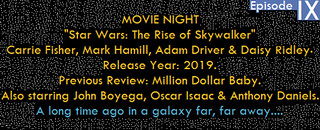
Carrie Fisher (Leia Organa), Mark Hamill (Luke Skywalker), Adam Driver (Ben Solo / Kylo Ren), Daisy Ridley (Rey), John Boyega (Finn), Oscar Isaac (Poe Dameron), Anthony Daniels (C-3PO), Naomi Ackie (Jannah), Domhnall Gleeson (General Hux), Richard E. Grant (Allegiant General Pryde), Lupita Nyong'o (Maz Kanata), Keri Russell (Zorri Bliss), Joonas Suotamo (Chewbacca), Kelly Marie Tran (Rose Tico), Ian McDiarmid (Palpatine / Darth Sidious), and Billy Dee Williams (Lando Calrissian) Directed by J. J. Abrams (#009 - Star Trek, #150 - Super 8, #665 - Star Trek Into Darkness, and #769 - Star Wars: The Force Awakens)

Review: 
Well, isn't this an interesting day. Nine years of Movie Night in written form, and I celebrate it with the ninth (and last) film of the Skywalker Saga (alongside being #98 in the Theater Saga). It sure has been quite a ride over these 3,287 days - basically a review every 2.5 days. The best is yet to come ahead for Movie Night 2020 (or Season X, if you will). If I am not mistaken, this may actually be the longest review yet. May the force be with you. 

How did you picture the last Star Wars movie in a trilogy was going to end? That's a question you can now ask three times and get three different answers. One trilogy conclusion had the burden of closing the loop on what was thought to be a six film saga while also sealing up loose ends of its own. Another trilogy conclusion had the burden of ending its story with its beloved characters that made for a worthy space fantasy adventure worth telling again and again. This trilogy conclusion has the burden of sealing a trilogy of trilogies once and for all - 42 years and nine main films with various actors tasked with interesting (for the most part) characters and worlds. Some landed better than others, but there are plenty of people who can say they grew up with a Star Wars trilogy, for better or worse. It is the journey that counts in the end when it comes to Star Wars, really, where George Lucas used his imagination alongside inspiration to cultivate a film all those years ago. He loved his comic books, his fairy tales, his Saturday morning serials, and he loved creating a mythology for a new generation. Everything gets picked apart in the age we live in nowadays, but it doesn't diminish the basic core of what made this series endure for so long. It will be nice to have a rest from these films for a little while, I must admit. After five films in five years, one can appreciate something else taking over the landscape for a bit (for those who refer to television, I have my own things to cycle through). This may seem like an elegy for Star Wars, but it really isn't. I am trying to express my train of thought when it comes to the realization of seeing a saga come to a close yet again and how it ended up following up not just its "polarizing" predecessor film (The Last Jedi, which I ran out of time in regards to re-watching it before doing this) but the others as a whole. Look, the last film had Leia pull herself out of space through the Force and then decided to kill off its big bad villain suddenly (complete with a jump to lightspeed to obliterate a ship because...[BLANK]) and wrote itself into a corner with mawkish sentiment. An intriguing corner, but still a corner that is not easy to pull out from without some sort of effort.

Could it really do a better job at closing a saga that Return of the Jedi did three decades prior? Honestly, it didn't. It sure tries hard to seal it all into a big ball of entertainment, and I applaud the effort - but the film is a mess. However, I enjoy big messes when there is enough positivity to go around (or camp), and this has that in spades. It becomes evident right from the very opening, where text crawls say the dead rise and get things rolling with quick editing and plenty of shots to go around. This is a 142 minute movie (somehow being ten minutes shorter than its predecessor), yet it sure feels like a big roller coaster ride that doesn't want to end. It tries to please everyone and may very well have a different kind of result. That doesn't mean it will go down as a monumental thing to ridicule, it just means it will go down as something to argue for/against when it comes to imagination for a space opera about laser swords and space beliefs. At a certain point, one has to wonder if this is meant to be a comeback on the scale of Elvis, where fan service deliver greatest hits very much like Abrams' previous work in this trilogy - wrapped with a tinge of bittersweet fervor. You know it is the end, I know it is the end - but it wants to throw everything at the void to make sure the end doesn't come easy. If the last one was inherently too ham-handed to stick to its principles in the face of the past, this one is inherently determined to glue everything together to land certain twists down without making too much laughter come out than needed. Allow me to use one pop culture analogy here: this is essentially the equivalent of when Homer Simpson tries to build his own barbecue pit and frantically tries to build it before the wet cement makes it stick permanently, just replace the grill with story toolbox and Homer with...you get the idea. Seriously, the film has four credited writers: Abrams and Chris Terrio for the screenplay while the story credit went to Derek Connolly, Colin Trevorrow (the initial director slated to direct this film before leaving production due to creative differences), Abrams and Terrio.

Golly, there sure a whole bunch of actors and characters present. Some are given their time to shine, some are thrown in there all of a sudden, some are given a bit less to do from before, and some are somehow back in the thick of things (for better or worse). You really have to just roll the dice and see what works and what doesn't, honestly. I didn't so much see a bad performance as I saw actors trying their hardest to stick through a big sprawling adventure with plenty of skepticism and fear circling around. I find that the best ones to come out of it are Ridley and Driver, a duo with their odd own kind of bond of vulnerability and fear over who they think they are and what they must face to step forward beyond their doubts. They definitely do well when it comes to lightsaber fighting, graceful despite rocky environments like a bit of water to get in the way. Granted, their paths seem a bit easy to draw out, where I wonder if it had been better to have swapped the focus to Driver as the main focus (or perhaps better framing to have a trilogy that spans more than a year in movie time). Boyega and Isaac try to fend off being wooden with humor, which goes off okay. They felt better together four years prior with the seventh film, but I do find myself at least going along with them on essentially a scavenger hunt, where characters pop out to wedge their own part to play, because I suppose one needed to try and give some sort of backstory/shared thing for people we just met to people we barely know much of through three films. It is quite striking to see Fisher appear on screen for a few minutes (in the sense just as much as she did for the other two films), where the re-purposed footage of her works for what is needed and gives her a fair way to make farewell without going overboard. It is nice to see Daniels get a bit more scenes to chew upon for another trip down the lane for our favorite fussy golden robot, who delivers a chuckle or two that is welcome here. The sudden new blood of Ackie, Grant and Russell prove alright, moreso for the latter two in that one can seep right into an obvious villain trap without having to get outside and the other can just wear a mask and beat some nobodies for a bit. Gleeson, Nyong'o and Tran seem like they drew small straws when it comes to "Who gets to be in another Star Wars film but doesn't have much meaningful things to say?" (which proves amusing if thought as essentially being Jar-Jarred out of importance). McDiarmid and Williams return to their roles with ease, in that neither have to really move too much to deliver their lines to serve the plot, where it is nice to see them again, if not for the camp of the former and the smooth charm of the latter. Granted, it barely makes sense to see either come back - but why not? The film feels like a whole batch of why nots. One might wonder how much of this is a hand-wave of what happened before - the jokester in me is slightly delighted at the idea of shaking the head-turning predecessor, even if that means more predictability. A good adventure is all that it takes, and this does fine with that. It won't be the kind of thing that inspires navel gazing or anything when it comes to analysis, but always take to heart four words: It's just a movie. Turning off my brain a bit for some ridiculous things in a Star Wars film didn't give me a headache as it did just help my throat get some chuckles.

At least the effects work themselves out pretty good. Sometimes you really need a bunch of flashing lights on a stormy dark world to really make something ooze out well, really. You don't need spoilers to know that the film will fling whatever it takes to make things work - a Skywalker has to stand triumphant after all. It isn't like anyone actually thought this would end on a downbeat note (much like how Lucas liked his happy ending for VI) - by golly one has to sell this product somehow (besides, Rogue One wedged in hope even with its downbeat stuff). One does tend to get tired of saying "X was better than Y", so I'll try to refrain from said comparisons too much. What we have here is an okay sequel trilogy, packed firmly between what was done before through Lucas and others - and that's okay. I'll probably look at these films in retrospect as ones that had their moment in the sun and did what they thought made sense - churning some nostalgia and Internet frothing for better or worse. They aren't the best or worst things to happen to the franchise, that much is for sure (a statement one could even see someone saying about the previous trilogy). Everything moves in a flash to get to some sort of point that matters, and I liked more than what I shook my head at. If you want to see something with space action and a bunch of things that relate to the stuff of the past, go right on ahead. If you want something a bit deeper or perhaps more fitting for the end of a space opera, consult oneself first. In my heart I enjoyed this weird little film, but I know the rating it really does deserve - it's an average film, but at least it isn't a complete mediocre one for the books.

Overall, I give it 7 out of 10 stars.

December 19, 2019

Million Dollar Baby.


Review #1310: Million Dollar Baby.

Cast: 
Clint Eastwood (Frankie Dunn), Hilary Swank (Margaret "Maggie" Fitzgerald), Morgan Freeman (Eddie "Scrap-Iron" Dupris), Jay Baruchel (Danger), Mike Colter ("Big" Willie Little), Lucia Rijker (Billie "The Blue Bear" Osterman), Brían F. O'Byrne (Father Horvak), Anthony Mackie (Shawrelle Berry), Margo Martindale (Earline Fitzgerald), Riki Lindhome (Mardell Fitzgerald), and Michael Peña (Omar) Directed by Clint Eastwood (#1252 - Space Cowboys)

Review: 
We all love underdogs. Or at least we love the idea of someone trying to claw their way out of their past and find a new life for themselves (a second act, if you will). Of course one may have already seen a Cinderella story through the eyes of boxing before with Rocky (1976), but the film finds its own place to deliver a wrenching drama that works wonderfully for its 132 minute run-time with a solid trio to make its foundation stick. The film is based on a short story collection named Rope Burns: Stories from the Corner by F.X. Toole (pen name of boxing trainer Jerry Boyd), with Paul Haggis writing the screenplay. The film plays itself out in realism piece by piece that draws its ensemble with quiet precision. The film plays itself out in realism piece by piece that draws its ensemble with quiet precision. Eastwood does the task of acting/directing with ease, seeping into a grizzled yet well-meaning teacher with confidence. Freeman (who also serves as narrator) does a wonderful sobering job, carrying the soul of the film to where it needs to go whenever he is on screen or narrating about these characters and who they are when down and out in boxing. Swank clearly trained hard to sell such a tough role, where looking the part is only the half of it all - one is invested in Swank because of the drive and raw charisma she brings here. It's no surprise each won an Academy Award (Best Director, Supporting Actor, Actress) for their work - they all play well with each other, no matter whose partnered with who is a scene. The supporting cast (filled with actors who would become known in their own right) give credence to this grizzled atmosphere seen in the film, where one has to find something to stick with to belong and face hard truths - whether it means how one can be as a fighter or as a father or with one's own relatives or with the reality of sudden changes. The boxing looks the part when it comes to giving the right balance of brutality and entertainment, where one is involved with the punches without bellowing for more or being squeamish for less.  It grips the audience like a book you'd find in the store and find reading piece by piece without hesitation, never hedging itself too long on somehing without a clear reason.

The film hits most of the right punches when it comes to mining hard hitting drama in and out of the ring, being more than a typical boxing film through its distinct first and second halves. It forges with its choices without hamhanded compromise or cruelty for its characters, which may work differently for a viewer with their own mindsets about certain uncomfortable decisions. For me, the film hits the landing with a quiet but resounding focus, where a tear may very well come out of a stone composure. After 15 years, it's no wonder why this proves to be a modern classic worth checking out at least once.

Overall, I give it 9 out of 10 stars.

December 13, 2019

Krampus.


Review #1309: Krampus.

Cast.
Emjay Anthony (Max Engel), Adam Scott (Tom Engel), Toni Collette (Sarah Engel), David Koechner (Howard), Allison Tolman (Linda), Krista Stadler (Omi Engel), Conchata Ferrell (Aunt Dorothy), Stefania LaVie Owen (Beth Engel), Lolo Owen (Stevie), Queenie Samuel (Jordan), Maverick Flack (Howie Jr.), and Mark Atkin (Ketkrókur) Directed by Michael Dougherty (#1227 - Godzilla: King of the Monsters)

Review: 
I suppose the best way to enjoy the holiday season would be to have at least one good scare to go along with the usual festivities, at least one holiday horror film to differentiate from the usual Christmas fare (or at least something that isn't a shameless remake of a classic without any new ideas). In that regard, this is inspired by Central European folklore with its title character, a half goat/demon that punishes children that have been bad for the year. Of course, the key thing to remember here is that this is trying to be a Christmas horror comedy, filling its cast with a mix of notable names and others alongside demented holiday creatures and an occasional sprinkling of Krampus, which proves to be an okay if unwieldy mix. It definitely does alright with tongue-in-cheek humor, mixing its familiar yet dependable character types with fairly decent special effects, that much is for sure. Anthony proves a worthy child lead to follow with, where a unwieldy family visit isn't always the most terrifying possibility to have for the holidays, and he does well with reacting to his surroundings when needed. One needs levelheaded people with a little sense of humor before the storm, and Scott and Collette do a fair job in that regard, who play off with Koechner and Tolman to pretty good effect when it comes to small consistent moments or when faced with the cold reaches of disagreements or killer gingerbread men. Stadler stands out just as much as the others without having to say as much as the others, a warm presence that lends the film's most interesting moment, a description of her first encounter with Krampus (told through stop motion). Ferrell delivers a good portion of the laughs throughout the film as well, and the other castmates prove fair with rounding out the remainders of a family dealing with a lack of holiday spirit. Honestly, while I did find myself chuckling at times with the film, I do wish that it had gone for a more serious turn with its main focus, where the stakes could be a little higher than where it eventually finds itself before its 98 minutes are up. Does this film even have a body count? Sort of. The creature is certainly a terror to think about, where he doesn't just lumber down on a family as much as he sends in smaller terrors to wear them down, but it seems to make one wonder for a little bit more. The ending is at least fine for what is needed (something to think about), accompanied by a cheesy jump scare. For the parts that seem reminiscent of Gremlins, it only just seems to remind me that some horror comedies handle their balances better than others. It is technically scary, in that one would probably go nuts wrapped with the idea of not having any power before a bunch of weirdo holiday creatures try to take you down in a blizzard. I ultimately found more to like than dislike when it reached its endpoint, so I can say I liked the movie okay. It isn't so much disappointing as it is just an okay film for the holidays, whether for a scare for the relatives or for a take on a different kind of folklore.

Overall, I give it 7 out of 10 stars.

Being John Malkovich.


Review #1308: Being John Malkovich.

Cast: 
John Cusack (Craig Schwartz), Cameron Diaz (Lotte Schwartz), Catherine Keener (Maxine Lund), John Malkovich (John Horatio Malkovich), Orson Bean (Dr. Lester), Mary Kay Place (Floris), and Charlie Sheen (Himself) Directed by Spike Jonze.

Review: 
Have you ever wanted to be someone else? Did you ever find yourself with an opportunity to step into someone else's mind for a moment? The first question is an interesting one to think about, while the second is certainly imaginative enough for a film to make for quite a ride, one that is full of desires, interesting imagery, and plenty to talk about after it ends. Writer Charlie Kaufman had written the script for this film in 1994, a combination of separate ideas he had, one involving a man falling for a woman that wasn't his wife, and the other being a discovery of a portal into John Malkovich. His attempts at selling it to studios were not successful, but it eventually reached the hands of Francis Ford Coppola, who showed it to Jonze (who was involved with his daughter Sofia) in 1996. Jonze, who had been known for his work on music and skate videos, agreed to direct the film (which served as his feature debut). 

Sometimes you really have to just keep an open mind and let the film go where it feels like going in its run-time, and this sure is one of them, where one does not get left off the hook easily in its 112 minute run-time when it comes to overt sympathy for these characters and their human nature when it comes to choices. Being someone else isn't just wish fulfillment or a case of touch and go, really. In that sense, there is a fairly picked trio to go along with the dimensions of finding themselves with a portal to a famous person's mind: commercialization and experimentation, where they are not so much easy to like as they are just people we can at least understand on a basic level. Cusack does a fine job in that regard, capturing someone with plenty of self-involvement and neurotic devotion to his craft of puppeteering (in whatever form it may take itself) without becoming wrapped in too much pity. Diaz sinks into a homely role without much hesitation, a quirky person that is seemingly trapped in their marriage but finds their own means of escape and actualization. Keener is the bold part of the triad, filled with self-confidence and desire, which serve as a pretty clear contrast to the other two from the very moment she is introduced to the film. Malkovich (playing Malkovich) had initially wanted to just produce the film and find a different star to be the focus before ultimately signing on. In that sense, he serves as the highlight of the film, a man faced with the task of playing a version of themselves that happens to be intruded by people in your head alongside the usual trappings of being famous. He composes himself well in each scene is in, most notably when faced with being in his own head. Bean and Place prove quite eccentric when needed, and Sheen is exactly the kind of off-balance cameo one needs for a fantasy comedy-drama, really. 

Once the film gets itself going, it moves with weird confidence, appropriate for delivering useful entertainment without tricking or angering its target too much. This is a film with plenty of weird things to say and show that handles itself without too many bumps in the road, where offbeat seems to meet The Twilight Zone (such as with its ending, a can of worms that goes off fine for discussion) and conventions aren't all necessary. On the whole, this is a fairly good movie, utilizing its imagination to fine heights through a well-rounded cast and careful execution that make for quite a debut for its director and writer.

Overall, I give it 8 out of 10 stars.

December 11, 2019

Jackie Brown.


Review #1307: Jackie Brown.

Cast: 
Pam Grier (Jackie Brown), Samuel L. Jackson (Ordell Robbie), Robert Forster (Max Cherry), Bridget Fonda (Melanie Ralston), Michael Keaton (Ray Nicolette), Robert De Niro (Louis Gara), Michael Bowen (Det. Mark Dargus), Chris Tucker (Beaumont Livingston), LisaGay Hamilton (Sheronda), Tom "Tiny" Lister Jr (Winston), Hattie Winston (Simone), and Sid Haig (Judge) Written and Directed by Quentin Tarantino (#638 - Kill Bill: Volume 1, #639 - Kill Bill: Volume 2, #1180 - Reservoir Dogs, #1218 - Pulp Fiction, and #1251 - Once Upon a Time in Hollywood)

Review: 
For a crime film, a well-detailed story can go a long way to make an experience worth remembering. Quentin Tarantino certainly had plenty of films to showcase interesting people and the environments they inhabit, and Jackie Brown proves no different, showing plenty of wit and charm through a 154 minute leisure that has a solid cast and pretty good execution that leaves one fairly satisfied. This happens to be the only Tarantino film where he adapted a previous work, with the source material being Rum Punch by Elmore Leonard (which Tarantino did over adapting Freaky Deaky or Killshot after re-reading), for which there were a few changes made involving its title character alongside her race that Leonard approved of, reportedly saying that this was the best screenplay he had ever read. For his third directorial effort, Tarantino uses a little less violence and a bit more chronology when it comes to telling his story, which works pretty well within some casual confines, featuring six distinct players in something reminiscent of blaxploitation films (having Grier helps in that regard) without losing itself too much in clear style. The main group of actors do pretty well in that regard, starting with its main lead. Grier, already a trail blazer for female action heroes in the 1970s, proves just as capable in sinking her teeth into a towering presence, capable of holding her own with whoever is on screen without even having to use a gun all too much. Jackson exudes ruthless confidence to a tee here, capable of sticking any kind of line involving unseemly things (such as trying to get someone in a trunk as a favor) without too much reluctance. Forster seems completely in his element here, a world weary straight-laced player with complete professionalism and subtle chemistry with Grier that makes for a well-deserved comeback for the character actor that ended up with an Academy Award nomination for Best Supporting Actor - the film's only Oscar nomination. Fonda and De Niro also provide welcome players, casual and raw for the moments that need to happen, which all comes full circle with the parking lot sequence in terms of emotion and payoff (sometimes you just need to see it all play out to make it really count). Keaton doesn't have as much time, but it sure is nice to see him and the rest of the supporting cast in those little moments to surround the environment of the plot. It has its choices when it comes to music or homages, doing so with careful ambition that extends to a plot that plays by the book in gathering these characters to the moments that matter without shortchanging them with cheap gags or rushes. The film has its amusing moments, but it knows when to drive itself with sharp senses of focus with characters who all seem to have been around the block a few times and seem weary for it. It's a nice movie that drags itself with daring regard for plenty to see with its characters and its sudden turns that make it all feel worth it. Sure, it isn't his best film, but it does prove a worthy one to view once if not twice to see how the run plays out.

Overall, I give it 8 out of 10 stars.

December 6, 2019

Knives Out.


Review #1306: Knives Out.

Cast: 
Daniel Craig (Benoit Blanc), Chris Evans (Hugh Ransom Drysdale), Ana de Armas (Marta Cabrera), Jamie Lee Curtis (Linda Drysdale), Michael Shannon (Walt Thrombey), Don Johnson (Richard Drysdale), Toni Collette (Joni Thrombey), Lakeith Stanfield (Detective Lieutenant Elliot), Katherine Langford (Meg Thrombey), Jaeden Martell (Jacob Thrombey), Christopher Plummer (Harlan Thrombey), Noah Segan (Trooper Wagner), Edi Patterson (Fran), Riki Lindhome (Donna Thrombey), K Callan (Wanetta "Great Nana" Thrombey), Frank Oz (Alan Stevens), and M. Emmet Walsh (Mr. Proofroc) Written and Directed by Rian Johnson (#1027 - Star Wars: The Last Jedi)

Review: 
To have a good murder mystery is to have something worth looking at once enough to want to see it again. Entertainment is one thing, having something that compels you into its little game is another, as is the intent behind Knives Out, which has certainly gained a bit of buzz leading up to its release. It sure is amazing to see something as wonderfully average as this proves to be, as if someone wanted to make the dumbest smart mystery movie. It does prove a bit irritating to wonder how much one can really say about a movie mystery like this without seeming like a spoiler hound waiting to bite. Whatever you may say about "subverted expectations" when it comes to movies, it also proves irritating to manage to make a farce as opposed to a real intriguing mystery on a consistent level. The fact that it does just okay with its ensemble cast should inspire annoyance rather than rapture, really. You could've made this with average marquee-sounding actors and nobody would shout to the balcony about how it was exceptional in its execution. But hey, what are deftly built murder mysteries for when you can have snide humor and creaky foundations? You too can hit for the low hanging fruit for humor and mystery if you have the PR push (edgy political commentary for current year flavor? Ooh, tell me more before I stick a fork in my brain and call it art), where using buzzwords for certain moments makes for okay satire.

It certainly has the style to inspire charm, and there are no real bad apples in the acting bunch, so that does tend to help the film in its favor. If you happen to be in the mood for eccentric family drama, this probably seems right up your alley, unless one is more into the sleuth and his southern fried accent. In this case, Craig is easily the best part of the film, amusing in his mannerisms when it comes to working out the oddities that tend to arise, never overstaying his welcome in any sense. Armas makes for a fairly compelling lead to follow when faced with the mystery and the facts that surround her, handling things with a dash of grace and confidence. Evans is tasked with delivering oozy charisma (while doing it in a silly sweater) for the film's second half, and he proves just fine with that in mind, where brash confidence at being the entitled black sheep of the family just comes with the territory. When it comes to the other members of the family, I find myself gravitating towards Curtis and Shannon when it comes to how they interact with the others in their family, for better or worse. Honestly, I feel like the film could've just focused on them even more, since the film doesn't even have red herrings or anything that would lead the mystery solely back on these quirky caricatures besides flashbacks. Plummer is wry and easy to follow as the center of this whole film for when needed that fits the film's bill to a T.

Am I so jaded that I can't appreciate the idea of a mystery that is ever so clever in not really being that much of a mystery? Sure, it seems to want to have cryptic seriousness, before it deluges itself with self-awareness that seems as smug in trying to be clever as having a character vomiting when they lie. Gee, I wonder if this will be used over and over for laughs. By the time the film tries to deliver on its payoff, I was thankful moreso because it meant that the film actually meant something to make 130 minutes seem worth more than just hearing about grandstanding praise for a film that teeters on being dangerously hollow. The film does have a nice look to it, seeming fairly authentic when setting up its story trappings, complete with plenty of knives. It seems cruel to nitpick at a film like this, because my fair expectations were met with mild entertainment alongside confusion at its ultimate execution. Sometimes you can shoot the target and still hit for average in the final tally, but I do at least see myself wondering what could come next from Johnson at least. Curiosity can prove rewarding for this film, if it manages to hit all the right buttons for those who seek it.

Overall, I give it 7 out of 10 stars.

December 5, 2019

Catch Me If You Can.


Review #1305: Catch Me If You Can.

Cast: 
Leonardo DiCaprio (Frank Abagnale Jr.), Tom Hanks (Carl Hanratty), Christopher Walken (Frank Abagnale Sr.), Nathalie Baye (Paula Abagnale), Amy Adams (Brenda Strong), Martin Sheen (Roger Strong), James Brolin (Jack Barnes), and Nancy Lenehan (Carol Strong) Directed by Steven Spielberg (#126 - Close Encounters of the Third Kind, #168 - Raiders of the Lost Ark, #169 - Indiana Jones and the Temple of Doom, #170 - Indiana Jones and the Last Crusade, #302 - Indiana Jones and the Kingdom of the Crystal Skull, #351 - Schindler's List, #480 - Jaws, #563 - The Sugarland Express, #573 - E.T. the Extra-Terrestrial, #642 - Jurassic Park, #958 - Always, and #1068 - Ready Player One)

Review: 
We all have a collection of lies in our lives, with some having more fabrications than others. We tell it to ourselves, our children, our loved ones, our friends and even random strangers if necessary. They can range from white lies to the outrageous. In this case, this is a film inspired by the real life story of Frank Abagnale Jr, a case of con-man forger turned consultant that wrote about his exploits as a teenager in 1980 with Stan Redding. Attempts to produce an adaptation had persisted for years with several directors attached before Spielberg (who had co-founded of Dreamworks Pictures and initially signed on as producer) ultimately became the one to direct. In any case, Catch Me If You Can is a wonderful crook tale headlined by a wonderful tandem performance from DiCaprio and Hanks that rolls for 141 minutes in consistent stylish entertainment. It takes the expected route to fact and fiction blending, but let it be said that the exploits of Abagnale are still a bit fuzzy even after several decades. Granted, there are significant differences, which range from minor stuff like a consolidated time-line to changing the name of the pursuing FBI agent to his family life (i.e. no siblings). It is a compromise kind of film, where the scenes with DiCaprio and Walken after he runs away from home are warm while being a product of movie-magic, which can be forgiven for a clever film like this one.

DiCaprio drives things along with such suave nature, a charming wunderkind of fabrication that never seems inauthentic to watch, where he doesn't seem too old to be playing a teenager-turned-criminal. Hanks is just as entertaining as the other side of the coin, where he doesn't become privy to the old traditions of the FBI pursuer of gritted teeth or Lt. Gerald style obsession - one trying to do their job without much of a family life (very much like the person pursued) but with a sense of commitment one would see from a composite (loosely based on real FBI Agent Joseph Shea). Walken plays things smooth, where one likes to see him talk to his on-screen son with caring warmth, and Baye does just as fine to portray this on-screen family before things go awry, a picture of a family that you might think was just fine. Illusions aren't limited to cons, you might say. Adams does pretty well with a lively performance to round out the edges of the caper filings. On the whole, the film does best in its look at the pursuit through technical lenses, such as the cinematography by Janusz Kamiński and a jazzy score from John Williams that each give the film plenty of surrounding atmosphere to go around. The film works best when seeing how DiCaprio and Hanks are when in their surrounding environments, or when they speak to each other (it should be noted that the real life Abagnale and Shea did have a long-standing friendship as well) that help the film be more than procedure. You aren't rooting for our lead to be caught, but instead are captivated by what goes on next with someone who goes from plucky kid to pilot passenger. We live in such a different world now compared to the late 1960s that the film presents, but that doesn't mean the con of assuming a different identity is a thing of the past - some just happen to be better than others. This is a case of someone who did it with embellishment, with a film that seems as appropriate for entertainment that is easy to expect from Spielberg but always interesting to see in how it actually plays out.

Overall, I give it 9 out of 10 stars.

December 3, 2019

Welcome Danger.


Review #1304: Welcome Danger.

Cast: 
Harold Lloyd (Harold Bledsoe), Barbara Kent (Billie Lee), Noah Young (Patrick Clancy), Charles B. Middleton (John Thorne), Will Walling (Captain Walton), Edgar Kennedy (Police Desk Sergeant), James Wang (Dr. Chang Gow), Douglas Haig (Buddy Lee), and Blue Washington (Thorne's Henchman) Directed by Clyde Bruckman (#908 - The General) and Malcolm St. Clair.

Review: 
It does seem interesting to finally reach the sound era when it comes to Harold Lloyd. He appeared in eighteen feature films, with just seven of them being sound. The production of this film came a few months after the release of Speedy (1928), with the intent to shoot as a silent production with the same director in Ted Wilde. However, Wilde (who subsequently died of a stroke in 1930 at the age of 40) became sick during production, which would continue for nearly a year. The idea to change it into a sound feature coming after it had already been shot after Lloyd felt that sound would not be just a passing fad. Extensive re-shoots where done, namely by re-doing half of the silent version into sound and dubbing the other parts. If one thinks the film seems a bit long at 115 minutes, this evidently was even longer in previews, reportedly being edited from roughly 165 minutes. Admittedly, nerdy botanist (and son of a famed San Francisco police chief) meets dope ring in Chinatown does seem like the kind of thing to inspire shenanigans for a premise. 

It sure is a shame the resulting film is a jumbled mess, racked with inconsistency when it comes to delivering gags that actually land. I suppose this was bound to happen if one thinks of it like with the law of averages, where one is bound to deliver a clunker at some point when it comes to Lloyd. After all, there are four credited writers for this film in Paul Gerard Smith, Felix Adler, Lex Neal and Bruckman. Maybe there were too many cooks present, or maybe this is an example of a film that really just doesn't have it. At least one can't say Lloyd sounds terrible in sound, seeming a bit more nervous to follow with the times than anything. The times unfortunately come with a slightly annoying lead and a pathetic villain alongside some dated humor to boot (while I do enjoy being amused at complaints from social justice loons for "cancel culture" stuff, the government of China at the time was actually offended at this, which led to Lloyd offering a sincere apology). Kent comes and goes from the film, which doesn't help make this little romance seem any more real than a coloring book. The others range from okay to awkward, where being used to the microphone (or dubbing) is something one needs to get used to but never quite does. I do wonder if the silent version of this film turned out any better, but this happens to be the longest feature Lloyd would ever do (the aforementioned Speedy lasted 86 minutes), with this going from focusing on Lloyd and Kent (i.e. lame physical gags) to the police stuff to Chinatown antics, which goes on and on before I eventually start twiddling my thumbs and start eyeing things on my shelf. Following the story of what actually is going on isn't much better, whereas a silent film seemingly could do more with its premise through imagination. Here, it just seems a bit less loose, and it results in a film that perfectly fits the mold of average old-timey filmmaking. If you want to spend two hours with a film that you could get a chuckle at while spending time with the newspaper or phone, this might work out if you prefer your films from 90 years ago.

Overall, I give it 6 out of 10 stars.

December 1, 2019

A Beautiful Day in the Neighborhood.

Review #1303: A Beautiful Day in the Neighborhood.

Cast: 
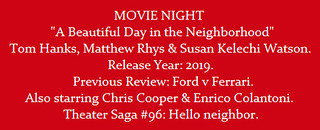
Tom Hanks (Fred Rogers), Matthew Rhys (Lloyd Vogel), Susan Kelechi Watson (Andrea Vogel), Chris Cooper (Jerry Vogel), Enrico Colantoni (Bill Isler), Maryann Plunkett (Joanne Rogers), Tammy Blanchard (Lorraine), Wendy Makkena (Dorothy), and Carmen Cusack (Margy) Directed by Marielle Heller.

Review: 
“You know everyone has lots of ways of feeling, and all those ways of feeling are fine. It’s what we do with our feelings that matter in this life. I trust that you’re growing in ways that will help you with whatever feelings you may have. When you’re a child and when you’re a grown up. I hope you’re able to grow to respect whoever you are inside.” - Mister Rogers

I do admit that there was plenty of interest in my mind to see this film. I even watched a pair of Mister Rogers Neighborhood episodes to remind myself of the effect that the show and its star had when it came to charm and sincerity when it came to feelings. This is a biographical drama loosely inspired by the 1998 article by Tom Junod, "Can You Say ... Hero?",  published by Esquire Magazine. It centers itself on its reporter character and the impact that his interview with Rogers has on him, as opposed to a biopic. A documentary based on his life and guiding philosophy had already been released prior with Won't You Be My Neighbor? (2018), but it is still interesting to see what one can do with depicting a man as beloved as Fred Rogers - a beacon of goodness when it came to public television and beyond - on screen. In a time like this where skepticism and cynical outlooks seem more and more prevalent in both media and life as a whole, it does seem refreshing to see a film that doesn't need to escape through action but rather careful honesty. It confronts its drama with the kind of style one could see from the show when it dealt with one's emotions (which work with children just as well as with adults) without becoming overly mawkish. Hanks drives the film all the way forward with care and sincerity, a portrait very much like its subject that inspires some thought alongside a smile without being in the film as much, looming even before he is formally introduced to his costar (helped by a nicely recreated opening sequence of the show, no doubt). Rhys has the task of playing someone racked with vulnerability and world-weariness for a character whose arc leans more towards fiction with its family drama trappings. Ultimately, his striking distinction serves the movie fine, proving worthy enough to follow in the film without needing to see Hanks pop out until proven necessary. It all comes with the right air of care, where one finds to accept their flaws and open themselves through the eyes of someone who strove to be honest and good on and off the camera while still being human. Watson does fine with the family drama without being in the background often. Cooper gives off a few layers to make an interesting play on the family drama without being too predictable. The rest of the cast fill in the environment fine. On the whole, it is the little moments that provide big results, such as a sequence involving silence in a public setting (itself a take off an actual call for silence by Rogers at an awards ceremony), or even just sequences around the Neighborhood set that seem so inviting. One can find themselves invested into this world because it doesn't try to evade or hide its human self, where fact and fiction work themselves into a well balanced thing to spend time with. Maybe it will inspire some emotion within the fellow viewer, but it certainly will inspire a look within oneself inside and outside.

Well, well, a Sunday review. Actually, I had meant to do this earlier, but this whole week has been a busy one. Oddly enough, today is my birthday - so why not break the (unofficial) no-Sunday tradition just once? Good to be another year older, too.

Overall, I give it 8 out of 10 stars.